MCP-Billing: A One-Stop Solution for MCP Server Authentication, Billing, and Monetization

A self-hosted boilerplate that adds OAuth auth, Stripe billing, and rate limiting to MCP servers for €79.
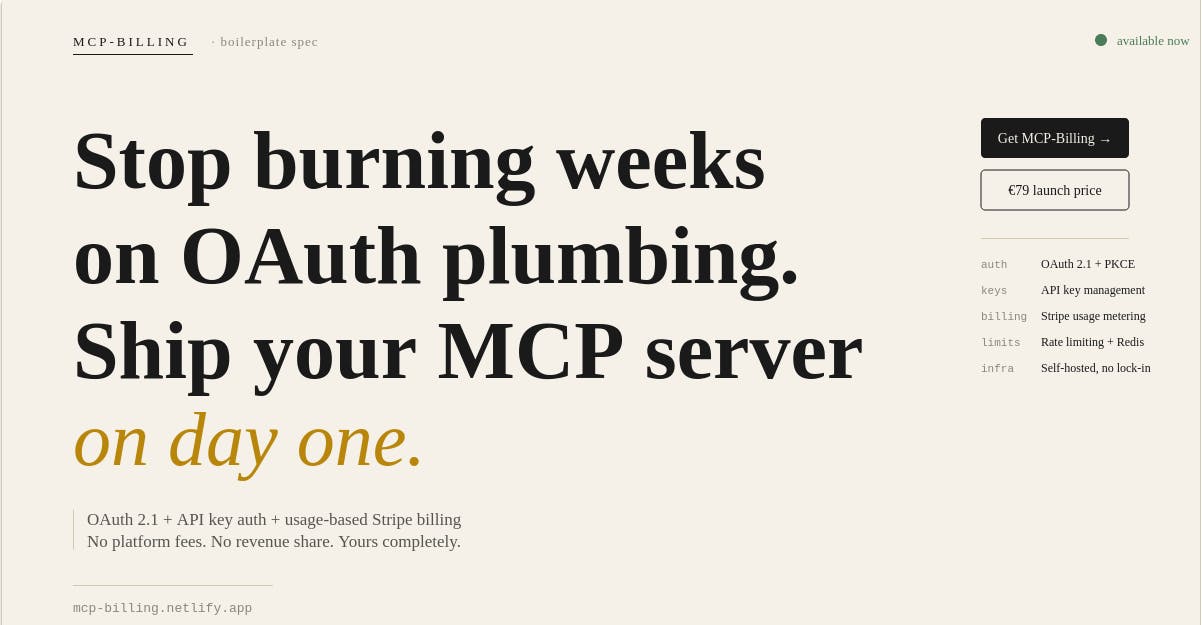
MCP-Billing is a Next.js/TypeScript self-hosted boilerplate that solves the key challenges of monetizing MCP servers: OAuth 2.1+PKCE authentication, usage-based Stripe billing, zero-downtime API key rotation, and Redis rate limiting. Priced at a one-time €79 with no revenue share, it includes 7 modules and 300+ tests. The metering core is open-sourced on npm, targeting indie developers who want to commercialize their MCP services without weeks of infrastructure work.
As the Model Context Protocol (MCP) increasingly becomes the standard interface connecting large language models with external tools, more and more developers are building their own MCP servers. However, when these services transition from personal projects to commercial offerings, an unavoidable challenge emerges: how do you add authentication, usage-based billing, and access control to an MCP server? MCP-Billing, recently launched on Product Hunt, targets precisely this gap, earning 119 upvotes and landing at #14 on the daily leaderboard.
The Core Challenges of Monetizing MCP Servers
Over the past year, the MCP ecosystem has expanded rapidly. MCP is an open protocol officially released by Anthropic in late 2024, designed to standardize communication between large language models and external data sources and tools. Before MCP, every AI application needed custom integration code for different data sources and tools, resulting in massive duplication of effort and fragmented interfaces. MCP's design is analogous to what USB-C does for hardware connections—it defines a universal client-server architecture that allows any compatible AI model to invoke external capabilities through a unified protocol. MCP servers expose three core primitives: Tools (executable operations), Resources (readable data), and Prompts (reusable templates).
From a technical architecture perspective, MCP uses JSON-RPC 2.0 as its communication protocol, with the transport layer supporting two modes: stdio (local inter-process communication) and HTTP+SSE (remote services). An MCP Host (such as Claude Desktop or IDE plugins) embeds an MCP Client, which is responsible for establishing connections and exchanging messages with MCP Servers. By mid-2025, the MCP ecosystem encompasses thousands of community-contributed server implementations, covering scenarios like database queries, file system operations, web search, and code execution. Major model providers including Anthropic, OpenAI, and Google have all announced support for or compatibility with the MCP protocol, transforming it from Anthropic's single-ecosystem standard into an industry-wide protocol.
Developers can easily set up an MCP server that lets Claude, GPT, and other models call custom tools or access private data sources. But the moment you want to sell this service to customers, problems pile up.
First, there's authentication. Who has the right to access your MCP server? How do you manage API keys? Then there's billing. Usage-based billing has become nearly standard in the AI era, since every tool call and data retrieval corresponds to real compute and cost—but accurately mapping usage to Stripe invoices is no simple task. Finally, there's rate limiting and security protection to prevent a single user from abusing resources and crashing the service.
These engineering details may seem trivial, but they often require weeks or even months of development effort. MCP-Billing's value proposition is packaging all this tedious but necessary infrastructure into a ready-to-use template.
MCP-Billing's Core Product: A Complete Self-Hosted Boilerplate
MCP-Billing is a self-hosted boilerplate project built on Next.js / TypeScript. The choice of Next.js as the foundation is no accident—its App Router architecture natively supports API Routes, capable of simultaneously hosting OAuth authorization endpoints, webhook receivers, and admin interfaces. Its server-side rendering capabilities mean the developer admin panel doesn't need a separate frontend project, while Edge Runtime support provides an execution environment close to users for rate-limiting middleware. TypeScript's type safety effectively reduces runtime errors when handling structured data like OAuth tokens and Stripe events. This full-stack monolithic architecture reduces deployment complexity—developers only need to manage a single service to get complete authentication + billing + management functionality.
According to its official description, it includes the following core capabilities:
OAuth 2.1 + PKCE Authentication System
A complete implementation of the OAuth 2.1 authorization flow with PKCE (Proof Key for Code Exchange) extension support. OAuth 2.1 is a consolidation and security enhancement of OAuth 2.0—it deprecates flows proven to have security vulnerabilities like Implicit Grant, and elevates PKCE from an optional extension to a mandatory requirement for all client types. PKCE effectively prevents Authorization Code Interception Attacks by introducing dynamically generated code_verifier and code_challenge pairs in authorization requests. This is particularly important for MCP scenarios, as MCP clients often run in the user's local environment or browser, qualifying as "Public Clients" that cannot securely store client secrets, making traditional Client Secret authentication inapplicable.
Notably, MCP's remote server authentication specification (updated March 2025) explicitly requires OAuth 2.1 as the standard authentication framework. This choice stems from MCP's usage pattern: users indirectly invoke remote MCP servers through AI assistants, with the entire flow involving user authorization delegation, token passing, and permission boundary delineation. Key improvements of OAuth 2.1 over 2.0 also include: mandatory HTTPS, access tokens must be short-lived tokens paired with refresh tokens, and removal of the Resource Owner Password Credentials grant type. These constraints ensure that even in complex multi-hop call chains, user credentials are never exposed to intermediate layers. MCP-Billing strictly follows this specification, meaning developers get an authentication system that both meets modern security standards and complies with official MCP specifications right out of the box, without needing to build an authorization server from scratch.
API Key Management with Zero-Downtime Rotation
The product provides full lifecycle management of API keys, with particular emphasis on "zero-downtime rotation." The core concept behind zero-downtime key rotation is establishing an "overlap period" between old and new keys. The typical implementation involves three phases: first, generate a new key and mark it as active; then enter a transition period where the system accepts both old and new keys; finally, after confirming all clients have switched over, revoke the old key. While this flow seems simple, in distributed systems it requires consideration of cache consistency, key state synchronization, audit logging, and many other details.
Key rotation is a common operational security requirement—when an old key may have been compromised, you need to smoothly switch to a new key without disrupting live services. This need is especially pronounced in the MCP ecosystem: a single MCP server might be simultaneously accessed by dozens of AI clients, and any authentication interruption directly impacts end users' AI assistant experience. This feature is quite practical in production environments.
Usage-Based Stripe Billing Integration
This is where the product gets its name and represents its most core selling point. MCP-Billing connects usage metering with Stripe's billing system, allowing developers to charge customers by call count, resource consumption, and other dimensions.
The fundamental reason usage-based billing has become standard for AI tool calls lies in the marginal cost structure. Unlike traditional SaaS where user logins incur no marginal cost, each MCP tool call may trigger model inference, database queries, third-party API calls, and other actual resource consumption. If a flat monthly fee model is used, a few heavy users might consume a disproportionate share of resources, causing losses for the service provider. Pay-per-use billing naturally aligns costs with revenue while lowering the barrier to entry for new users—no large upfront subscription fee is needed to start using the service.
Stripe's usage-based billing relies on its Metering API and Billing Meter features. Developers need to report usage data to Stripe each time a billable event occurs, and Stripe automatically aggregates usage at the end of the billing cycle to generate invoices. While this mechanism is powerful, actual integration requires handling event deduplication, metering latency, failure retries, usage aggregation, and many other edge cases. Particularly in AI tool call scenarios, a single request might trigger multiple sub-calls—how to accurately define "one billable event" itself requires careful design. For example, a "search and summarize" MCP tool might internally call a search API three times and execute one LLM summarization—does that count as one call or four? MCP-Billing encapsulates these complex edge cases in the template, so developers only need to define their own billing dimensions and pricing strategies.
For MCP services looking to implement pay-per-call or tiered pricing, this integration significantly lowers the barrier to entry.
Redis Rate Limiting Protection
Request rate limiting is implemented through Redis to protect backend services from abuse and traffic spikes. Redis is the preferred solution for rate limiting because it provides atomic operations and sub-millisecond response latency. Common Redis rate-limiting algorithms include fixed window counters, sliding window logs, token bucket, and leaky bucket algorithms. In MCP server scenarios, rate limiting needs to operate simultaneously across multiple dimensions—by user, by API key, by IP address, by specific tool call, etc. Redis data structures (such as Sorted Sets for sliding windows) are naturally suited for these requirements and support distributed deployment for multi-instance scenarios.
The rate-limiting challenges facing MCP servers differ from traditional Web APIs. AI Agent behavior patterns can produce bursty high-frequency calls—for example, an Agent executing a complex task might initiate dozens of consecutive tool calls in a short period. This requires rate-limiting algorithms that can handle instantaneous bursts while ensuring long-term average rates stay within limits. The token bucket algorithm is particularly suitable here: it allows a certain degree of burst requests (tokens accumulated in the bucket) while controlling the long-term average through a fixed token replenishment rate. Additionally, when MCP servers scale horizontally across multiple instances, all instances need to share rate-limiting state, and Redis's centralized storage characteristics make it a natural coordination point.
The entire solution comprises 7 modules and comes with over 300 test cases. From an engineering completeness standpoint, the author clearly aimed for a "production-grade, out-of-the-box solution."
Pricing Strategy: One-Time Payment, No Revenue Share
In terms of pricing strategy, MCP-Billing takes a path distinctly different from mainstream SaaS platforms. It uses a one-time payment of €79 with an explicit promise of "no revenue share, no platform lock-in."
This is noteworthy. Many AI service monetization platforms currently on the market use a commission model, taking a percentage of every transaction the developer earns. For independent developers who want complete control over their business and profits, such commissions often represent an unacceptable long-term cost. Take Stripe itself as an example—it charges 2.9% + $0.30 per transaction. If platform-level commissions are added on top, developers' actual take-home revenue can be eroded by multiple layers. MCP-Billing's one-time purchase model combined with self-hosted deployment means that after paying, developers have complete control over their code and data, without worrying about the platform adjusting rules or raising prices at any time.
Self-hosted solutions always have a place in the developer tools market, but they also require developers to have certain DevOps capabilities. A typical deployment path includes: deploying the Next.js application to Vercel or AWS, configuring a Redis instance (such as Upstash's Serverless Redis or AWS ElastiCache), setting up Stripe Webhook endpoints, and configuring SSL certificates and domains. While managed SaaS solutions eliminate operational burden, they often come with data sovereignty concessions and vendor lock-in risks. For MCP servers handling sensitive data (such as accessing enterprise internal knowledge bases), self-hosting ensures data never passes through third-party platforms, meeting compliance requirements.
Even more interestingly, the creator Marc Gil has also open-sourced the metering core and published it for free on npm. This means the most basic usage metering capability is freely available to anyone, while the paid purchase covers the complete authentication, billing, and rate-limiting integration solution built around it. This "open-source core + paid complete solution" strategy has numerous successful precedents in the developer tools space—such as Sidekiq (a Ruby background job framework) open-sourcing its core engine while charging for enterprise features, GitLab open-sourcing its community edition while charging for advanced features, and more recently Cal.com open-sourcing its scheduling engine while charging for hosted services. This model both lowers the trust barrier for developers (they can verify whether the core capability meets their needs first) and provides a natural distribution path for the product—npm download counts and GitHub stars are themselves the best marketing.
Target Users: Independent Developers Monetizing MCP Servers
From a product positioning perspective, MCP-Billing's target users are very clear: independent developers and small teams who are currently or planning to monetize MCP servers.
For these users, their core competitive advantage lies in the value provided by the MCP service itself—such as connecting to unique data sources (like industry-specific professional databases or real-time market data) or encapsulating domain-specific tool capabilities (like legal document analysis, medical image interpretation, code security auditing, etc.). Authentication, billing, and rate limiting—this "plumbing work"—is essential but not where they want to invest significant effort. MCP-Billing abstracts this work into a standardized template.
From a broader perspective, MCP-Billing's emergence is itself a signal that the MCP ecosystem is maturing. When a technology protocol begins spawning commercial products at the "infrastructure layer"—payments, authentication, metering, monitoring—it typically means the ecosystem has crossed the pure technical exploration phase and entered genuine commercial deployment. We've seen similar evolution in the API economy and SaaS waves. Looking back at the REST API ecosystem's development, when API gateway and management platforms like Apigee (later acquired by Google for $625 million), Kong, and Mashery emerged, that was the turning point when APIs went from internal tools to external commercial offerings. Going further back, when AWS launched S3 and EC2 in 2006, the rapid emergence of monitoring (Datadog), deployment (Heroku), CDN (CloudFront), and other services around them similarly marked cloud computing's transition from experimental technology to industrialization. The MCP ecosystem is currently undergoing a similar phase—the critical leap from "it works" to "it sells."
Summary: An Early Sample of the MCP Monetization Toolchain
MCP-Billing is not some disruptive technical innovation—it's more like a pragmatic "engineering lever" that helps developers save weeks of repetitive work with a small one-time payment while retaining complete autonomy. For developers riding the MCP wave who want to monetize their services as quickly as possible, a boilerplate validated by over 300 tests and adhering to modern security standards holds considerable appeal.
Of course, a self-hosted solution also means developers must bear deployment and operational costs themselves, and whether it truly saves headaches depends on code quality and documentation completeness. But regardless, as the number of MCP servers continues to grow, the toolchain around their monetization will only become richer—from authentication and billing to monitoring and alerting, from marketplace distribution to customer management. MCP-Billing may be just an early sample in this wave, but it clearly points the direction: the next battleground for the MCP ecosystem is not the protocol itself, but the commercial infrastructure built on top of it.
Related articles

Switching Back from Claude to ChatGPT: AI Tool Choice Isn't Just About Performance
A user switched from ChatGPT to Claude and back within a week, revealing that interaction style, habits, and emotional connection matter more than benchmarks in AI tool choice.

Hoplite: A Deep Dive into the Cloud-Based Coding Agent Deployment Platform
Deep analysis of YC S26 project Hoplite, a platform for cloud coding agent deployment and orchestration. Learn how it addresses execution isolation, scalable orchestration, and the AI programming infrastructure market.

AACL Commitment Guide: Tips and Templates for Writing Your Response to Metareview
A detailed guide to writing the Response to Metareview for ACL Rolling Review Commitments, with structure, tips, and templates to maximize persuasiveness within the 2000-character limit.