MCP Protocol Deep Dive: The Unified Standard and Practical Guide for Agent Development

MCP is the unified protocol replacing Function Calling to connect AI agents with tools and data sources at scale.
MCP (Model Context Protocol), launched by Anthropic in 2024, is rapidly becoming the standard for agent development. It replaces fragmented Function Calling approaches with a unified protocol for remote tool invocation, supports JWT-based authentication for security, and is evolving toward Streamable HTTP as its primary transport — enabling agents to integrate tools and data sources across organizations globally.
Why Agent Development Can't Ignore MCP
In the AI application development landscape, MCP (Model Context Protocol) is rapidly becoming a core technology that can no longer be overlooked. According to Bilibili tech creator 老肖 in his LangChain/LangGraph tutorial series, over 90% of enterprise agents in the future will leverage MCP — nearly every production-grade agent or workflow project will be built around it.
This isn't an empty claim. MCP was officially released by Anthropic (the company behind the Claude family of models) in November 2024 as an open standard for the entire industry. Its core objective is to unify the communication protocol between large language models and external data sources and tools. The design philosophy draws on the classic software engineering idea of interface standardization — just as USB unified hardware connection standards and HTTP unified web communication, MCP aims to establish the same level of interoperability foundation for AI tool invocation. Before MCP, having a model call a tool was a genuinely painful experience — and understanding that pain is the starting point for understanding MCP's value.
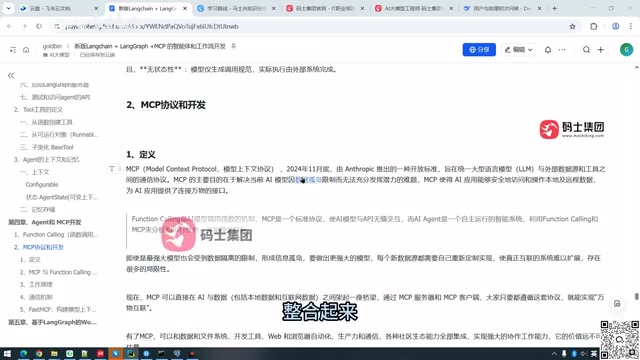
From Function Calling to MCP: A Paradigm Upgrade
The Inherent Flaws of Function Calling
Before MCP, large models relied primarily on Function Calling to invoke tools. This capability was first introduced by OpenAI in 2023: developers declare available functions — their names, descriptions, and parameter types — in JSON Schema format within API requests. The model then decides during inference whether to call a function based on conversation context, outputs a structured invocation instruction if needed, and the developer's code handles actual execution and returns results to the model. Other model providers soon followed with similar capabilities, but this approach had two fatal problems:
First, no unified standard. Different model providers had different interface formats and parameter specifications, with no common standard. This meant tool-calling code written for OpenAI couldn't be directly reused with other vendors.
Second, fragmented execution. Actual tool execution was handled by external frameworks, but there was no single unified external framework across the industry. The result: different third-party frameworks paired with different model providers meant your code needed corresponding changes every time.
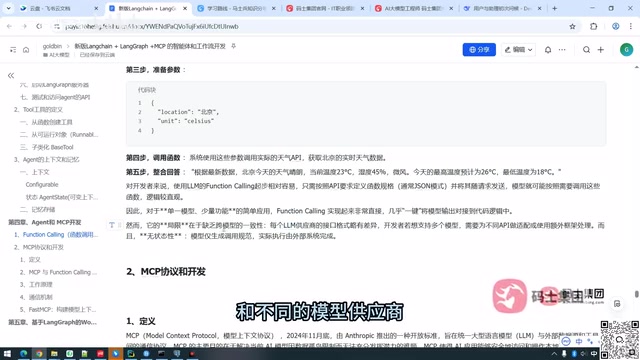
For this reason, the tutorial author explicitly recommends: if you're still developing agents with Function Calling today, you're in some sense still operating with an outdated mindset. Function Calling is worth understanding conceptually, but it's no longer recommended for actual development.
What MCP Solves
In the simplest terms, MCP is a communication protocol between models (agents) and tools. Its core value lies in enabling a complete decoupling between agents and tools.
Consider a real-world scenario: a team has already built a general-purpose tool, and you want multiple agents to use it. Without MCP, would you copy the tool code into every agent project individually? That's clearly impractical. MCP allows agents to flexibly integrate with external tools via remote network protocols.
MCP's Communication Mechanisms: Local vs. Remote
There's a technical detail here that's easy to misunderstand and worth clarifying. Although MCP is often described as a "remote tool protocol," it actually includes a local communication mechanism as well — Stdio (Standard Input/Output). Stdio is the most basic inter-process communication method provided by the operating system: MCP's Stdio transport layer works by having a parent process spawn a child process, then exchanging JSON-RPC messages via pipes to enable local tool invocation. This approach is simple to implement but involves serialization overhead and inherently cannot work across networks.
However, the tutorial author offers very practical advice: in real enterprise deployments, you'll almost never use MCP to call local tools. The reason is simple — local tools can be called directly within the same process, which is faster and requires no round-trip through a standard I/O intermediary protocol. Using MCP to call local tools is overkill and actually slows things down.
MCP's true value, therefore, lies in remote tool invocation over network communication. This means your tools can be written by another team and accessed via a network address, or they can be publicly available MCP tools published by major companies like Tencent, Alibaba, or Zhipu AI.
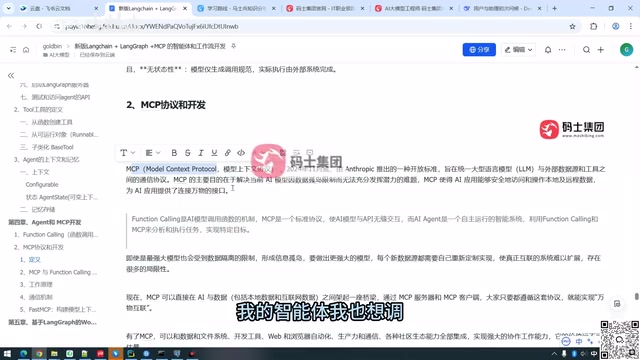
Streamable HTTP: The Emerging Standard
Notably, MCP servers have added a new communication mechanism called Streamable HTTP, which industry observers expect to become the dominant approach going forward. This mechanism is a significant upgrade over the earlier HTTP + SSE (Server-Sent Events) design — the original approach required maintaining two separate connections (a POST request and an SSE connection simultaneously), making the architecture more complex. Streamable HTTP unifies these into a single HTTP connection, allowing the server to return either a regular response or upgrade to streaming on demand. This makes it much easier to deploy on standard cloud infrastructure and to manage traffic through API gateways. Accordingly, LangChain's client library langchain-mcp-adapters has been updated, and client-side code has changed as a result — developers should pay attention to differences between old and new versions in real projects.
Security: MCP Is Not an Open Door
When it comes to remote tool invocation, many developers' first instinct is to worry about security. The answer here is clear: MCP's security is fully covered.
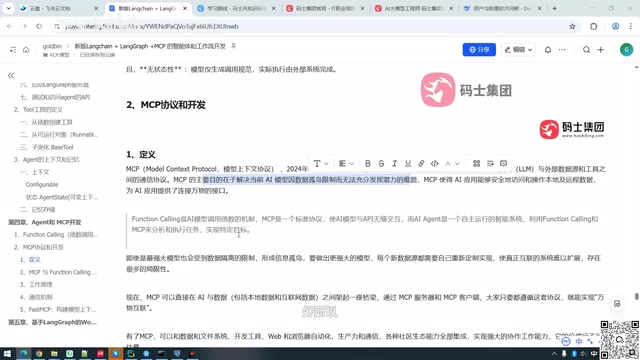
Specifically, MCP can implement user authentication based on JWT or other encryption methods. JWT (JSON Web Token) is currently the most mainstream stateless authentication standard in web services: a JWT consists of three parts — a Header (declaring the algorithm), a Payload (carrying identity and permission claims), and a Signature (signed with a secret key). The server doesn't need to store session state; it simply validates the signature to confirm the caller's identity. In an MCP context, the client includes the JWT in the HTTP request header (Authorization: Bearer <token>) when invoking a tool, and the MCP server only allows execution after successful verification.
Two typical scenarios exist in practice:
- Internal company MCP services: Often require no authentication, prioritizing speed;
- Publicly exposed MCP tools: Services published to the internet by major companies like Alibaba, Tencent, and Zhipu AI typically require a token for authentication.
MCP's True Potential: Connecting Global Resources
To summarize the deeper significance of the MCP protocol, here's an apt analogy: before MCP, every system was like an isolated, disconnected computer; with MCP, not only can departments within a company's intranet connect through agents — enterprises across the entire internet can interconnect as well.
As long as a company is willing to expose MCP interfaces publicly, any team developing agents can call those resources. In other words, MCP gives you the ability to integrate the resources of every company in the world, as well as every department within your own organization.
Additionally, MCP servers can define not only tools but also static and even dynamic data — a capability referred to as "resources" (data sources). While data source usage isn't yet widespread, it further expands MCP's potential.
This also explains why industry practitioners repeatedly emphasize that MCP's core mission is to address the problem of data silos limiting AI models from reaching their full potential. Data silos refer to the state where data across internal or cross-enterprise systems is isolated and difficult to share — for large language models, this means they can only process training data or content directly provided by users, with no real-time access to CRM systems, ERP databases, internal knowledge bases, or other critical business data. MCP breaks this barrier at the architectural level by providing standardized tool and data source interfaces, allowing models to fetch various external data on demand during inference. With this protocol, agents will become increasingly flexible and increasingly powerful.
Conclusion
The MCP protocol represents a pivotal shift in agent development — from fragmented, siloed approaches to standardized, interconnected ones. It replaces the fragmented tool-calling methods of the Function Calling era with a unified protocol, and continues to evolve through mechanisms like Streamable HTTP. For developers, mastering MCP's principles and practical application early means getting ahead in the wave of large-scale agent deployment. The next step — deeply understanding MCP's various communication mechanisms and their underlying principles — will be essential coursework for putting this protocol to real use.
Key Takeaways
Related articles

WebMCP in Practice: How MakeMyTrip Is Reshaping the Travel Booking Experience
India's largest OTA platform MakeMyTrip uses WebMCP to standardize AI Agent interactions with web apps, replacing fragile DOM scraping with natural language-driven test automation and simplified complex booking scenarios.

Deep Dive into the EYG Programming Language: A New Portable Programming Paradigm Designed for Humans
Deep analysis of the EYG programming language's core design, including algebraic effects, program state persistence, and cross-platform portability, exploring how it addresses modern software fragmentation.

WebMCP in Practice: How MakeMyTrip Is Reshaping the Travel Booking Experience
India's largest OTA platform MakeMyTrip uses WebMCP to standardize AI Agent interaction with web apps, solving DOM scraping fragility, enabling natural language test automation, and simplifying complex international flight bookings.