Mistral's First Embodied Navigation Model: Single Camera Outperforms LiDAR Solutions

Mistral's 8B robot navigation model uses just one RGB camera to outperform LiDAR-based multi-sensor systems.
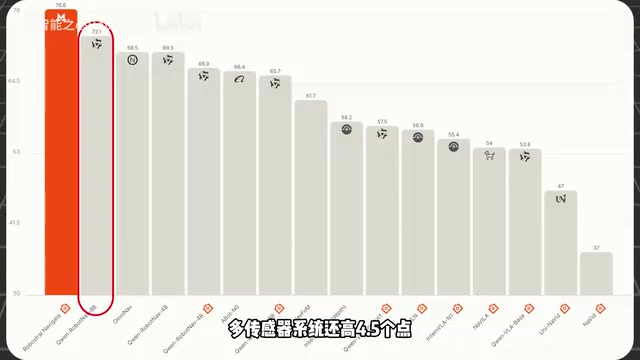
Mistral has released its first embodied navigation model, achieving a 76.6% success rate in unseen environments using only a single RGB camera and natural language instructions — surpassing both the best single-camera alternatives and multi-sensor LiDAR systems. Key innovations include pixel-space prediction for sim-to-real robustness, latent caching for 22x training efficiency, and online RL fine-tuning via CISPO.
Mistral Enters the Embodied AI Space
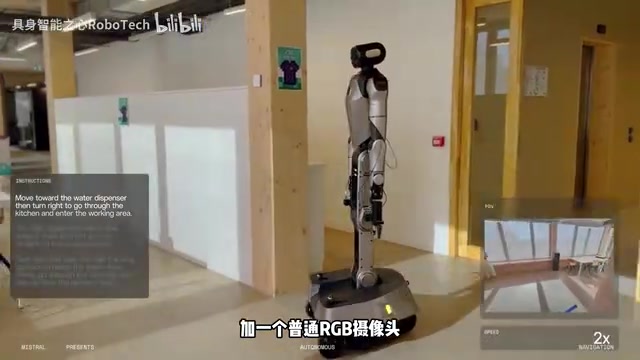
A company known for large language models suddenly releasing a robot navigation model — that alone is a signal worth paying attention to. Mistral has launched an embodied navigation model (RoboStroll Navigate) with 8 billion parameters. Armed with just a single natural language instruction and an ordinary RGB camera, a robot can autonomously navigate through offices and into storage rooms to complete tasks.
The key phrase here is "single camera." Traditional robot navigation solutions almost universally treat multi-sensor fusion — combining LiDAR, depth cameras, IMUs, and more — as a baseline requirement, at the cost of high expense and complex calibration. LiDAR emits laser beams to measure point clouds with centimeter-level precision, but a single mechanical LiDAR unit can cost thousands to tens of thousands of dollars. Depth cameras use structured light or ToF technology to capture per-pixel depth, while IMUs assist with dead reckoning. More critically, multi-sensor fusion requires precise extrinsic calibration — the geometric relationships between each sensor's coordinate frame — and any sensor replacement or positional shift invalidates the calibration, triggering a tedious recalibration process. Yet Mistral's model, relying solely on an ordinary RGB camera, achieved a 76.6% navigation success rate in the hardest "unseen environment" test — 9.7 percentage points above the best single-camera approach, and even 4.5 points above multi-sensor systems using LiDAR and depth cameras.
Less hardware, better results — that's exactly what makes this work both counterintuitive and valuable.
Why Is a Single Camera Enough?
Predicting Pixels, Not Distances
Traditional navigation approaches rely on hard geometric computation: move forward 2 meters, turn left 25 degrees — fundamentally dependent on precise camera intrinsics and spatial scale calibration. Swap the camera model or shift the mounting angle, and the model tends to break down.
Mistral's model takes a different approach: rather than computing absolute distances, it directly predicts the pixel-level position of the target in the image frame, along with the orientation the robot should have upon arrival. This "image-space" prediction is inherently insensitive to camera parameters and spatial scale changes — because pixel-level semantic representations don't depend on absolute geometric scale, making the model more robust to the geometric gap between simulation and reality. Only when the target leaves the field of view entirely does the model fall back to explicit motion commands like "move forward 2 meters, turn left 25 degrees."
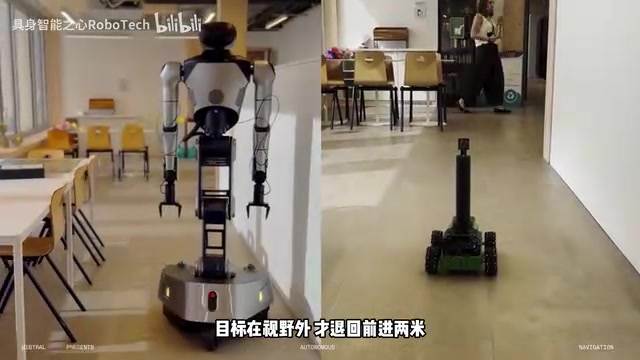
The elegance of this design lies in how it reframes navigation from a "geometric measurement" problem into a "visual understanding" problem — and visual understanding is exactly where large models excel. This also explains how a large language model company managed to achieve a breakthrough in robot navigation.
Trained Entirely in Simulation, Deployed in the Real World
The second highlight is where the training data comes from. The model was trained entirely in simulated environments, spanning roughly 400,000 trajectories across 6,000 scenes. The biggest challenge with simulation training is the "Sim-to-Real Gap" — even perfect simulation performance often fails to transfer to the real world. This is a long-standing problem: simulated environments have systematic differences from reality in rendering fidelity, physical accuracy, lighting variation, and material textures. Traditional solutions include domain randomization (randomly perturbing lighting, color, and noise) or domain adaptation (aligning feature distributions through adversarial training). Mistral's pixel-space prediction strategy is essentially a form of implicit domain randomization — its insensitivity to absolute scale makes it naturally better at bridging the sim-to-real gap.
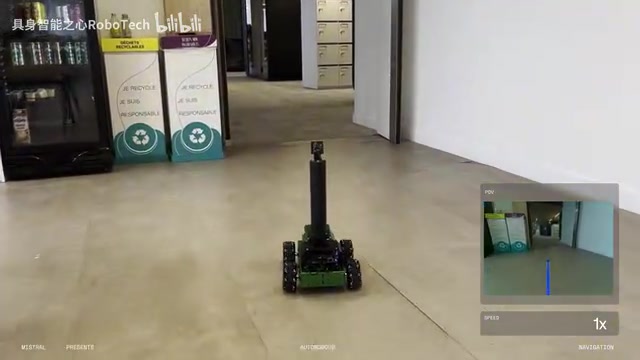
The results confirmed this: the model not only works in real offices but also handles dynamic scenes with people moving around.
Two Key Training Tricks
Latent Caching: Compressing an Entire Trajectory
Training embodied navigation models is notoriously expensive — a single trajectory often contains a large number of consecutive frames, and per-frame training carries enormous overhead. Mistral uses a latent cache technique that compresses an entire trajectory into a single training pass as token inputs, reportedly cutting computational cost by roughly 22x.
This technique draws from the KV Cache (key-value cache) mechanism in large language models: in the Transformer architecture, attention computation requires generating Key and Value matrices for every position in the sequence. KV Cache avoids redundant computation by caching these results for historical positions — it's the foundation of LLM inference acceleration. Mistral transfers this idea to the training phase: latent representations of historical trajectory frames are precomputed and cached, allowing the current time step to reuse them without re-encoding the entire history. This reflects a unique advantage that LLM teams bring to embodied AI: they're more practiced at optimizing training pipelines from the perspective of sequence modeling and token efficiency, rather than purely from robotic control.
Online Reinforcement Learning with CISPO: +3.2%
After supervised training, the team introduced an online reinforcement learning method called CISPO, allowing the model to continuously self-correct through exploration — improving success rates by another 3.2%. The team reports no performance ceiling in sight, suggesting significant headroom remains.
CISPO shares roots with PPO (Proximal Policy Optimization), widely used in LLM training. Its core mechanism clips the importance sampling ratio to constrain policy update magnitude and prevent policy collapse. The robot explores autonomously in the environment, with successful or failed navigation outcomes serving as reward signals that progressively update the policy via clipped weights — a process nearly identical to RLHF alignment in LLMs.
The combination of "simulation-based supervised training + online RL fine-tuning" closely mirrors the LLM training paradigm (pre-training + RLHF) — essentially porting mature language model training methodology directly into embodied AI.
Mistral's Ambition: A Unified Embodied Agent
Notably, this is Mistral's first embodied navigation model, and it has already been deployed on real robots — not just published as a paper.
In Mistral's roadmap, navigation is just the starting point. Their goal is to build a unified embodied agent. In the future, models like this could appear in factories, logistics, hotels, hospitals, and beyond — beginning with the most fundamental capability of "navigating on demand," and progressing toward general-purpose robots capable of autonomous movement.
An Embodied AI Race Just Getting Started
As OpenAI, Google, and numerous domestic players all push into embodied AI, Mistral's move from large language models into this space confirms that embodied intelligence is becoming the next must-win frontier for LLM companies. The competitive landscape is already intense: OpenAI has backed Figure AI and 1X Technologies for humanoid robotics; Google DeepMind has released vision-language-action models like RT-2; and Chinese organizations including Unitree Robotics, Zhiyuan Robot, and Huawei are all advancing rapidly. The underlying logic for LLM companies entering embodied AI is straightforward: visual understanding, natural language instruction parsing, and long-horizon planning are precisely the core capabilities of LLMs — and they're also the key to making robots truly "understand tasks" rather than "execute fixed programs."
The value of a single-camera approach goes beyond lower cost — it dramatically lowers the barrier to robot deployment. No expensive LiDAR, no complex multi-sensor calibration: just an ordinary camera and a spoken instruction to get a robot moving. If this approach achieves validation at scale, it could fundamentally reshape the cost structure of robot hardware.
The race around embodied intelligence has only just begun.
Key Takeaways
Related articles

Older Google Home Gets Gemini Live Upgrade: Conditions and Experience Fully Explained
Google is rolling out Gemini Live conversational AI to older Google Home speakers, but subscription or plan requirements may apply. Here's what you need to know.

Older Google Home Gets Gemini Live Upgrade: Complete Breakdown of Requirements and Experience
Google is rolling out Gemini Live conversational AI to older Google Home speakers, but subscription or plan restrictions may apply. Full breakdown of the upgrade details and impact.

GPT-5.6 Hands-On Review: Analyzing the Agent Capabilities Behind Its #1 Ranking on the Frontend Development Leaderboard
GPT-5.6 SoulX High tops the frontend dev leaderboard at 1636 points with Agent Arena rank #2. Hands-on tests of portfolio pages and mystery games reveal its task decomposition and self-correction capabilities.