Musk vs. OpenAI: A Full Legal Breakdown of the Two-Hour Jury Verdict

A jury took just two hours to rule against Musk in his lawsuit against OpenAI — here's why he lost.
Elon Musk's federal lawsuit against OpenAI and CEO Sam Altman ended swiftly: the jury deliberated just two hours before unanimously ruling against him. The case centered on claims that Altman "stole" a charitable trust by converting OpenAI from nonprofit to for-profit — but a statute of limitations defense, combined with Musk's own credibility problems, proved fatal to his case.
A highly anticipated legal showdown in the tech world has come to a close. Elon Musk's lawsuit against OpenAI and its CEO Sam Altman ended with a federal jury deliberating for just two hours before unanimously ruling against Musk. The case not only exposed the bitter falling-out between two tech titans but also laid bare the full arc of OpenAI's transformation from a nonprofit idealist organization into a commercial powerhouse. Based on LegalEagle's legal analysis video, this article breaks down the lawsuit's origins, key events, and core legal issues.
From Allies to Adversaries: The Birth and Fracture of OpenAI
The story begins in 2014. Google acquired DeepMind — a London-based AI research lab founded by Demis Hassabis and others, focused on artificial general intelligence research, whose reinforcement learning techniques had already demonstrated superhuman performance in games — for approximately $500 million. The acquisition sent a signal through Silicon Valley: cutting-edge AI research capabilities were rapidly consolidating in the hands of a few tech giants.
Musk was deeply alarmed. He had long held the view that "AGI controlled by a single commercial entity would pose an existential threat to human civilization," and had publicly expressed his fear of superintelligent AI on multiple occasions. That alarm directly fueled his insistence on a nonprofit model for OpenAI: placing AGI research in an institution free from shareholders and profit pressures would, in theory, prevent commercial logic from eroding safety goals.
The following year, Altman — who shared the same sense of urgency — approached Musk. The two hit it off immediately and decided to co-found a nonprofit AI research organization: OpenAI.
According to court documents, Altman pledged that the organization would "put safety first" and recruit top talent "for the benefit of the world." In December 2015, OpenAI was publicly announced as a nonprofit, with Musk and Altman serving as co-chairs. Musk claimed to be OpenAI's largest early donor — contributing over $15 million in 2016, nearly $20 million in 2017, and covering office space and recruiting costs.
However, ideological differences soon surfaced. The computational costs required for large-scale AI training were growing exponentially — GPT-3's training cost alone was estimated at over $4 million, with more advanced models scaling up by orders of magnitude. Musk accused Altman of gradually pivoting toward a for-profit direction, arguing that OpenAI needed the ability to generate revenue in order to achieve its technical goals. The emails exchanged between the two were charged with tension.
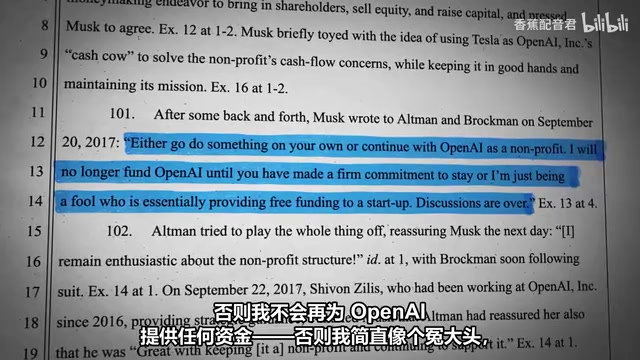
In a September 2017 email, Musk wrote: "Guys, I've had enough. This is the final straw... I will not fund OpenAI further unless you make a concrete commitment to stay." Musk formally resigned from the board in February 2018.
The Motivation Debate: Hero Narrative vs. Conflicts of Interest
In his legal filings, Musk cast himself as a "selfless, benevolent hero" simply trying to protect humanity from uncontrolled AI. But Altman's legal team and numerous commentators pointed out that this framing was "more than a little disingenuous."
During the debate over the for-profit pivot, Musk had proposed folding OpenAI into Tesla as a "cash cow" — a proposal Altman rejected. Musk then launched his own competing AI venture, xAI (home of Grok), in July 2023, roughly eight months after OpenAI's ChatGPT ignited a global AI frenzy. Grok was deliberately positioned to differentiate itself from ChatGPT, billing itself as offering "less content moderation and more willingness to discuss sensitive topics" — though this approach sparked safety controversies. Grok was reported to have generated non-consensual explicit content, and Musk appeared to have "little interest in addressing" the issue.
On one hand, Musk filed a lawsuit presenting himself as a guardian of AI safety. On the other, his own product was being criticized for having looser safety guardrails. This contradiction seriously undermined his credibility with the jury.
Interestingly, Altman himself is far from above reproach. On November 17, 2023, OpenAI's board voted 5-to-1 to abruptly fire Altman, citing that he had "not been consistently candid in his communications with the board." The decision triggered one of the most dramatic power struggles in Silicon Valley history over the next 72 hours: over 700 OpenAI employees signed a letter threatening to resign en masse, Microsoft CEO Satya Nadella announced plans to hire Altman's team, and investors applied sustained pressure. Altman ultimately returned in triumph and replaced most of the board. Former board member Helen Toner publicly stated that Altman had "withheld information, misrepresented facts, and outright lied to the board." The episode starkly exposed the inherent tension in OpenAI's hybrid governance structure: the nonprofit board theoretically holds supreme authority, but when its decisions clash with hundreds of billions of dollars in commercial interests, that authority proves extremely fragile in practice.
The Core Claim: Accusing Altman of "Stealing" a Charitable Trust
Musk's central argument was that Altman used his money, reputation, and expertise to found a charitable organization, then "stole" it by converting it into a for-profit company.
Understanding this claim requires understanding OpenAI's structural evolution. OpenAI was originally incorporated as a 501(c)(3) nonprofit, meaning its assets legally belonged to the "public interest" and could not be distributed to private shareholders. In 2019, OpenAI created a unique "capped-profit" subsidiary structure: investors could receive returns of up to 100 times their investment, with any surplus going to the nonprofit parent. This hybrid structure attracted Microsoft's initial $1 billion investment, and eventually led to a deep partnership in which Microsoft invested a cumulative total of over $13 billion.
This structural shift became the cornerstone of Musk's "stolen charity" accusation — assets that originally belonged to the public were being funneled to private investors through complex corporate structures. By one count, Musk repeated the phrase "stolen charity" a total of 17 times during his testimony. He also named Microsoft as a defendant, accusing the company of "aiding and abetting" the entire process.
The case itself was anything but straightforward. Musk initially filed suit in state court in February 2024, voluntarily withdrew in August, then refiled in federal court. In November he sought a preliminary injunction to block OpenAI's conversion — which Judge Gonzalez Rogers denied. He then made a series of extraordinary demands:
- Force OpenAI to revert from a for-profit company back to a nonprofit
- Remove Altman and co-founder Greg Brockman from their leadership positions
- Sever OpenAI's relationship with Microsoft
- Require the for-profit entity to return up to $180 billion in funds to the nonprofit
Trial Strategy: The Maneuvering to Narrow the Claims
Before the trial formally began, Musk voluntarily dropped his originally broader claims — including fraud and racketeering — and focused solely on three counts: breach of charitable trust, aiding and abetting breach of charitable trust, and unjust enrichment.
This was likely a calculated trial strategy. Fraud charges require proving "a knowing false representation, intent to deceive, reliance, and damages" — an extremely high evidentiary bar. The three remaining claims were comparatively easier to build a case around.
A charitable trust, under Anglo-American law, is a special property arrangement whose defining feature is that the beneficiary is not a specific individual but "the public" or some public interest purpose. Under California law, the state Attorney General's office is typically the primary enforcer of charitable trusts, and private individuals face a standing threshold just to bring suit. Remedies for breach of a charitable trust typically involve specific performance — such as compelling a reversion to nonprofit status — rather than monetary damages. This is the legal basis for Musk's demand that OpenAI "reverse" its for-profit conversion.
In California, a breach of charitable trust claim requires establishing five elements: the existence of a trust, the defendant's duty, an enforceable provision, a breach, and the appropriateness of the remedy. Altman's core defense was whether a legally binding contract existed at all — he argued that broad, altruistic terms like "benefiting humanity, openness, safety, and nonprofithood" were too vague to constitute an enforceable contract. Musk countered that his $44 million in donations came with two fundamental conditions: that OpenAI remain open-source and nonprofit.

The judge ultimately found that these claims involved genuine disputes of material fact and should be submitted to the jury.
The Fatal Defense: How the Statute of Limitations Ended the Case
Altman's most lethal defense ultimately came down to the statute of limitations.
The core logic of statutes of limitations is this: as time passes, evidence disappears, memories fade, and social circumstances change — the law should protect parties who reasonably believed a dispute had been put to rest. California's "Discovery Rule" further provides that the limitations period begins running from the date the plaintiff "actually discovered, or through reasonable diligence should have discovered," the harm — not from the date the harm occurred. Under the California Probate Code, the statute of limitations for breach of charitable trust is three years; for unjust enrichment, it is even shorter at two years.
Altman's team argued that internal emails between Musk and OpenAI showed he was aware of the organization's commercial leanings as early as 2017 — that he had effectively "discovered" the breach long ago. Musk invoked the Discovery Rule in response, arguing that OpenAI's changes were gradual and that the pivotal moment was the creation of the capped-profit structure in 2019, and that determining when he "should have discovered" the issue was a question of fact for the jury to decide. The jury ultimately chose the timeline most unfavorable to Musk, effectively rejecting his "gradual discovery" defense.
During the trial, Musk was reminded by the judge that "he is not himself an attorney" after he was sharp-tongued toward opposing counsel. Altman, meanwhile, was forced to awkwardly acknowledge that while serving as an OpenAI director, he had not disclosed that he had fathered children with Musk's former partner.
In the end, none of these dramatic details mattered. The jury deliberated for just two hours before unanimously finding that the statute of limitations had expired. Because Musk's claims fell under equitable jurisdiction, the jury's verdict was not directly binding on the judge — but Judge Gonzalez Rogers nonetheless affirmed the verdict, citing "substantial evidence" in support.
Conclusion: Commercial Warfare Beneath the Banner of Idealism
Musk promptly took to X to declare this a "terrible precedent set by a radical judge," insisting he had "only lost on procedural grounds" and vowing to appeal.
Whatever the outcome of any appeal, the lawsuit reflects a profound paradox at the heart of the AI industry: two founders who once campaigned together for "AI safety" are now pouring resources into their own competing commercial AI products and battling each other in court for control. OpenAI's experiment with a hybrid governance structure has demonstrated that when tens of billions of dollars in commercial interests collide with a nonprofit mission, even the most elegantly designed institutions ultimately buckle under real-world pressure. And Musk's lawsuit, launched from the posture of an "AI safety guardian," was undercut by his own product's contentious safety boundaries. The so-called founding idealism proved remarkably fragile when set against commercial interests and personal grievances.
As one commentator noted with dark humor: who wins the appeal hardly matters — "by the time AI actually takes over, we'll all have lost."
Key Takeaways
Related articles

Disaster and Glory of the Apollo Program: The History We Must Revisit Before Returning to the Moon
From the fatal Apollo 1 fire to Apollo 8's daring lunar orbit to Apollo 11's successful landing—revisiting the disasters, fears, and compromises of the Apollo program and their lessons for today's return to the Moon.
Netflix Trust Exercise Turns Into Firing Trap: Where Are the Boundaries of Corporate Trust?
A Netflix employee was fired after sharing private info in a trust exercise. We analyze the risks of corporate trust exercises and how employees can protect themselves.

AMD CDNA5 Architecture Deep Dive: Technical Evolution and the AI Computing Competition Landscape
Deep analysis of AMD's CDNA5 architecture covering Chiplet packaging upgrades, HBM memory evolution, and low-precision compute optimization, examining how AMD challenges NVIDIA's AI chip dominance.