Must-Know AI Skills for Software Testing Interviews in 2026: Four Core Competencies & Top Interview Questions Explained

AI skills are now a hard requirement for software testing jobs in 2026, ending the era of pure manual testing.
Pure functional testing positions have sharply declined in 2026, with AI testing skills becoming a hard hiring requirement. Enterprises now demand four core competencies from test engineers: API testing, Python programming, proficiency with AI tools and prompt engineering (most critical), and hands-on AI testing experience with real projects. Practitioners should proactively transition to become AI-empowered testing decision-makers rather than replaceable executors.
The Era of Pure Manual Testing Is Ending
If you're still relying on "click-and-check" functional testing to find a job, the 2026 job market will hit you hard. Sending out hundreds of resumes with no response, interviews that go nowhere after two questions—this isn't an isolated case; it's a reality that many testing professionals are experiencing right now.
One practitioner with over a decade of testing experience discovered that every company's job posting now states "must have AI-related testing skills." Pure functional testing positions have further shrunk dramatically in 2026, with dozens of candidates competing for a single role, while salary growth remains extremely slow. Meanwhile, positions requiring AI testing capabilities have seen significant growth, with salaries generally starting at 12K-15K.
This doesn't mean the software testing industry is dying—it means the industry has fundamentally changed with the introduction of AI. AI is no longer a resume bonus; it's a hard requirement.
Four Core Skills Enterprises Demand
The core logic of job hunting is what enterprises need, not what you know. Many people start from their own perspective—"I'll list whatever I know"—while ignoring shifts in market demand. Based on the current hiring landscape, enterprise requirements for test engineers can be summarized in four areas.
1. API Testing: The Most Basic Entry Threshold
Whether at SMEs or large tech companies, API testing is the current mainstream of day-to-day work. You need to master HTTP protocols, API testing principles, and be proficient with tools like Postman, API Fox, and JMeter. More importantly, you need to independently write API automation test code. If you can't do API testing, you won't even pass the resume screening stage.
2. Python Programming: The Key to Higher Salary Brackets
As a test engineer, you don't need to become a backend developer—you don't need Flask, Django, or web scraping skills. What you need is the ability to implement automated testing code, scripts, and frameworks in Python, mastering core technologies like Selenium, Requests, Pytest, and the POM design pattern.
One point deserves special emphasis: You must be able to read and understand code. Even if it's not other people's code, in the AI era you need to understand AI-generated code, be able to debug it, modify it, and grasp its logic. Companies won't hire someone who can only "click around"—that kind of work can be done by any intern.
3. Proficiency with AI Tools and Prompt Engineering (Most Critical)
This is the most crucial of the four skills. When enterprises screen resumes, "AI testing" and "Cursor" have become high-frequency keywords. Interviewers may directly ask you to explain how to write test case scripts for a testing scenario using Cursor.
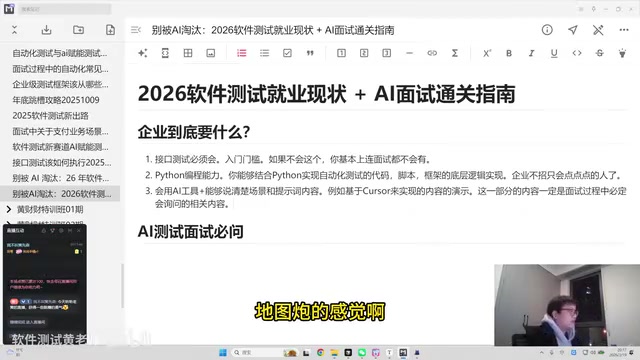
Many people think using AI means "opening Cursor and typing a couple of sentences to generate test cases," but that's far from sufficient. What interviewers want to see is: What's your prompt engineering structure? How do you go from writing 50 scripts a day to 300 in an hour? How do you use AI to fix issues discovered during execution? How do you compress three to five days of work into one or two hours?
A real case: One candidate claimed their company mandated Cursor, but during a mock interview when asked "What does your prompt engineering look like?" they answered "There's no structure, I just say a few simple things"—and the opportunity was lost. Using it and truly knowing how to use it are two completely different concepts.
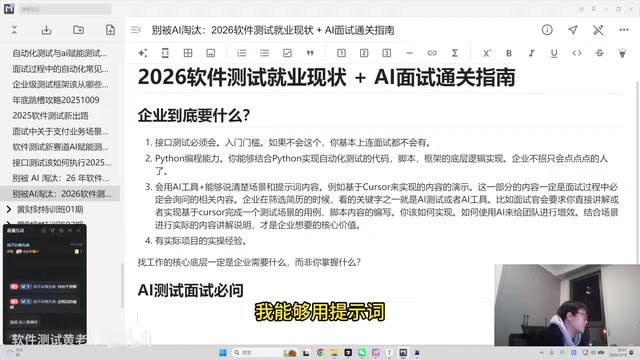
Many companies now mandate the use of AI coding tools, whether it's Cursor, Claude Code, or Gemini CLI. This isn't optional—it's a daily work essential.
4. Hands-on AI Testing Experience with Real Projects
Saying "I know how to use AI" without substance is meaningless. What interviewers want to see is how you've applied AI to provide effective solutions in real projects. For example: completing a system's API automation project with Cursor, optimizing automated testing workflows with AI, or batch-generating test data and test cases using AI.
Showing what you've actually done is far more convincing than hearing what you claim to have done.
Top AI Testing Interview Questions Explained
Question 1: What impact has AI had on the software testing industry? How does it improve testing efficiency?
Standard answer framework:
- Impact: AI can take over 80%-90% of repetitive work—from test case design to coding to execution to result feedback—automating the entire pipeline. Pure manual testing positions are clearly shrinking, but at the same time, new roles like AI Test Engineer are emerging. Core conclusion: People who can use AI will inevitably replace those who cannot.
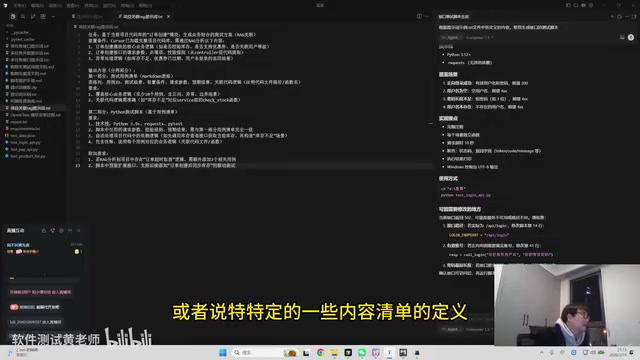
- Efficiency improvement: Taking API automation testing as an example, through structured prompt definitions (including tech stack, API information, test scenario coverage, output requirements), Cursor can complete the entire workflow from code generation to execution to result feedback in two minutes, while doing the same work manually could take several times longer.
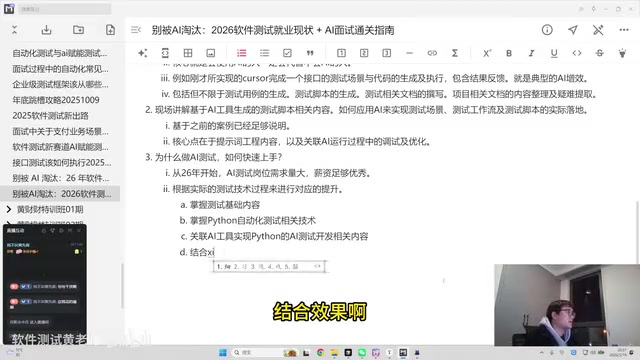
Question 2: What is Vibe Coding? How do you use it to fulfill testing requirements?
Vibe Coding is a concept proposed by an OpenAI co-founder. Its essence is: Generating code based on prompts, optimizing existing code through additional prompts, iterating back and forth until the code fully meets requirements.
It transforms the human role from code writer to code director and optimizer. Steps to implement testing requirements:
- Define testing requirements: Describe the test target, test scenarios, and expected results in natural language
- Write structured prompts: Organize prompt content following a "scenario + constraints + output format" structure
- Let AI generate the first version: Obtain the initial test script
- Iterate and optimize: Continuously refine prompts, verify execution results, and loop until requirements are fully met
The core value of this process: AI delivers enormous efficiency gains, while human involvement ensures compliance and risk control.
Question 3: Will AI completely replace test engineers?
The answer is no. AI replaces repetitive work, not people themselves. Just as test automation cannot fully replace manual testing, AI cannot replace test engineers. Three reasons:
- AI cannot deeply understand complex business processes and edge cases
- AI cannot perform risk assessment and compliance verification
- AI output accuracy requires professional secondary validation
The correct positioning is: Become a decision-maker who uses AI, not an executor who gets replaced by AI. Do you really want to go back to spending four or five working days manually writing thousands of test cases?
Learning Path: From Zero to AI Test Engineer
For practitioners at different stages, here's a recommended systematic learning path:
Phase 1: Build a Solid Testing Foundation
- Master testing fundamentals and common tools (MySQL, Linux, Postman, etc.)
- Learn Python automation testing basics (UI automation, API automation)
Phase 2: AI + Automation Testing Practice
- Independently build UI and API automation testing frameworks
- Master AI coding tools like Cursor, with a focus on prompt engineering
- Learn practical techniques including script generation, script maintenance, and RAG integration with projects
Phase 3: Multi-Project Full-Scale Practice
- Apply your technical system to 2-3 different types of projects
- Accumulate AI testing experience across different business scenarios
- Continuously improve the accuracy and usability of AI-generated results
Phase 4: Resume Optimization and Interview Preparation
- Systematically document your hands-on experience in your resume
- Conduct targeted preparation for high-frequency AI testing interview questions
Conclusion: Embrace Change and Become a Testing Decision-Maker in the AI Era
The software testing market in 2026 has undergone fundamental changes. AI is no longer icing on the cake—it's a hard requirement for employment. API testing, Python programming, AI tool proficiency, and project experience—all four capabilities are indispensable.
Rather than complaining about market changes, proactively embrace them and become a testing decision-maker in the AI era. Remember: The core logic of job hunting is always what enterprises need, not what you know.
Related articles
 Tech Frontiers
A Rare Quiet Day in AI: Recursive Self-Improvement Stirs Beneath the Surface
A rare quiet day in AI sees multiple sources go silent simultaneously. Behind the calm, Recursive Self-Improvement (RSI) research continues. What this means for the industry.
 Tech Frontiers
Reve 2 vs. Ideogram 4: A Deep Dive into Layout Control in AI Image Generation
A deep comparison of Reve 2 and Ideogram 4's layout control capabilities, covering technical approaches, real-world use cases, and industry trends for designers and creators.
 Tech Frontiers
In the Weights: Check Your Influence Score in the AI World
In the Weights is an AI influence search engine that quantifies your presence in the AI world with a score. Explore how it evaluates practitioners and what it means for digital identity.