Nadella Introduces the Loopcraft Framework: Building AI Ecosystems Through Feedback Loops

Nadella's Loopcraft framework reframes AI competition as a flywheel of nested feedback loops, not a race for static moats.
Microsoft CEO Satya Nadella introduced 'Loopcraft,' a framework for building sustainable frontier AI ecosystems through nested feedback loops spanning technology, business, and ecosystem dimensions. The concept shifts competitive thinking from static moats to dynamic flywheels, with Microsoft's OpenAI partnership and GitHub Copilot serving as early real-world validations of the model.
Introduction: Nadella's Article Sparks Industry Debate
Microsoft CEO Satya Nadella published a deep-dive piece titled Loopcraft: Building Frontier Ecosystems, which quickly sparked widespread discussion among AI practitioners and tech observers. The core ideas presented in the article offer a fresh analytical framework for understanding how today's AI ecosystems are being built.
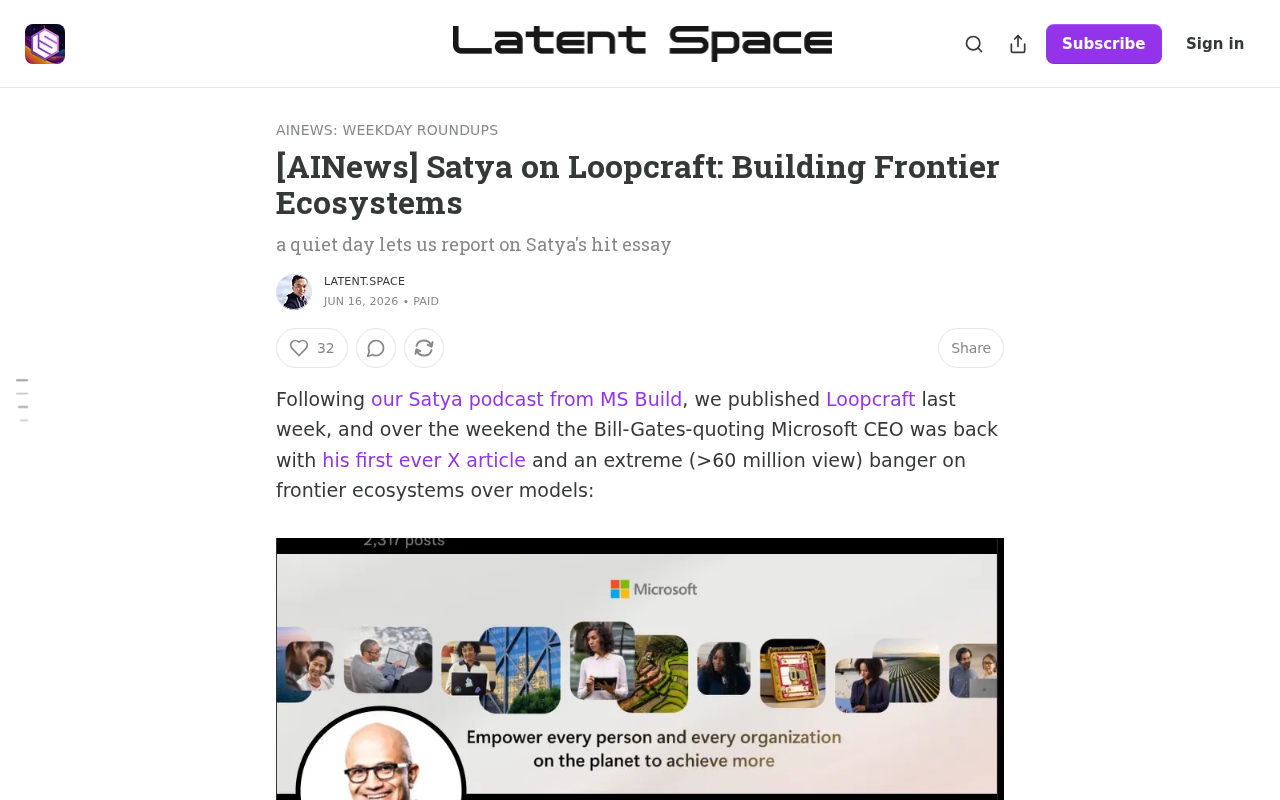
What Is Loopcraft? Nadella's Methodology Explained
Loopcraft is a conceptual framework Nadella introduced to describe how to build sustainable ecosystems in frontier technology domains. At its heart is the idea of feedback loops — closed-loop systems formed by the interplay of R&D, product deployment, user feedback, and iterative improvement.
In Nadella's view, truly successful frontier ecosystems don't advance linearly. Instead, they continuously self-reinforce through multiple nested loops. This aligns closely with Microsoft's AI strategy in recent years: from investing in OpenAI to embedding AI capabilities across Office, Azure, GitHub Copilot, and its entire product lineup — each step tightening the feedback loop further.
It's worth noting that Microsoft's strategic partnership with OpenAI is itself an early embodiment of this philosophy. Microsoft's investment in OpenAI began with an initial $1 billion injection in 2019, followed by a multi-year strategic agreement worth up to $13 billion announced in early 2023, making Microsoft OpenAI's exclusive cloud computing partner. This structure — compute in exchange for models, distribution channels in exchange for technology — is a textbook example of the Loopcraft framework's technical and commercial loops interlocking. Microsoft gained priority access to deeply integrate the GPT model series into its product lines, while OpenAI secured Azure compute resources and an enterprise-grade distribution channel. Both sides accelerated each other's flywheel.
Three Key Dimensions of the Feedback Loop
The Loopcraft framework can be broken down along three dimensions:
- Technology Loop: Advances in foundation model capabilities enable new application scenarios, while the data and demands generated by those scenarios in turn drive continued model evolution.
- Business Loop: Platform revenue funds ongoing R&D investment, and R&D breakthroughs translate into stronger platform competitiveness, creating positive growth.
- Ecosystem Loop: Developers and partners build applications on the platform; those applications attract end users; and the growing user base draws in even more developers.
Deeper Implications of Loopcraft for the AI Industry
From Static Moats to Dynamic Flywheel Effects
Traditional tech companies tend to measure competitive advantage through the lens of "moats," but Nadella's Loopcraft concept points toward a more dynamic competitive logic. In frontier AI, static barriers matter far less than a dynamic flywheel effect. Whoever can run the complete "R&D → deployment → feedback → improvement" cycle faster will hold the initiative in competition.
The flywheel effect was first systematically articulated by management scholar Jim Collins in Good to Great, and was later developed by Amazon CEO Jeff Bezos into one of the most influential business growth models of the internet era. Its core logic: spinning the flywheel initially requires enormous energy, but once momentum builds, the system self-accelerates — marginal costs fall while marginal returns rise. Nadella's Loopcraft concept is cut from the same cloth as the flywheel effect, but adds a new dimension specific to the AI era: the bidirectional reinforcement between data and model capability. This is a variable that traditional internet flywheels simply didn't have. Data is no longer just a byproduct of traffic — it becomes the core fuel for continuous model evolution, meaning AI platform network effects manifest simultaneously in user scale and ongoing improvements in model intelligence.
The development of GitHub Copilot is perhaps the most compelling early validation of this logic. Launched in 2021 and trained on billions of lines of public code from GitHub, Copilot's business significance goes beyond subscription revenue. It built a continuously running data flywheel: the usage behaviors of millions of developers — accepting, modifying, or rejecting code suggestions — generated high-quality human feedback signals. These signals continuously improved model performance through RLHF (Reinforcement Learning from Human Feedback), leading to a significant increase in code completion accuracy within two years of launch. This also explains why Microsoft has been so aggressive about pushing AI capabilities to end users — not because the products are already perfect, but because early deployment is itself a critical link in keeping the loop running. The rapid iteration of the Copilot product line is a direct expression of this philosophy.
Upgrading Ecosystem Thinking for the AI Era
The concept of a "frontier ecosystem" that Nadella emphasizes in his article is fundamentally an upgrade to traditional platform economics. Platform economics studies how platforms in multi-sided markets coordinate interactions and value creation among different user groups. Traditional platforms (like the App Store or Android) derive their core value from reducing transaction costs and improving matching efficiency, with network effects primarily manifesting in user scale.
In the AI era, this logic has changed fundamentally. An ecosystem is no longer simply a collection of API interfaces and developer tools. It's a multi-party collaborative network encompassing model providers, data partners, application developers, and end users. Every participant is both a consumer of value and a producer of data and feedback signals, collectively driving the intelligent evolution of the entire system. This "intelligence flywheel" mechanism is a new phenomenon that traditional platform economics has yet to fully describe.
This perspective has reference value for the entire industry. Whether it's Google, Meta, or the many AI startups, all face the same core question: how do you build an ecosystem that is both stable and scalable in an environment of rapid technological iteration?
Microsoft's AI Strategy Through the Loopcraft Lens
Viewing Microsoft's current AI strategy through the Loopcraft framework reveals a clear logical thread:
- Infrastructure Layer: Azure cloud services provide the compute foundation, while deep partnerships are established with model vendors like OpenAI and Mistral.
- Platform Layer: Tools like Copilot Studio and AI Foundry lower the barrier to AI development, drawing developers into the Microsoft ecosystem.
- Application Layer: Products like Microsoft 365 Copilot and GitHub Copilot directly reach hundreds of millions of users, continuously generating usage data.
- Loop Closure: User behavior data feeds back into product improvement and model optimization, completing the full loop from infrastructure to application to iteration.
This nested structure of multiple interlocking loops is precisely the commercial realization of the Loopcraft philosophy Nadella articulates.
Industry Observation: The Long Game in Frontier Technology Competition
Nadella's choice to publish this article at this particular moment carries significance. After a period of frenzied investment and fierce competition, the AI industry is entering a new phase that demands serious thinking about how to build sustainable competitive advantage.
The Loopcraft philosophy sends a clear signal: competition in frontier technology is not a sprint — it's a long game about who can run feedback loops more efficiently. A lead in raw model capability may be temporary, but once an ecosystem's flywheel is spinning at full speed, the accumulated momentum creates a genuine long-term competitive barrier.
For practitioners in China's AI industry, this framework is equally worth deep consideration. China's large model market has undergone rapid evolution since 2023, moving from a "hundred models war" to rational differentiation. The gap in foundation model capabilities is narrowing among major players — including Baidu's ERNIE, Alibaba's Tongyi, Huawei's Pangu, ByteDance's Doubao, and Tencent's Hunyuan — as well as startups like Zhipu AI, Moonshot AI, and MiniMax. Alibaba Cloud through its ModelScope open-source community, and Baidu through its Wenxin Qianfan platform, are both attempting to build developer ecosystems along Loopcraft-like logic. However, compared to Microsoft, domestic players still face structural challenges in enterprise-grade data accumulation, global developer community scale, and self-controlled underlying compute infrastructure — making the startup cost of the ecosystem flywheel higher and the cycle longer. As large model competition moves toward rational differentiation, how to shift from single-point technical breakthroughs to systematic ecosystem building may well be the defining question of the next competitive phase.
Key Takeaways
- Microsoft CEO Satya Nadella introduced the "Loopcraft" concept, emphasizing building frontier AI ecosystems through feedback loops.
- Loopcraft encompasses three key dimensions — technology, business, and ecosystem — forming a multi-layered, self-reinforcing system.
- The concept marks a shift from static "moat" thinking to a dynamic "flywheel effect" competitive view, a concept rooted in Collins' management theory and popularized by Bezos.
- Microsoft's strategic partnership with OpenAI and GitHub Copilot's RLHF data flywheel represent the earliest commercial validations of the Loopcraft philosophy.
- Microsoft is executing a multi-loop nested ecosystem strategy through product lines including Azure and Copilot.
- The global AI industry takeaway: sustainable competitive advantage comes from efficiently running feedback loops, not single-point technical breakthroughs — and domestic players still face structural challenges in building their ecosystem flywheels.
Related articles
 Industry Insights
OpenAI's Internal Codex Usage Surges 56x — AI Coding Is Eating Everything
OpenAI reveals internal Codex usage data: Research up 56x, Customer Support 32x, Engineering 27x, Legal 13x since Nov 2025. AI coding tools are penetrating every department faster than expected.
 Industry Insights
IRS Fully Embraces Claude AI, Accelerating Federal Government's AI Adoption
The IRS is recruiting staff with 24/7 Claude AI access, marking Anthropic's breakthrough into the federal government. Explore the strategic implications and tax use cases.
 Industry Insights
The IRS Mobile App Debate: A Trust Crisis in Government Digital Transformation
The IRS's proposed mobile app has sparked heated debate. This article analyzes the core arguments, exploring data security, privacy, and the trust crisis in government digital transformation.