Non-Technical College Student Builds App with Claude Code, Hits 200K Daily Active Users

Non-technical college student uses Claude Code to build an app that reaches 200K daily active users.
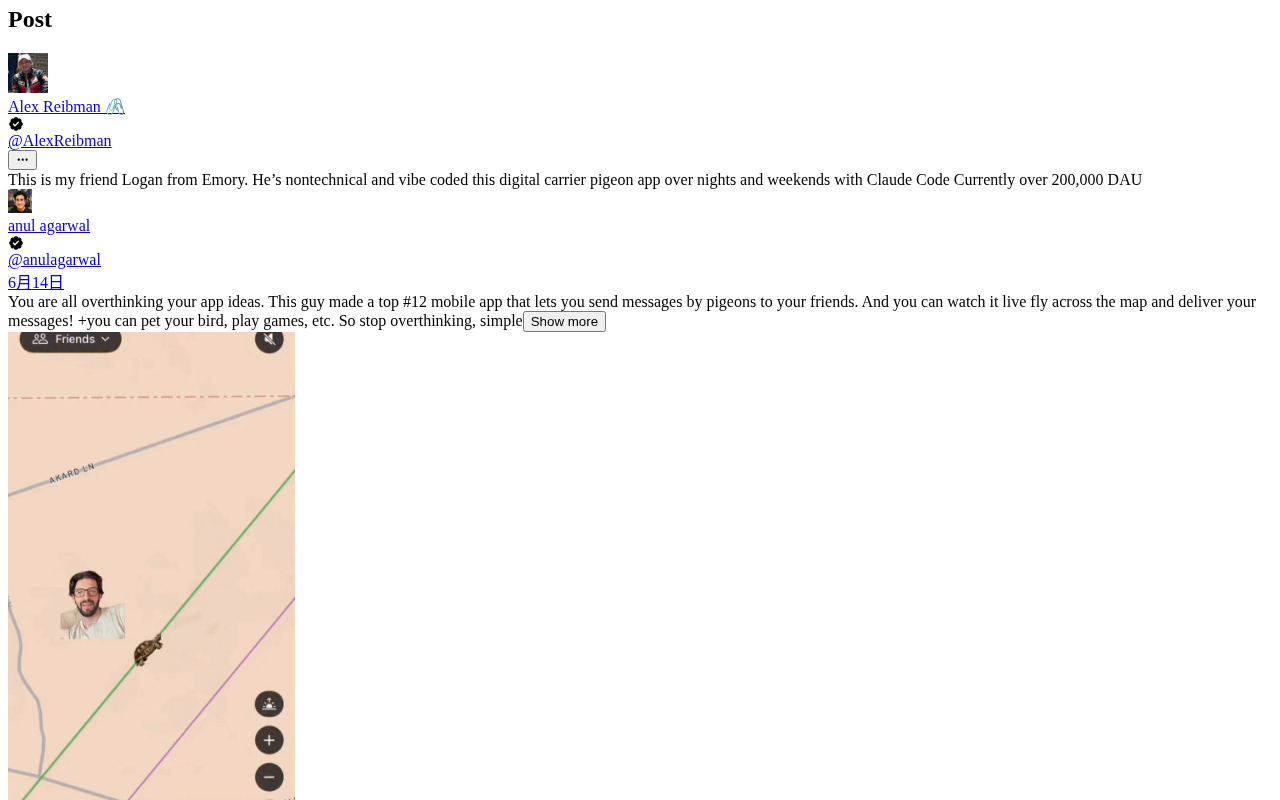
Logan, a non-technical student at Emory University, used Claude Code's Vibe Coding approach during nights and weekends to build a Digital Carrier Pigeon app that has surpassed 200K daily active users. This case demonstrates that AI programming tools have reached production-grade maturity, enabling anyone with strong product thinking to build successful applications without coding skills, accelerating the era of solo developers and democratized software development.
A Non-Technical Person's Vibe Coding Miracle
Logan, a student at Emory University with no technical background, used his spare time (nights and weekends) to develop a Digital Carrier Pigeon app through Claude Code using a "Vibe Coding" approach. The app has now surpassed 200,000 daily active users (DAU).
Claude Code is a command-line AI programming tool developed by Anthropic. Unlike GitHub Copilot, Cursor, and similar products, it works through terminal interaction—developers describe their requirements in natural language via the command line, and Claude Code directly reads project files, understands code context, then autonomously completes code writing, debugging, and even deployment operations. Its core advantage lies in handling complex cross-file tasks rather than just single-line code completion, enabling even users with zero programming knowledge to build complete applications through conversation-driven development.
This news was shared by Logan's friend on Twitter and quickly garnered widespread attention. It once again proves that AI-assisted programming tools are fundamentally changing the barrier to software development.
What Is Vibe Coding?
Vibe Coding is a concept that has recently gained popularity in the AI programming community, first proposed by former OpenAI co-founder and former Tesla AI Director Andrej Karpathy in February 2025. Karpathy described a completely new programming state on social media: you fully immerse yourself in the "vibe," embrace exponential possibilities, forget about the specific existence of code, and simply describe in natural language, observe results, and adjust direction. The concept went viral because it precisely captures the paradigm shift brought by AI programming tools—programming is no longer about "writing code" but about "expressing intent."
Traditional software development follows a strict process: requirements analysis, architecture design, coding implementation, testing and debugging, deployment and operations—each step requiring specialized skills. Vibe Coding compresses this process into a continuous human-machine dialogue loop: the developer describes the desired outcome, AI generates and executes code, the developer observes results and provides feedback, and AI iterates accordingly. Developers don't need to write code line by line but instead "feel out" the entire application's form through conversation with AI.
For someone like Logan with no programming background, Claude Code served as his full-stack engineer. He only needed to clearly express what features and interaction experiences he wanted, and the AI would transform those ideas into runnable code. The key capability here isn't programming skill but product thinking—whether you can clearly describe user scenarios, interaction logic, and expected experiences determines the quality of AI output.
Insights Behind 200K DAU
Product Creativity Matters More Than Technical Ability
The "Digital Carrier Pigeon" concept itself is full of creativity—in an era of ubiquitous instant messaging, an app that simulates traditional carrier pigeon message delivery stands out precisely because of its uniqueness. While WeChat, iMessage, WhatsApp, and other instant messaging tools compress message delivery to milliseconds, "Digital Carrier Pigeon" goes in the opposite direction, introducing delay, ritual, and anticipation. This "anti-efficiency" design philosophy precisely hits users' desire for slower-paced communication in an age of information overload. Similar "counter-intuitive" product designs have become increasingly common in recent years—BeReal emphasizes authenticity over polished content, and Locket pushes photos directly to friends' phone home screens. This demonstrates that after AI tools lower the technical barrier, true competitiveness returns to the level of product creativity and user experience.
AI Programming Tools Have Reached Production-Grade Maturity
The fact that a non-technical person can develop an app supporting 200K daily active users in their spare time means that AI programming tools like Claude Code are no longer just "toys" or "assistive tools"—they truly possess the capability to independently produce production-grade code.
To understand the weight of this achievement, you need to know where 200K DAU sits in the mobile app industry. According to industry data, among millions of apps globally, fewer than 1% reach over 100K DAU. Supporting 200K daily active users means the app needs to handle hundreds to thousands of concurrent requests per second, requiring stable database read/write operations, reliable push notification systems, reasonable CDN distribution strategies, and elastically scalable cloud service architecture. These technical challenges previously required experienced backend engineers and DevOps teams to address.
From the evolution of AI programming tools, this field has gone through three phases: the first phase was code completion (like early TabNine, Kite), where AI could only predict the next line of code; the second phase was code generation (like early versions of GitHub Copilot), where AI could generate function-level code based on comments; the third phase is autonomous programming (like Claude Code, Devin, Cursor Agent mode), where AI can understand the entire project context and autonomously complete complex cross-file development tasks—from frontend interfaces to backend logic, from database design to server deployment, AI is covering the complete development chain. Logan's case demonstrates that we have firmly entered the third phase.
The Solo Developer Era Is Accelerating
In the past, an app with 200K DAU typically required a complete technical team behind it—at minimum including frontend engineers, backend engineers, UI designers, product managers, and operations staff, with team sizes usually ranging from 5-15 people. Now, a single person with a good idea, combined with AI tools, can complete product development from zero to one in an extremely short time.
This trend aligns closely with the rising "Indie Hacker" movement in recent years. Since the Indie Hacker community was founded by Courtland Allen in 2016, it has advocated for individuals or tiny teams building profitable internet products. In the past, participants in this community were almost exclusively experienced programmers, because the prerequisite for indie development was that you had to be able to write code yourself. But AI programming tools are breaking this prerequisite—Pieter Levels (levelsio) once predicted that "one-person companies will become the norm," and now that "one person" doesn't even need to be a programmer. According to statistics, since 2024, the number of successfully launched projects by non-technical founders using AI tools has grown by over 300%.
This poses a profound challenge to the organizational model of the traditional software development industry. When one person can accomplish what previously required an entire team, software companies' value propositions, team structures, and hiring standards all need to be reconsidered.
What This Means for Entrepreneurs and Developers
This case sends a clear signal: Don't let technical ability become the bottleneck for realizing your ideas. If you have a good product concept, now is the best time to try. The advancement of AI programming tools means:
- The cost of validating ideas has dropped dramatically: You can build an MVP (Minimum Viable Product) over a weekend. In lean startup methodology, MVP is the key step for validating market hypotheses. Previously, building an MVP typically required 2-4 weeks of professional development time and costs ranging from thousands to tens of thousands of dollars. Now, with AI tools, this cycle can be compressed to days or even hours, with costs reduced to nearly zero (only the AI tool subscription fee).
- Iteration speed has significantly increased: User feedback can be quickly translated into feature updates. In traditional development, a feature from requirement confirmation to launch typically goes through requirement review, development scheduling, coding, code review, testing, and deployment, with cycles measured in weeks. In Vibe Coding mode, developers can complete feature adjustments and publish updates on the same day they receive user feedback.
- Technical debt is manageable: The quality of AI-generated code continues to improve. It's worth noting that the latest generation of AI programming tools generates code that is significantly better than earlier versions in readability, structural quality, and adherence to best practices—in some scenarios even surpassing code handwritten by junior developers. Of course, there's still room for improvement in complex system architecture and performance optimization.
Naturally, as the app scales to 200K DAU, subsequent challenges in performance optimization, security hardening, and team expansion still exist. Particularly in data security and privacy compliance (such as GDPR, CCPA requirements), and system stability during sudden traffic spikes—these may require bringing in professional technical personnel. But at minimum, for the most difficult stage of going from zero to one, AI can effectively help non-technical people cross that threshold.
Conclusion
Logan's story isn't an isolated case but an inevitable trend following the popularization of AI programming tools. Similar cases are emerging worldwide: teachers have developed classroom management apps with AI tools, doctors have built patient follow-up systems, and designers have created their own portfolio platforms. In the future, more and more "non-technical founders" will use AI tools to turn creativity into reality.
For the entire tech industry, this represents both opportunity and transformation—when everyone can program, what becomes truly scarce will be the ability to understand user needs and unique product perspectives. Just as the spread of the internet didn't turn everyone into publishers but did give everyone the ability to have a voice, the popularization of AI programming tools won't turn everyone into software engineers but will give everyone with an idea the opportunity to turn creativity into a working product. The era of democratized software development is accelerating toward us.
Related articles

The Truth Behind Codex 'Build a Website in 5 Minutes': AI Isn't Creating Sites—It's Helping You Copy Them
Exposing the truth behind viral Codex 5-minute website videos: creators aren't building original sites with AI—they're copying shared prompts or scraping others' work. Learn AI coding tools' real limits.

Getting Started with AI Agent Development: A Complete Guide from Concept to Practice
A comprehensive guide to AI Agent architecture and development, covering automated marketing, intelligent customer service, and investment analysis scenarios with single and multi-agent collaboration.

The Truth Behind Codex 'Build a Website in 5 Minutes': AI Isn't Creating Sites — It's Helping You Copy Them
Exposing the truth behind viral Codex 5-minute website videos: creators aren't building original sites with AI — they're copying shared prompts or scraping others' work.