NVIDIA CUDA Tile: A Detailed Look at the New Tile-Based GPU Programming Paradigm

NVIDIA releases CUDA Tile programming model, simplifying high-performance GPU kernel development with tile abstractions
NVIDIA has introduced the CUDA Tile programming model, which organizes computational tasks into tile-based block units, providing higher-level abstractions than traditional CUDA. Fully implemented in C++, it seamlessly integrates with existing codebases, boosts GPU performance through optimized data locality and native Tensor Core support, and significantly lowers the barrier to high-performance GPU programming for HPC, deep learning, graphics rendering, and AI inference scenarios.
NVIDIA recently released the CUDA Tile programming model, introducing a brand-new tile-based programming paradigm for GPU kernel development. Developers can now use CUDA Tile directly within existing large-scale C++ GPU codebases to write highly optimized GPU kernels without leaving the familiar C++ ecosystem.
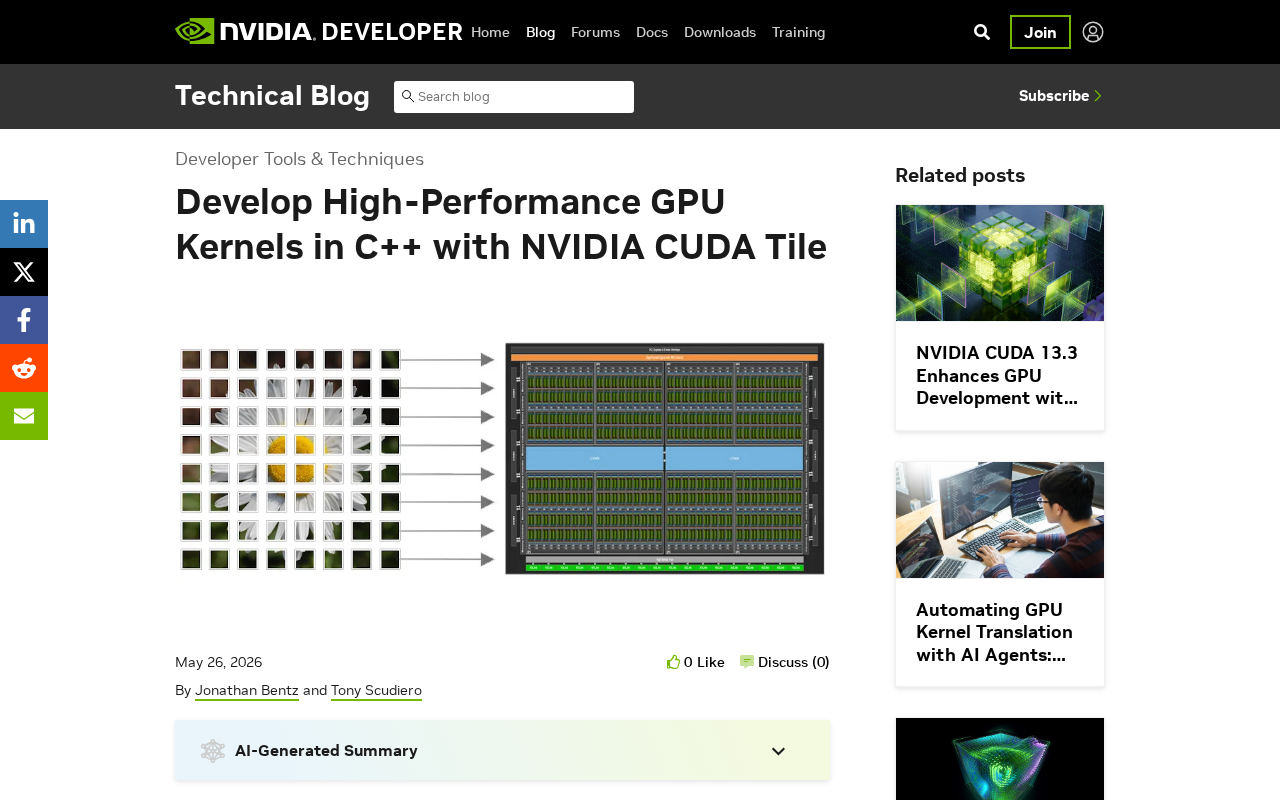
What is CUDA Tile
CUDA Tile is a new GPU programming abstraction introduced by NVIDIA. Its core concept is organizing computational tasks into "tiles" — regularized block units of data and computation. This approach allows developers to express data locality and parallel computation patterns more intuitively, enabling more efficient utilization of GPU hardware resources.
Traditional CUDA programming requires developers to manually manage low-level details such as thread blocks, shared memory, and register allocation, which not only increases development complexity but also easily introduces performance pitfalls. CUDA Tile encapsulates these low-level optimizations within tile operations through higher-level abstractions, allowing developers to focus on the algorithm logic itself.
Why Tile-Based Programming is Critical for GPU Performance
Data Locality Determines Actual GPU Program Performance
Modern GPUs have computational capabilities that far exceed their memory bandwidth. Take the NVIDIA H100 as an example — there is a massive gap between peak computational throughput and memory bandwidth. This means the bottleneck for most GPU programs is not computation itself, but data movement.
Tile-based programming is naturally suited to address this problem. By partitioning data into small blocks that fit in on-chip storage (such as shared memory and register files) and performing dense computation on these blocks, accesses to global memory can be minimized, resulting in significant performance gains.
Deep Integration of CUDA Tile with the C++ Ecosystem
A major highlight of CUDA Tile is that it is entirely implemented in C++, which brings several practical benefits for developers:
- Seamless integration with existing projects: Developers can gradually introduce Tile programming into existing C++ GPU codebases without rewriting entire projects
- Template metaprogramming support: Leveraging C++ template mechanisms, tile dimensions and types can be determined at compile time, achieving zero-overhead abstractions
- Full toolchain compatibility: Works seamlessly with existing CUDA compilers, debuggers, and profiling tools
Core Design Principles of CUDA Tile
Declarative Parallel Expression
Unlike traditional CUDA where thread indices are managed imperatively, CUDA Tile adopts a more declarative approach to expressing parallel computation. Developers only need to define the shape of tiles and their operations, while the runtime system handles efficiently mapping these tiles to GPU hardware.
This design significantly lowers the barrier to writing high-performance kernels. Kernels that previously required senior CUDA engineers to spend days tuning can now potentially achieve near-optimal performance levels in less time through the Tile abstraction.
Native Optimization for Tensor Cores
NVIDIA's Tensor Cores are specialized hardware units for accelerating matrix operations, widely used in deep learning training and inference. CUDA Tile's design naturally aligns with how Tensor Cores work — Tensor Cores themselves execute matrix multiply-accumulate (MMA) operations on a per-tile basis.
With CUDA Tile, developers can more naturally express critical operations like tiled matrix multiplication (Tiled GEMM), fully unleashing the computational potential of Tensor Cores without having to deal with low-level PTX instructions such as wmma or mma.sync.
Use Cases for CUDA Tile
CUDA Tile excels particularly in the following scenarios:
- High-Performance Computing (HPC): Algorithms with inherent tile structures in scientific simulations, such as stencil computations and FFT
- Deep learning operator development: Kernel implementations for compute-intensive operations like custom attention mechanisms and convolutions
- Graphics rendering and image processing: Applications requiring fine-grained memory management, such as ray tracing and image filtering
- Large-scale AI inference deployment: Integrating high-performance custom kernels into existing C++ inference engines (such as TensorRT)
It's worth noting that CUDA Tile is not meant to replace existing CUDA programming approaches, but rather provides a higher-level option built on top of them. For engineers already familiar with low-level CUDA optimization, the Tile abstraction can significantly improve development efficiency; for C++ developers, it lowers the technical barrier to entering the high-performance GPU programming domain.
Summary
The release of NVIDIA CUDA Tile marks another important evolution in GPU programming models. From the original CUDA C to CUDA C++, and now to tile-based abstractions, NVIDIA continues advancing along the path of making GPU programming more efficient and accessible. As AI training and HPC workloads continue to grow, this programming model — which improves development efficiency without sacrificing performance — will be adopted by an increasing number of development teams.
For developers interested in trying CUDA Tile, it is recommended to follow the official NVIDIA developer blog and subsequent CUDA Toolkit updates for detailed API documentation and sample code.
Related articles
 Tutorials
ChatGPT Plus Subscription Guide: Are GPT-5.5, image-2, and Codex Worth the Upgrade?
A detailed look at ChatGPT Plus features — GPT-5.5, image-2, and Codex — with a Plus vs Pro comparison and a complete step-by-step subscription guide for users outside the US.
 Tutorials
Harness AI Engineering in Practice: Using Claude Code to Master Enterprise-Level E-Commerce Development
Deep dive into Harness AI Engineering: master enterprise e-commerce development with Claude Code using the Rules, Skills, Wiki, and Changes framework.
 Tutorials
Cursor + Codex Dual-IDE Collaboration: A Practical Methodology for Open-Source Project Customization
A complete methodology for open-source project customization based on real-world experience, detailing the Cursor+Codex dual-IDE workflow, seven-stage process, MVP validation, and AI source code reading techniques.