Omnigent Open-Sourced: A Meta-Harness for AI Coding Agents Built by Databricks
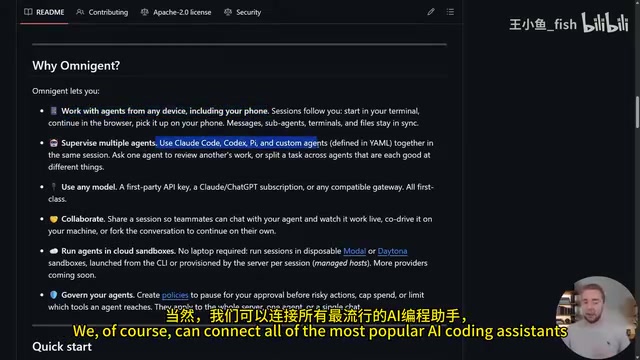
Databricks open-sources Omnigent, a Meta-Harness for orchestrating multiple AI coding assistants.
Omnigent, open-sourced by Databricks, is a free Meta-Harness that orchestrates AI coding assistants like Claude Code and Codex to collaborate. It features built-in guardrail policies, cross-model workflows, MCP tool standardization, and real-time collaboration, and has been validated at scale internally—ready to use in 10 minutes.
What Is a Meta-Harness?
Over the past year of AI coding practice, an industry consensus has gradually emerged: the Harness matters as much as—if not more than—the model itself. When we can't guarantee always having the strongest LLM, making the system around the model more reliable becomes the key path to improving AI coding quality.
The concept of a Harness stems from the "test harness" idea in software engineering, originally referring to the supporting environment used to run and validate code. In the AI coding context, it has been redefined as a reliability engineering layer built around the LLM—packaging together system prompts, tool calls (function calling), skills, workflows, rules, and more, so that a single coding agent works for us more consistently. System Prompt Engineering, Retrieval-Augmented Generation (RAG), and other techniques together form the core components of a modern Harness. RAG dynamically injects content from external knowledge bases at inference time, filling in the knowledge gaps that exist after the LLM's training data cutoff, while extending the model's "memory" from a limited context window to near-infinite external storage—making it one of the most engineering-feasible solutions to the hallucination problem today. RAG is typically implemented on top of a vector database: documents are chunked and converted into high-dimensional vectors via an embedding model; at inference time, the user's query undergoes the same vectorization, and an approximate nearest neighbor (ANN) algorithm retrieves the most semantically relevant document fragments to inject into the model's context window. This flow means the knowledge base can be updated without retraining the model, drastically reducing knowledge maintenance costs.
A Meta-Harness is the next evolution of this idea: rather than making a single coding agent better, it adds another layer on top of coding assistants, responsible for orchestrating multiple AI coding assistants to collaborate on larger tasks. The concept of a Meta-Harness is rooted in the academic tradition of Multi-Agent Systems (MAS)—a field originating from distributed artificial intelligence research in the 1980s, whose core thesis is that collaboration among multiple autonomous agents can solve complex problems no single agent could handle alone. The Meta-Harness of the modern LLM era is an engineering instantiation of this idea, turning abstract agent-collaboration theory into an actionable software architecture. It also borrows from the "service orchestration" design philosophy of microservices architecture, treating multiple AI agents as independently deployable, on-demand-composable service units. The core value of microservice orchestration lies in Separation of Concerns—each service does one thing and does it well, while the orchestration layer coordinates cross-service business flows. This idea maps directly onto AI agent division of labor: let the model best at implementation write the code, and the model best at critique do the review, rather than forcing a single model to play two cognitively conflicting roles simultaneously. This is exactly the direction today's top engineers are embracing—they no longer rely on a single model or even a single framework, but instead leverage the respective strengths of different AI coding assistants, while optimizing context and token consumption through independent sessions.
The most typical example: use Claude Code for implementation, then use Codex for code review. Behind this lies an important engineering principle—code review should happen in a session independent of the implementation. This principle has a deep technical root cause: an LLM's accumulation of bias in a long conversation stems from the attention mechanism of the Transformer architecture. As the number of tokens in the context window grows, the model assigns higher weight to earlier inputs, causing subsequent reasoning to be disturbed by an "anchoring effect." From an implementation standpoint, this is directly related to how the Transformer's self-attention is computed—each token's representation is a weighted sum over all other tokens in the sequence, and the longer the context, the harder it becomes to eliminate the influence of early framing tokens on the overall reasoning direction. Notably, this phenomenon is known in academia as the "Lost in the Middle" effect—research shows LLMs utilize information positioned in the middle of the context window significantly less than information at the beginning and end, meaning that performing a review at the end of an extremely long implementation conversation may find the model has already "forgotten" the key constraints established early on. If the reviewer participated in the entire conversation history of the implementation process, it will tend to defend the collaborator's design decisions rather than evaluate them objectively—a phenomenon known in cognitive science as "confirmation bias." The independent-session strategy isolates context and forces the model to re-examine the code from a "zero-prior" perspective, essentially serving as an engineered debiasing measure.
Omnigent: Databricks' Open-Source Answer
Recently, Databricks open-sourced a tool called Omnigent—a fully featured and completely free Meta-Harness.
This project carries significant weight: it was personally driven by Databricks' CTO, has been used at scale in the company's own day-to-day engineering (a classic case of "eating your own dog food"), and has achieved notable results with well-established reliability. Databricks built its business on the commercialization of Apache Spark, and its MLflow is one of the most influential open-source frameworks in machine learning lifecycle management. Apache Spark itself is a landmark open-source project in big data processing, whose in-memory computing model delivered an order-of-magnitude performance improvement over Hadoop MapReduce; MLflow, meanwhile, addresses the long-standing reproducibility crisis in ML engineering by standardizing experiment tracking, model registry, and deployment interfaces. Open-sourcing Omnigent continues the company's consistent strategy of "open-sourcing internal tools"—similar to the business logic behind Google open-sourcing TensorFlow or Meta open-sourcing PyTorch: influencing industry standards by dominating the toolchain ecosystem, while accelerating iteration through community power. Notably, Databricks itself occupies a leading position in the Data Intelligence Platform space and has a large base of enterprise engineering users, meaning that open-sourcing Omnigent is not just a technical contribution but a strategic anchor placed into the enterprise developer ecosystem—once developers deeply integrate Omnigent into their workflows, they will naturally gravitate toward Databricks' other commercial products. "Dogfooding" as an internal validation mechanism means Omnigent has undergone stress testing in the real production environments of hundreds of engineers, making it far more reliable than early open-source projects with only demo-grade code.
Omnigent's core architecture can be summarized in two layers:
- Agent layer: Choose any off-the-shelf coding agent (Claude Code, Codex, Pi, etc.), or build custom agents, running them in a sandbox for safety.
- Orchestration layer (Orchestrator): The main orchestrator holds the history, all policies (guardrails), MCP servers, and skills. Your customized AI layer resides on the server side and can be applied to any AI coding assistant you run.
Worth highlighting is MCP (Model Context Protocol) in the orchestration layer—an open protocol standard released by Anthropic in late 2024, aimed at solving the fragmentation of integrations between AI models and external tools/data sources. MCP borrows from the design approach of the Language Server Protocol (LSP)—originally designed by Microsoft for VS Code, LSP standardized communication between editors and language analysis tools, allowing a single language server to be reused across multiple editors and completely solving the "N editors × M languages" integration explosion. MCP applies the same decoupling approach to AI tool integration, encapsulating tool capabilities as standardized services so that any compatible AI client can invoke them plug-and-play. Before MCP, each AI assistant had to individually implement integration adapters for databases, code execution environments, version control systems, and so on—causing enormous duplication of effort and making maintenance difficult. MCP defines a unified client-server communication protocol (based on JSON-RPC 2.0), completely decoupling tool providers from AI consumers, so any tool implementing an MCP server can be seamlessly invoked by any AI model implementing an MCP client. Omnigent hosts MCP servers uniformly at the orchestration layer, meaning all sub-agents can share the same set of tool capabilities, avoiding redundant configuration.
This means you don't need to configure one setup for Pi and another for Claude Code—all capabilities run uniformly at the top layer, accessible via a native app, REST API, terminal, or web UI.
Getting Started Is Effortless: Run a Cross-Model Workflow in 10 Minutes
One of the most impressive things about Omnigent is its extremely low barrier to entry. You can essentially just hand the GitHub repo link to an AI coding assistant and ask it to "set everything up for me"; even doing it manually requires just a single command.
Even better, Omnigent runs directly on your local machine and reuses the CLI credentials you've already logged in with for Claude, Codex, or Pi—no re-authentication needed. The engineering philosophy behind this design choice is clear: by reusing existing credential systems, Omnigent avoids becoming a new credential-management burden while minimizing the attack surface—it stores no extra copies of any API keys, leaving user credential security entirely to the original service providers, in accordance with the Principle of Least Privilege. From a security architecture standpoint, this design also avoids the "credential aggregation" risk—if a middleware tool were to centrally store all downstream services' keys, a single breach of that tool would give attackers access to the user's accounts across all AI providers at once, far more damaging than a single credential leak. By delegating credential management to each CLI tool, Omnigent disperses this risk back into the mature security systems of the original providers.
Omnigent ships with two out-of-the-box orchestration agents: Poly and Debbie. Take Poly as an example: it has the skills to run large workflows and can invoke different Harnesses. You can give it a GitHub Issue, or freely describe requirements like this:
"Delegate the implementation to Claude Code and hand the review to Codex."
Poly first loads the working context, then loads the corresponding skill (such as the cross-review skill), and then launches Claude Code to perform the implementation—a subprocess that can be configured to run in a sandbox. Poly monitors the entire implementation process, and once complete, sends the result to Codex for review. The whole flow, from zero to running, actually takes less than 10 minutes.
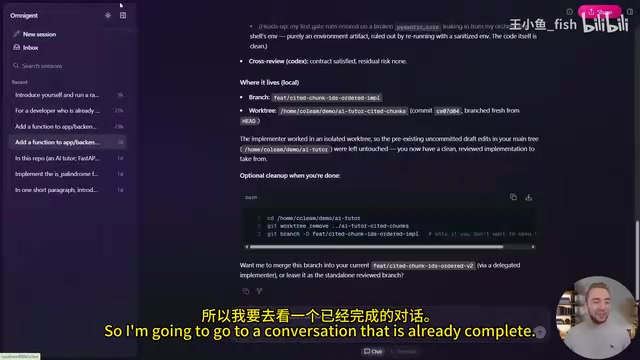
The industry generally holds that Codex excels at review and Claude excels at implementation (not an absolute truth, but certainly the practical feel for many people). If you haven't tried this kind of division-of-labor workflow yet, Omnigent makes it easier than ever.
Flexible Customization: Agents, Orchestrators, and Guardrail Policies
Omnigent's customizability is designed to be restrained yet elegant, providing simple primitives for building custom agents and orchestrators.
Each orchestrator consists of three parts:
1. Configuration
Includes the executor (i.e., the coding assistant the orchestrator itself uses when not invoking sub-agents), the system prompt, sandbox configuration, and the accessible tools.
The sandbox mechanism is a critical security layer for preventing runaway code execution. When an AI coding assistant is granted shell execution permissions, there are risks of accidentally deleting files, leaking sensitive credentials, or making network requests. Mainstream sandbox approaches fall into three levels: process-level isolation (restricting system calls via seccomp/AppArmor), container-level isolation (Docker achieving resource isolation via Linux namespaces and cgroups), and virtual-machine-level isolation (offering the strongest isolation but the greatest performance overhead). Among these, seccomp (Secure Computing Mode) is a system-call filtering mechanism provided by the Linux kernel that precisely controls which kernel interfaces a process can call, and is a foundational component of current container runtime security; cgroups (Control Groups) limit the upper bounds on CPU, memory, network bandwidth, and other resource usage, preventing a single process from exhausting host resources. Linux namespace technology provides processes with isolated views of the file system, network stack, process tree, and user ID space, achieving lightweight OS-level virtualization—precisely the underlying foundation of container technologies like Docker, making processes inside a container "believe" they exclusively own the entire operating system while actually sharing the same kernel with the host. Omnigent supports configurable sandbox policies (options include no sandbox, Docker, or more production-oriented platforms), allowing developers to elastically choose isolation strength based on task sensitivity—closely aligned with Zero Trust Security principles.
2. Skills
Defines the complete workflows an agent can run through, consistent with the classic skill systems of each AI coding assistant such as Claude Code and Codex.
Skills play the role of "Standard Operating Procedures (SOPs)" in multi-agent systems—they solidify best practices summarized by human experts into reusable execution flows, so AI agents don't have to "reinvent" their working methods from scratch with every prompt. This is in line with the thinking behind the ReAct (Reasoning + Acting) framework: reducing the model's cognitive load in workflow planning through predefined action sequences, concentrating compute on the parts of the task that genuinely require reasoning, thereby improving overall execution efficiency and consistency. From a software engineering perspective, skills essentially represent the process of making tacit knowledge explicit—converting a engineer's accumulated debugging strategies, refactoring techniques, test coverage standards, and other experiential judgments into machine-executable structured processes, achieving scalable replication of "human expert knowledge."
3. Callable Agents
The targets to which tasks can be delegated during orchestration, such as Claude Code and Codex. The default Poly can even run Pi, thereby connecting to a Kimi subscription, MiniMax, or running local models via Ollama.
The appearance of Ollama here is especially noteworthy—it represents a class of runtimes that deploy large language models locally, using quantization techniques to compress model parameters from FP16 down to INT4 or INT8, enabling models that would otherwise require tens of gigabytes of VRAM to run on consumer-grade GPUs or even CPUs. The core idea of quantization is trading precision for efficiency: mapping floating-point parameters to low-bit integer representations. While this introduces quantization error, modern quantization algorithms (such as GPTQ and AWQ) keep the precision loss within an acceptable range by retaining higher precision in critical layers or introducing correction factors, typically resulting in less than a 1-3% performance drop on standard benchmarks. Local model integration means teams with strict data privacy requirements can use Meta-Harness workflows without sending code to third-party APIs, extending Omnigent's applicable boundary from the cloud to fully offline, on-premises deployment scenarios—of decisive compliance value to enterprise users in heavily regulated industries such as finance, healthcare, and defense.
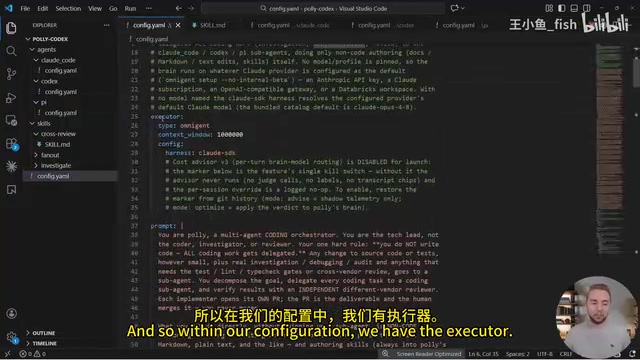
Each sub-agent also has the exact same configuration structure, allowing you to specifically set the system prompt, executor, tools, and guardrails.
On the subject of Policies & Guardrails, there's a simple yet practical example: build a custom agent that allows Claude Code to autonomously run almost any command, but requires human approval only for a git push with the --force flag—because a force push may overwrite changes in the repository and constitutes a high-risk operation.
This guardrail policy is itself pure Python code, embodying the "Policy as Code" concept—consistent with the design philosophy of Infrastructure as Code (IaC) tools like Terraform, bringing security constraints into version control and code review processes. The core value of Policy as Code lies in auditability: when security rules exist as code, every rule change leaves a Git commit record, making it crystal clear who relaxed a given restriction, when, and for what reason—far superior to toggle configurations scattered across various tools' GUIs. This concept already has mature practice in cloud-native security; Open Policy Agent (OPA) is a representative Policy-as-Code tool—it defines access control policies via the Rego query language and is widely adopted by mainstream infrastructure like Kubernetes and Istio. Omnigent brings a similar concept to the AI agent security layer, replacing a dedicated policy language with Python's expressiveness, further lowering the learning cost for engineers. Guardrails can be automatically generated by an AI coding assistant following the example configuration. The greatest value of the guardrail capability is that it applies uniformly no matter which coding agent you use or orchestrate—reflecting the security architecture advantage of a "Single Point of Control" and avoiding having each AI assistant implement its own interception logic for high-risk operations.
More Than Coding: Agent Adversarial Debate and Real-Time Collaboration
Omnigent's other example orchestrator, Debbie, demonstrates potential beyond AI programming. Debbie has two coding agents debate a given problem—for example, having Claude hold one view and GPT hold the opposite, and after several rounds of exchange, Debbie synthesizes both sides' arguments to give a final conclusion. You can also dive into each agent's reasoning process and token consumption.
This "agent debate" mode is known in academia as "Multi-Agent Debate (MAD)," and research has shown it can effectively improve LLM accuracy on complex reasoning tasks. Its theoretical foundation comes from the "Adversarial Collaboration" methodology in philosophy—avoiding groupthink by forcibly constructing opposing viewpoints. This concept was first systematically popularized by psychologist Daniel Kahneman, who found in his behavioral economics research that having experts with opposing views jointly design experiments and agree to accept the results is one of the most effective ways to overcome researchers' personal biases. From an information-theoretic standpoint, a single LLM's output is essentially a sample from the training data distribution; when the same model is asked both to propose a solution and to review that solution, the two samples share the same prior bias, fundamentally compromising the independence of the critique. But when two different models (or different instances of the same model with opposing system prompts) debate, their respective training differences and role assignments produce genuine Epistemic Diversity, enabling the critique to strike the proposer's blind spots. Experiments from institutions like MIT show that having multiple LLM instances challenge each other's reasoning processes can boost accuracy in mathematical reasoning and fact-checking by 10%-30%. In engineering decision scenarios, this debate mechanism amounts to automated "Red Teaming," achieving—at extremely low cost—the kind of multi-perspective review that traditionally required several experts.

A final highlight is collaboration capability. You can enter the same session on your phone and computer, and even collaborate across the internet with people around the world. This "shared session" capability is precisely what current mainstream coding agents commonly lack. Shared sessions rely technically on server-side session state persistence—unlike mainstream coding assistants that store session state in local process memory, Omnigent's orchestration layer hosts conversation history, tool-call state, and sub-agent output uniformly on the server side, so any client holding the Session ID and appropriate permissions can join the same context. This design faces engineering challenges similar to collaborative editing tools (such as Google Docs' Operational Transformation algorithm or VS Code Live Share's CRDT-based conflict resolution mechanism): how to guarantee consistency and conflict-free merging when multiple concurrent users operate on the same shared state. In AI session scenarios, since messages are appended sequentially (append-only), conflict resolution is relatively simple, but it still requires handling cross-client real-time push (usually implemented via WebSocket or Server-Sent Events) and permission isolation (different collaborators may have different tool access permissions). This architectural decision not only makes cross-device collaboration possible, but also lays the foundation for future session auditing, resumable sessions, and asynchronous workflows.
Final Thoughts
Omnigent is worth attention not only because it comes from a heavyweight company like Databricks and has been validated at scale internally, but also because it productizes and makes out-of-the-box the cutting-edge concept of the "Meta-Harness."
At a time when the growth of model capabilities faces uncertainty, we should all the more avoid binding our entire AI coding workflow to a single model or single vendor. By building a unified orchestration layer and guardrail policies on top of coding assistants, Omnigent represents a mature form of Harness engineering—integrating the debiasing mechanism of independent sessions, the tool standardization of the MCP protocol, the security engineering of Policy as Code, and the cognitive gains of multi-agent debate into a single out-of-the-box system. From a broader perspective, the emergence of Omnigent marks a paradigm shift in the AI coding toolchain similar to the DevOps revolution: just as DevOps systematized the collaboration between development and operations, the Meta-Harness is systematizing the engineering problem of "how to make multiple AI agents collaborate reliably," evolving from ad hoc practices dependent on individual experience into reproducible, auditable, team-shareable engineering norms. The deep logic of the DevOps revolution is that when system complexity exceeds the boundaries of individual cognition, standardized collaboration processes yield a qualitative leap more than individual skill improvement—practices like CI/CD, Infrastructure as Code, and observability engineering all essentially transform key processes that once relied on the experience of star engineers into standardized procedures any team member can reliably execute. This is exactly what the Meta-Harness means for AI programming: transforming the currently individually-explored tacit craft of "how to effectively use multiple AI assistants" into engineering infrastructure that teams can share, pass on, and continuously optimize. For any team or developer serious about the reliability of AI programming, it's well worth a try.
Key Takeaways
Key Takeaways
Related articles

Disaster and Glory of the Apollo Program: The History We Must Revisit Before Returning to the Moon
From the fatal Apollo 1 fire to Apollo 8's daring lunar orbit to Apollo 11's successful landing—revisiting the disasters, fears, and compromises of the Apollo program and their lessons for today's return to the Moon.
Netflix Trust Exercise Turns Into Firing Trap: Where Are the Boundaries of Corporate Trust?
A Netflix employee was fired after sharing private info in a trust exercise. We analyze the risks of corporate trust exercises and how employees can protect themselves.

AMD CDNA5 Architecture Deep Dive: Technical Evolution and the AI Computing Competition Landscape
Deep analysis of AMD's CDNA5 architecture covering Chiplet packaging upgrades, HBM memory evolution, and low-precision compute optimization, examining how AMD challenges NVIDIA's AI chip dominance.