OmniRoute: Manage 200+ Model Endpoints from One Console — No More Constant API Switching

OmniRoute unifies 200+ AI model endpoints into one local console with smart failover and auto-routing.
OmniRoute is an open-source local routing hub that lets AI coding tools like Claude Code, Codex, and Cursor all point to a single local address. It supports 200+ providers and uses Combo fallback chains and Auto mode to automatically switch between APIs when quotas run out — eliminating constant manual reconfiguration.
Switching Endpoints Takes More Time Than Writing Code?
If you use AI coding tools like Codex, Claude Code, or Cursor simultaneously, you've probably run into this scenario: you're deep in a coding session in Codex, suddenly hit a quota limit, switch to Claude Code only to redo the entire configuration, and then have to re-integrate yet another API. You spend more time switching endpoints than actually writing code.
An open-source project called OmniRoute — recently dissected on Bilibili and already boasting over 16,000 GitHub stars — is built specifically to address this pain point. The idea is straightforward: let your coding tools handle reading files, writing code, and running commands, while a single local console manages all the messy details of model endpoints, quotas, and switching.
What Is OmniRoute and What Problem Does It Solve?
OmniRoute runs on your own machine and functions as a local "model routing hub." You add your API Keys, subscription accounts, and local models to it, then point Claude Code, Codex, Cursor, and other tools to the same local address. All requests go through OmniRoute first, which then distributes them according to your configured rules.
There's a technical concept worth understanding here: the "routing hub" architecture OmniRoute uses is essentially the API Gateway pattern applied to the AI domain. API gateways became widely adopted in microservices architectures — the core idea being that all external requests pass through a single unified entry point, which handles authentication, rate limiting, load balancing, and routing, while downstream services remain transparent to callers. OmniRoute brings this pattern to the desktop for individual developers: it listens on a fixed local port and exposes an interface compatible with the OpenAI API format — the communication protocol that virtually all AI coding tools support by default — allowing tools like Claude Code and Cursor to operate without knowing which backend provider they're actually connected to.
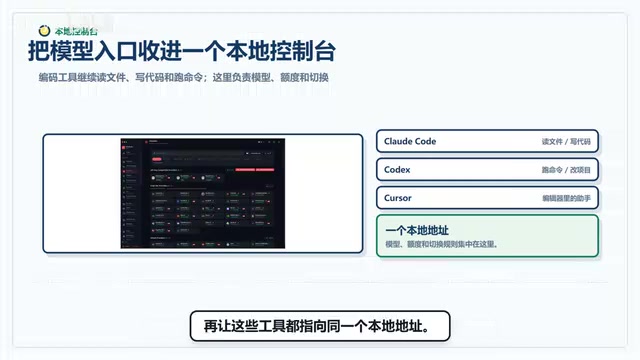
This means you only need to configure your tools once. After that, which model to use and which quota to draw from are all managed from the OmniRoute console — no need to go back into each tool and update settings one by one.
Combo: Fallback Chains That Keep Your Work Uninterrupted
One of OmniRoute's most practical features is what it calls the Combo fallback mechanism. You define a priority chain — for example: use subscription quota first, then fall back to your own API key, then automatically switch to a cheaper model when quota runs out. When a service runs out of quota or throws an error, OmniRoute automatically falls through to the next option in the chain, without requiring you to manually stop your task, switch tools, change the model name, and resubmit the same prompt.
From an engineering perspective, Combo is a combination of Failover and Priority Queuing. In distributed systems, failover refers to the ability to automatically redirect traffic to a backup node when the primary becomes unavailable — the goal being high availability. When an API returns a 429 (quota exceeded) or 5xx (server error) status code, the routing layer captures that signal and re-submits the request to the next provider in the chain without any user intervention. This is especially critical for long-running AI coding tasks — a single interruption often means having to reconstruct context. The Combo mechanism essentially protects workflow continuity.
Auto Mode and Fixed Mode
Beyond manually defining a Combo chain, you can enable Auto mode. After connecting multiple services, it will automatically select a route based on remaining quota, price, speed, and service status. Of course, if you prefer to always use a specific model, you can hardcode that preference as well.

The console also provides real-time visibility into each service's status, usage, and remaining quota. For anyone constantly switching between multiple models, this alone can eliminate the need to keep several dashboard tabs open at once.
200+ Providers and "1.6 Billion Free Tokens"
OmniRoute's README lists over 200 providers and 90+ free tiers, calculating roughly 1.6 billion free tokens available per month.
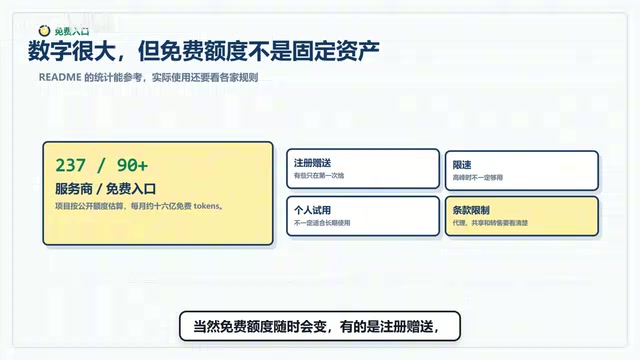
This number deserves a healthy dose of skepticism. The 1.6 billion figure is an estimated value that the project authors calculated by summing up publicly stated quotas from each provider — it is not a stable, reliably available pool. Free tiers change constantly: some are one-time sign-up bonuses, some are rate-limited, some are for personal trial use only. More importantly, some providers' terms of service explicitly prohibit proxy sharing and resale.
In short, you can use OmniRoute to organize and manage multiple API sources under your own accounts — but don't treat it as a stable, unlimited free model pool to exploit. That's neither realistic nor likely compliant with terms of service.
Context Compression: Reducing Token Consumption
OmniRoute also includes a built-in compression feature. When lengthy tool outputs or repetitive content pass through the router, it attempts to shorten that content before sending it to the model. The project claims significant savings, which can meaningfully reduce token costs in scenarios involving long logs or verbose outputs.
Understanding this feature requires knowing how Context Windows work in large language models. Current mainstream models support context windows ranging from tens of thousands to hundreds of thousands of tokens, but AI coding tools working on large codebases can rapidly fill those windows with log outputs, file contents, and conversation history — all while incurring substantial token costs. Common compression strategies include truncating older messages, extracting summaries (Summarization), removing duplicate content, and using sliding window mechanisms. However, all of these are forms of lossy compression — content that's trimmed or summarized cannot be recovered. In debugging scenarios, an error stack or edge case that gets cut may be exactly what you needed. The takeaway: compression is inherently lossy — important content should still be reviewed directly. This feature is better suited for handling redundant logs than for preserving critical reasoning chains in conversation history.
Installation, Deployment, and Security Considerations
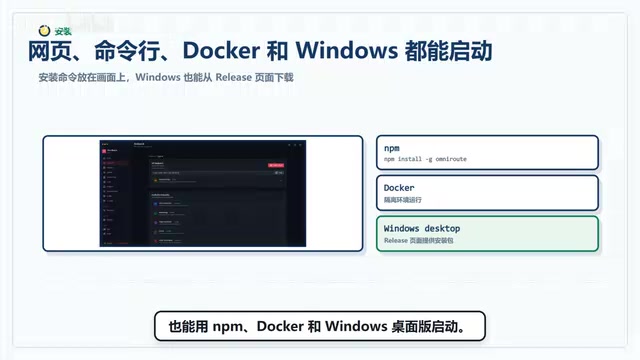
OmniRoute offers a web-based console and supports startup via NPM, Docker, and a Windows desktop installer. The repository is actively maintained, and Windows installer packages are available on the releases page.
API Key Security Warning
One point that must be emphasized: OmniRoute centrally stores all your API Keys and login credentials. API Keys are the sole credentials for accessing model services — if leaked, an attacker can silently drain your quota, access your data, or rack up large bills without your knowledge. This "Credential Aggregation" design is a double-edged sword: it's convenient to manage, but it also makes this node a high-value attack target.
For local-only use, this centralized approach is relatively safe — the attack surface is fairly contained. But if you plan to deploy it on a server, you need to seriously evaluate: whether HTTPS encryption is enabled, whether access is restricted to whitelisted IPs, and whether keys are stored encrypted rather than written in plaintext config files — after all, this node holds the keys to all your services, and exposure carries significant risk. Industry best practices recommend creating separate API Keys for different use cases and setting usage alerts and spending caps in each provider's dashboard so you're immediately notified if anything abnormal occurs.
Is OmniRoute Worth Using?
The answer is clear, and it depends on your situation:
- If you only use one service consistently: sticking with your existing configuration is simpler — there's no need to introduce a new tool to solve a problem you don't have.
- If you already juggle multiple accounts and tools: OmniRoute consolidates the repetitive time cost of "switching" into a single managed workflow — that's a genuine productivity win.
For heavy AI coding users, fragmented management of multiple models, quotas, and tools is a real problem. OmniRoute unifies all those entry points behind a single local console, and with Combo fallback chains and Auto routing, it genuinely helps you keep your focus on the code itself. Just don't lose sight of the uncertainty around free quotas and the security boundaries that come with centralized API Key storage.
Key Takeaways
Related articles

Disaster and Glory of the Apollo Program: The History We Must Revisit Before Returning to the Moon
From the fatal Apollo 1 fire to Apollo 8's daring lunar orbit to Apollo 11's successful landing—revisiting the disasters, fears, and compromises of the Apollo program and their lessons for today's return to the Moon.
Netflix Trust Exercise Turns Into Firing Trap: Where Are the Boundaries of Corporate Trust?
A Netflix employee was fired after sharing private info in a trust exercise. We analyze the risks of corporate trust exercises and how employees can protect themselves.

AMD CDNA5 Architecture Deep Dive: Technical Evolution and the AI Computing Competition Landscape
Deep analysis of AMD's CDNA5 architecture covering Chiplet packaging upgrades, HBM memory evolution, and low-precision compute optimization, examining how AMD challenges NVIDIA's AI chip dominance.