Open-Source 3D Generation Models Tested: Can Trellis 2 Challenge Paid Products?

Trellis 2 vs. paid 3D generators: open-source has arrived, but paid still leads on complex details.
A rigorous blind test pits open-source 3D models (Trellis 2, Hunyuan 2.1, UltraShape) against paid products (Tripo 3.1, Hi3D) across geometry, texture, and complex detail tests. Trellis 2 impresses on materials and transparency but struggles with complex structures. The verdict: use free tools for environment assets and dev workflows, go paid for high-precision tasks like 3D printing.
The Open-Source 3D Generation Boom Has Arrived
Two years ago, AI-based 3D generation was still in its wild west phase. The only models worth using were TripoSR and early versions of Trellis — impressive for their time, but far from production-ready in terms of detail and structural accuracy. Today, the landscape has fundamentally shifted: open-source 3D generation models are experiencing a wave of rapid technical breakthroughs.
Bilibili creator Stephen recently conducted a rigorous head-to-head evaluation, pitting locally-runnable open-source models — Trellis 2, Hunyuan 2.1, and UltraShape 1.0 — against paid leaders Tripo 3.1 and Hi3D in a blind comparison. The core question: when you can run AI models locally for free, is there still a reason to pay?
What makes this evaluation valuable is that it goes beyond a simple feature checklist. Using diverse prompts — a metallic rooster, complex scenes, realistic characters, and a tentacled monster — it conducts a rigorous comparison across three dimensions: geometry, texture quality, and proportional accuracy. These dimensions map directly to real-world needs: geometry concerns mesh topology soundness (are there intersecting faces or holes?), which determines whether a model can enter an animation rigging or 3D printing pipeline; texture quality covers UV unwrapping efficiency and completeness of PBR material channels; proportional accuracy evaluates whether spatial relationships between components match the reference, which is critical for character animation and scene composition.

The Evolution — and Frustrations — of Open-Source 3D
From TripoSR to Trellis 2
Looking back at this technical progression, the pace of improvement in open-source 3D generation has been remarkable. Hunyuan released versions 2.0 and 2.1 in succession, becoming nearly indispensable in the Comfy UI community and a staple in countless workflows. The Hunyuan 3D series uses a multi-stage generation paradigm: first generating multi-view images, then producing high-quality meshes via a reconstruction network, followed by texture baking — a pipeline that naturally fits ComfyUI's node-based workflow design, making it one of the most easily integrated 3D generation nodes. Direct3D-S2 then improved on textures and mesh structure, typically used alongside Hunyuan 2.1 to achieve the highest quality 3D outputs at the time.
The real turning point came recently with Microsoft's release of Trellis 2. According to the reviewer, this is the most significant event in the open-source community to date. The core innovation in the Trellis series lies in using structured latent representations (SLAT) combined with sparse voxel diffusion to generate 3D assets — a significant improvement over earlier NeRF- or point cloud-based approaches in both memory efficiency and geometric precision. This explains why Trellis 2 delivers strong geometric understanding, excellent texture results, mesh resolution up to 1530, 4K textures, and even native transparency support. Even paid generators often struggle with transparent or semi-transparent elements like eyes, but Trellis 2 genuinely handles them.
The barrier to local deployment is also dropping rapidly. While the full version typically requires around 24GB of VRAM, optimized builds can run on 6GB — a major win for everyday creators.
The Stalled Open-Source Plans for Lattice
The evaluation also revealed some painful news for the open-source community: Lattice, the core technology behind Hunyuan 2.5 and Hunyuan 3, was rumored to be open-sourced, with quality reportedly exceeding even Trellis. Those plans have been shelved due to company policy.
The reviewer's take is insightful: under intense commercial competition from companies like Tripo and Meshy, Hunyuan's choice not to release — or to delay releasing — Lattice is ultimately a reflection of financial and competitive realities. This differs from Meta's aggressive open-source strategy with LLaMA in the large language model space. In the specialized 3D generation market, companies like Tripo and Meshy, whose core business model depends on API services, rely heavily on maintaining a model quality gap as their competitive moat. Once a core model is open-sourced, that differentiation largely evaporates. This reveals a harsh truth: high-quality 3D generation technology is becoming increasingly difficult to fully open-source, and commercial competition is quietly becoming an invisible barrier to model releases.

Open-Source vs. Paid: A Head-to-Head Blind Test
Hard Surface: The Metal Rooster Test
The first test was a metal rooster standing on an object — and the results were telling:
- Trellis 2: Missed the metal rooster entirely; post-processing with UltraShape didn't fix it
- Hunyuan 3.1: Clearly better, but the rooster's position was completely wrong
- Tripo 3.1: Correct positioning, somewhat imprecise in form, but closest to the reference — winner of this round
On texture, Trellis's PBR rendering gave the metal can a brocade-like sheen, with solid rooftop detail. PBR (Physically Based Rendering) simulates real material parameters like metalness and roughness to produce lifelike visuals — models with complete PBR channels can go directly into game engines or film rendering pipelines, which is Trellis's key material advantage. Hunyuan exposed its typical weakness: a tendency to over-smooth and over-simplify. While the image appeared sharper, visible aliasing throughout indicated insufficient resolution. Tripo performed best on fine details like wood grain and ladders, with consistent results from all angles.
Complex Scenes: Ready for Unreal Engine?
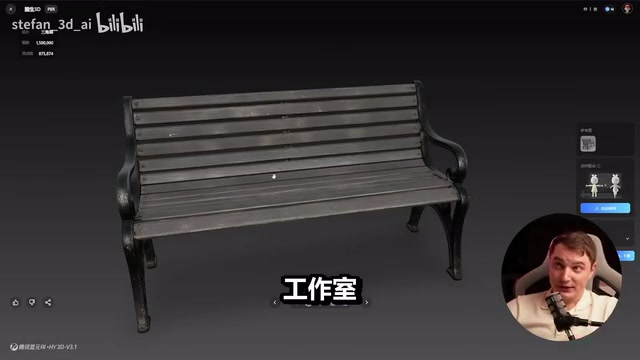
The reviewer posed a practical question: could a scene generated from a simple prompt in Trellis 2 be used directly in an Unreal Engine game? Unreal Engine has strict technical requirements for imported assets: meshes must be closed manifolds, polygon counts must be reasonable, UV unwrapping must be overlap-free, texture dimensions must be powers of two, and material channels must comply with UE's Lumen/Nanite rendering pipeline. The intersecting faces, holes, and non-standard UVs common in AI-generated models often require extensive manual cleanup to meet these standards. The result: shapes were acceptable but flawed, lacking the precision needed for direct production use. One telling detail — Trellis has so many settings that the reviewer admitted not knowing how to use them all, with only resolution and meshing being reliably understood.
Realistic Characters: Smoothness Is a Double-Edged Sword
Character tests further revealed the distinct personalities of each model. Hunyuan's human faces showed more detail and even added a smile, but over-smoothing was a critical flaw — realistic qualities like skin texture were lost. Tripo showed layered detail beneath the skin on high-poly versions, with shapes closest to the reference.
For stylized full-body characters, the tables turned — stylized content is one of Hunyuan's strongest suits, with clothing handling and overall treatment outperforming Trellis. Meanwhile, Tripo's accuracy actually declined with more complex details, with face and head fidelity falling short. This shows that different models have different sweet spots — paid doesn't always mean better.
Complex Details Are the True Differentiator

The most revealing test was a complex tentacled monster. Trellis 2's output was disastrous: tentacles intersected each other, structure was chaotic, and holes appeared throughout — even as a base mesh it would require extensive rework. These non-manifold geometry issues (self-intersecting faces, holes) are classic 3D generation model defects and are unacceptable when animation rigging or 3D printing is the goal.
The paid camp showed a clear advantage here:
- Hi3D (formerly HiTem/Spark): approximately $0.30 per generation, rich and logically coherent detail, with occasional extra tentacles but overall quality that justifies the cost
- Tripo 3.1: Decorative details and tentacle directions were all logical — fully usable as a base for 3D printing
The reviewer's conclusion was pragmatic: for precision-critical use cases like 3D printing, spending $0.30 on the paid version is not only faster, it saves two to three hours of manual cleanup — a clear value proposition.
Open-Source or Paid? Decide by Use Case
The reviewer's answer isn't absolute: open-source isn't categorically better than paid, but it's absolutely worth trying.
The sensible strategy is to choose based on scenario:
- Environment assets / budget-sensitive projects: Trellis 2 is free and well-suited for environment asset creation and saving project costs
- Developer integration: Local deployment makes clear sense for deep workflow customization; for developers embedding 3D generation into their own products or CI/CD pipelines, local models also mean data privacy and no API call limits
- High-precision use cases (e.g., 3D printing): Go straight to the paid version — the time cost of reworking free outputs far exceeds the small fee
Leaderboard data shows Trellis 2 currently ranked 17th, with Hunyuan 2.1 and SAM3D also listed but lower — confirming that an objective gap still exists between open-source models and top paid products. That said, the reviewer expressed strong confidence in Trellis 2's potential, seeing it as the future direction of open-source 3D generation.
It's worth noting that most of these tools offer generous free tiers — Hunyuan allows 20 free generations per day, and Tripo has its own free quota. Readers can easily run their own blind comparisons and find the tool that best fits their workflow.
Key Takeaways
Related articles

The Truth Behind Codex 'Build a Website in 5 Minutes': AI Isn't Creating Sites—It's Helping You Copy Them
Exposing the truth behind viral Codex 5-minute website videos: creators aren't building original sites with AI—they're copying shared prompts or scraping others' work. Learn AI coding tools' real limits.

Getting Started with AI Agent Development: A Complete Guide from Concept to Practice
A comprehensive guide to AI Agent architecture and development, covering automated marketing, intelligent customer service, and investment analysis scenarios with single and multi-agent collaboration.

The Truth Behind Codex 'Build a Website in 5 Minutes': AI Isn't Creating Sites — It's Helping You Copy Them
Exposing the truth behind viral Codex 5-minute website videos: creators aren't building original sites with AI — they're copying shared prompts or scraping others' work.