OpenAI Codex Adds Settings Search: Quickly Locate Configuration Options

OpenAI Codex adds searchable settings with category-grouped results for faster configuration.
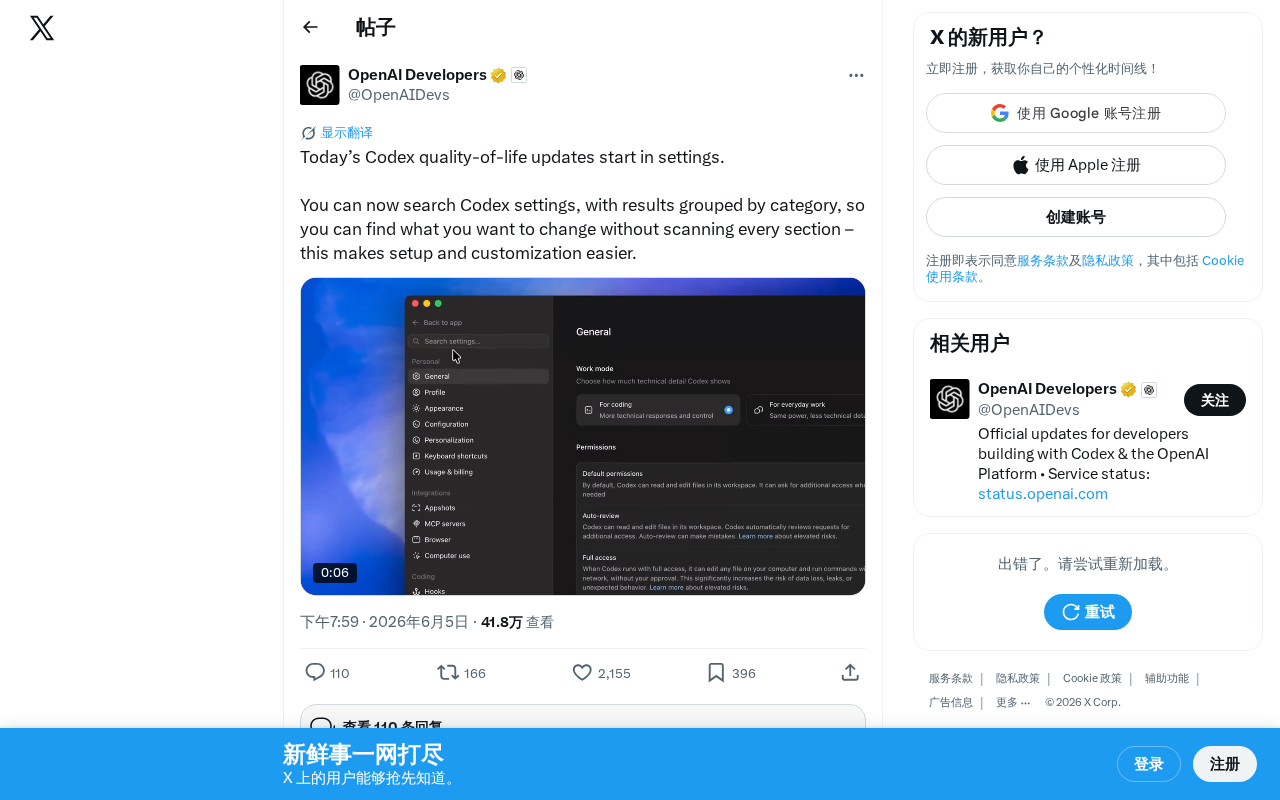
OpenAI Codex has introduced a settings search feature that lets users find configuration options by keyword, with results grouped by category. This Quality-of-Life update eliminates the need to manually browse through numerous settings sections, significantly improving workflow efficiency as AI coding tools mature toward traditional IDE standards.
Codex Adds Settings Search Feature
OpenAI's AI coding tool Codex has rolled out a practical Quality-of-Life update — a new search function on the settings page. Users can now type keywords directly in Codex settings to search, with results displayed in grouped categories. There's no longer any need to browse through each settings section one by one to find the option you want to modify.
Why This Update Matters
Lowering the Configuration Barrier
For AI coding tools, settings are often numerous and scattered across different categories. From code completion behavior and model selection to keybinding configurations, users frequently spend significant time hunting for specific options when initially setting up or adjusting their workflow. The addition of search functionality directly addresses this pain point, making the setup and customization process much more efficient.
Search Results Grouped by Category
Interestingly, Codex's search results aren't displayed as a simple flat list — they're grouped by category. This means when users search for a keyword, they can clearly see which functional module each related setting belongs to. This helps users understand the logical relationships between settings and makes it convenient to adjust similar configurations all at once.
The Trend of AI Coding Tool Experience Optimization
While QoL updates like this don't grab headlines the way new model releases do, their impact on daily usage experience is very real. As AI coding tools grow increasingly feature-rich, the complexity of their settings also increases. How to help users quickly find and adjust the configurations they need is becoming an important competitive dimension among these tools.
From VS Code's settings search to JetBrains IDE's configuration management, mature development tools have long considered settings search a standard feature. Codex's adoption of this capability reflects how AI coding tools are catching up to the maturity level of traditional IDEs, transitioning from "functional" to "user-friendly."
Related articles

WebMCP in Practice: How MakeMyTrip Is Reshaping the Travel Booking Experience
India's largest OTA platform MakeMyTrip uses WebMCP to standardize AI Agent interactions with web apps, replacing fragile DOM scraping with natural language-driven test automation and simplified complex booking scenarios.

Deep Dive into the EYG Programming Language: A New Portable Programming Paradigm Designed for Humans
Deep analysis of the EYG programming language's core design, including algebraic effects, program state persistence, and cross-platform portability, exploring how it addresses modern software fragmentation.

WebMCP in Practice: How MakeMyTrip Is Reshaping the Travel Booking Experience
India's largest OTA platform MakeMyTrip uses WebMCP to standardize AI Agent interaction with web apps, solving DOM scraping fragility, enabling natural language test automation, and simplifying complex international flight bookings.