OpenAI GPT-Live Full-Duplex Voice Model: Reshaping the Human-Computer Interaction Gateway

OpenAI's GPT-Live full-duplex voice model redefines voice assistants and targets the OS-level interaction gateway.
OpenAI's GPT-Live introduces full-duplex voice interaction, foreground-background compute orchestration, real-time generative UI rendering, and a preemptive emotional safety line. Together these features form a complete agent solution aimed not at Siri, but at the operating system's voice interaction gateway itself.
A Paradigm Shift in Voice Assistants
While Apple's Siri is still stuck in the walkie-talkie-style interaction of "wake—ask—wait," OpenAI has already pushed voice assistants into an entirely new dimension. The newly released GPT-Live is no longer just a tool that understands commands, but a versatile personal agent capable of real-time interface rendering and seamless orchestration of top-tier compute.
The significance of this release goes far beyond "yet another voice feature upgrade." It marks the transition of voice interaction from simple information Q&A into the era of the "fully multimodal agent." For Apple—which has long relied on a closed ecosystem to build its moat—the appearance of this crack is worth watching closely.
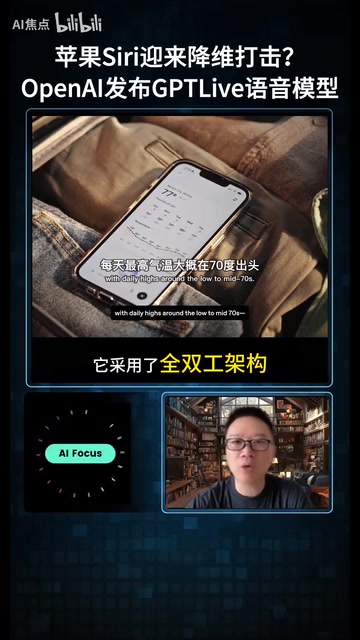
Full-Duplex Architecture: A Definitive Farewell to Walkie-Talkie Conversations
The most intuitive breakthrough of GPT-Live lies in the reconstruction of its underlying interaction logic. It adopts a Full-Duplex architecture, allowing users to interrupt the model at any time and to listen and speak simultaneously—completely leaving behind the one-way turn-taking mode of previous voice assistants, where "you had to finish speaking before I could talk."
Full-duplex communication technology originated in the field of telecommunications engineering. It was first applied to wired telephone networks and later became standard in cellular communication (GSM, LTE). Its core meaning is that both parties can send and receive signals simultaneously—a sharp contrast to "half-duplex" (i.e., walkie-talkie mode, where one party must finish before the other can speak). However, the challenges of introducing full-duplex into an AI voice interaction system far exceed those of traditional telecom scenarios. Traditional telecom full-duplex only needs to handle the bidirectional transmission of analog or digital signals, whereas GPT-Live's full-duplex architecture must also perform semantic understanding, intent recognition, and interruption decisions synchronously within a real-time voice stream—requiring neural network inference latency to be compressed to within the threshold of human perception (roughly 150–200 milliseconds).
In early voice assistant designs, limited by the accuracy of Voice Activity Detection (VAD) algorithms and model inference latency, the system had to wait for the user to pause before processing a command, creating a distinct sense of "turn-taking." VAD algorithms determine the start and end boundaries of speech by analyzing the energy, zero-crossing rate, and spectral characteristics of the audio signal. Their working principle resembles a "gating switch" that continuously monitors the noise environment—opening the processing channel only when signal features match a speech pattern. But in noisy environments or with varying speech rates, this mechanism is prone to misjudgment, causing the assistant to cut in prematurely before the user finishes, or conversely to wait too long during pauses. This is one of the key reasons why traditional voice assistant interactions feel stiff.
GPT-Live's full-duplex architecture means the model continuously listens to user input while outputting speech, and can decide in real time whether to abort the current output and switch its response. This requires the coordinated design of ultra-low-latency streaming speech recognition (Streaming ASR), streaming speech synthesis (Streaming TTS), and interruption-handling logic at the foundational level. Streaming ASR differs from traditional batch speech recognition; it uses online decoding algorithms (such as RNN-T or Conformer architectures) to output partial transcription results immediately as audio frames arrive, without waiting for the complete utterance to end. Streaming TTS, meanwhile, must synthesize audio segments in real time as the model generates text and push them to the audio buffer. The engineering complexity of coordinating these two streaming systems far exceeds that of the traditional "request-response" model. It's worth noting that the RNN-T (Recurrent Neural Network Transducer) architecture is widely adopted in streaming speech recognition precisely because it can make alignment decisions on the current frame without relying on future context—a characteristic that makes it naturally suited to real-time scenarios requiring "transcribing while listening," rather than traditional CTC models that must wait for the entire sentence to end before decoding.
This interaction style is closer to genuine human conversation—we interrupt, we chime in, we give real-time feedback, rather than mechanically waiting for the other person to finish an entire paragraph. The full-duplex architecture gives voice assistants the ability to hold a "natural conversation" for the first time, marking a key leap in affective computing and interaction experience.
Foreground-Background Separation: Deep Reasoning Without Dropping the Voice Connection
What truly demonstrates engineering prowess is the routing logic and compute-orchestration architecture behind GPT-Live.
When a user poses a complex task in conversation that requires deep reasoning or web search, the foreground GPT-Live responsible for real-time responses will "quietly" hand the task off to the more powerful GPT-5.5 running in the background. Throughout the entire process, the user's voice conversation with the foreground model is never interrupted.
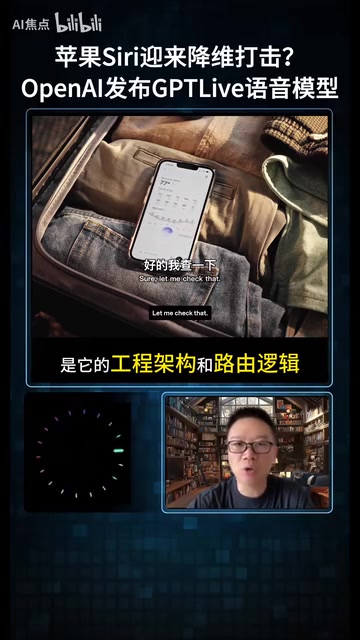
The "foreground-background separation" architecture adopted by GPT-Live is essentially a dynamic Compute Routing strategy, closely resembling the "edge-cloud" collaborative computing model in cloud computing—a model already well-established in autonomous driving (in-vehicle perception + cloud-based high-definition map updates) and industrial IoT. In autonomous driving scenarios, the in-vehicle edge computing unit (typically equipped with dedicated AI chips such as NVIDIA Drive or Qualcomm Snapdragon Ride) handles millisecond-level real-time perception and emergency decisions, while the cloud takes on latency-tolerant heavy computing tasks such as high-definition map updates and route planning optimization. The two layers coordinate through a clear task-tiering protocol—almost identical to GPT-Live's foreground-background division of labor. This architectural pattern is called "Fog Computing" in industrial IoT: an intermediate compute layer is inserted between the endpoint and the cloud, dedicated to handling tasks that demand extremely high responsiveness but limited computation, avoiding the latency overhead of round-tripping to the cloud for every request. GPT-Live essentially transplants this layered computing philosophy—already proven mature in the physical world—into the domain of language-intelligence reasoning orchestration.
The lightweight foreground model is responsible for maintaining the immediate responsiveness of the conversation, and its inference latency typically needs to be kept within 200 milliseconds to match the human perception threshold for "real-time." From a model architecture perspective, the lightweight foreground model may adopt a Distilled Model or Quantized Model with fewer parameters and shorter inference paths, trading some reasoning depth for extremely low response latency. Knowledge Distillation was systematically proposed by Hinton et al. in 2015. Its core idea is to use the "soft label" probability distributions generated by a large model (the teacher model) to train a small model (the student model), so that the latter retains as much of the teacher model's reasoning ability as possible while drastically reducing parameter count—this is the key technical foundation enabling the lightweight foreground model to maintain usable conversation quality at extremely low latency. The core innovation of GPT-Live in introducing this architecture to voice AI lies in the real-time dynamic evaluation of task complexity: the system must instantly judge, during the conversation, whether the current request should be handled by the lightweight foreground model or forwarded to the heavy background model—a decision involving a joint evaluation of query intent, knowledge timeliness, reasoning depth, and other dimensions. When it recognizes that a task's complexity exceeds the foreground's processing capacity, the system asynchronously forwards the request through a Task Dispatcher to the heavy background model for deep reasoning or web retrieval, then relays the result back to the foreground and presents it to the user in natural language.
The "fast foreground response + heavy background reasoning" division of labor solves a core contradiction in real-time voice interaction: low latency and high-quality reasoning are often difficult to achieve simultaneously. Through tiered task routing, GPT-Live guarantees conversational fluency while being able to invoke top-tier reasoning capabilities when needed. Users can even adjust the reasoning intensity themselves, flexibly balancing response speed against answer quality.
Real-Time UI Rendering: Voice Directly Generates Visual Interfaces
If full-duplex and compute orchestration are still optimizations of the interaction experience, then real-time generation of interactive UI cards is GPT-Live's complete breakthrough beyond the boundaries of traditional voice assistants.
Based on the conversation content, the model can directly render visual interactive cards—for weather, stocks, and more—on screen in real time. From a technical standpoint, the model must, while understanding the conversation's semantics, dynamically generate a structured UI description (such as a JSON Schema or a similar DSL), which the client-side rendering engine then converts into a visual card.
This capability is in line with the concept of "AI-generated UI" (Generative UI) that has emerged in recent years. Since 2023, Vercel's AI SDK, Anthropic's Claude, and others have all explored letting models dynamically output UI component descriptions. Its technical core lies in shifting interface rendering from "precompiled templates" to "runtime generation": the model outputs a structured UI description, and the client-side rendering engine parses it into actually interactive visual components. At the protocol level, such systems typically use Streaming JSON output combined with Incremental Parsing techniques, allowing the client to begin partial rendering before the model has finished generating the complete UI description—further reducing the "first-screen latency" the user perceives. This shares the same design philosophy as the streaming ASR/TTS mentioned earlier: replacing batch output with incremental output, and replacing full-completion waiting with partial usability.
It's worth noting that this technical path is fundamentally different from traditional low-code/no-code platforms. The essence of low-code platforms is combining a preset component library with visual orchestration tools, where the interface logic is fixed at the build stage and runtime only executes predefined interaction flows. Generative UI, on the other hand, can dynamically decide the presentation form, data dimensions, and combination of interactive elements at inference time, theoretically unconstrained by preset templates. This difference means generative UI possesses "scenario adaptability": for the same functional requirement, the system can generate in real time the interface form best suited to the current situation based on the user's current conversational context, device screen size, and data state—rather than picking the closest option from a fixed template library. In theory, a sufficiently powerful generative UI system could assemble temporary interfaces on demand to meet specific scenario needs without installing any App at all.

This means the voice assistant is no longer merely an "outputter of sound," but simultaneously a "front-end renderer" that controls the visual interface. The strategic value of this capability is extremely high: when a voice assistant can render functional interfaces on demand, users can complete common tasks without opening a standalone App—directly threatening platform companies that rely on App ecosystems to distribute traffic. When an AI can both understand voice and dynamically generate front-end interfaces, it is effectively taking over the entire chain of human-computer interaction—from input to output, from hearing to sight. This directly touches the core of the OS-level interaction gateway.
Emotional Dependence: A Preemptive Safety Line
GPT-Live has also made targeted designs in the field of affective computing. When AI can read a user's emotions and hold natural conversations, the most sensitive issue becomes humans' emotional dependence on AI.
The risk of humans developing emotional dependence on AI is not a recently raised concern. As early as 1966, MIT computer scientist Joseph Weizenbaum developed the ELIZA chatbot—one of the world's earliest natural language processing programs—which simulated a psychotherapist's dialogue through simple pattern matching and rule-based scripts. Weizenbaum himself was deeply shocked by the phenomenon of users forming emotional bonds with ELIZA. Researchers named this phenomenon the "ELIZA effect," and Weizenbaum later issued an early warning about the ethical risks of AI anthropomorphization in his 1976 book Computer Power and Human Reason. Notably, ELIZA's mechanism was extremely crude: it was essentially just a keyword-matching rule engine that converted users' statements into rhetorical questions (for example, turning "I'm sad" into "Why do you feel sad?"), with no semantic understanding capability whatsoever. Yet even such a program with almost no real intelligence was enough to trigger humans' deep emotional projection mechanisms. This historical fact profoundly reveals that the root of the problem lies not in AI's capabilities, but in the underlying architecture of human cognition.
From a cognitive science perspective, the root of the ELIZA effect lies in the human brain's tendency toward "Social Attribution"—a cognitive shortcut formed over the long course of human evolution: our nervous system defaults to treating any entity capable of conversation as a social actor and automatically activates emotional circuits associated with interpersonal interaction, even when we rationally know the other party is a program. Neuroscience research shows that when humans interact with anthropomorphized AI, the brain's medial prefrontal cortex (mPFC) and temporoparietal junction (TPJ)—both core nodes of the social cognition network—exhibit activation patterns highly similar to those in real interpersonal interactions. This explains, at the neural level, why pure "rational cognition" alone cannot fully block the formation of emotional connections. As the anthropomorphization of large language models continues to increase, this effect is significantly amplified: recent research from Stanford University and the MIT Media Lab has documented psychological phenomena in which users develop interpersonal-like attachment to AI companion apps, with some studies indicating that users who interact long-term with highly anthropomorphized AI exhibit social-substitution behavior, partially replacing real interpersonal interaction with AI interaction. The explanation from evolutionary psychology is even more fundamental: the human brain's "Theory of Mind" module never encountered an entity that could "converse fluently but lacks subjective consciousness" over millions of years of evolution. Therefore, when facing highly anthropomorphized AI, this evolutionarily ancient neural mechanism systematically makes "incorrect" social attributions—and this error is virtually inevitable under the current neural architecture.
The preemptive emotional safety line built into GPT-Live's architecture may include multiple mechanisms: limiting expressions that actively reinforce emotional dependence, giving guiding prompts when it detects excessive dependence tendencies in the user, and avoiding the model deceptively simulating deep emotions—embodying the practical implementation of the "Responsible AI" concept, moving from policy documents to the product engineering layer.
OpenAI states that it has reinforced the safety line at the foundational architecture level. This detail is worth noting: as voice models grow increasingly anthropomorphic, emotional dependence is no longer a science-fiction hypothesis, but a real risk that must be squarely addressed at the product design stage. Building safety mechanisms into the foundational layer reflects OpenAI's pragmatic attitude toward such ethical issues.
Comprehensively Leading in Blind Tests—but the Real Rival Lies Elsewhere
Across various blind-test metrics, GPT-Live has comprehensively surpassed the previous state of the art.

But what's even more thought-provoking is this: when an AI can read emotions, seamlessly invoke top-tier compute, and render front-end UIs in real time based on conversation, Siri is no longer its main rival.
What GPT-Live is truly aiming at is the voice interaction gateway of the entire operating system. Voice is evolving from a "feature" into an "entry point," and whoever masters natural, intelligent, visual voice interaction has the chance to become the core platform for the next generation of human-computer interaction. This poses a substantive challenge to Apple, famous for its closed ecosystem—if the system-level voice gateway is occupied by more powerful third-party agents, the moat of the closed ecosystem will also face reassessment. Judging from the historical patterns of platform competition, every migration of the human-computer interaction gateway (from desktop to browser, from browser to mobile App) has been accompanied by a reshuffling of the existing ecosystem landscape, and the voice agent may well become the most disruptive interaction-paradigm shift since the touchscreen. What's worth watching is that Apple's most robust moat—the iPhone hardware ecosystem and iOS system permission controls—may become a double-edged sword in this round of competition: strict system permission controls can certainly slow the penetration of third-party voice agents, but they may also force users to make an active choice between "a better AI experience" and "the convenience of the Apple ecosystem." This very pressure of choice is itself a signal that the moat is being eroded.
Conclusion
The release of GPT-Live is not just an iteration of voice technology, but a redefinition of the product form we call the "voice assistant." Full-duplex interaction, foreground-background compute orchestration, real-time UI rendering, and an emotional safety line—these four characteristics together constitute a complete agent solution aimed at the operating system gateway.
The future competition in voice interaction will no longer be about "who can understand commands," but about "who can become the most natural, most intelligent gateway between users and the digital world." This battle has only just begun.
Key Takeaways
Key Takeaways
Related articles

Network Doctor: An Open-Source Terminal Tool for Network Fault Diagnosis
Network Doctor is an open-source terminal network diagnostic tool that integrates ping, dig, curl, and traceroute, automatically detecting connectivity in stages and outputting fault conclusions in natural language.

LangChain Guardrails Explained: Building Safe and Controllable AI Agents
A detailed guide to LangChain Guardrails covering layered ecosystem architecture, middleware implementation, deterministic and model-driven protection for building production-grade secure AI Agents.

Deep Dive into Microsoft's AI Security Tools: Does Performance Really Surpass the Competition?
Microsoft launches enterprise AI security tools claiming superior performance. This deep analysis examines core capabilities, ecosystem advantages, and risks to guide enterprise security decisions.