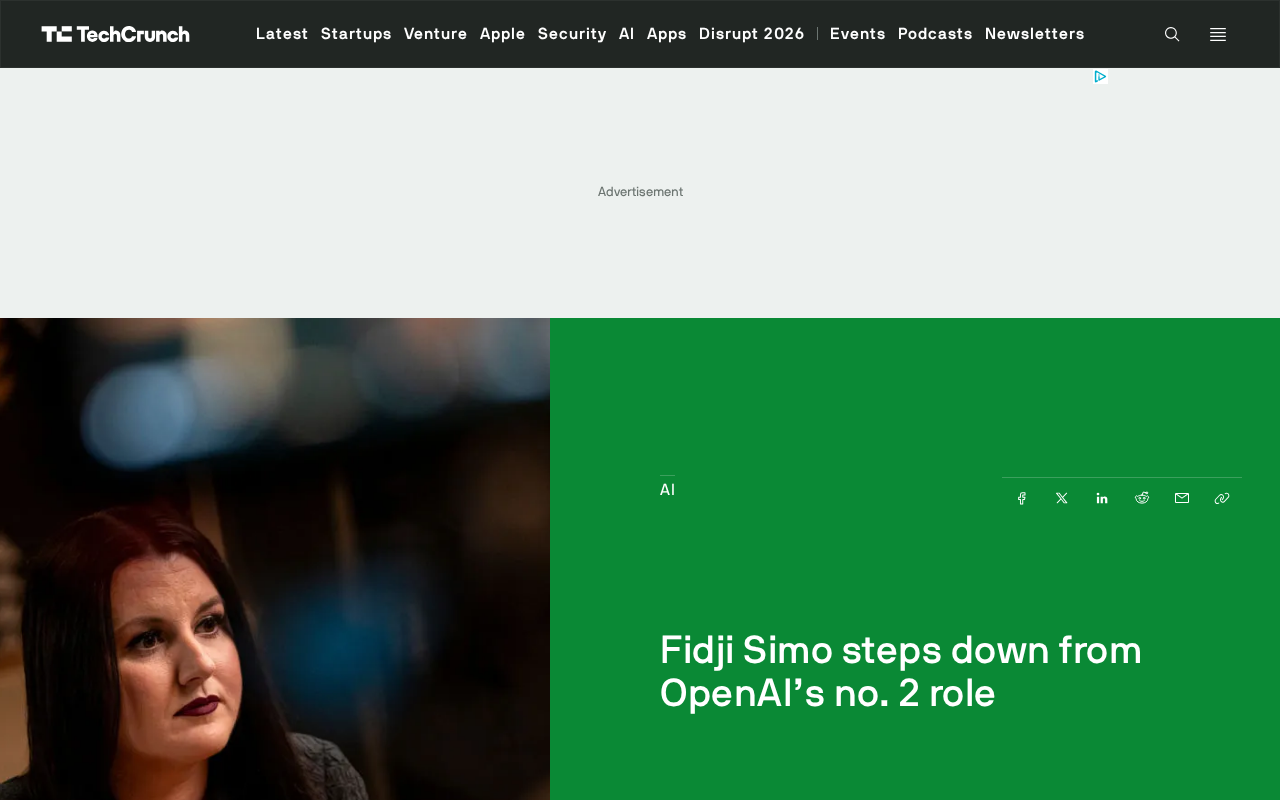
OpenAI's No. 2 Fidji Simo Steps Down: Leadership Shake-Up Amid Dual Pressure of IPO Preparation and Anthropic Competition

OpenAI's No. 2 Fidji Simo steps down amid dual pressure of IPO prep and Anthropic competition.
OpenAI's second-in-command Fidji Simo is stepping down from her full-time leadership role after her medical leave exceeded expectations. The timing is sensitive—OpenAI is preparing for a potential IPO while racing to catch Anthropic in the enterprise market, raising questions about its organizational stability and commercialization strategy.
OpenAI Leadership Shake-Up: Fidji Simo Steps Down as Full-Time No. 2
According to foreign media reports, Fidji Simo, OpenAI's second-in-command, will step down from her full-time leadership role. The immediate trigger is that her medical leave has exceeded expectations, but the timing of this power vacuum is particularly sensitive—OpenAI is preparing for a potential IPO while simultaneously engaged in a fierce race with rival Anthropic in the enterprise market.
Notably, under the framework of U.S. securities law, publicly traded companies or companies in an IPO quiet period have disclosure obligations regarding significant health conditions of key executives, though the boundaries are ambiguous. The SEC's "materiality" standard requires that any information a "reasonable investor would consider important" must be disclosed in a timely manner. Whether a key executive's extended medical leave constitutes a "material matter" has long been a contentious area for securities attorneys, which explains why OpenAI chose to characterize this personnel change as "stepping down from a full-time role" rather than "continued medical leave"—the former is a proactively disclosed adjustment to the management structure, while the latter could trigger a more complex disclosure compliance assessment.
For a leading AI company amid explosive growth and intense competition, the departure of a key executive is far from trivial. As OpenAI's No. 2, Fidji Simo has long served as the bridge connecting technical R&D with commercialization. Her absence means the management team must quickly complete a reorganization and adjustment.
From Instacart to OpenAI: A Hybrid Executive's Career Track Record
Before joining OpenAI, Fidji Simo served as CEO of the grocery delivery platform Instacart, and earlier led core app businesses at Meta (formerly Facebook). She is one of the few female executives in Silicon Valley who combines large-scale consumer product experience with commercialization execution capabilities.
Her decade at Meta is key to understanding her capability profile. Simo joined Facebook in 2011 and rose through the ranks from product manager to VP of the Facebook app, spearheading the rollout of several core businesses including Facebook Live, the video advertising ecosystem, and News Feed monetization. She is regarded as a hands-on expert in scaling consumer products into revenue and has a deep understanding of the mechanics of platform economics and advertising ecosystems.
Facebook Live officially opened to the world in 2016, rapidly gaining hundreds of millions of users through real-time interaction and viral distribution mechanisms, and Simo led the deep integration of live streaming with the advertising ecosystem in this process. What's worth understanding in depth is that monetizing a video live-streaming platform isn't simply about inserting ads next to content, but rather a sophisticated ecosystem design: she drove a monetization loop between live content, pre-roll advertising, and branded content, truly transforming video from a traffic vehicle into a sustainable revenue unit. Branded Content refers to a content format co-produced by creators and brands, disclosed and distributed through the platform's official tools. Its core advantage lies in naturally embedding brand messaging into the content consumption process, circumventing users' immunity to traditional advertising, while achieving precise audience targeting through the platform's first-party data. This productized "content-as-ad-context" thinking builds a systematic connection between video content and commercial monetization, and holds direct methodological transfer value for her later leadership of OpenAI's enterprise commercialization strategy—both are essentially about converting core capabilities (live-streaming traffic/AI model capabilities) into sustainable, scalable commercial revenue.
After becoming Instacart CEO in 2021, she reshaped the company's organizational structure before its IPO, introducing an advertising business as a new growth engine, transforming Instacart from a pure delivery platform into a Retail Media Platform, and successfully leading the company to a Nasdaq listing in 2023. Retail Media is one of the fastest-growing advertising formats in recent years—brands purchase ad placements on platforms like Instacart and Amazon that possess first-party shopping data, leveraging high-precision consumer intent data to achieve precise targeting. Unlike traditional programmatic advertising, which relies on third-party cookies to infer user interests, retail media platforms hold users' actual shopping behavior data, dramatically compressing the advertising conversion funnel, with ROI (return on investment) often significantly outperforming traditional digital advertising.
From the perspective of data assets, the core moat of a retail media platform lies in the quality and granularity of its first-party data—Instacart not only knows what users "looked at" but also what they "bought," "how often they buy," and "how elastic their spending is in a given category." This data asset, based on real purchasing behavior, upgrades its ad targeting precision from "probabilistic inference" to "behavioral confirmation," fundamentally changing advertisers' ROI accounting logic. Simo successfully grafted this business model onto Instacart, not only enhancing the company's valuation logic but also adding a foundation of sustainable profitability to its IPO narrative—what investors saw was no longer just scale expansion dependent on delivery subsidies, but a hybrid business model with high-margin advertising revenue. This complete "Pre-IPO operating" experience is precisely one of the key reasons OpenAI brought her into a core position during its IPO preparation phase.
Her joining was once seen by the industry as an important signal of OpenAI's transformation from a purely technical organization into a mature commercial company. It was precisely this hybrid background—"understanding both product and business"—that placed her in the core position second only to CEO Sam Altman in OpenAI's organizational structure. Her responsibilities spanned product, operations, and commercialization strategy, serving as the key pillar supporting the company's daily operations while Altman focused on the technical vision and external affairs.
The Power Vacuum Emerges at the Most Sensitive Moment
The reason this personnel change has drawn widespread attention is largely due to the highly sensitive timing. OpenAI is currently facing two major strategic tests simultaneously.
Organizational Stability During IPO Preparation
The market widely expects OpenAI to be actively advancing an initial public offering (IPO). Notably, OpenAI's path to listing is far more complex than that of an ordinary tech company, rooted in its unique "capped-profit" governance structure—OpenAI was founded as a nonprofit organization, later introducing a for-profit subsidiary to attract external investment, but with a cap on investment returns, with excess returns required to be returned to the nonprofit parent. This structure has virtually no precedent in the tech industry: its nonprofit parent, OpenAI Inc., set a return cap of approximately 100x on investments in the for-profit subsidiary, with the original intent of preventing commercial interests from overriding the AI safety mission.
When OpenAI announced in late 2024 its transition to a traditional for-profit company, the legal restructuring involved was far more complex than commonly understood. The nonprofit parent, OpenAI Inc., needed to complete the legal divestiture of control over the for-profit subsidiary through a series of asset transfer agreements, independent valuation reports, and a review process by the California Attorney General. This process is unprecedented under U.S. public benefit corporation law, directly determining the predictability of the IPO timing window, and further amplifying the signal significance of management stability to external regulators and potential investors.
However, as OpenAI's valuation surpassed $157 billion at the end of 2024, the tension between this design and traditional capital market rules became increasingly prominent. To understand the root of this tension, one must understand the core framework institutional investors use to evaluate tech companies: traditional IPO pricing models (such as DCF discounted cash flow or comparable-company multiples) rely on fully pricing in extreme upside scenarios for a company's future cash flows, whereas the "return cap" mechanism artificially truncates this upside, meaning any valuation model relying on terminal value must undergo fundamental revision. The deeper issue is that the arrangement of the nonprofit parent's control over the for-profit subsidiary would trigger governance-level compliance reviews such as "dual-class share structures" and "related-party transactions" in public markets, subjecting the SEC's S-1 review process to greater uncertainty. This is precisely the deeper motivation behind OpenAI announcing in late 2024 that it was exploring a transition to a more traditional for-profit corporate structure: not only to clear legal obstacles, but to reconstruct an investor narrative that meets public market expectations.
For the capital markets, a public company must not only meet the SEC's financial disclosure standards (such as the mandatory disclosure obligations regarding key executive changes in the S-1 prospectus—the SEC requires detailed disclosure in the prospectus of the background, compensation, and any significant position changes of all "Named Executive Officers"), but must also demonstrate to institutional investors the stability and execution capability of its management. Going public is not just a capital operation; it also requires the company to meet the public market's rigorous standards in governance structure, financial transparency, and operational maturity. A vacancy in the No. 2 position could affect the pace of the IPO's progress—OpenAI needs to fill this management gap as quickly as possible to simultaneously maintain internal operational efficiency and external investor confidence.
The Urgent Pressure of Catching Up to Anthropic in the Enterprise Market
Another, more pressing strategic pressure comes from the competitive front line. The report explicitly states that OpenAI is striving to catch up to Anthropic in the enterprise market. Anthropic was co-founded in 2021 by former OpenAI VP of Research Dario Amodei and his sister Daniela Amodei, with a core team largely drawn from OpenAI, its founding itself stemming from a philosophical disagreement over AI safety approaches.
Anthropic's core differentiating advantage is its "Constitutional AI" training method: unlike RLHF (reinforcement learning from human feedback), which relies on large amounts of manually annotated preference data, Constitutional AI presets a clear set of value principles (i.e., the "constitution") and allows the model to internalize these norms through self-critique and iterative revision—the specific process has the model first generate a response, then critique and revise its own output against the "constitution" text, thereby making AI behavior more predictable and interpretable without the need for large-scale manual annotation.
Understanding this further from a technical implementation perspective, the core bottleneck of traditional RLHF methods lies in the implicitness and inconsistency of "human preferences"—different annotators have subjective differences in their judgment of the boundaries of "harmful content," and it is difficult to dynamically update these judgments as social norms evolve. Constitutional AI makes this implicit knowledge explicit: through an explicitly stated system of principles (such as "prioritize human autonomy" and "avoid inflammatory content"), it makes the model's value alignment process auditable and iterable. This characteristic offers a natural compliance advantage in heavily regulated industries such as finance, law, and healthcare—corporate compliance officers can review the specific principles the model follows, rather than facing an inexplicable black-box system, which is especially critical for scenarios that need to demonstrate AI decision-making logic to regulators. The Claude series (spanning three tiers—Haiku, Sonnet, and Opus—corresponding respectively to lightweight/fast, balanced performance, and flagship complex reasoning needs) has performed impressively in code generation and enterprise application scenarios, and has established powerful cloud distribution channels through deep strategic investments from Amazon AWS and Google Cloud (cumulatively exceeding $8 billion), winning over a large number of B2B customers in industries with strict compliance requirements such as finance, law, and healthcare.
Competition in the enterprise AI market is about more than just model capability. Unlike the low-friction "sign-up-and-use" logic of consumer products, large enterprises' AI procurement typically involves multiple stages including proof of concept (PoC), information security audits, data compliance assessments (especially industry regulations such as GDPR and HIPAA), and IT system integration testing, with the entire sales cycle potentially lasting 6 to 18 months.
In large enterprises' AI procurement decisions, technology vendors also need to establish industry trust anchors through "reference customer endorsements." When a leading financial institution or healthcare group publicly announces its adoption of a specific AI platform, potential customers in the same industry will view it as an implicit compliance endorsement, greatly reducing their own due diligence costs. This "industry benchmark effect" gives competition in the enterprise AI market a distinct first-mover advantage—the first vendors to win key vertical-industry leading customers often gain a nonlinear competitive advantage in subsequent market expansion, further highlighting the strategic value of professional enterprise sales leaders.
Particularly noteworthy is the logic of establishing the "trust chain" in enterprise AI procurement: when evaluating AI vendors, an enterprise's core decision-makers (CIO/CISO/CDO) often place "explainability" and "data sovereignty" above model performance. The core concern of data sovereignty is whether the data an enterprise feeds into an AI system will be used to train models, whether it will cross regulatory boundaries (e.g., GDPR requires data processing to be completed within the EU), and whether private deployment (on-premise or VPC isolation) can truly achieve physical isolation. These requirements go far beyond technical discussions, involving legal dimensions such as contract terms, audit rights, and data deletion mechanisms, requiring the joint support of professional enterprise sales teams and solutions architects (SAs). Data sovereignty and private deployment capabilities (on-premise or VPC-isolated deployment), API stability, and enterprise-grade SLA (service level agreement) guarantees often influence the final procurement decision more than a model's public benchmark scores. Within this complex enterprise sales system, building a customer success team focused on the "last mile," packaging industry-customized solutions, and cultivating relationships with the enterprise IT decision-making chain (CIO/CISO/CDO) are all systematic undertakings requiring long-term investment from professional leaders. This is precisely what requires a hybrid leader like Simo, who understands both technical product boundaries and large-account business operations, to coordinate and drive forward—which is also the deeper reason why her departure may weaken OpenAI's execution rhythm in this critical battle in the short term.
What This Means for OpenAI
A Test of the Leadership Pipeline's Maturity
For any high-growth company, heavy reliance on key executives is a double-edged sword. Fidji Simo's departure is a genuine test of OpenAI's organizational maturity and leadership pipeline development. A healthy organization should be capable of quickly filling gaps and transitioning smoothly when changes occur in key positions.
One of the core dimensions for measuring organizational resilience is precisely the design of key-talent replaceability—that is, the completeness of "succession planning." In rapidly expanding tech companies, this mechanism is often overlooked, because rapid growth masks weak links in organizational capability. When key executives leave due to sudden factors such as health, poaching, or internal conflict, companies lacking a talent pipeline often fall into "firefighting mode": parachuting in an executive from outside requires a 3-to-6-month adjustment period, while internal promotion tests the depth and breadth of the existing talent pool. The challenge OpenAI now faces is particularly special—under the dual pressure of the IPO window period and the peak of market competition, any extension of the transition period could produce an amplified effect.
How to complete the transfer of power while maintaining strategic continuity will be the top priority for Sam Altman and the OpenAI management team in the near term. This also indirectly confirms a simple truth: even for a tech company at the frontier of AI, its core challenge ultimately remains the classic organizational management proposition.
The Strategic Balance Between Commercialization and Technical Direction
On a deeper level, Fidji Simo represents an important pole of the commercialization forces within OpenAI. Her role was essentially about seeking a dynamic balance between pure technical pursuit and real-world commercial demands. Her departure may prompt external re-examination of OpenAI's strategic focus: will the company lean further toward technical R&D, or will it bring in a new commercialization leader to continue this function?
Currently, the main competitors in the enterprise generative AI market include: OpenAI (GPT-4 series + ChatGPT Enterprise), Anthropic (Claude for Enterprise), Google (Gemini for Workspace + Vertex AI), Microsoft (the Copilot ecosystem), and cloud vendors' multi-model platforms represented by Amazon Bedrock. Among these, the Bedrock model is especially noteworthy—it does not bet on a single model, but rather aggregates the capabilities of multiple frontier AI vendors in a "model supermarket" format (including Anthropic Claude, Meta Llama, Mistral, etc.), allowing enterprise customers to flexibly switch on a unified cloud infrastructure, and reducing multi-model management costs through unified billing, security, and compliance frameworks.
From the perspective of industrial economics, the Bedrock model is essentially implementing a "platform-layer intervention" strategy in the AI value chain—analogous to the historical dimensionality-reduction competition logic of PC operating systems against hardware vendors. When AWS standardizes models from different vendors into interchangeable "compute commodities" through a unified API abstraction layer, the space for differentiated competition among model vendors is systematically compressed: enterprise customers can switch models without deeply binding to a single vendor, all without modifying their underlying business code. This architectural flexibility fundamentally weakens the ability of a single AI vendor to establish long-term lock-in effects through technical generational gaps, forcing companies like OpenAI and Anthropic to continuously strengthen "non-technical moats" such as ecosystem integration, vertical-industry solutions, and customer success experiences beyond model capabilities. This platform-layer strategy essentially commoditizes AI capabilities, posing potential structural competitive pressure on both OpenAI and Anthropic, which are strongly bound to being single vendors—when enterprises can easily compare and replace models through a single entry point, a single vendor's differentiation moat will be continuously diluted. In this multi-front competitive landscape, regardless of the ultimate direction, OpenAI must stabilize morale and clarify its direction as quickly as possible in order to continue leading on both the IPO and enterprise market fronts.
Summary
Fidji Simo's departure, on the surface a personal career choice triggered by health reasons, deeply reflects the organizational governance challenges OpenAI must confront amid rapid expansion. Against the dual backdrop of IPO expectations and fierce market competition, this personnel change offers a rare window for outsiders to observe OpenAI's internal operations and strategic direction.
Going forward, how OpenAI fills this key position, how it maintains commercialization momentum, and how it holds its ground in the enterprise-market contest with Anthropic will all become important benchmarks for measuring this leading AI company's true maturity.
Key Takeaways
Related articles

Disaster and Glory of the Apollo Program: The History We Must Revisit Before Returning to the Moon
From the fatal Apollo 1 fire to Apollo 8's daring lunar orbit to Apollo 11's successful landing—revisiting the disasters, fears, and compromises of the Apollo program and their lessons for today's return to the Moon.
Netflix Trust Exercise Turns Into Firing Trap: Where Are the Boundaries of Corporate Trust?
A Netflix employee was fired after sharing private info in a trust exercise. We analyze the risks of corporate trust exercises and how employees can protect themselves.

AMD CDNA5 Architecture Deep Dive: Technical Evolution and the AI Computing Competition Landscape
Deep analysis of AMD's CDNA5 architecture covering Chiplet packaging upgrades, HBM memory evolution, and low-precision compute optimization, examining how AMD challenges NVIDIA's AI chip dominance.