OpenAI Sites: Turn Ideas into Published Websites Instantly — No Coding Required

OpenAI Sites turns plain-language descriptions into live, shareable websites with zero coding required.
OpenAI has launched Sites, a tool that converts natural language descriptions into fully published websites and lightweight interactive apps — no coding or deployment knowledge needed. Embodying the vibe coding paradigm, Sites compresses the entire pipeline from idea to live URL into minutes, potentially democratizing web creation for product managers, creators, and non-technical users alike.
OpenAI Sites: From Idea to Live Website in Minutes
OpenAI recently launched a new tool called Sites, built around a straightforward premise: turn an idea directly into a publishable, shareable website. No front-end development or deployment expertise required — just describe what you want and watch it go live.
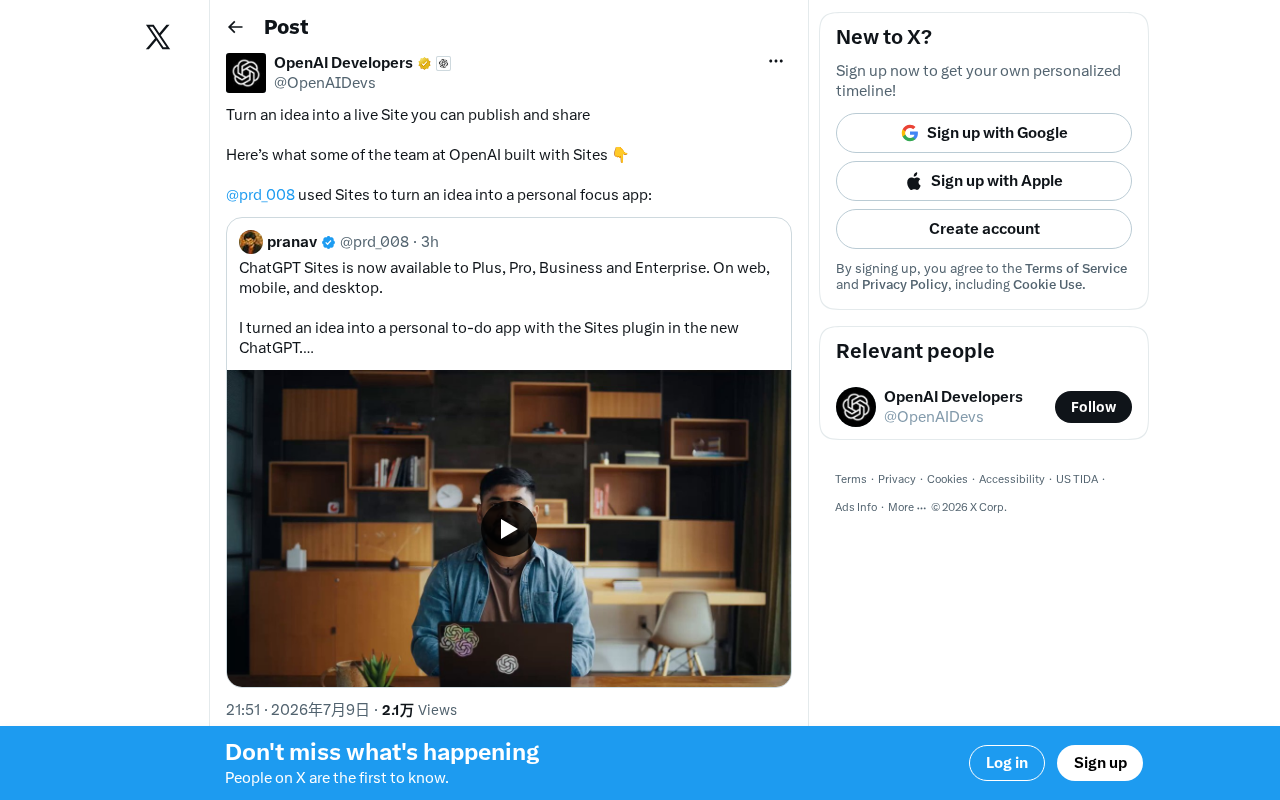
According to OpenAI's official demos, team members have already used Sites to build real-world examples. Notably, @prd_008 used it to create a personal focus app — which suggests Sites isn't just generating static landing pages, but can support lightweight apps with actual interactive logic.
The Core Idea: "Idea as Product"
Historically, turning an idea into a shareable website meant going through design, coding, debugging, and deployment — even with existing website builders, users still had to deal with template selection, content layout, and domain configuration. Sites aims to compress that entire pipeline: describe your intent, get a finished product, and receive a live URL ready to share.
This "idea → live site" path essentially connects AI generation with web publishing infrastructure, shrinking the validation cycle from days to minutes.
To truly appreciate this leap, it helps to look back at the long evolution of web publishing infrastructure. Getting a web app "live" has always involved several invisible layers: code must be hosted on a server, domain names must be resolved via DNS to server IP addresses, HTTPS certificates must be configured for secure transmission, and dynamic apps require backend runtimes and database support.
The journey from users manually purchasing physical servers, configuring Apache/Nginx, and uploading files via FTP, to AWS S3 and CloudFront enabling cloud-hosted static sites with global CDN acceleration, to platforms like Netlify and Vercel drastically lowering deployment barriers through Git integration and automated CI/CD pipelines — this has been decades of incremental evolution. Each step stripped away another layer of technical complexity: from "manage your own server" to "hand it off to a cloud platform," from "manual deployment" to "push code and it's live."
This evolution hasn't been a straight line — it's punctuated by paradigm shifts every several years: the rise of cloud computing around 2006 eliminated the need to purchase physical servers; the JAMstack philosophy around 2015 decoupled front and back ends and reduced deployment to a git push. JAMstack — JavaScript, APIs, and Markup — pre-builds static files, distributes them globally via CDN, and handles dynamic functionality through external API calls, balancing performance, security, and deployment simplicity. The emergence of AI-native tools represents a third paradigm shift. Sites represents the next node on this path: completely abstracting away the user's awareness of underlying infrastructure. Users don't need to understand hosting, CDN, or CI/CD at all — the AI tool handles every technical detail, presenting users with nothing more than an accessible URL. For individuals, product managers, and content creators looking to quickly validate ideas, this kind of immediacy is deeply compelling.
What Sites Can Do: From Landing Pages to Functional Apps
Based on information available so far, Sites' capabilities extend beyond traditional "website generators." The focus app built by @prd_008 indicates that Sites can produce outputs with real functional logic — not just text and image layouts.
A "personal focus app" typically involves interactive elements like timers, task management, and state tracking. From a technical standpoint, this kind of lightweight tool is entirely achievable with a pure front-end stack: JavaScript's setTimeout/setInterval for timer logic, localStorage or IndexedDB for local data persistence, and Service Workers for offline support.
It's worth understanding just how far modern browser APIs have come — far beyond what most users realize. localStorage can persistently store up to 5–10MB of structured data after a tab is closed; IndexedDB supports more complex transactional database operations with theoretical storage limits up to 50% of device disk space; and Service Workers, running as independent background threads in the browser, can enable offline caching, intercept network requests, and push notifications — giving pure front-end apps an experience close to native apps. This combination is known as PWA (Progressive Web App).
The PWA standard was first proposed by Google engineer Alex Russell in 2015. Its core value lies in allowing web apps to break free from browser tab constraints — gaining capabilities like "install to desktop," "offline availability," and "background push notifications" that were once exclusive to native apps, while retaining the web's natural cross-platform nature and app-store-free distribution. Companies like Twitter Lite, Pinterest, and Starbucks have demonstrated through their PWA implementations that on performance-constrained devices, PWAs significantly outperform traditional web pages in user retention and conversion rates.
These apps require no backend server and are naturally suited to AI generation and static hosting — which is a key technical prerequisite enabling Sites to quickly produce "functional applications." In scenarios that don't require databases or user authentication, modern browser APIs are more than capable, making it entirely feasible for Sites to generate such interactive apps.
If Sites can generate this kind of functional application with a single prompt, it's closer to a lightweight AI app-building platform than a simple website builder — aligning closely with the recently popular concept of vibe coding.
Vibe coding is a human-AI collaborative programming paradigm that emerged around 2025, first proposed and popularized by former OpenAI co-founder and Tesla AI director Andrej Karpathy. The core idea: developers don't write code line by line — instead, they describe intent in natural language, and an AI model automatically generates complete, runnable code. This is made possible by the maturity of large language models' code generation capabilities — models like GPT-4 and Claude have approached or exceeded average human performance on benchmarks like HumanEval, a standardized coding benchmark proposed by OpenAI containing 164 Python programming problems covering algorithms, string manipulation, and math. GitHub Copilot data also shows that developers accept AI-suggested code more than 30% of the time. From single-file completion to multi-file project scaffolding, the rapid maturation of code generation toolchains has moved vibe coding from concept to practice.
What's particularly significant is that vibe coding is reshaping how the industry thinks about talent. Traditional wisdom held that programming was a specialized skill requiring years of training, with software development's scarcity rooted in the limited number of engineers who could "write correctly functioning code." The vibe coding paradigm shifts that bottleneck from "ability to write code" to "ability to clearly articulate requirements" and "judgment to validate and iterate on results" — capabilities that more naturally belong to domain experts, product thinkers, and entrepreneurs. This means doctors, teachers, designers, and researchers could potentially translate their domain knowledge directly into working digital tools, without the lengthy communication and translation process that currently requires professional developers as intermediaries.
In this paradigm, users primarily act as "requirement describers" and "validators" rather than traditional line-by-line coders — which carries profound social implications for lowering the barriers to software development and freeing creativity from the constraint of "knowing how to code." Sites is essentially the productized implementation of vibe coding applied to web publishing: users describe the website they want, AI handles everything from code generation to live deployment, and throughout the process users deal only with intent — never implementation details.
How Sites Differs From Comparable Tools
The market already has a number of AI website and app generation tools — Vercel v0, Replit, Bolt, and others — collectively forming an emerging "AI-native developer tools" category. Vercel v0 focuses on generating front-end components and pages using a React/Next.js stack, with results deployable directly to Vercel, targeting developers with some front-end background. Replit Agent supports generating and running complete full-stack applications from natural language descriptions, with a broader target audience. Bolt (by StackBlitz) features a complete in-browser development environment supporting full project generation including dependency management and file systems.
OpenAI's biggest potential advantages with Sites are: the semantic understanding of its own models, ChatGPT's massive existing user base, and potential multimodal input capabilities. Thanks to GPT-4o's image understanding, Sites could theoretically accept hand-drawn sketches, design mockup screenshots, or reference website screenshots as input, converting them directly into runnable web applications. This image-to-code capability has solid technical precedent: Microsoft's Sketch2Code project demonstrated the feasibility of converting hand-drawn UI sketches to HTML code back in 2018; Stanford's pix2code model proved that generating front-end code directly from UI screenshots was achievable; and multiple open-source projects based on Vision-Language Models (VLMs) have since implemented conversion of Figma designs, Sketch files, and arbitrary UI screenshots into runnable React or Vue components.
The technical foundation for this image-to-code capability relies on VLMs' ability to understand UI layout semantics. Unlike general image description tasks, UI understanding requires models to simultaneously handle visual perception (recognizing the position and hierarchy of buttons, input fields, navigation bars, and other controls) and code generation (mapping visual structure to semantically correct HTML/CSS/JavaScript). GPT-4o's breakthrough in this area stems from training data that includes large volumes of paired UI screenshots and their corresponding code, enabling the model to understand fine-grained visual-semantic correspondences like "this rounded rectangle is a primary action button and should map to a <button> element with a primary style class."
For product managers, this means a whiteboard photo could be the starting point for a product prototype. If Sites can seamlessly invoke OpenAI's language and multimodal capabilities while handling hosting and publishing in one step, it would have a clear competitive advantage in delivering an "all-in-one experience."
That said, official information remains limited — technical implementation details, the complexity of applications it can support, and whether it's available to all users have yet to be fully disclosed.
Who Will Benefit From Sites
Sites targets a remarkably broad user base:
- Individual creators: Quickly build portfolios, personal pages, or small utilities;
- Product managers and entrepreneurs: Validate product ideas and build interactive prototypes at low cost;
- Non-technical users: People with ideas but no coding skills who want to produce usable results directly;
- Developers: Use it as a rapid prototyping tool to save time on boilerplate scaffolding.
This aligns with OpenAI's consistent product direction — making advanced AI capabilities accessible to as many ordinary users as possible, not just professional developers.
Key Questions and Future Outlook
Despite the exciting concept, several core questions deserve ongoing attention.
Capability ceiling: Building a focus app is one thing — supporting more complex application logic, data storage, and user authentication is another. The tool's real value ultimately depends on how large a scope of genuine needs it can handle.
Publishing and ownership: "Publishable and shareable" raises questions about hosting, domains, and data privacy. In the SaaS and low-code platform space, user data ownership and code export capability have always been central points of contention. This issue has deep historical roots: traditional website builders like Squarespace and Wix all have varying degrees of "vendor lock-in" — content, style configurations, and visitor data accumulated on these platforms are often difficult to migrate elsewhere. If a platform changes its pricing or shuts down, users face steep migration costs. This lock-in effect isn't unique to website builders — it's a structural feature of the SaaS business model: platforms increase retention through proprietary data formats, API restrictions, and migration barriers, but at the cost of users' long-term autonomy. Enterprise SaaS customers at Salesforce, HubSpot, and similar companies face similar challenges, which has fueled regulatory discussions around "data portability" — EU GDPR Article 20 explicitly grants users the right to data portability. In the website builder space, Webflow has earned notably higher regard among developers specifically because it offers HTML/CSS/JavaScript source code export, returning both "content ownership" and "technical ownership" to users.
For Sites, whether users can export the generated source code will directly determine its appeal to users seeking long-term control, and is a key differentiator from tools like Vercel v0. This question also touches on deeper business logic: if OpenAI opts for open code export, Sites becomes more of an "AI-assisted development starting point" — users see it as an accelerator rather than a dependency, building higher long-term trust but lower platform stickiness. If it opts for a closed hosting environment, user growth may be faster short-term, but it faces sustained criticism from the developer community and growing platform dependency risk as user scale increases. Given OpenAI's brand positioning and product philosophy, the former may better align with its long-term narrative of "empowering users."
If generated sites can only run within OpenAI's hosting environment with no export or migration option, users are essentially accepting a new form of platform dependency. If Sites supports full code export, it's closer to an "AI-assisted development starting point" than a closed content hosting service. Users' ability to control, export, and maintain generated content will directly affect its long-term viability.
Availability: Current demos have primarily come from OpenAI's internal team. When ordinary users will gain access, and in what form (free/paid, standalone product/integrated into ChatGPT), remains unknown.
Overall, Sites represents an important step in the evolution of AI tools from "generating content" to "generating usable products." As the cost of turning an idea into a live website approaches zero, the value of the idea itself will be further amplified. For anyone hoping to quickly bring inspiration to life, this is a direction well worth watching closely.
Related articles

Disaster and Glory of the Apollo Program: The History We Must Revisit Before Returning to the Moon
From the fatal Apollo 1 fire to Apollo 8's daring lunar orbit to Apollo 11's successful landing—revisiting the disasters, fears, and compromises of the Apollo program and their lessons for today's return to the Moon.

Netflix Trust Exercise Turns Into Firing Trap: Where Are the Boundaries of Corporate Trust?
A Netflix employee was fired after sharing private info in a trust exercise. We analyze the risks of corporate trust exercises and how employees can protect themselves.

AMD CDNA5 Architecture Deep Dive: Technical Evolution and the AI Computing Competition Landscape
Deep analysis of AMD's CDNA5 architecture covering Chiplet packaging upgrades, HBM memory evolution, and low-precision compute optimization, examining how AMD challenges NVIDIA's AI chip dominance.