Pi Agent Deep Dive: Four Core Advantages of a Minimalist Open-Source Framework

Pi is a 70K-star minimalist Agent framework offering lower token costs, deep customization, full transparency, and SDK embeddability.
Pi is a minimalist open-source Agent framework ranked 6th on OpenRouter's token-usage leaderboard, shipping with only 4 default tools and a sub-1,000-token system prompt. This article breaks down its four core advantages: significantly lower token costs vs. Claude Code, deep customization via skills and extensions, transparent execution that accelerates learning, and SDK support for embedding Agent capabilities into custom applications.
If you're already using AI Agents in your workflow, you've probably heard of Claude Code and Codex. But on OpenRouter's public Agent leaderboard ranked by token usage, there's another name sitting at number six — Pi.
OpenRouter is a unified LLM API routing platform that lets developers call models from OpenAI, Anthropic, Google, and dozens of other providers through a single interface. Its public token usage statistics are one of the few third-party data sources that objectively reflect real-world Agent usage at scale, making its leaderboard a meaningful reference.
Pi is a minimalist open-source Agent framework that ships with only four basic tools by default and a system prompt under 1,000 tokens. In less than a year, it has earned 70,000 stars on GitHub, and its core package was used in the early Agent runtime layer of OpenClaude. So with Claude Code and Codex already quite mature, why does Pi still deserve attention? This article analyzes its four core characteristics.
The Essential Difference Between a Product and a Framework
To understand Pi's value, you first need to distinguish between a "product" and a "framework."
Tools like Claude Code and Codex are more like products designed for general-purpose scenarios. They come pre-loaded with rich toolsets, safety mechanisms, and default rules — install and go. But these tools carry strong built-in opinions, and with each version update, they tend to get more bloated.
Pi is closer to a freely composable foundational framework — essentially a minimalist harness. A harness is the core orchestration layer in an Agent architecture, responsible for connecting a large model's reasoning capabilities to the outside world. It handles: constructing the context window for each model call (system prompt + tool definitions + message history), parsing tool call instructions returned by the model, dispatching actual tool execution, and injecting results back into the next round of context. The harness design directly determines token efficiency, execution reliability, and extensibility. If you think of the entire Agent as a car: the LLM is the engine, and the harness is the full vehicle system surrounding the engine — responsible for organizing context, providing tools, executing model-initiated actions, and returning results to the model.
Pi defaults to just four basic tools — read file, write file, edit file, and execute terminal commands — with a system prompt that's more than ten times shorter than comparable products. Its core philosophy can be summarized as: make Pi adapt to your way of working, not the other way around.
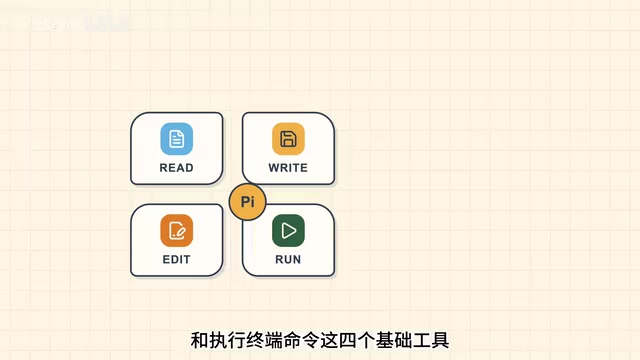
Advantage 1: Minimalist Design That Significantly Reduces Token Costs
What practical impact does this minimalist design have? The author ran multiple equal-condition tests comparing Pi and Claude Code using a Remotion video production skill: same model, same reasoning intensity, same task — then compared backend token consumption data.
The results are worth noting:
- Including cache, Pi averaged 2.82 million tokens vs. Claude Code's 5.52 million — Pi's cost is roughly 51% of Claude Code's
- Time-wise, Pi averaged 8.75 minutes vs. Claude Code's 11 minutes — a relatively modest time difference
- Video quality showed almost no meaningful difference, and Pi's output was sometimes better, with far fewer element-stacking issues
While the sample size is limited and doesn't cover all task types, this result reveals a pattern worth paying attention to: given the same underlying model and task, simply switching the harness can produce a significant difference in token consumption.
The reason is that every time a model is called, the Agent sends the system prompt, tool definitions, project rules, message history, and previous tool results simultaneously. Across multi-turn Agent tasks, these accumulate linearly or even exponentially. With Claude 3.5 Sonnet, for example, input tokens are billed at roughly three times the rate of output tokens, so redundant system prompts and tool definitions generate significant extra costs in long tasks. While the KV Cache mechanism can cache repeated prefix content, it requires the prefix to remain unchanged — the more concise the system prompt, the higher the cache hit rate. The more context there is, the more tokens re-enter the context window on each turn; and the longer the irrelevant context, the more the model's attention gets diluted, potentially degrading performance. Pi's author argues that current models have already undergone extensive programming and Agent training, so many baseline behaviors can be left entirely to the model — hence starting tasks with a lean prompt and minimal tools.
Advantage 2: Deep Customization — Skills and Extensions
Pi's second advantage is deep customization, offered at two levels: skills and extensions.
Skills: On-Demand Professional Playbooks
Skills are a mechanism used by nearly all Agent tools — they function more like on-demand professional playbooks. For example, a Remotion video production skill tells the Agent how to analyze a script, design storyboards, generate video, and validate the final result. Pi's runtime behavior itself stays the same; it simply loads the relevant methods and templates when it encounters a matching task.
The on-demand loading mechanism for skills is essentially a lightweight context injection strategy, closely related to the core idea of Retrieval-Augmented Generation (RAG): rather than stuffing all knowledge into a single super-long prompt, relevant content is dynamically retrieved and injected at runtime. The difference is that RAG typically targets unstructured knowledge bases, whereas skills are more like structured task operation manuals — containing domain-specific workflows, templates, and validation rules. This design keeps the base system prompt lean while still allowing the Agent to receive adequate domain guidance for specialized tasks.
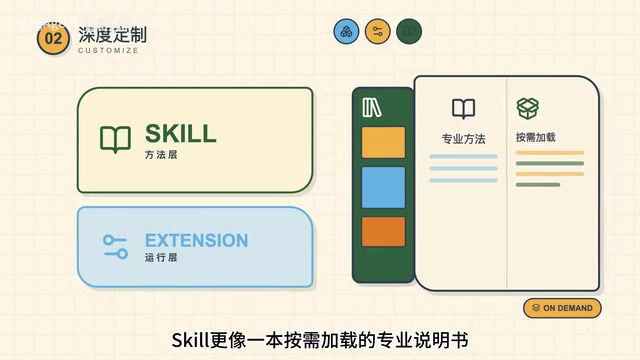
Extensions: Changing How the Agent Itself Operates
Extensions are one of Pi's more distinctive design choices. Extensions hook into Pi's runtime process via code, changing how it receives input, calls tools, displays status, or outputs results. They can add new tools, connect external services, modify the terminal interface, add permission confirmations for high-risk commands, or introduce entirely new interaction modes.
Pi's extension mechanism shares goals with Anthropic's MCP (Model Context Protocol) but operates at a different level. MCP is an open protocol that defines a standard communication format between models and external tools/data sources, focusing on tool interface interoperability. Pi's extensions, by contrast, are code hooks that directly intervene in the Agent's execution loop — capable of modifying input preprocessing, tool execution behavior, output rendering, and even the entire interaction mode, offering finer-grained control. The two are not mutually exclusive — Pi extensions could theoretically wrap MCP-compatible tools for unified scheduling.
In short: skills tell the Agent how to complete a specialized task; extensions change how the Agent itself operates.
Take Chinese voice interaction as an example: Pi doesn't have voice capabilities by default, but you can write an extension file that connects a local speech recognizer, a voice API, and the system audio player — implementing a complete workflow that reads folder contents, analyzes and summarizes them, and plays the summary as audio.
What's even more interesting is that extensions don't require you to write code yourself. You can simply tell Pi what feature you want to add, have it read its own extension documentation, and let it create and modify the extension — in other words, letting the Agent participate in building and modifying the Agent itself.
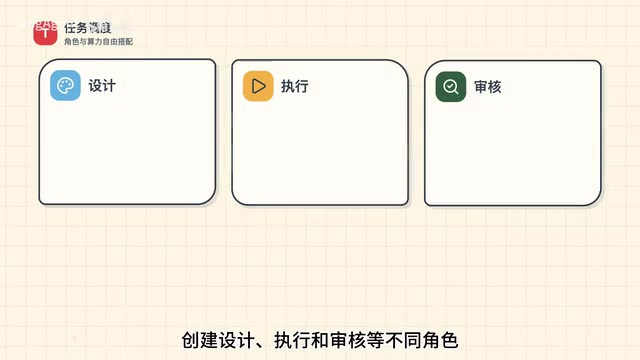
The sub-agent mechanism is another practical use case. The Sub-Agent mechanism is an engineering implementation of Multi-Agent Systems: the main Agent (Orchestrator) handles task planning and result integration, while sub-agents handle specific subtasks. Different sub-agents can be configured with different models, toolsets, and permission boundaries to balance cost, speed, and capability — for example, document review can use a lightweight model to reduce costs, while code generation calls a more capable reasoning model to ensure quality. Pi doesn't include sub-agents by default, but they can be flexibly implemented by installing an extension package: creating different roles like designer, executor, and reviewer based on the task, configuring different model tiers and reasoning intensities for each role, and even routing to models from different providers — simpler tasks go to faster, cheaper models, while complex tasks call stronger reasoning models.
Advantage 3: Transparent, Observable Execution That's Easier to Learn From
In Claude Code and Codex, tools, permissions, context management, and execution details are all packaged into a polished product, letting users focus on the task itself. Pi, on the other hand, makes it much easier to see the full execution logic of an Agent task:
- After the user inputs a task, the harness first organizes the system prompt, project rules, tool descriptions, and message history
- This is handed to the model, which decides to call a specific tool
- The harness executes the call, then returns the result to the model
- The model continues evaluating the next step, looping until the task is complete
Pi's code is fully open-source, making every step above inspectable; the core is lean enough that the overall structure is easy to understand; and the extension mechanism allows you to modify individual steps and verify the results through actual outcomes.
Once you internalize these fundamental relationships, picking up any other Agent tool becomes much easier: how to structure project rules, when to add a skill, why different configurations produce different results. This understanding transfers to Claude Code, Codex, and other Agent frameworks, raising your overall ceiling when working with Agents.

Advantage 4: SDK Integration — Embedding Agent Capabilities Into Your Own Applications
Pi's fourth advantage is SDK support: its core capabilities can run outside the terminal and be embedded directly into applications you build yourself.
Embedding an Agent framework as an SDK represents an "Agent as Infrastructure" architectural philosophy. Unlike standalone Agent tools, an SDK-based Agent core can be precisely controlled by the application layer: restricting available tools, injecting business context, intercepting sensitive operations, and feeding execution logs into existing monitoring systems. This is especially important for developers deploying Agent capabilities in production environments, where requirements for observability, permission boundaries, and error handling far exceed those of personal use.
For example, using web coding, you could build a custom tool from scratch and use Pi as its Agent engine under the hood. In other words, Pi can serve both as a ready-to-use Agent framework and as the Agent core inside your own application.
OpenClaude's early use of Pi-related core packages is a perfect illustration of this capability: a minimalist Agent core that can be further composed into more complex functionality like messaging channels, scheduled tasks, long-running processes, and multi-agent coordination.
Because Pi's core implementation (system prompt, tools, execution flow) is fully inspectable, developers can know exactly what the Agent sends to the model and precisely limit what operations the Agent can perform — effectively reducing uncertainty during integration.
How to Install and Get Started
Installing Pi is straightforward:
- Visit the official Pi website, copy the installation command for your local environment, and run it in your terminal
- Once installed, type
pito launch - Type
/loginto authenticate — you can use a subscription or API key (to connect DeepSeek, choose the API method and enter your key) - Use
/modelto select a model, andShift+Tabto adjust reasoning intensity
Important note: Pi's minimalist design does not include permission controls or operation confirmation by default. When first getting started, it's recommended to install a permission-protection extension that adds a second confirmation step before deleting files, executing high-risk commands, or accessing specific paths. Installing community extensions is equally straightforward — find the target extension on the official Package page, click the copy button, and run the install command in your terminal.
Should You Choose Pi or a More Mature Product?
Pi hands more control to the user, but also brings more configuration, debugging, and maintenance work. Use the following as a guide:
- If you value a complete, stable, out-of-the-box experience, Claude Code and Codex will be more hassle-free
- If you want to deeply understand how Agents work, or need personalized capabilities that off-the-shelf products can't cover, Pi offers much more room to explore
For developers who genuinely want to understand how Agents operate under the hood — or need to embed Agent capabilities into their own products — this minimalist open-source framework is worth serious study.
Key Takeaways
Related articles

The Truth Behind Codex 'Build a Website in 5 Minutes': AI Isn't Creating Sites—It's Helping You Copy Them
Exposing the truth behind viral Codex 5-minute website videos: creators aren't building original sites with AI—they're copying shared prompts or scraping others' work. Learn AI coding tools' real limits.

Getting Started with AI Agent Development: A Complete Guide from Concept to Practice
A comprehensive guide to AI Agent architecture and development, covering automated marketing, intelligent customer service, and investment analysis scenarios with single and multi-agent collaboration.

The Truth Behind Codex 'Build a Website in 5 Minutes': AI Isn't Creating Sites — It's Helping You Copy Them
Exposing the truth behind viral Codex 5-minute website videos: creators aren't building original sites with AI — they're copying shared prompts or scraping others' work.