Qwen3 Deep Dive: A Complete Look at the Open-Source Hybrid Reasoning Model
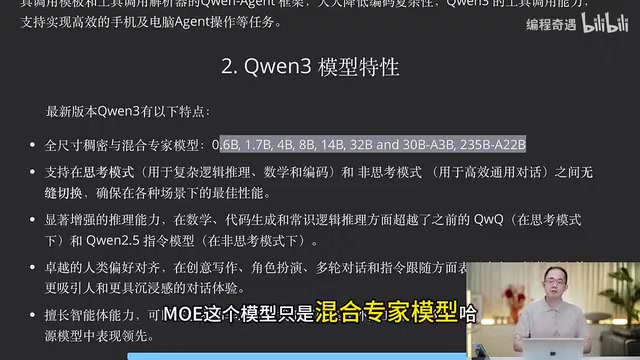
Qwen3 is Alibaba's open-source hybrid reasoning model series rivaling Gemini 2.5 Pro across 0.6B–235B sizes.
Qwen3, the fifth generation of Alibaba's Qwen series, launches six models from 0.6B to 235B using both Dense and MoE architectures. Its flagship 235B-A22B MoE model matches Gemini 2.5 Pro on key benchmarks, while Qwen3 becomes the world's first open-source hybrid reasoning model — seamlessly switching between fast conversational and deep Chain-of-Thought reasoning modes in a single deployment.
The Qwen Series: The "God of Open Source"
After six months, Alibaba's Qwen series has arrived at its fifth generation — Qwen3. Looking back over the past two years, from the first generation's promising debut to Qwen3 reaching the top tier of the open-source AI community, this journey of commitment to open source has been both challenging and impressive.
Since 2023, the large model landscape has split into two camps: one focused on closed-source online services, and the other committed to releasing open-source models. To understand this divide, we need to recall the industry context since 2022 — after ChatGPT ignited the AI boom, closed-source models (led by OpenAI's GPT series) operated through paid API access with no public weight releases, while open-source models made their weights publicly available for local deployment and fine-tuning, with core value propositions around data privacy, customizability, and zero marginal inference cost. For a long time, the open-source camp was overshadowed by online services — GPT-4's arrival left virtually no competition. But the landscape has shifted. The world's most capable model is still Gemini 2.5 Pro, yet Qwen3's largest flagship model can now go head-to-head with it.
The Open-Source Frontrunners After the Shakeout
Over two years, many teams that once worked shoulder-to-shoulder on open-source large models have faded from view: Llama stumbled, ChatGLM pivoted to online services, Baichuan went all-in on healthcare verticals, and Mistral has been quiet for some time. Today, in the open-source LLM space, Qwen3 stands out as one of the strongest contenders alongside DeepSeek. In terms of overall capability, Qwen3 has pulled ahead of DeepSeek V3 and R1, establishing itself as one of the most powerful open-source large language models available.
The Qwen series is known in the industry as the "God of Open Source." Its tradition isn't just releasing a single powerful flagship — it's delivering a complete, full-scale model family covering the entire application ecosystem. When Qwen2.5 launched with over a hundred different model variants all at once, the industry was genuinely stunned.
Six Models: Dense and MoE Running in Parallel
The Qwen3 series launches six model sizes, ranging from the smallest at 0.6B to the largest at 235B. Of the six, four use a Dense architecture and two use a MoE (Mixture of Experts) architecture.
- Dense models: The standard form of traditional Transformer neural networks. All parameters are activated during inference, making computation proportional to parameter count — straightforward and transparent in behavior.
- MoE models: Introduce a routing mechanism in the Feed-Forward layers, grouping parameters into multiple "expert" modules. During each inference pass, a routing network dynamically selects a small number of experts to activate while the rest remain dormant. This allows MoE models to maintain a massive total parameter count (boosting model capacity and knowledge storage) while keeping actual computation within a small range, dramatically reducing runtime overhead.
Following DeepSeek's industry-wide demonstration of MoE's potential, the architecture has gained broad recognition and an increasing number of models are moving in this direction.
Flagship Models: 32B Dense and 235B-A22B MoE
Qwen3's two strongest flagships are the 32B Dense model and the 235B-A22B MoE model.
- Qwen3-32B: A moderate parameter count, well-suited for enterprise-level deployment scenarios.
- Qwen3-235B-A22B: A total of approximately 235 billion parameters. The "A22B" stands for Activate, meaning roughly 22 billion parameters are actually activated per inference pass. In other words, despite the model's total parameter count of 235B, its actual inference cost is closer to that of a 22B Dense model — balancing knowledge capacity with computational efficiency.
This naming convention differs from DeepSeek 671B (which only lists total parameters). Qwen3 incorporates the activated parameter count directly into the model name, making it easy to estimate actual runtime costs. Smaller models (like 0.6B) are primarily aimed at lightweight use cases such as document retrieval, on-device mobile deployment, and in-browser execution, while larger models focus on complex enterprise applications.

According to official benchmarks, the 235B model delivers strong results on AIME math competition tests, LiveCodeBench coding evaluations, and several other metrics. Compared to Gemini 2.5 Pro, the results are mixed across dimensions — but overall, Qwen3 roughly matches this natively multimodal "all-rounder." That an open-source model can go toe-to-toe with Gemini 2.5 Pro is a remarkable achievement.
The World's First Open-Source Hybrid Reasoning Model
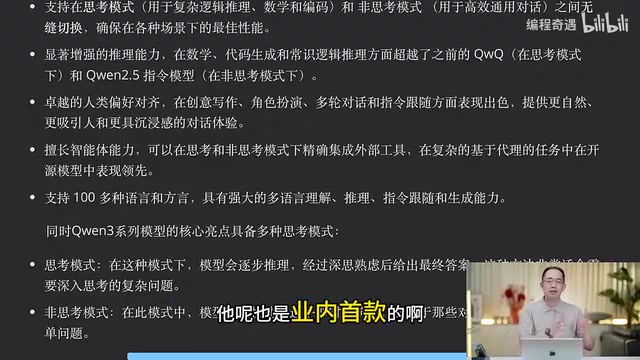
Qwen3's biggest technical highlight is its status as the world's first open-source hybrid reasoning model.
Today's large models fall into two main categories:
- Conversational models (e.g., GPT-4o, DeepSeek V3): Fast response times, strong at text writing, translation, and similar tasks.
- Reasoning models (e.g., OpenAI o-series, DeepSeek R1): Built on Chain-of-Thought (CoT) technology, these models work through complex derivations in a "thinking space" before producing detailed answers. They excel at math, coding, and other tasks requiring deep analysis. This "slow thinking" paradigm was pushed to its limits by OpenAI's o1 model, which uses reinforcement learning to train extended reasoning chains.
Both types have weaknesses — reasoning models respond more slowly and inherently lack Function Calling capabilities, creating significant limitations when building AI agents and applications.
The Technical Evolution of Hybrid Reasoning
How to combine reasoning and conversational capabilities within a single model is a core challenge in the field. The difficulty lies in the "Mode Collapse" problem — models tend to apply the same response strategy across all tasks, either over-thinking simple questions with lengthy derivations or losing deep reasoning ability and degrading into a standard conversational model. Solving this requires careful tuning of training data ratios, reinforcement learning reward function design, and mode recognition mechanisms at inference time.
OpenAI chose to develop the two types of models separately (the o-series for reasoning, GPT-series for conversation), and the merged approach has yet to succeed. The first true hybrid reasoning model in the industry was Claude 3.7, which allows switching between reasoning and conversational modes via parameter settings. Before that, this capability remained exclusively in the hands of closed-source providers. Qwen3 making this capability open source represents a significant leap forward for the open-source ecosystem.
How Hybrid Reasoning Works
At its technical core, large models are sequence models that output text token by token — they don't inherently distinguish between "reasoning" and "conversation." But by introducing two distinct dataset types marked with special tokens during training, models can learn fundamentally different response patterns.
Specifically:
- Reasoning training text includes
<think>markers, teaching the model to develop a thought process before producing output. Thinking content generated during inference is wrapped in this special token, allowing users to view the full reasoning chain or retrieve only the final answer. - Standard conversational text omits this marker, teaching the model to respond directly in appropriate contexts.
This is similar to how Function Calling works — by mixing ordinary Q&A data with tool-calling data, the model gains the flexibility to switch between modes. It's worth noting that pure reasoning models often produce unstable formatting when generating structured tool-call instructions, because their training objective favors free-form reasoning over structured output. Qwen3's hybrid training addresses this issue simultaneously, enabling the model to reason deeply while reliably invoking external tools.

The theory is clear; the execution is extremely difficult. Knowing that different dataset types yield different capabilities, and actually training a high-performance hybrid reasoning model, are separated by an enormous gap. Qwen3 has genuinely bridged it.
A Seamless Mode-Switching Experience
In practice, Qwen3's hybrid reasoning performs remarkably smoothly. Beyond switching modes via inference framework parameters, it also supports soft prompting — simply including keywords like no thinking in your input, and the model automatically enters the corresponding Q&A or thinking mode. The transition feels entirely natural.
Soft prompting works because these keywords were associated with specific behavioral patterns during training as part of the Instruction Following training objective. Users don't need to understand API parameter details — they can simply express their needs in natural language to get the desired response mode, making this extremely user-friendly for end users.
The deeper value lies here: enterprises or developers only need to deploy a single model to gain both response capabilities, significantly reducing deployment costs and operational complexity. Official data also confirms the performance gains from enabling reasoning mode — the more thorough the thinking steps, the higher the answer quality, consistent with the fundamental pattern seen across all reasoning models.
Small Models Hold Their Own
Beyond the flagship, Qwen3's smaller models are not to be overlooked. Take the 30B-A3B MoE model and the Qwen3-4B Dense model as examples — even a lightweight 4B model is competitive with DeepSeek V3 or GPT-4o on several reasoning benchmarks. This means Qwen3 delivers real-world deployment value across the full spectrum, from edge devices to the cloud.
Conclusion
The launch of Qwen3 represents not only the fifth generation of the Qwen series, but a significant milestone for the open-source large model community. A complete size matrix from 0.6B to 235B, flagship performance that matches Gemini 2.5 Pro, and a world-first open-source hybrid reasoning capability together make a powerful statement about what open-source models can achieve. Whether you're an independent developer looking to quickly build AI applications or an enterprise seeking a private deployment solution, Qwen3 offers a complete range of choices — from lightweight entry points to full-scale production deployment.
Related articles

The Truth Behind Codex 'Build a Website in 5 Minutes': AI Isn't Creating Sites—It's Helping You Copy Them
Exposing the truth behind viral Codex 5-minute website videos: creators aren't building original sites with AI—they're copying shared prompts or scraping others' work. Learn AI coding tools' real limits.

Getting Started with AI Agent Development: A Complete Guide from Concept to Practice
A comprehensive guide to AI Agent architecture and development, covering automated marketing, intelligent customer service, and investment analysis scenarios with single and multi-agent collaboration.

The Truth Behind Codex 'Build a Website in 5 Minutes': AI Isn't Creating Sites — It's Helping You Copy Them
Exposing the truth behind viral Codex 5-minute website videos: creators aren't building original sites with AI — they're copying shared prompts or scraping others' work.