Reinforcement Learning Drives AI Reasoning Evolution: From Imitator to True Thinker

RL and Self-Play are the core forces that break SFT's imitation ceiling and unlock deep reasoning in AI models.
SFT-trained models are constrained by an "imitation ceiling" and cannot achieve true autonomous reasoning. Breaking through requires three core mechanisms: RL guides models via reward/penalty feedback; Self-Play generates multiple candidate paths for self-reflection and correction; and Verifiers eliminate false reasoning during training to reduce hallucinations. Together, they drive models from System 1 intuition to System 2 deep reasoning.
Introduction: Breaking Through the SFT Ceiling
In the first two installments of this reasoning model training series, we covered the importance of SFT (Supervised Fine-Tuning) and Chain-of-Thought injection — high-quality labeled data is the foundation of reasoning ability. But here's the problem: models trained on labeled data are ultimately just imitating human logic, and they struggle to break through the ceiling set by the data itself.
The essence of SFT is training a model on human-annotated input-output pairs, teaching it to mimic the behavior patterns of annotators. This approach has a fundamental limitation known as the "Imitation Ceiling" — the model's performance is capped by the quality and diversity of the labeled data. Even when annotators are domain experts, their labeled data can only cover a limited range of reasoning patterns. More critically, SFT-trained models tend to learn surface-level mappings from input to output rather than truly understanding the causal logic underlying the reasoning process. This is why pure SFT models often exhibit "brittleness" on complex multi-step reasoning tasks — slightly rephrasing a question or adding more reasoning steps can cause accuracy to drop sharply.
For models to truly evolve and develop autonomous reasoning capabilities beyond mere imitation, they must enter the next critical stage: Reinforcement Learning (RL) and Self-Play. This is the core driving force behind the logical evolution of reasoning models, and the watershed moment that transforms a model from an "imitator" into a "thinker."
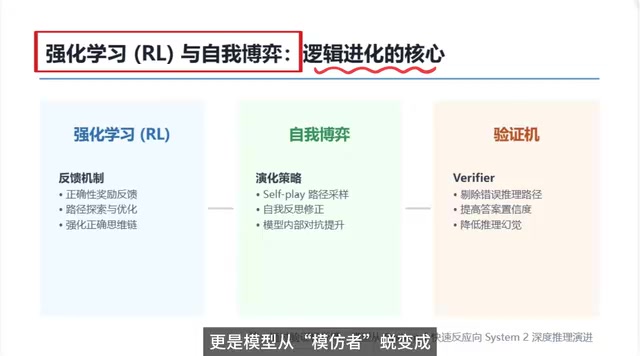
Reinforcement Learning: The Core Engine of Reasoning Training
RL Is Not Simple Fine-Tuning — It's a Professional Sparring Partner
The role reinforcement learning plays in reasoning training is fundamentally different from ordinary fine-tuning. Regular fine-tuning is more like "rote memorization" — the model sees an input and maps it to an output, with little capacity for flexible adaptation. Reinforcement learning, by contrast, acts more like a professional sparring coach, guiding the model to explore and evolve autonomously through a reward feedback mechanism.
Specifically, here's how the RL mechanism works:
- Positive rewards: Correct, rigorous, and logically coherent reasoning paths receive positive reinforcement
- Negative penalties: Chaotic, logically inconsistent, or erroneous reasoning chains are penalized
- Iterative reinforcement: Through continuous logical exploration and positive/negative feedback loops, the model gradually consolidates correct internal reasoning chains
Designing the Reward Function is one of the core challenges in RL-based reasoning training. Common approaches include Outcome-Based Rewards, which only evaluate whether the final answer is correct, and Process-Based Rewards, which score each individual step in the reasoning chain. OpenAI used a Process Reward Model (PRM) when training o1, enabling fine-grained evaluation of intermediate reasoning steps. Mainstream RL algorithms include PPO (Proximal Policy Optimization) and the more recent GRPO (Group Relative Policy Optimization), proposed by the DeepSeek team. GRPO computes rewards through within-group relative ranking, eliminating the need to train a separate Critic Model and significantly reducing training costs.
What makes this process elegant is that the model is no longer passively memorizing "correct answers" — instead, through repeated trial and error, it learns how to think and how to reason. Every correct reasoning path gets reinforced, every flawed logic gets corrected, and the model's reasoning ability advances one step further.
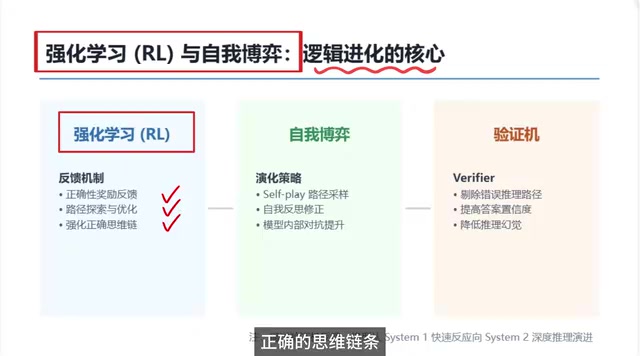
Self-Play: The Evolutionary Path of Playing Against Yourself
The Model Plays Chess Against Itself
Self-Play is another powerful tool for reasoning model evolution. Simply put, it means the model engages in a kind of internal sparring match with itself. This concept first gained widespread attention with AlphaGo and has since been introduced into large language model reasoning training, where it has demonstrated equally remarkable results.
The idea of self-play traces back to the intersection of game theory and reinforcement learning. In 2016, DeepMind's AlphaGo defeated the world champion by combining human game records with self-play. AlphaGo Zero in 2017 went even further — completely discarding human game records and surpassing all previous versions through self-play alone. In the large language model domain, self-play works differently: rather than competing against an "opponent," the model generates multiple candidate reasoning paths for the same problem (typically using higher sampling temperatures to increase diversity), then uses a reward model or verification mechanism to rank and filter these paths. This approach is also known as "Rejection Sampling" or the "Best-of-N" strategy. DeepSeek-R1's training process made extensive use of this self-play mechanism, enabling the model to exhibit emergent self-reflection capabilities on math and code reasoning tasks.
The core self-play workflow consists of four steps:
- Extensive path sampling: The model generates multiple different reasoning paths for the same problem
- Independent strategy construction: Without external annotation, the model independently formulates reasoning strategies
- Self-reflective verification: The model performs lateral comparison and evaluation across its own generated paths
- Self-correction: Upon identifying logical flaws, the model actively adjusts and optimizes its reasoning chain
This mechanism creates a self-adversarial, self-improving feedback loop within the model. The model continuously challenges itself with more complex logical scenarios, mining for more robust and deeper reasoning strategies. Just as a chess player sharpens their skills through self-play, the model continuously expands the boundaries of its reasoning capabilities.
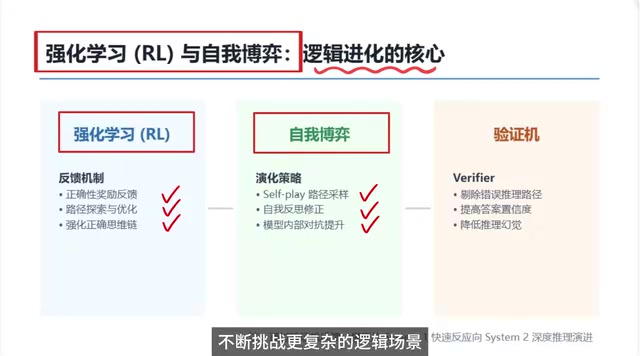
The Verifier: A Strict Judge of Reasoning Paths
Why Is the Verifier Indispensable?
There is one more indispensable role in the entire evolution pipeline — the Verifier. It acts like a strict professional referee, specifically responsible for distinguishing the authenticity and quality of reasoning paths.
Why is this role necessary? Because many model-generated reasoning processes sound convincing on the surface but are riddled with logical flaws — essentially "confidently talking nonsense." This is what the industry calls the "reasoning hallucination" problem — the model's output looks like reasoning in form, but doesn't hold up under scrutiny.
Reasoning hallucination is a more insidious problem than ordinary factual hallucination. A model may generate a reasoning chain that is perfectly formatted and professionally worded, yet contains logical leaps, circular arguments, or faulty premises. Verifiers are technically implemented in two main categories: Rule-Based Verifiers, which are suitable for scenarios with deterministic answers such as mathematical calculations and code execution, where correctness can be determined by running code or performing mathematical verification; and Model-Based Verifiers, which involve training a dedicated neural network to evaluate the quality of reasoning paths. OpenAI's Process Reward Model (PRM) falls into the latter category and has significantly improved reasoning accuracy on benchmarks like GSM8K. It's worth noting that verifiers themselves can be biased, which is why the field is also exploring more robust approaches such as multi-verifier ensembles and adversarial verification.
The core responsibilities of the verifier include:
- Filtering false reasoning: Identifying and removing reasoning paths that appear plausible but are logically unsound
- Reducing hallucinations at the source: Rather than patching the output, eliminating flawed logic during the training phase itself
- Quality control: Only reasoning paths that pass the verifier's review are retained
With the verifier acting as gatekeeper, the model's outputs are no longer a matter of luck — they become rigorously validated logical derivations.
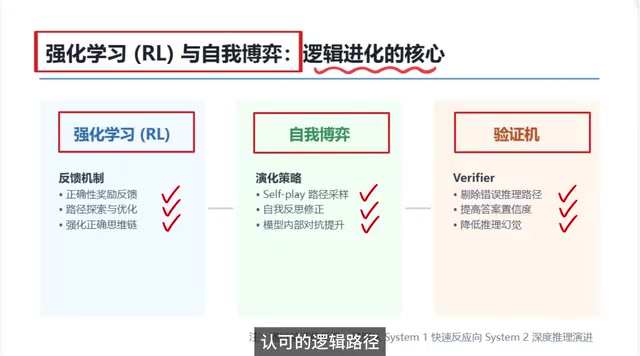
The Complete Loop: The Leap from System 1 to System 2
The Trinity of Feedback, Self-Play, and Verification
Putting these three core mechanisms together, the complete feedback loop of reasoning model evolution becomes clear:
| Mechanism | Role | Core Function |
|---|---|---|
| Reinforcement Learning (RL) | Sparring coach | Reinforces correct reasoning paths through reward/penalty feedback |
| Self-Play | Sparring partner | Explores superior reasoning strategies through self-adversarial play |
| Verifier | Professional referee | Identifies and filters false reasoning paths |
It is precisely through the complete loop formed by feedback, self-play, and verification that models can truly achieve a cognitive-level leap — evolving from a mode analogous to System 1 (fast, intuitive responses) in psychology, to System 2 (deep logical reasoning).
The concepts of System 1 and System 2 come from Nobel Prize-winning economist Daniel Kahneman's classic work Thinking, Fast and Slow. System 1 is fast, automatic, and intuitive — like recognizing a face or doing simple arithmetic. System 2 is slow, effortful, and requires focused attention for deep reasoning — like solving a complex math problem or constructing a logical argument. Traditional large language models (such as GPT-4 in standard inference mode) primarily operate in a System 1-like mode — generating answers directly through a single forward pass, with reasoning depth limited by the knowledge encoded in the model's parameters. Reasoning models like OpenAI o1 and DeepSeek-R1, by allocating more computational resources at inference time (i.e., "Test-Time Compute"), enable the model to engage in multi-step thinking, backtracking, and verification — essentially simulating the deep reasoning process of System 2. This leap from System 1 to System 2 is considered one of the key pathways toward AGI (Artificial General Intelligence).
This is not merely an improvement in performance metrics — it represents a fundamental paradigm shift in how the model thinks. The model is no longer just "quickly producing an answer that looks reasonable," but is instead capable of "thinking deeply, exploring multiple paths, and rigorously verifying before delivering an answer that stands up to scrutiny."
Coming Up Next
Now that we understand the underlying logic of reasoning training, the next question is: how does a model actually think and search during inference? The next installment will dive deep into the search mechanisms of Tree of Thought, examining how models perform multi-branch exploration and how they automatically backtrack and correct course when they go down the wrong path. Stay tuned.
Key Takeaways
- Reinforcement learning guides models to autonomously explore correct reasoning paths through reward/penalty feedback, rather than simply imitating labeled data
- Self-play enables models to form a self-improving loop through path sampling, self-reflection, and self-correction
- The verifier acts as a strict referee, filtering out false reasoning paths from the training phase itself and reducing reasoning hallucinations at the source
- The complete trinity of feedback, self-play, and verification drives models from System 1 fast intuition to System 2 deep reasoning
- SFT-trained models can only imitate human logic; RL and self-play are the keys to breaking through the reasoning ceiling
Related articles
Deep Dive into AI Agent Skill Design: …
Deep Dive into AI Agent Skill Design: Engineering Practices from Anthropic and Perplexity
A deep dive into Skill design philosophy from Anthropic's Claude Code team and Perplexity's Agent team, covering the Tax Test, Gotchas Flywheel, progressive disclosure, and Eval-First practices for building high-quality AI Agent skill systems.
Deep Dive into OpenAI's Official GPT-5…
Deep Dive into OpenAI's Official GPT-5.6 Prompting Guide: The Shift from Manual to Automatic
A deep dive into OpenAI's official GPT-5.6 Sol prompting guide: conciseness-first, outcome-oriented design, autonomy boundaries, tool routing, and reasoning intensity tuning.
 Deep Dives
Deep Dive into How OpenClaw (Open-Source Crayfish) AI Agent Works
Deep analysis of OpenClaw AI Agent internals: System Prompt, tool calling, SubAgents, Skill system, memory, and Context Engineering explained.