Ribbie: A Creative App That Turns MLB Live Data into Pixel Art Arcade Visuals

Ribbie turns MLB real-time game data into retro pixel art arcade-style live visuals.
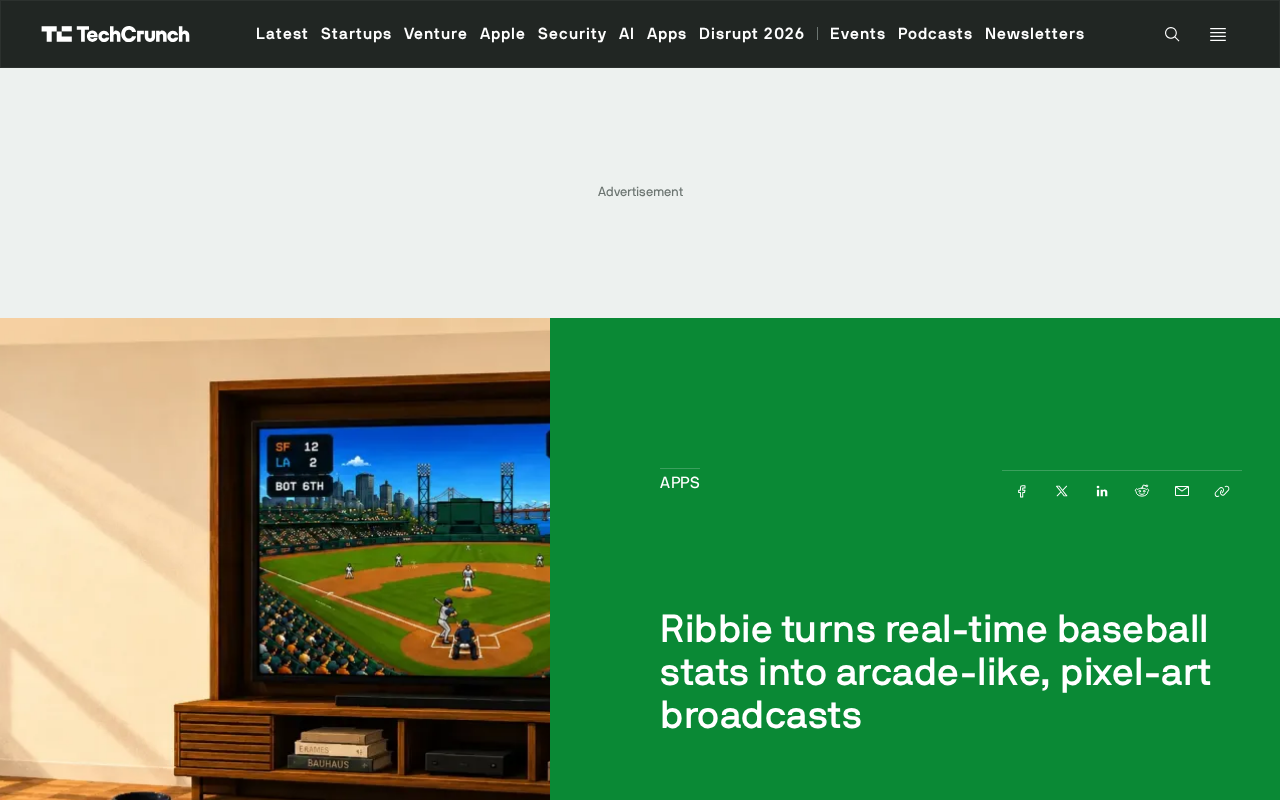
Ribbie is a creative app that transforms MLB live game data into pixel art arcade-style interfaces. By leveraging MLB's Stats API for real-time pitch-by-pitch data, it renders game progress as charming retro pixel animations. Designed for fans in low-bandwidth situations, retro gaming enthusiasts, and data-driven baseball lovers, Ribbie demonstrates how gamification and nostalgic aesthetics can make sports data visualization more engaging and accessible.
When Baseball Meets Pixel Art
If you're a baseball fan who also has a soft spot for retro gaming aesthetics, Ribbie might just catch your eye. This app transforms MLB (Major League Baseball) live game data into a delightful, arcade-style pixel art live interface.
The Fusion of Real-Time Data and Retro Aesthetics
Core Concept
Ribbie's design philosophy is truly unique — it's not a traditional video streaming tool. Instead, it presents real-time baseball statistics in pixel art form. Users can track MLB games in real time through an interface that feels like stepping into a classic arcade game.
Pixel art is a form of digital art where creators draw images pixel by pixel, with each pixel's color and position carefully designed. This art form originated during the 1970s–80s era of video games and computer graphics limitations, when hardware could only display limited resolutions and color palettes (such as the NES's 54-color palette or the Game Boy's 4-level grayscale), forcing developers to create visual expression under extreme constraints. As technology advanced, pixel art evolved from a technical limitation into a deliberate aesthetic choice. In recent years, it has experienced a strong revival in indie games (such as Celeste and Stardew Valley) and digital art communities, becoming an important medium for expressing nostalgia and minimalist aesthetics.
This design evokes memories of baseball video games from the 1980s and early 1990s — those classic visuals built from simple pixel grids depicting ballparks, players, and scoreboards. The history of baseball video games dates back to Atari's Home Run in 1978, but the true golden age began on the NES platform. Nintendo's Baseball, released in 1983, was among the console's first titles. Subsequent games like R.B.I. Baseball (1986), Base Wars (1991), and Ken Griffey Jr. Presents MLB (1994) defined the visual language of pixel baseball games — top-down ballparks, chibi-style player sprites, and flickering scoreboards. Constrained by 8-bit and 16-bit hardware, these games conveyed the core rhythm of baseball through clever pixel design, forming the collective memory of an entire generation of gamers. Ribbie combines this nostalgic aesthetic with modern real-time data streaming technology to create an entirely new way to follow games.
The Data Technology Behind It
Ribbie's ability to deliver real-time pixelated game visuals relies on MLB's robust data infrastructure. MLB boasts an industry-leading sports data system — its Statcast system has been deployed across all 30 ballparks since 2015, using high-speed cameras and the Hawk-Eye optical tracking system to capture ball spin rate, launch angle, exit velocity, as well as player sprint speed and running paths at hundreds of times per second. This data is made available through MLB's Stats API, allowing developers to access near-real-time pitch-by-pitch data, including pitch type, strike zone location, and hit outcomes. Ribbie is built on this type of API, transforming structured JSON data streams into pixel animation visuals.
Why Pixel-Style Data Presentation Is More Engaging
Traditional sports data displays tend to be dry numerical tables or standardized graphical interfaces. Ribbie breaks this convention, proving that data visualization doesn't have to take a serious approach. Wrapped in pixel art, otherwise cold statistics become lively and fun — watching game data itself becomes an entertainment experience.
This design philosophy aligns closely with the concept of gamification — a design methodology that applies game design elements to non-game contexts. Its core mechanisms include instant feedback, progress visualization, achievement systems, and aesthetic pleasure. In the sports domain, Fantasy Sports is one of gamification's most successful applications, with a global market size exceeding $20 billion. Ribbie's innovation lies in applying gamification to the "watching" rather than "participating" aspect of sports, transforming passive data consumption into active visual enjoyment through arcade aesthetics. This design approach aligns with the recent popularity trend of "cozy games."
Ribbie's Product Positioning and Use Cases
Target Audience
- Situations where video streaming isn't available: At the office, during commutes, or when network conditions are poor, Ribbie offers a low-bandwidth, high-fun way to follow games
- Retro gaming enthusiasts: Users who have a passion for pixel art and arcade-style aesthetics
- Data-driven fans: Hardcore baseball fans who care more about game statistics than visual broadcasts
Arcade-Style Interface Design Highlights
Ribbie employs an "arcade-inspired" interface design language, meaning the entire interactive experience simulates the visual style of classic arcade games. From color schemes to animation effects, every detail pays homage to the golden age of pixel gaming. Arcade game visual design follows its own unique principles: high-contrast color combinations ensure readability under various lighting conditions, exaggerated animation frames convey the power of action, and limited screen space forces designers to refine information hierarchy to the extreme. These principles are cleverly translated into data display design standards in Ribbie — important data is highlighted with accent colors, key game moments are accompanied by exaggerated pixel animations, and complex statistical information is progressively revealed through layered interfaces.
Implications for the Sports Data Visualization Industry
New Approaches to Data Visualization
Ribbie's emergence offers some valuable insights for the sports tech and data visualization fields. In the age of AI and big data, we have access to massive amounts of real-time data, but how to make that data engaging and easy to consume remains a direction worth exploring.
Sports data visualization has evolved from paper stat sheets to digital dashboards to immersive experiences. Early iterations like ESPN GameCast and Yahoo Sports text-based live updates represented the first generation of real-time data presentation. Companies like Second Spectrum then introduced real-time tactical analysis overlays based on computer vision. Today, AR/VR technology and generative AI are driving the next generation of experiences. However, the field has long suffered from a "data overload" problem — too many statistical metrics actually reduce casual viewer engagement. Ribbie's pixel-simplified strategy is effectively a counter-response to this trend, enhancing user experience by reducing information density and increasing emotional connection.
Introducing gamification elements into data presentation not only boosts user engagement but also reaches younger audiences who may not be interested in traditional sports broadcasts. This cross-disciplinary approach could potentially extend to other sports or even non-sports real-time data displays.
The "Small but Beautiful" Product Philosophy
Ribbie also represents a "small but beautiful" product philosophy — it doesn't try to replace traditional broadcasts but instead provides unique value in a niche scenario. This product strategy, focused on specific user groups and use cases, can actually stand out more easily in today's fiercely competitive app market. In the indie developer ecosystem, this strategy is a practical application of the "1,000 True Fans" theory — rather than chasing millions of users, it's better to deeply serve a passionate niche community, building loyalty and word-of-mouth through an exceptional product experience.
Key Takeaways
Related articles

The Truth Behind Codex 'Build a Website in 5 Minutes': AI Isn't Creating Sites—It's Helping You Copy Them
Exposing the truth behind viral Codex 5-minute website videos: creators aren't building original sites with AI—they're copying shared prompts or scraping others' work. Learn AI coding tools' real limits.

Getting Started with AI Agent Development: A Complete Guide from Concept to Practice
A comprehensive guide to AI Agent architecture and development, covering automated marketing, intelligent customer service, and investment analysis scenarios with single and multi-agent collaboration.

The Truth Behind Codex 'Build a Website in 5 Minutes': AI Isn't Creating Sites — It's Helping You Copy Them
Exposing the truth behind viral Codex 5-minute website videos: creators aren't building original sites with AI — they're copying shared prompts or scraping others' work.