Seedcamp Raises $320 Million to Enter the U.S.: A Veteran European VC's Transatlantic Expansion

Seedcamp raises $320M to expand from Europe into the U.S., marking a major transatlantic VC shift.
European early-stage VC firm Seedcamp has raised a $320 million fund to formally enter the U.S. market after 18 years focused on Europe. Driven by the AI boom and converging transatlantic startup ecosystems, the move intensifies competition in U.S. seed investing while signaling deeper cross-border collaboration between European and American tech communities.
After 18 Years in Europe, Seedcamp Sets Its Sights on America
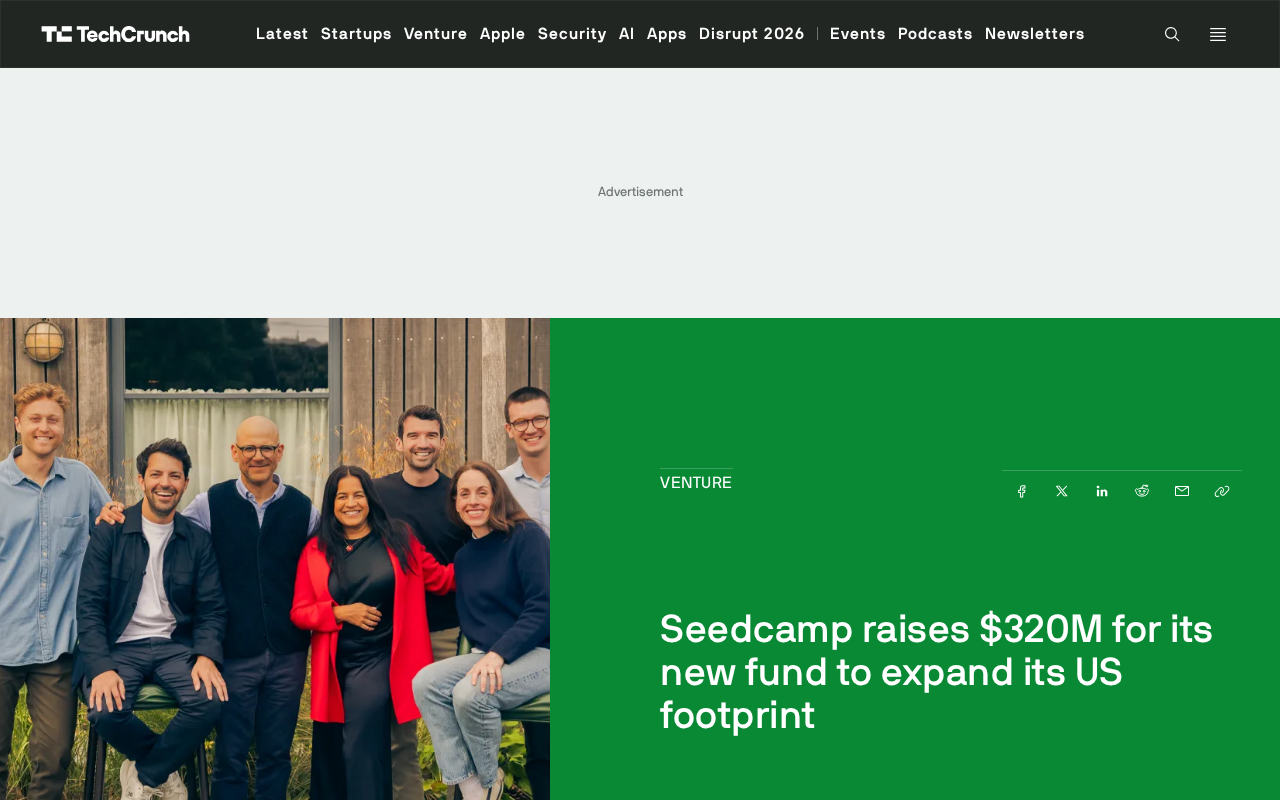
Seedcamp, one of Europe's most prominent early-stage investment firms, recently announced that its latest fund has successfully raised $320 million (approximately £255 million), which will be used to significantly expand its presence in the U.S. market. This marks the official launch of a transatlantic expansion strategy for the veteran venture capital firm that has focused exclusively on Europe for 18 years.
Who Is Seedcamp? A Benchmark Institution in European Early-Stage Investing
Seedcamp has been operating for 18 years and has long been one of the most influential investment firms in Europe's early-stage startup ecosystem. As a specialist investor in seed and early-stage rounds, Seedcamp has built a deep brand reputation and extensive investment network within the European tech startup community.
A Seed Round is the earliest institutional fundraising stage in a startup's financing lifecycle, typically occurring when a company has only a product prototype or early user validation. Seed round investment amounts generally range from $500,000 to $5 million, with investors typically acquiring 10%-20% equity. Unlike later-stage investments, seed round investments carry extremely high risk — statistics show that approximately 60%-70% of seed-funded projects ultimately fail to generate returns for investors. However, successful seed investments can yield extraordinary multiples, with top-performing seed funds achieving 10x or even tens of times overall fund returns.
The firm is renowned for discovering and backing Europe's most promising startups, with a portfolio that includes numerous companies that later grew into unicorns. Since its founding in 2007, Seedcamp has invested in over 500 startups, including several that went on to achieve valuations exceeding $1 billion. Its most notable investments include: Wise (formerly TransferWise, which listed on the London Stock Exchange in 2021 with a market cap that briefly exceeded $11 billion), Revolut (one of Europe's highest-valued fintech companies), and UiPath (a leader in robotic process automation that went public on the NYSE in 2021). These success stories have not only delivered substantial returns for Seedcamp's LPs but also cemented its position as a benchmark in European early-stage investing.
The $320 million size of this new fund also reflects the high confidence that LPs (Limited Partners) have in its investment strategy and historical returns. LPs are the capital providers of venture capital funds, typically including pension funds, university endowments, sovereign wealth funds, family offices, and insurance companies. LPs entrust their capital to GPs (General Partners — the fund management team) for investment decisions and management. The fundraising process typically takes 6-18 months, during which GPs must demonstrate their track record, investment strategy, and team capabilities to potential LPs. A $320 million fund size is considered large for a seed-stage fund, indicating that Seedcamp has earned an exceptionally high level of trust from the LP community.
Why Enter the U.S. Market Now?
The AI Wave Is Reshaping the Global Investment Landscape
The center of gravity in global tech investment is undergoing a profound shift driven by the AI wave. As the core hub for AI research, development, and commercialization, the United States concentrates top-tier talent, cutting-edge technology, and abundant capital. For any early-stage investment firm seeking to remain competitive in the AI era, establishing a presence in the U.S. has become a strategic imperative.
The U.S. early-stage AI investment market is currently dominated by several top-tier firms, including Andreessen Horowitz (a16z), Sequoia Capital, and Lightspeed Venture Partners, as well as AI-focused funds that have emerged in recent years. In 2024, total venture capital investment in U.S. AI is expected to exceed $70 billion, with early-stage investments accounting for approximately 30%. Silicon Valley, New York, and Boston are the three most active cities for AI startups. By entering this market, Seedcamp faces not only well-capitalized local competitors but also needs to build connections with the talent spillover ecosystems of top U.S. AI research institutions (such as Stanford and MIT) and tech giants (such as Google and Meta).
The European and American Startup Ecosystems Are Converging
In recent years, an increasing number of European founders have chosen to establish headquarters in the U.S. or adopt a dual-headquarters model to access larger markets and richer funding channels. The dual headquarters model is an organizational structure that European tech companies have increasingly adopted in recent years. The typical approach is to keep engineering and product teams in Europe (leveraging relatively lower talent costs and a high-quality technical talent pool) while establishing a business development and go-to-market headquarters in the U.S. (usually New York or San Francisco). This model has emerged for multiple reasons: the U.S. market accounts for over 50% of global enterprise software spending; American investors prefer to invest in companies with a local presence; and U.S. customers favor localized services. European tech giants such as Stripe, Klarna, and Checkout.com have all adopted similar transatlantic strategies.
Seedcamp's move can also be seen as following in the footsteps of its portfolio companies — by building a localized team and network in the U.S., it can better support startups with transatlantic growth ambitions.
What Does Seedcamp's U.S. Entry Mean for the Industry?
Intensifying Competition in Early-Stage Investing
Seedcamp's entry into the U.S. market introduces a new variable into an already fiercely competitive early-stage investment landscape. Leveraging its unique perspective accumulated in Europe and cross-border investment experience, Seedcamp is well-positioned to carve out a differentiated niche in the U.S. market — particularly among startups with potential in both European and American markets.
Closer Transatlantic Startup Collaboration
From a broader perspective, Seedcamp's expansion also reflects an important trend in the global venture capital industry: geographic boundaries are becoming increasingly blurred. European firms entering the U.S. and American capital penetrating deeper into Europe — this bidirectional flow is accelerating the interconnection of global startup ecosystems.
For founders, this means more diversified funding options and a broader international support network. For the industry as a whole, the proliferation of cross-regional investment firms helps promote the spread of best practices and the optimal allocation of innovation resources.
Conclusion
The $320 million new fund is not only a significant milestone in Seedcamp's history but also a microcosm of European VC firms' global expansion strategies. Against the backdrop of AI technology reshaping the global tech landscape, whether Seedcamp can successfully establish a firm foothold in the U.S. market will be a critical test of its strategic vision and execution capabilities.
Key Takeaways
Related articles

Disaster and Glory of the Apollo Program: The History We Must Revisit Before Returning to the Moon
From the fatal Apollo 1 fire to Apollo 8's daring lunar orbit to Apollo 11's successful landing—revisiting the disasters, fears, and compromises of the Apollo program and their lessons for today's return to the Moon.
Netflix Trust Exercise Turns Into Firing Trap: Where Are the Boundaries of Corporate Trust?
A Netflix employee was fired after sharing private info in a trust exercise. We analyze the risks of corporate trust exercises and how employees can protect themselves.

AMD CDNA5 Architecture Deep Dive: Technical Evolution and the AI Computing Competition Landscape
Deep analysis of AMD's CDNA5 architecture covering Chiplet packaging upgrades, HBM memory evolution, and low-precision compute optimization, examining how AMD challenges NVIDIA's AI chip dominance.