Self-Hosted AI vs. Cloud Services? Microsoft CEO's Warning on Data Sovereignty

Satya Nadella warns: using cloud AI means paying twice — with money and your proprietary knowledge.
Microsoft CEO Satya Nadella highlights a hidden cost of cloud AI: to get useful results, businesses must continuously feed proprietary knowledge into third-party systems, risking data loss and potential competitive harm. This article examines the data sovereignty risks of cloud AI, the limits of 'no training' guarantees, and why self-hosted open-source AI is becoming a serious strategic alternative.
The Hidden Cost of AI That Most People Ignore
When businesses and individuals embrace cloud-based AI services, they tend to fixate on subscription fees and API call costs. But a far more insidious — and potentially far more expensive — price tag goes largely unnoticed: the proprietary knowledge you're required to hand over.
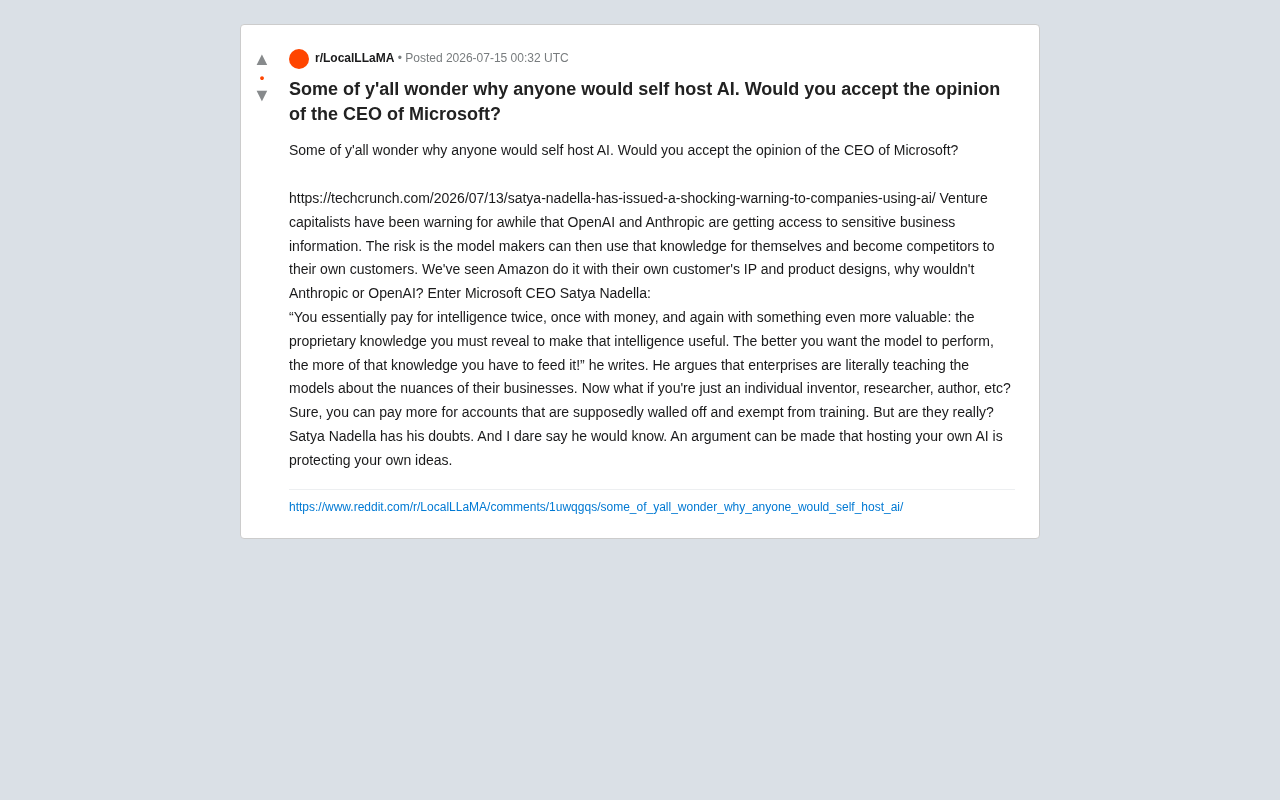
Recently, a discussion citing Microsoft CEO Satya Nadella's views sparked heated debate on Reddit. Nadella cut straight to the core contradiction in how AI is being used today:
"You're essentially paying for intelligence twice — once with money, and once with something far more valuable: the proprietary knowledge you must reveal to make that intelligence actually useful. The better you want the model to perform, the more of that knowledge you have to feed it!"
This statement exposes a truth the industry has quietly downplayed: to make AI truly understand your business, your products, and your unique workflows, you have no choice but to continuously feed your core secrets into the model provider's systems.
Your Data May Be Training Tomorrow's Competitors
The Real Logic Behind Paying Twice
Nadella's argument reveals a brutal logical chain: model performance scales with the amount of data you feed it. In pursuit of more precise, context-aware AI outputs, businesses continuously pump in operational details, customer data, internal processes, and even strategic plans. This process essentially "trains" the model, gradually giving it a nuanced understanding of your industry's inner workings.
To understand why enterprises must keep "feeding" the model, it helps to know the two dominant AI customization approaches. The first is Retrieval-Augmented Generation (RAG): before generating a response, the system retrieves relevant document snippets from the company's private knowledge base and injects them as context into the prompt. This means every query sends fragments of internal documents to the model provider's servers. The second is Fine-tuning: companies upload their own labeled data, conversation samples, or domain-specific corpora directly to the provider's platform to adjust the base model's parameters and make it more aligned with specific business needs. Both approaches structurally funnel enterprise knowledge outward — the former as a real-time stream, the latter as a one-time transfer. When Nadella says "feed it more knowledge," these are the two pipelines he's describing.
The problem: once that knowledge enters the provider's system, you no longer control it.
The Cautionary Tale of Platforms Turning Competitor
The discussion surfaced one particularly compelling case study — Amazon. The e-commerce giant was reportedly caught using third-party sellers' sales data and product information to launch its own private-label products, competing directly with the very merchants on its platform. Playing both referee and player is hardly a new phenomenon.
The Amazon seller data incident is not an isolated case. Academics call this the "Platform Paradox" or the "Complementor's Dilemma": while platforms attract third parties to create value, they simultaneously accumulate the leverage to eventually replace them. Historical examples abound: Microsoft used bundled Internet Explorer to squeeze Netscape out of the browser market; Apple's App Store has repeatedly been accused of cloning popular independent apps; Google consistently prioritizes its own services in search results.
The platform paradox in AI is more insidiously destructive — what enterprises hand over isn't just sales data, but industry know-how refined through human intelligence: pricing logic, customer profiles, production workflows, R&D direction. The knowledge density here far exceeds that of raw transaction records. Once in possession of it, a platform gains the ability to replicate entire industry competitive advantages at near-zero marginal cost.
So what exactly prevents OpenAI, Anthropic, and other AI companies — sitting on vast troves of corporate secrets — from walking the same path? Venture capitalists have already sounded the alarm: model makers are accumulating sensitive business knowledge, and they have every capability to leverage it for their own benefit, ultimately becoming their customers' competitors.
Can Paid "Data Isolation" Plans Really Be Trusted?
Some push back: don't enterprise accounts promise that data won't be used for training?
This is indeed the standard line from major AI vendors. OpenAI, Anthropic, and others all offer paid "data isolation" plans, claiming that user inputs won't be incorporated into training datasets.
However, the promise of "data not used for training" contains multiple technical ambiguities. First, the boundaries of data usage are difficult to define: even if raw inputs aren't added to the training set, providers may still use interaction metadata — query patterns, feature usage frequency — for product optimization. Second, Model Distillation makes knowledge transfer even more covert: by having a smaller model learn from a larger model's output distribution, knowledge can be extracted and compressed without direct access to the original data. The legal landscape is equally riddled with loopholes: U.S. data protection regulations are far more permissive than the EU's GDPR, and vague language like "improving our services" in terms of service agreements leaves ample room for interpretation. Multiple class-action lawsuits filed against AI companies in 2023 have already revealed that "no training" pledges are nearly impossible to audit or enforce in court.
Nadella himself is skeptical of these assurances — and as the head of Microsoft, he has more industry insight than virtually anyone. The fundamental dilemma here is the unverifiability of trust:
- You cannot truly audit a provider's internal data flows
- Contract terms contain interpretive wiggle room and exceptions
- Business policies can shift at any time under commercial pressure
- Once data is leaked, the damage cannot be undone
For individual inventors, independent researchers, and creators, this risk is particularly acute. Their core assets are often unpublished ideas, manuscripts, or research findings. Feeding these into a black-box system is tantamount to surrendering your most vital assets.
Self-Hosted AI: From Hobbyist Tech to Strategic Defense
The New Logic of Data Sovereignty
It's against this backdrop that "self-hosting AI" has evolved from a niche pursuit in tech circles into a carefully considered strategic choice. When you deploy an open-source large language model in a local or private environment, the greatest value you gain isn't cost savings — it's complete control over your data.
Your proprietary knowledge never leaves your own servers. It never becomes training material for any third party. And it never ends up as a weapon in a competitor's hands.
Real Trade-offs and Practical Considerations
Of course, self-hosting AI comes with its own costs, including:
- Hardware investment, especially GPU resources
- Technical operations and maintenance capacity
- A potential performance gap compared to top-tier closed-source models
That said, the technical feasibility of local AI deployment has undergone a qualitative shift over the past two years. On the model front: Meta's Llama series (latest: Llama 3.1, supporting up to 405B parameters), Alibaba's Qwen2.5, DeepSeek-V3, and other open-source models have matched or even surpassed certain closed-source commercial models on multiple benchmarks — and are freely available to download. On the inference framework front: llama.cpp uses CPU quantized inference to bring the barrier down to consumer-grade hardware; Ollama provides one-click local model management; LM Studio offers a graphical interface for non-technical users. On the application integration front: frameworks like LangChain and LlamaIndex support quickly connecting local models to RAG pipelines and agent workflows, with minimal switching costs compared to cloud APIs. On the hardware front: a Mac Mini M4 with Apple Silicon GPU acceleration ($500) can smoothly run 70B quantized models, while an NVIDIA RTX 4090 ($1,500) can handle higher-precision local inference tasks — significantly lowering the hardware barrier for enterprise-grade private deployment.
As open-source models like Llama, Qwen, and DeepSeek rapidly improve in capability, and as local inference tools like Ollama and LM Studio mature, the barrier to self-hosting continues to fall. For organizations and individuals who genuinely care about data sovereignty, the calculus is becoming increasingly favorable.
Whoever Controls the Knowledge Controls the Future
What makes Nadella's warning so striking is precisely who it comes from — one of the greatest beneficiaries of the AI wave. When even Microsoft's CEO is cautioning people about the hidden cost of "trading knowledge for intelligence," perhaps it's time for all of us to reexamine our relationship with cloud AI services.
The most valuable resource in the AI era isn't compute power — it's knowledge itself. Before you hand over your unique, proprietary knowledge to a model, ask yourself: are you willing to train a system that may one day become your competitor?
For a growing number of users, the answer is pointing in one direction — keep AI within your own control.
Key Takeaways
Related articles

Disaster and Glory of the Apollo Program: The History We Must Revisit Before Returning to the Moon
From the fatal Apollo 1 fire to Apollo 8's daring lunar orbit to Apollo 11's successful landing—revisiting the disasters, fears, and compromises of the Apollo program and their lessons for today's return to the Moon.
Netflix Trust Exercise Turns Into Firing Trap: Where Are the Boundaries of Corporate Trust?
A Netflix employee was fired after sharing private info in a trust exercise. We analyze the risks of corporate trust exercises and how employees can protect themselves.

AMD CDNA5 Architecture Deep Dive: Technical Evolution and the AI Computing Competition Landscape
Deep analysis of AMD's CDNA5 architecture covering Chiplet packaging upgrades, HBM memory evolution, and low-precision compute optimization, examining how AMD challenges NVIDIA's AI chip dominance.