shadcn/ui Major Update Incoming: What Changes Could It Bring?

shadcn/ui teases a major change — here's what it could mean for your projects.
shadcn/ui has announced a major upcoming change with no details disclosed, sparking wide discussion in the frontend community. This article covers shadcn/ui's unique copy-paste distribution model, its Radix UI and Tailwind CSS foundations, and the most likely directions for the update — including a Tailwind CSS v4 migration, Registry restructuring, or expanded framework support.
A Brief Teaser That Sparked Community-Wide Discussion
The widely beloved open-source component library shadcn/ui recently posted a short but loaded teaser on Twitter:
"We are going to make one big change to shadcn/ui this week."
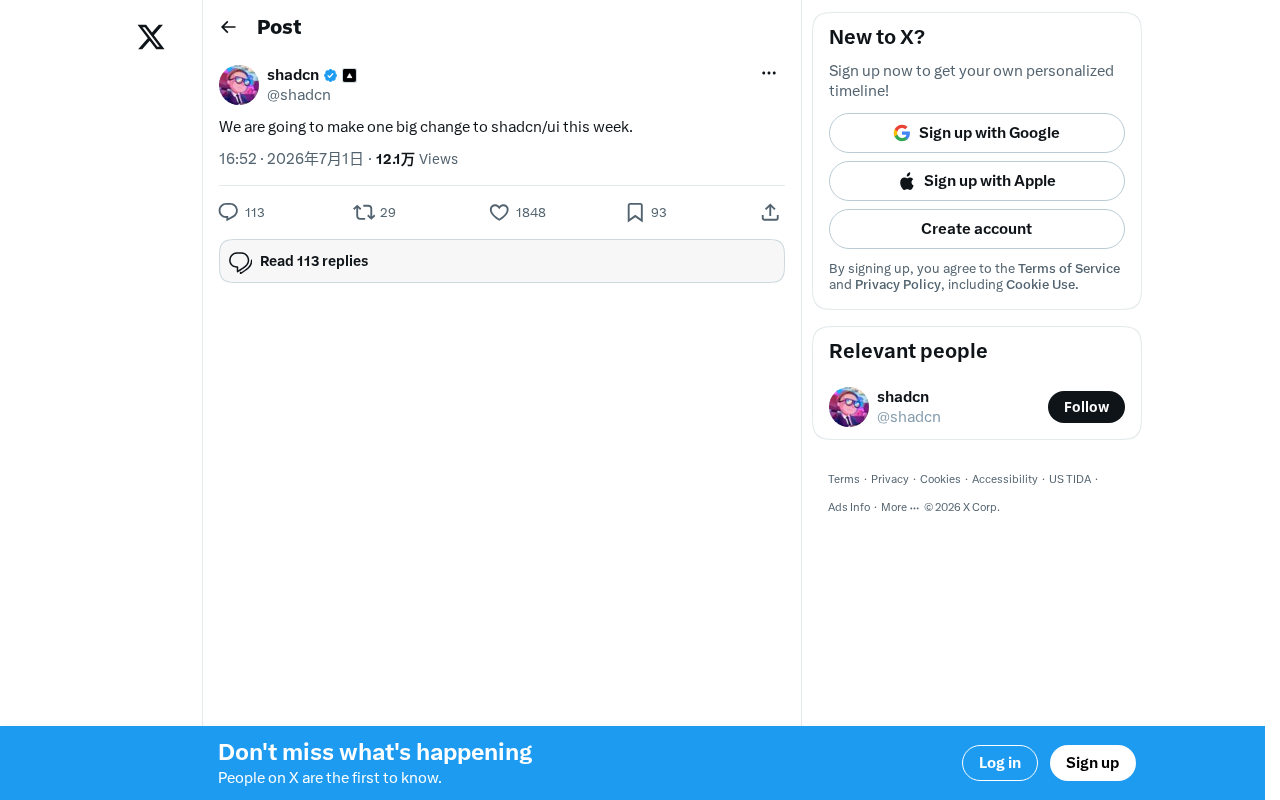
No specific details were disclosed, but the tweet quickly ignited heated discussion across the frontend community. As one of the fastest-growing UI solutions in recent years, any change to shadcn/ui has the potential to affect tens of thousands of active projects. This article outlines shadcn/ui's unique positioning and analyzes what this "big change" could actually mean in practice.
Why shadcn/ui Deserves Your Attention
The Rise of shadcn/ui
shadcn/ui was released by developer Shadcn in early 2023 and quickly became one of the most-watched frontend projects on GitHub within just a few months. Its GitHub star count surpassed 40,000 within the first year — a growth rate rarely seen among UI frameworks of its kind. Behind this phenomenon lies years of accumulated frustration in the frontend community with "black-box component libraries" — developers were often stuck struggling with style overrides, bloated bundle sizes, and version lock-in. shadcn/ui answered these frustrations in a nearly counterintuitive way: no npm package, just hand over the source code.
A Radically Different Component Distribution Model
What sets shadcn/ui apart is that it completely breaks from the traditional component library distribution model. Unlike libraries such as Material UI or Ant Design that are installed via npm packages, shadcn/ui uses a "copy-paste" distribution approach — developers use a CLI tool to copy component source code directly into their own projects.
This model offers several tangible advantages:
- Full code ownership: Component code lives in your codebase, free to modify however you like, without being constrained by upstream version upgrades.
- Zero unnecessary dependencies: No need to pull in a large third-party dependency tree — only the components you actually use.
- Highly customizable: Built on Tailwind CSS and Radix UI with a clean separation between styles and logic, making it easy to extend and modify.
Standing on the Shoulders of a Mature Ecosystem
shadcn/ui doesn't reinvent the wheel — it brings together two well-established tools: Radix UI and Tailwind CSS.
Radix UI serves as shadcn/ui's underlying interaction foundation. Developed by the Modulz team, it focuses on providing unstyled (headless), WAI-ARIA compliant UI primitive components. These "headless primitives" encapsulate interaction logic, keyboard navigation, focus management, and screen reader compatibility — without any visual styling. WAI-ARIA (Web Accessibility Initiative – Accessible Rich Internet Applications) is a W3C technical specification that adds semantic attributes to make dynamic web content more accessible to assistive technologies like screen readers. By wrapping Radix UI, shadcn/ui allows everyday developers to achieve enterprise-grade accessibility without needing to deeply understand ARIA specifications.
Tailwind CSS provides an atomic styling solution that fully decouples visual customization from the logic layer. This combination ensures both accessibility (a11y) and interaction quality, while offering flexible visual customization.
Where Could This "Big Change" Be Headed?
While no details have been officially released, the following directions are worth watching closely based on community discussions and the project's development trajectory:
Direction 1: Full Migration to Tailwind CSS v4
Tailwind CSS v4 is the most disruptive version upgrade the framework has seen since its 2019 release. Key changes include: completely dropping the tailwind.config.js config file in favor of CSS native variables and the @theme directive; introducing a new Oxide engine (a high-performance scanner rewritten in Rust) that offers build speeds up to 10x faster than v3; and deeper use of CSS cascade layers (@layer).
shadcn/ui's theming mechanism relies heavily on CSS custom variables linked with Tailwind configuration, meaning the v4 architectural changes make migration far more than a simple version bump. For projects still on older versions of Tailwind, this would be a systemic adjustment that needs careful evaluation.
Direction 2: Restructuring the Component Registry Mechanism
The shadcn/ui Registry mechanism is a key attempt at building an open ecosystem. Technically, the Registry is essentially a standardized component metadata protocol — each component declares its dependencies, file structure, and installation instructions via JSON files, which the CLI tool uses to automate source code fetching and local installation.
The broader significance of this mechanism is that it transforms shadcn/ui from a single official component collection into an extensible component distribution platform. Third-party developers and design system teams can publish their own component sets using the same protocol, and users can install components from different sources using a unified CLI command — somewhat analogous to how Homebrew works for the macOS software ecosystem. Third-party component collections like shadcn-ui-expansions and Magic UI have already been built on this mechanism. This "big change" could also be a further standardization of this system, pushing the ecosystem toward a more open model.
Direction 3: Enhanced Framework Agnosticism
Although shadcn/ui is currently centered on the React ecosystem, community demand for ports to Vue, Svelte, and other frameworks has always been present. If the team makes a move toward broader framework compatibility, it would significantly expand shadcn/ui's reach.
How Developers Can Prepare Ahead of Time
With the details still undisclosed, there's no need to panic — but a few proactive steps are worth taking:
- Watch official channels closely: Keep an eye on shadcn/ui's official documentation and GitHub changelog to stay on top of changes as soon as they land.
- Lock your production version: For live projects, don't rush to sync updated component code until you've completed thorough testing.
- Estimate migration costs: Since component code lives in your own repository, major changes typically require manual syncing — it's worth assessing the effort required ahead of time.
Closing Thoughts
A single brief teaser reflects the shadcn/ui team's continuous drive to iterate. As a project that has fundamentally changed how frontend components are distributed, every evolution it makes resonates throughout the entire community. Where exactly this "big change" is headed still awaits the official announcement. But one thing seems clear: whatever the specific direction, shadcn/ui is steadily moving toward a more flexible and open future.
Note: This article is based on the official teaser tweet. Refer to the official release for the actual update details.
Related articles

Disaster and Glory of the Apollo Program: The History We Must Revisit Before Returning to the Moon
From the fatal Apollo 1 fire to Apollo 8's daring lunar orbit to Apollo 11's successful landing—revisiting the disasters, fears, and compromises of the Apollo program and their lessons for today's return to the Moon.

Netflix Trust Exercise Turns Into Firing Trap: Where Are the Boundaries of Corporate Trust?
A Netflix employee was fired after sharing private info in a trust exercise. We analyze the risks of corporate trust exercises and how employees can protect themselves.

AMD CDNA5 Architecture Deep Dive: Technical Evolution and the AI Computing Competition Landscape
Deep analysis of AMD's CDNA5 architecture covering Chiplet packaging upgrades, HBM memory evolution, and low-precision compute optimization, examining how AMD challenges NVIDIA's AI chip dominance.