Spring AI Alibaba Getting Started: Understand the Best Java-to-LLM Integration Solution in 3 Minutes

Spring AI Alibaba is a mainstream bridge framework for connecting Java apps with LLM capabilities.
This article targets Java developers exploring how to connect Java applications with LLM capabilities. Using JDBC as an analogy, the author explains how Spring AI Alibaba abstracts away differences between various LLM provider APIs through unified interfaces, making it one of the most mainstream Java AI development frameworks. The article also compares LangChain4J, Spring AI, and Spring AI Alibaba, introduces core technical paradigms like RAG, and provides a framework selection guide for developers.
Why Java Developers Should Pay Attention to Spring AI Alibaba
Nearly every project today is seeking to leverage large language models — e-commerce systems, admin dashboards, and customer service platforms are no exception. For Java developers, there's one unavoidable question: How do you truly connect Java applications with LLM capabilities?
This question isn't entirely new. Think back to our Java learning journey — Java and databases were originally two completely different technology stacks, but with JDBC as the "bridge," connecting the two became natural. JDBC (Java Database Connectivity), released with JDK 1.1 in 1997, defines a unified API specification that lets Java programmers work without worrying about underlying database differences — they simply program against interfaces. This "programming against abstractions" design philosophy is exactly the core concept behind the Spring AI family of frameworks — using unified interfaces like ChatClient and EmbeddingModel to abstract away API differences between various LLM providers. Java applications need the same kind of bridge to connect with large models, and Spring AI Alibaba is currently one of the most mainstream choices.
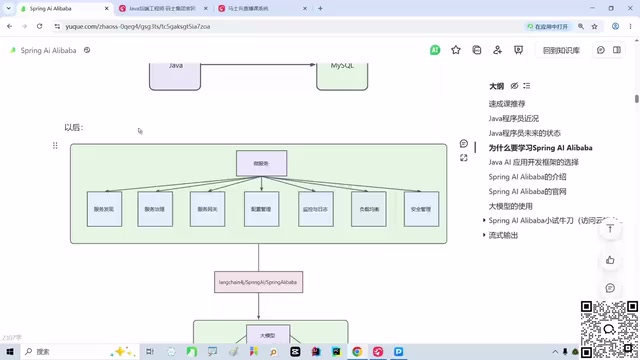
There are currently three major Java AI development frameworks on the market: LangChain4J, Spring AI, and Spring AI Alibaba. All three share the same general direction — helping Java applications integrate LLM capabilities — with differences in implementation and ecosystem support. Once you've mastered one, the learning curve for switching to another is relatively low.
Comparison and Selection Guide for the Three Major Java AI Frameworks
Spring AI: A Lightweight Choice for Getting Started
If your tech stack is entirely Spring-based and you only need basic LLM conversations or simple RAG applications, Spring AI is sufficient. It's officially maintained by the Spring team, integrates seamlessly with Spring Boot and other components, and has a low barrier to entry.
RAG (Retrieval-Augmented Generation) is one of the most essential technical paradigms in enterprise AI applications today. The principle is to retrieve relevant content from external knowledge bases (such as enterprise documents or databases) before querying the LLM, then feed the retrieved results as context alongside the question. This breaks through the LLM's "knowledge cutoff date" limitation and effectively reduces the model's tendency to "confidently hallucinate."
Related articles
 Tutorials
ChatGPT Plus Subscription Guide: Are GPT-5.5, image-2, and Codex Worth the Upgrade?
A detailed look at ChatGPT Plus features — GPT-5.5, image-2, and Codex — with a Plus vs Pro comparison and a complete step-by-step subscription guide for users outside the US.
 Tutorials
Harness AI Engineering in Practice: Using Claude Code to Master Enterprise-Level E-Commerce Development
Deep dive into Harness AI Engineering: master enterprise e-commerce development with Claude Code using the Rules, Skills, Wiki, and Changes framework.
 Tutorials
Cursor + Codex Dual-IDE Collaboration: A Practical Methodology for Open-Source Project Customization
A complete methodology for open-source project customization based on real-world experience, detailing the Cursor+Codex dual-IDE workflow, seven-stage process, MVP validation, and AI source code reading techniques.