SubjectiveZero: A New Creative Coding Paradigm with AI Agents and Node Editors
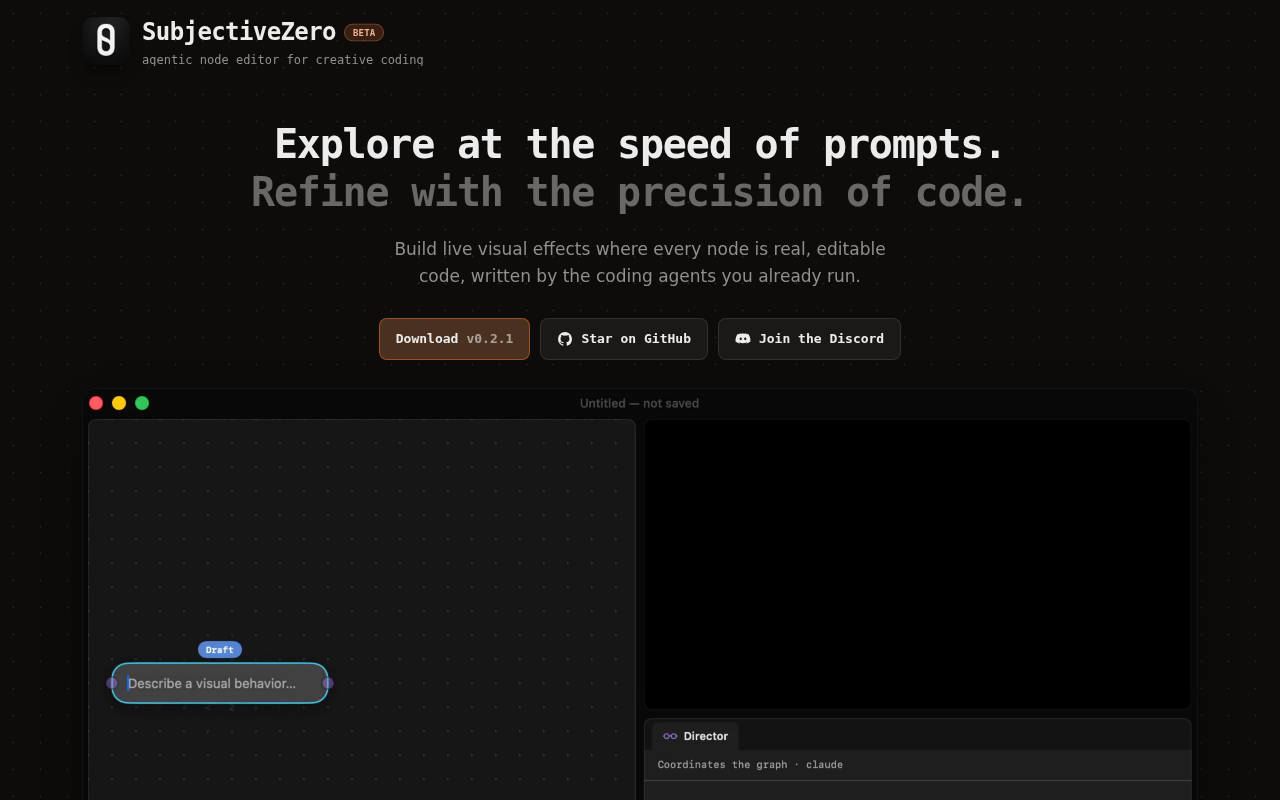
SubjectiveZero blends AI agents with node-based visual programming for a new creative coding workflow.
SubjectiveZero is an open-source agentic node editor that fuses AI agents with visual node-based programming, targeting the creative coding space. By letting AI autonomously build and adjust node graphs, it lowers the technical barrier for digital artists while preserving workflow transparency. Though still in early stages, it points toward a compelling direction in human-AI creative collaboration.
When Creative Coding Meets an AI Agentic Node Editor
On the developer community Hacker News, an open-source project called SubjectiveZero has quietly been drawing attention. It positions itself as an "agentic node editor for creative coding," aiming to merge two of today's most prominent tech trends — AI agents and visual node-based programming — into a single unified workflow.
Creative coding itself has a long history. Processing, born in 2001, laid the foundation for this field by wrapping Java into a clean language for visual artists, making it possible to "paint with code." openFrameworks took a C++ approach, targeting artists who need high-performance real-time rendering. TouchDesigner and Max/MSP went in a different direction — handling audio/visual data streams through a node/patch-based visual interface, carving out a unique creative niche in live performance and installation art. What all these tools have in common is an attempt to find a balance between "pure code" and "zero programming," letting technology recede into the background as a vehicle for creativity. SubjectiveZero's distinctive angle is introducing the concept of "agents" into the node editing paradigm — so that the creative process is no longer limited to manually wiring nodes and tweaking parameters, but can instead be driven by AI collaboration.
What Is an "Agentic Node Editor"?
Understanding this project requires unpacking two core concepts.
A node editor is a visual programming interface. Users build logic or data flows by dragging nodes and connecting them with wires, without writing code line by line. Blender's shader editor, Unreal's Blueprint system, and ComfyUI are all classic examples. ComfyUI's rise is particularly instructive — it breaks down Stable Diffusion's complex inference pipeline into freely composable node graphs, giving users fine-grained control over every intermediate step of image generation (such as prompt encoding, sampler parameters, ControlNet conditioning, and more). This design philosophy of "visible process, controllable steps" quickly attracted a large base of power users and spawned a vast ecosystem of custom nodes. This paradigm is especially friendly to creative workers because it transforms abstract program logic into intuitive, visible graphical structures.
Agentic represents the core philosophy of a new generation of AI applications. Since the 2022 ReAct (Reasoning + Acting) paper proposed the framework of "having language models alternate between reasoning and tool calls," the concept of AI agents has rapidly moved from academic research into engineering practice. Unlike traditional single-turn Q&A, the agentic paradigm allows models to break complex goals into multiple subtasks, sequentially calling external tools like code execution, file I/O, and web retrieval, then dynamically adjusting subsequent steps based on intermediate results. OpenAI's Assistants API, Anthropic's Claude tool use, and frameworks like LangChain and AutoGen are all driving adoption of this paradigm. Combining the two means SubjectiveZero allows AI agents to automatically generate node graphs, adjust parameters, and even construct complete creative generation pipelines from natural language descriptions.
Open-Source Positioning and Technical Significance
As an open-source project, SubjectiveZero has chosen a community-driven development path. This is nothing new in the creative coding world — many classic tools in the field exist as open-source or free software, and have spawned vibrant creator ecosystems as a result. Being open-source means developers can freely inspect the code, contribute features, and even build customized versions tailored to specific art forms on top of it.
From a technical evolution perspective, projects like this reflect a clear trend: AI is shifting from "delivering outputs" to "deeply integrating into the process." Traditional AI art tools generate an image directly, while an agentic node editor lets AI participate in the intermediate stages of creation. Creators can introduce AI capabilities at any point in the node graph while retaining full controllability and interpretability over the entire workflow. This "human-machine collaboration" model precisely addresses the inherent shortcomings of purely end-to-end generative models — users can't intervene in the generation process, it's difficult to reproduce specific results, and generative capabilities can't easily be combined with other toolchains. All of these pain points are structurally addressed by a node-based architecture.
Potential Value for Creative Workers
For digital artists, interaction designers, and creative technologists, the biggest appeal of tools like this is lowering the technical barrier to "realizing a creative idea." In the past, a complex generative art piece often required solid programming skills. With the assistance of an agent, creators can express intent in something closer to natural language, leaving the tedious node-building and debugging to the AI.
That said, it's worth noting that SubjectiveZero is still in an early stage. Judging by its limited traction on Hacker News, it has yet to build significant community momentum — it's closer to an exploratory experiment worth tracking than a mature productivity tool.
Three Directions Worth Watching
For readers who follow the AI tooling ecosystem, SubjectiveZero offers an interesting case study and raises several thought-provoking questions:
First, where does the collaborative boundary lie between agents and visual programming? When AI can autonomously generate node graphs, does the human creator's role devolve into that of a "director," or do they still need to be deeply involved in every detail?
Second, can open-source communities sustain the ongoing iteration of complex creative tools? The success of creative coding tools often depends on an active ecosystem of shared work and tutorials — the p5.js community around Processing and the ComfyUI workflow-sharing platform Civitai both demonstrate this. Whether SubjectiveZero can cultivate such a community atmosphere remains to be seen.
Third, how does it position itself relative to existing tools? Compared to mature products like ComfyUI and TouchDesigner, is it a complement, a replacement, or will it push the entire field to redefine what a "creative coding" workflow looks like?
Conclusion
SubjectiveZero may not yet be a widely known, mature product — but the triple convergence it represents, AI agents + node editors + creative coding, is one of the most imaginative frontiers in the current evolution of AI tools. For developers and artists hoping to explore new forms of creative expression in the age of AI, keeping an eye on open-source experiments like this may just capture the early signals of the next wave of tool transformation before it arrives.
As AI agent capabilities continue to grow, we can expect an increasing number of similar tools to emerge, further bridging the gap between creativity and technology.
Related articles

Disaster and Glory of the Apollo Program: The History We Must Revisit Before Returning to the Moon
From the fatal Apollo 1 fire to Apollo 8's daring lunar orbit to Apollo 11's successful landing—revisiting the disasters, fears, and compromises of the Apollo program and their lessons for today's return to the Moon.

Netflix Trust Exercise Turns Into Firing Trap: Where Are the Boundaries of Corporate Trust?
A Netflix employee was fired after sharing private info in a trust exercise. We analyze the risks of corporate trust exercises and how employees can protect themselves.

AMD CDNA5 Architecture Deep Dive: Technical Evolution and the AI Computing Competition Landscape
Deep analysis of AMD's CDNA5 architecture covering Chiplet packaging upgrades, HBM memory evolution, and low-precision compute optimization, examining how AMD challenges NVIDIA's AI chip dominance.