Tailscale: Build a Secure Private Network Effortlessly with WireGuard

Tailscale makes WireGuard networking effortless with automated setup, SSO, and zero-trust security.
Tailscale is an open-source networking tool built on WireGuard that eliminates the pain of manual key management and network configuration. It uses an automated control plane, identity-based zero-trust access, and peer-to-peer connectivity with smart relay fallback — making secure private networking as simple as logging in.
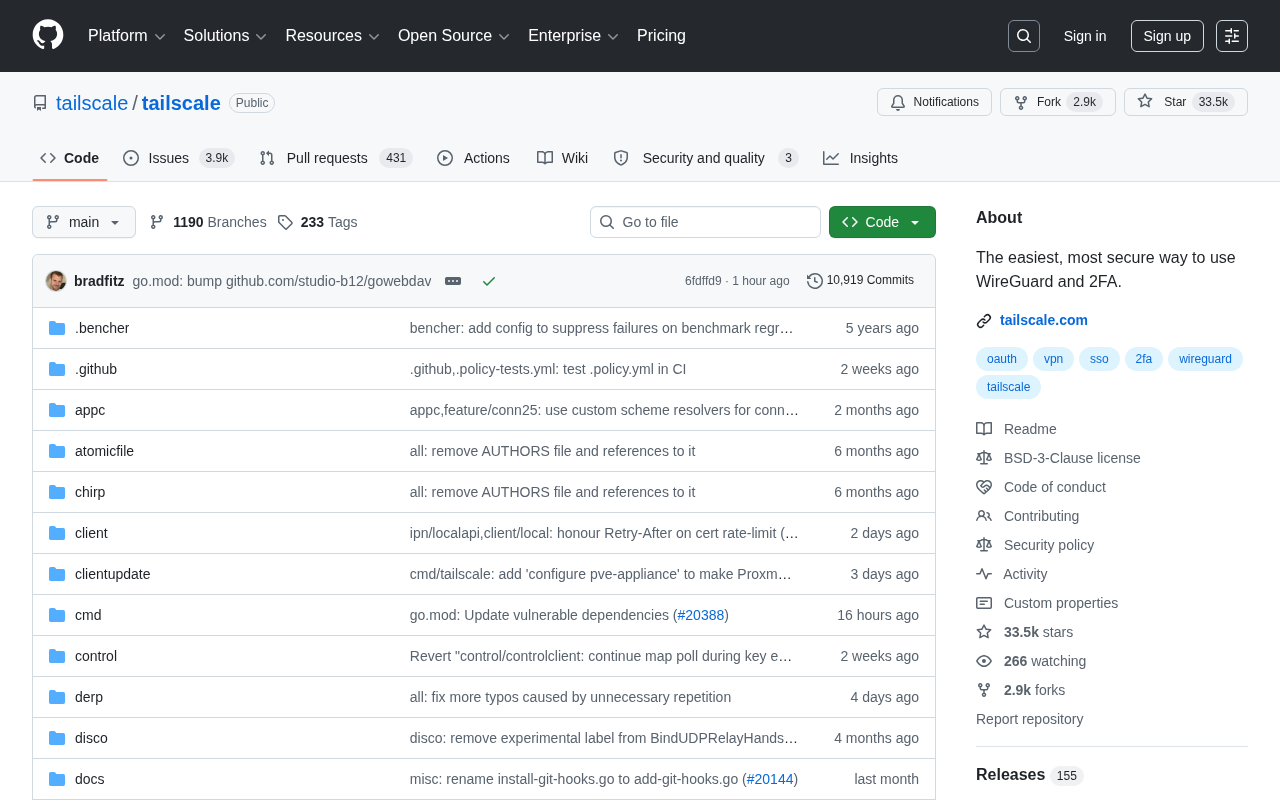
In an era when traditional enterprise VPNs are becoming increasingly bloated and difficult to maintain, a new networking solution built on WireGuard is rapidly gaining traction in the developer community. Tailscale, as an open-source project, has already earned over 33,000 stars on GitHub and continues to grow at a rate of 66 new stars per day. Its mission is crystal clear: make WireGuard as simple and secure as possible to use, with built-in two-factor authentication (2FA).
What Problem Does Tailscale Solve?
WireGuard is a modern VPN protocol that has been widely praised in recent years for its lean codebase, excellent performance, and strong encryption. Development began in 2015 under Jason A. Donenfeld, and in 2020 it was officially merged into the Linux 5.6 kernel mainline — a milestone that marked its maturity and earned recognition from top-tier engineers worldwide. Compared to OpenVPN's roughly 100,000 lines of code, WireGuard's kernel implementation spans only about 4,000 lines, dramatically reducing the surface area for security audits and potential attacks. On the cryptographic side, WireGuard uses a fixed, opinionated set of modern primitives — Curve25519 for key exchange, ChaCha20 for symmetric encryption, and Poly1305 for message authentication — a design philosophy that completely eliminates the risk of downgrade attacks through algorithm negotiation.
But WireGuard has one significant pain point: key distribution and network configuration are extremely tedious. When connecting multiple devices, you must manually generate keys for each node, maintain configuration files, and manage IP address allocation. Adding or removing any device requires synchronizing updates across all related nodes.
Tailscale's core value is automating all of that.
Core Technical Features
Control Plane–Driven Automated Networking
Tailscale builds an intelligent control plane on top of WireGuard's data plane, automatically handling key exchange, node discovery, and route configuration. Users simply log in to their account, and their devices are automatically joined to the same private network — known as a "tailnet."
The separation of control plane and data plane draws on the classic principles of Software-Defined Networking (SDN): the data plane handles actual packet forwarding, optimized for maximum throughput and minimal latency, while the control plane manages routing decisions, topology maintenance, and policy distribution, with relatively relaxed real-time requirements. Tailscale's coordination server pushes public keys and endpoint information to each node via persistent HTTPS connections, while WireGuard handles the high-performance data transfer. This decoupled design ensures that iterating on control logic has zero impact on the stability of the data transmission path.
Identity-Based Network Access
Unlike traditional VPNs that rely on IP allowlists and firewall rules, Tailscale adopts an identity-based access model — a core practice of Zero Trust Architecture. The traditional perimeter security model assumes "trust the internal network, distrust the external network," whereas Zero Trust operates on the principle of "never trust, always verify."
Tailscale integrates seamlessly with major identity providers (IdPs) — including Google Workspace, Microsoft Azure AD, Okta, and GitHub — via standard OAuth 2.0 / OIDC protocols, enabling single sign-on (SSO) and two-factor authentication. Network access permissions are tied to user identity, not to devices or IP addresses. This means organizations no longer need to maintain a separate VPN account system: when an employee leaves, simply disabling their account on the IdP side immediately revokes all their network access — a significant improvement in both security and manageability.
Decentralized Peer-to-Peer Connections with Intelligent Fallback
One of Tailscale's standout features is its effort to establish direct peer-to-peer connections between devices whenever possible. The coordination server is only responsible for brokering node information and key distribution; actual data traffic flows directly between devices without passing through a central server, reducing latency and eliminating a central bottleneck.
However, direct connections are not always feasible when two devices sit behind different NAT routers. Tailscale uses a combination of techniques — including STUN-like protocols for public address discovery and UDP Hole Punching — to attempt direct connectivity. When UDP is completely blocked by a firewall, Tailscale falls back to its DERP (Designated Encrypted Relay for Packets) relay servers to ensure connectivity. DERP nodes are distributed across multiple data centers worldwide, and end-to-end encryption ensures that even the relay servers cannot decrypt the traffic. This "direct first, relay as fallback" strategy guarantees near-100% connectivity with seamless degradation.
Built with Go, Broad Cross-Platform Support
The entire project is built in Go, balancing cross-platform portability with runtime efficiency. Tailscale currently supports Linux, macOS, Windows, iOS, Android, and even various NAS and router devices — covering virtually every major platform. The open-source codebase also allows security researchers to audit the implementation, strengthening community trust.
Typical Use Cases
Tailscale's flexibility makes it well-suited for a wide range of scenarios:
- Remote work: Employees can securely access corporate resources without complex configuration, replacing traditional enterprise VPNs.
- Self-hosted personal services: Home servers, NAS devices, Raspberry Pis, and more can be easily grouped into a private network, accessible from anywhere.
- Multi-cloud and hybrid cloud connectivity: Bring servers spread across different cloud providers into a single virtual network, simplifying cross-cloud communication.
- Development and testing environments: Team members can quickly share local development services without exposing public ports.
Balancing Open Source and Commercialization
Tailscale follows an open-source + managed service business model. The client code is open source, and individual users and small teams can use the official hosted control plane for free. For users who require greater autonomy, there is also Headscale — an open-source control server alternative that supports full self-hosting, removing any dependency on Tailscale's official services.
Headscale is a community-developed reimplementation of the Tailscale control server protocol in Go, fully compatible with existing clients. For organizations with strict data sovereignty requirements — such as those in finance, healthcare, or government — Headscale keeps all control plane data (device registration, key distribution, ACL policies, etc.) on their own servers, with no reliance on any third-party service. Notably, the very existence of this open-source alternative carries significant commercial weight: it demonstrates the openness of the protocol to prospective enterprise customers, dispels concerns about vendor lock-in, and ultimately builds greater trust in the official managed service. This strategy sustains strong community engagement while leaving room for a viable commercial operation.
Summary
Tailscale's rise validates a familiar pattern: the best infrastructure software often doesn't invent new protocols — it makes powerful existing technology accessible to everyone. Rather than building a new encryption protocol from scratch, Tailscale stands on WireGuard's shoulders and uses an automated control plane combined with an identity-based Zero Trust security model to eliminate the most painful complexities of networking. Whether you're a developer, a DevOps engineer, or an everyday tech enthusiast, Tailscale offers a modern networking solution that balances security and ease of use — well worth trying out.
Related articles

The Truth Behind Codex 'Build a Website in 5 Minutes': AI Isn't Creating Sites—It's Helping You Copy Them
Exposing the truth behind viral Codex 5-minute website videos: creators aren't building original sites with AI—they're copying shared prompts or scraping others' work. Learn AI coding tools' real limits.

Getting Started with AI Agent Development: A Complete Guide from Concept to Practice
A comprehensive guide to AI Agent architecture and development, covering automated marketing, intelligent customer service, and investment analysis scenarios with single and multi-agent collaboration.

The Truth Behind Codex 'Build a Website in 5 Minutes': AI Isn't Creating Sites — It's Helping You Copy Them
Exposing the truth behind viral Codex 5-minute website videos: creators aren't building original sites with AI — they're copying shared prompts or scraping others' work.