The Codex Orange Book: An Open-Source Full-Stack Practical Guide for AI Programming Beginners

An open-source full-stack guide helping beginners master AI programming with Codex through hands-on projects.
The Codex Orange Book is a community-driven open-source guide on GitHub with over 2.5K Stars, designed to help complete beginners get started with AI programming. It covers everything from Codex installation and configuration to plugin usage, MCP protocol extensions, and practical projects including front-end websites, back-end systems, and multimedia content creation, all with rich illustrations and step-by-step guidance.
A Codex Guide That Even Beginners Can Follow
For many newcomers looking to get started with AI programming, tool installation and configuration, feature comprehension, and practical application are often three daunting hurdles. Recently, an open-source project that launched on GitHub not long ago — dubbed the "Codex Orange Book" by the community — has been rapidly gaining traction among developers. As of now, the project has earned over 2.5K Stars, and numerous bloggers in China have even created dedicated content to break it down.
What is Codex? OpenAI Codex is an AI programming system built on the GPT series of large language models, specifically fine-tuned for code generation and comprehension tasks. It can understand natural language descriptions and convert them into executable code, supporting dozens of programming languages including Python, JavaScript, TypeScript, Go, Ruby, and more. Codex serves as the underlying engine for GitHub Copilot and is one of the key driving forces behind the "AI-assisted programming" wave.
From a technical evolution perspective, Codex originated from OpenAI's research of the same name published in 2021. Its training data encompasses hundreds of millions of public code repositories on GitHub, giving it code comprehension and generation capabilities far exceeding those of general-purpose language models. The core difference from the GPT series lies in Codex's specialized fine-tuning for the code domain, enabling it to understand function signatures, API calling conventions, code comments, and other programming-specific semantic structures.
"Fine-tuning" refers to the process of performing secondary training on a pre-trained base model using a high-quality dataset from a specific domain, allowing the model to exhibit stronger expertise in targeted tasks while retaining its general language understanding capabilities. The underlying logic of this technical approach is: large-scale pre-training gives the model a broad understanding of language structures, while domain-specific fine-tuning is akin to specialist training on top of a generalist foundation — the model doesn't need to learn language patterns from scratch but instead reinforces pattern recognition in a specific domain based on its existing capabilities. Codex's fine-tuning dataset primarily consists of real open-source code, including a large number of paired samples of function definitions, unit tests, code comments, and their corresponding implementations, enabling the model to learn the mapping relationship of "natural language description → code implementation" rather than merely statistical patterns at the linguistic level. This technical approach later became the mainstream paradigm in the code LLM field, with subsequent models like DeepSeek Coder, StarCoder, and CodeLlama all adopting a similar two-stage training strategy of pre-training + code fine-tuning. Notably, these successor models further introduced Fill-in-the-Middle (FIM) training on top of the paradigm established by Codex, enabling models to not only predict subsequent code based on preceding context but also complete missing code snippets in the middle based on both preceding and following context, which significantly improves practicality for code completion scenarios.
It's worth adding that Codex also incorporated Reinforcement Learning from Human Feedback (RLHF) during its training phase — having human annotators rate the quality of model-generated code, then using these ratings as reward signals for reinforcement training, making outputs better align with real developers' coding habits and quality expectations. The core innovation of RLHF lies in converting human subjective judgments into quantifiable training signals: annotators evaluate not only functional correctness but also readability, security, code style compliance, and other multi-dimensional metrics, upgrading the model's optimization objective from simply "predicting the next token" to "generating code that humans consider high-quality." This mechanism shares the same lineage as the training methods later used for ChatGPT and is one of the key reasons why Codex-generated code exhibits strong readability and standardized style.
In recent years, as OpenAI has further integrated Codex capabilities into ChatGPT and its API ecosystem (especially as next-generation models like GPT-4o have internalized code capabilities as a foundational skill), developers can invoke its code generation abilities through multiple avenues, from simple function completion to full project scaffolding. Notably, in 2023 OpenAI officially shut down the standalone Codex API endpoint, fully integrating its capabilities into the ChatGPT ecosystem — marking an important milestone in the evolution of AI programming from a "specialized tool" to "general intelligent infrastructure." The deeper logic behind this integration strategy is: as general-purpose large models continue to improve their code capabilities, the marginal value of maintaining a separate code-specific model gradually diminishes, while internalizing code capabilities as a core competency of the base model allows users to seamlessly switch between code generation, debugging analysis, documentation writing, and other tasks within a single conversation interface, greatly improving workflow continuity.
The greatest value of this guide lies in its "full-stack" approach. Rather than covering isolated features, it spans from Codex installation and configuration all the way through plugin usage, skill extensions, and complete hands-on case studies. For users with zero prior experience, this means they can progress along a clear path step by step, instead of fumbling through fragmented tutorials.
It's worth noting that while AI programming tools (such as Copilot, Cursor, Windsurf, Codex, etc.) lower the barrier to writing code, their own learning curves are often underestimated. Users need to understand not only the basic operations of these tools but also master the art of "Prompt Engineering" — how to precisely describe requirements in natural language to obtain high-quality code output.
Prompt Engineering is not simply a "question-asking" technique but rather a systematic methodology for human-AI collaboration. In code generation scenarios, high-quality prompts typically need to include the following elements: clear task boundaries (what to do and what not to do), technology stack constraints (which language/framework to use), input/output format specifications, and necessary contextual background (such as existing code structure, business logic constraints, etc.). Research shows that for the same programming task, the quality difference between code generated from a carefully crafted prompt versus a casually written one can be orders of magnitude. The root cause of this gap lies in how large language models work: models essentially predict the most likely output based on the input context distribution, and prompt quality directly determines the "probability space" the model operates in — vague prompts cause the model to randomly wander among multiple possible interpretations, while precise prompts lock the model's attention onto the target solution space.
Additionally, advanced techniques such as "Chain-of-Thought Prompting" and "Few-shot Examples" are being adopted by an increasing number of developers in their AI programming workflows. Chain-of-Thought prompting was proposed by Google Research in 2022, with the core idea of guiding the model to output intermediate reasoning steps before giving a final answer — similar to a human "showing their work" when solving problems. In code generation scenarios, this means having the model first describe the algorithmic approach and then progressively refine the implementation, rather than directly requesting complete code output. This significantly improves generation accuracy for complex logic. Few-shot examples involve including 1-5 "input → expected output" demonstration pairs in the prompt, helping the model quickly understand the task's format specifications and quality standards. This is especially useful for scenarios with specific code style requirements or domain-specific syntax. The effectiveness of few-shot examples stems from the "In-context Learning" capability of large language models — the model can instantly infer task patterns from the examples in the prompt without retraining, which is one of the key properties that distinguishes large-scale pre-trained models from traditional machine learning models.
The Cognitive Science Foundation of Prompt Engineering The reason Chain-of-Thought prompting works has its basis in cognitive science: there is a positive correlation between a large language model's reasoning ability and the length of its output token sequence — when a model is allowed to "unfold its thinking process," it is actually using the intermediate steps it has already generated as context for subsequent reasoning, thereby avoiding the logical gaps that easily occur when jumping directly to conclusions. This phenomenon is referred to in academia as the "Computational Depth Hypothesis." From an information theory perspective, each intermediate reasoning step provides additional conditional information for subsequent generation, essentially decomposing a high-difficulty "single leap" problem into multiple "small step" problems, each with local difficulty well within the model's capability range. This also explains why Chain-of-Thought prompting shows particularly significant improvements in tasks requiring multi-step logical reasoning, such as mathematical reasoning and algorithm design. For developers, a simple and effective practical tip is to append guiding phrases like "please analyze the requirements first, then provide the implementation plan" or "please think step by step" at the end of prompts, which often significantly improves code quality for complex tasks. The recently emerging "o-series" reasoning models (such as OpenAI o1, o3) further internalize this approach as a training objective, using reinforcement learning to teach models to independently engage in deep thinking before answering — this can be seen as the evolution of Chain-of-Thought prompting from "external guidance" to "internal spontaneity." Notably, the training process of o-series models introduced the concept of a "Process Reward Model" (PRM) — rewarding not only the correctness of final answers but also evaluating the quality of intermediate reasoning steps. This enables models to develop more rigorous and organized reasoning habits rather than merely optimizing the surface quality of final outputs. This paradigm shift in training marks an important transition in AI reasoning capabilities from being "outcome-oriented" to "process-oriented."
The combined use of these two techniques has become standard practice in professional AI programming workflows.
How to verify the correctness of AI-generated code, and how to debug and iterate with AI assistance, are also common challenges faced by beginners. This is precisely the core value of systematic learning materials compared to fragmented tutorials: they provide not just "how to click buttons" but a complete AI-assisted programming workflow mindset.
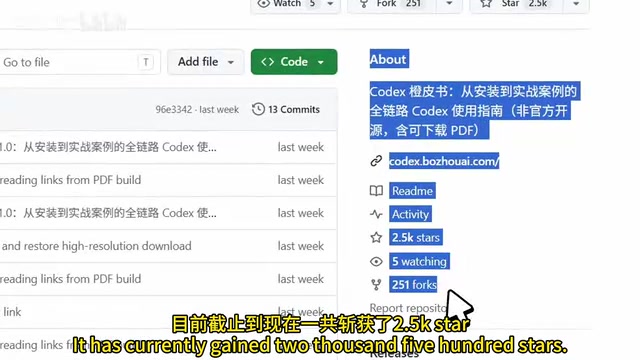
Here's a detail worth mentioning: although this is an "unofficial" community document, its popularity and reputation are in no way inferior to official materials. In the GitHub ecosystem, a "Star" is the core metric for measuring the popularity of an open-source project, similar to a "like" on social media, but carrying stronger technical community endorsement significance.
Unlike casual likes on social media, GitHub Star behavior has its own unique community culture logic: developers typically only Star projects that are genuinely valuable to them or technically impressive. Therefore, Star counts represent, to a certain extent, genuine recognition from the technical community rather than mere traffic metrics. GitHub also promotes high-growth projects to its "Explore" page and "Trending" rankings through algorithms — the latter categorizes the fastest-growing projects by programming language and time dimension (daily/weekly/monthly), serving as an important channel for developers to discover quality resources.
It's worth understanding in depth that the ranking mechanism of GitHub Trending does not simply rely on total Star count but rather focuses on growth velocity within a given time period. This means a new project that receives concentrated attention in a short period often has a better chance of making the rankings than an older project with years of accumulation. The intent behind this design is to help the community discover "emerging" projects that are on the rise, rather than merely showcasing historically dominant projects. Once a project lands on the Trending rankings, its exposure to developers worldwide increases exponentially, leading to inclusion in various tech newsletters and recommendations from prominent developers, creating a positive word-of-mouth cycle. The Orange Book's ability to trigger large-scale secondary dissemination by bloggers both domestically and internationally in a short time is a textbook example of this flywheel effect. This also reflects a broader phenomenon: in an era of rapid AI programming tool iteration, high-quality community-driven documentation often better addresses the real learning needs of users.
Content Structure: From "Who Is It For" to "How to Implement"
Opening the table of contents of this Orange Book, you can see that its organizational logic is quite comprehensive. The opening section doesn't rush into technical details but first answers a key question — who is this book for and who can use it. This reader-centered design helps users manage their expectations before committing to study, allowing them to determine whether they belong to the target audience.
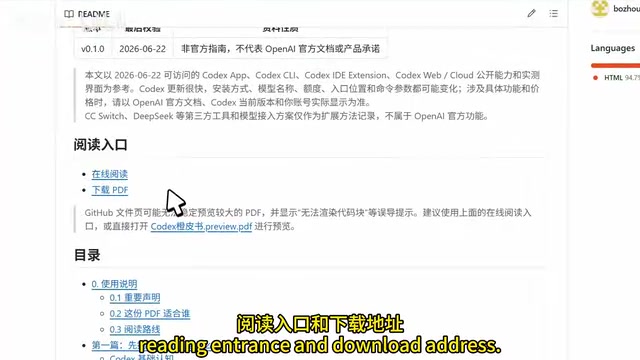
From there, the content moves into hands-on sections, covering the following in sequence:
- Installation and Configuration: Helping users build a working environment from scratch;
- Plugins (Skills) and MCP Usage: Introducing how to extend Codex's functional boundaries through add-on capabilities;
- Rich Hands-on Case Studies: This is the centerpiece of the entire book.
About the MCP Protocol MCP (Model Context Protocol) is a standardized, open-source protocol proposed by Anthropic in late 2024, designed to address the fragmentation problem in integrating AI models with external tools and data sources. Simply put, MCP defines a unified "socket" specification that allows AI assistants to connect to databases, file systems, third-party APIs, and other external resources in a standardized way, without needing to develop a custom adapter for each tool.
From a technical architecture perspective, MCP adopts a Client-Server Architecture: the AI model acts as the client, communicating with various MCP servers via the standardized JSON-RPC protocol, with each MCP server responsible for encapsulating a specific type of external capability (such as file read/write, database queries, browser control, etc.). JSON-RPC is a lightweight remote procedure call protocol that encodes requests and responses in JSON format, with language-agnostic and simple-to-implement characteristics, making it well-suited as a standard interface for cross-system communication. On top of this, MCP defines a complete interaction specification for Tool Discovery, Tool Invocation, and result return, allowing AI models to call any external capability through a unified interface without needing to understand the underlying implementation details. The Tool Discovery mechanism is particularly crucial — AI models can dynamically query at runtime which tools a given MCP server provides and what parameter formats each tool expects. This "self-describing" feature means new tools can be onboarded without modifying the model itself, greatly lowering the barrier to ecosystem expansion.
The core value of this design lies in "integrate once, use everywhere" — developers only need to build a tool server following the MCP specification, and it can then be called by all AI clients that support MCP, completely breaking the previous pattern of each AI tool vendor reinventing the wheel independently. Currently, mainstream AI programming tools including Claude, Cursor, and Windsurf have all adopted MCP support, and the Codex ecosystem is rapidly following suit.
From a broader industry perspective, the emergence of MCP marks a critical "infrastructuralization" transformation in the AI tool ecosystem. Before MCP, every AI tool vendor had to maintain their own integration adapter code for various external services, which not only caused massive duplication of effort but also made the tool ecosystem extremely fragmented — the same database connector might need three different adapter layers developed separately for Copilot, Cursor, and Windsurf. MCP aims to break this deadlock through standardized protocols, with significance analogous to how the USB interface unified hardware connection standards — before USB, every peripheral required a dedicated interface and driver, and USB's adoption made "plug and play" a reality; MCP aims to achieve the same paradigm shift in the AI tool space. Notably, MCP's adoption speed has far exceeded expectations, going from release to mainstream tool support in just months, which partly reflects the entire industry's urgent demand for "tool interoperability standards." From a developer ecosystem perspective, MCP's rapid adoption has also spawned a new career direction: MCP server developers — specialists who build standardized MCP interfaces for specific domains (such as financial data, medical records, enterprise ERP systems, etc.), enabling the data and capabilities of these vertical domains to be seamlessly called by various AI tools. For learners, understanding MCP means grasping the underlying logic of AI tool "capability extension," rather than merely knowing how to use a specific plugin.
This progressive structure of "concept foundation → environment setup → capability extension → project practice" aligns with how most people naturally learn a new technology and effectively lowers the psychological barrier to getting started.
Hands-on Case Studies: Making AI Programming Learning Actually "Run"
When it comes to technology learning, theory can never replace practice. One of the Orange Book's major highlights is its abundance of reproducible hands-on projects covering a variety of typical scenarios:
- Building front-end web pages for a pop-up shop;
- Setting up back-end management systems;
- Using AI to assist in creating presentations;
- Generating promotional videos and other multimedia content.
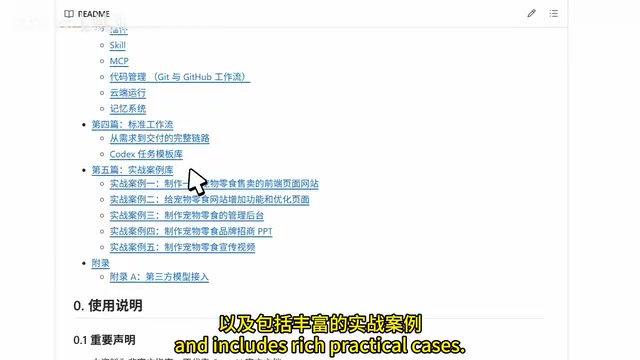
These case studies span multiple directions from front-end to back-end, from documents to video. No matter where your interests lie, you can find a relevant practice project. From an AI-assisted programming workflow perspective, the value of these cases lies not just in "learning how to build a specific project" but in helping learners establish a reusable collaboration paradigm: how to break down a vague product requirement into a sequence of AI-executable subtasks, how to effectively review and iterate after AI generates an initial draft, and how to handle common edge cases and error patterns in AI-generated code.
This touches on a key cognitive shift in AI-assisted programming: from "having AI write complete code" to "collaborating with AI to complete complex engineering." The former is suitable for simple scripts or utility functions, while the latter requires developers to have task decomposition skills — breaking a complete project into subtasks with clear boundaries and self-contained context, each of which can be independently completed by AI with high quality, with final integration and debugging handled by humans. This collaboration model of "humans handle architecture and decomposition, AI handles implementation and filling" is considered the most efficient human-AI collaboration paradigm within the current boundaries of AI programming capabilities, and it's the core workflow mindset that the Orange Book cultivates through its hands-on case studies.
The "Context Window" Limitation in AI Programming Understanding the necessity of task decomposition also requires awareness of a core technical constraint of large language models: the Context Window. Each model has a limited amount of text it can process in a single conversation (measured in token count), and content exceeding this limit will be truncated or forgotten. A token is the basic unit of text processing for large language models, roughly corresponding to one word in English or 1-2 Chinese characters. GPT-series models typically use "1000 tokens ≈ 750 English words" as a rough conversion standard. For large software projects, the complete codebase often far exceeds the model's context window capacity, meaning the AI cannot "see" the entire project in a single interaction. Therefore, decomposing large engineering tasks into context-self-contained subtasks is not only a best practice in engineering management but also a necessary strategy to work around model technical limitations. The context windows of current mainstream models have expanded from the early 4K tokens to 128K or even longer (e.g., the Claude 3 series supports 200K tokens), but for real large-scale codebases, "how to effectively manage context" remains one of the most critical engineering challenges in AI-assisted programming. The industry has developed multiple strategies to address this challenge: RAG (Retrieval-Augmented Generation) technology dynamically retrieves relevant code snippets via vector databases and injects them into the context; Code Graph technology builds structured indexes by analyzing code dependency relationships; while tools like Cursor and Windsurf use intelligent context management algorithms to automatically determine which code files are most relevant to the current task and prioritize their inclusion in the context — these are all key technical differentiators in today's AI programming tool competition. It's worth noting that the core principle of RAG is to convert files, functions, comments, and other content from the codebase into high-dimensional vectors stored in a vector database. When a user presents a programming request, the system similarly converts the request into a vector, quickly retrieves the most relevant code snippets by calculating vector similarity, and then dynamically injects these snippets into the model's context — this "on-demand retrieval" mechanism enables AI to obtain the most valuable information within a limited context window rather than simply truncating the most recent code history.
More importantly, through the guidance of complete case studies, learners can connect scattered functional knowledge into a complete workflow and truly understand Codex's practical value in real projects.
Reading Experience: Richly Illustrated, Accessible Online
Beyond the content itself, this guide is also thoughtfully designed in terms of reading experience. It's hosted on GitHub and supports direct online reading, with a clean and distraction-free interface. The entire book is accompanied by numerous screenshots and diagrams, with virtually every operational step illustrated with corresponding images.
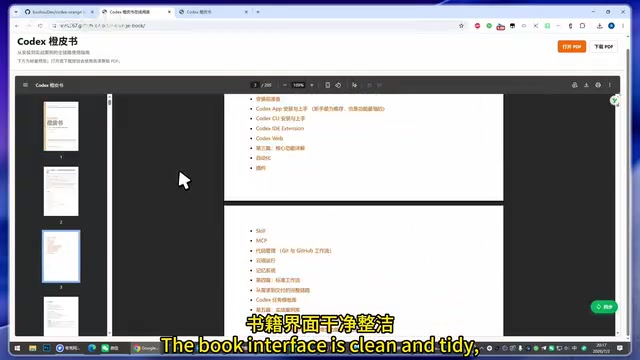
For beginners, the richly illustrated format dramatically reduces comprehension costs — many operations that could be ambiguous in pure text descriptions become immediately clear with a single screenshot. This attention to detail is also one of the key reasons it has rapidly built up its reputation.
It's worth mentioning that this project is hosted on GitHub Pages or a similar static site service, meaning anyone can Fork the project to create their own personal version or even contribute content modifications. This "Docs as Code" collaboration model is a typical paradigm for knowledge production in open-source communities — documentation, like code, accepts Pull Requests, Issues, and version management from the community, enabling content quality to continuously improve through community collaboration rather than relying on a single author's individual maintenance. The technical foundation of this model is the Git version control system: every content modification is recorded as a traceable Commit, contributors can work in parallel on different branches, and content review is conducted through Pull Request mechanisms in a code-review style before being merged into the main branch. This toolchain, originating from software engineering, has made large-scale distributed collaboration possible when introduced to documentation writing — the Linux kernel documentation, Kubernetes official documentation, and other large technical documentation projects are all classic examples of the "Docs as Code" model in successful operation. It's worth adding that GitHub Pages itself is a free static website hosting service provided by GitHub. It can automatically render Markdown files or HTML content from a repository into accessible web pages. Combined with static site generators like Jekyll or MkDocs, developers can publish documentation as a professional online website without any server operations knowledge. This technology combination (Git version control + GitHub Pages hosting + Markdown writing) constitutes the standard infrastructure for current open-source technical documentation production, and its zero-cost, high-availability, and easy-collaboration characteristics make it the preferred platform for community knowledge sharing.
Final Thoughts: The True Value of Open-Source Community Documentation
The rise of the Codex Orange Book reflects a deeper trend: as AI programming tools become more widespread, user demand for low-barrier, highly practical learning materials is growing rapidly. Official documentation tends to be rigorous but reference-manual-oriented, while community projects like the Orange Book fill the "beginner guidance" gap in a more down-to-earth manner.
This phenomenon is not uncommon in open-source communities — historically, community-driven technical books like Niao Ge's Linux Private Kitchen (a renowned Chinese Linux guide) and Professional JavaScript for Web Developers have often been more effective than official documentation in helping beginners build systematic understanding. The fundamental reason is that official documentation is typically written from a "feature completeness" perspective, ensuring that every feature has an accurate description, while community authors write from the perspective of "the learner's cognitive path" — they better understand where real learners get stuck, which concepts are easily confused, and which analogies best produce "aha" moments. The narrative style difference that comes from this "been there, done that" perspective often has a greater impact on learning outcomes than differences in content itself. From an educational psychology standpoint, this corresponds to the "Expert Blind Spot" phenomenon: domain experts often have difficulty accurately predicting what confuses beginners because they have already internalized a large amount of tacit knowledge as intuition, and this tacit knowledge is precisely what beginners most need explicitly explained. Community authors are typically at the "just learned" stage and have fresher memories of beginner confusion, enabling them to provide explanations more precisely at critical junctures. This phenomenon has deeper theoretical support in cognitive science: psychologists relate it to the "Curse of Knowledge" concept — once we master a piece of knowledge, it becomes very difficult to imagine what it's like not knowing it. This cognitive bias systematically affects experts' teaching and writing, inclining them to skip foundational explanations that are crucial for beginners.
From a knowledge dissemination perspective, another structural advantage of community documentation lies in its iterative response speed. When tools are updated or the community discovers new best practices, community documentation can often reflect these changes faster than official documentation — this is especially important in today's era of rapid AI tool iteration. Taking Codex as an example, from its standalone API to integration into the ChatGPT ecosystem, to its combination with the MCP protocol, each major change means learning materials need corresponding updates. Official documentation updates often need to go through internal review processes, while community documentation can have updates submitted by community members within hours of a change — this "distributed maintenance" model of knowledge production has a unique competitive advantage in the rapidly iterating AI era. This advantage is particularly pronounced in the AI field: the iteration cycle of current mainstream AI tools has shortened to weeks or even days. The traditional knowledge dissemination chain of "write book → publish → readers purchase" is completely unable to keep up with this pace in terms of timeliness, while the open-source documentation collaboration model based on Git is naturally suited to this high-frequency iteration requirement. This is also why an increasing number of AI tool learning resources are choosing to be published as GitHub repositories rather than traditional books.
If you're interested in AI programming but struggling with where to begin, this open-source guide is undoubtedly a starting point worth bookmarking. It supports both online reading and offline download for convenient reference anytime.
Of course, as unofficial material, it's recommended to cross-reference with official documentation for verification — especially given the rapid pace of tool version updates. Staying mindful of content timeliness will ensure the best learning outcomes.
Related articles

The Era of AI Capability Overhang: Why You Need to Reset Your Ambition Every 3 Months
Understanding Capability Overhang in the AI era: when model capabilities far exceed application imagination, how teams should reset feasibility boundaries quarterly to avoid ceding advantages to competitors.

Firemaps Spain: Real-Time Wildfire Monitoring Map with Wind Flow Visualization
Firemaps Spain is an open-source real-time wildfire monitoring tool for Spain and Portugal, combining fire hotspot data with wind flow visualization to help assess fire spread direction.

Google AI Studio Hiring TPM Lead: Decoding the Three Key Criteria Including 'AI Pilled'
Google DeepMind's AI Studio team is hiring a TPM lead with three key criteria: AI pilled, high agency, and pushing the frontier. A deep dive into Google's acceleration strategy and AI talent trends.