The Complete Guide to AI-Native Architecture: RAG, Agents, and MCP

A complete architectural guide to building production-ready AI systems with RAG, Agents, and MCP.
This article systematically breaks down the full architecture of AI-native applications — from LLM inference and RAG knowledge retrieval (covering vector databases, knowledge graphs, and BM25) to Agent planning, MCP tool invocation, AI gateways, and observability. It gives developers a clear, end-to-end engineering perspective to move beyond fragmented learning and build production-grade AI systems.
AI System Architecture: From Request to Response
Modern AI systems have long surpassed the stage of simple "Q&A chatbots." From a user's request to a final executed action, a truly production-ready intelligent AI system spans multiple layers: LLM inference, knowledge retrieval, intelligent planning, tool invocation, and production-grade reliability. This article provides a systematic overview of AI-native application architecture to help developers build a macro-level understanding and escape the trap of fragmented, piecemeal learning.
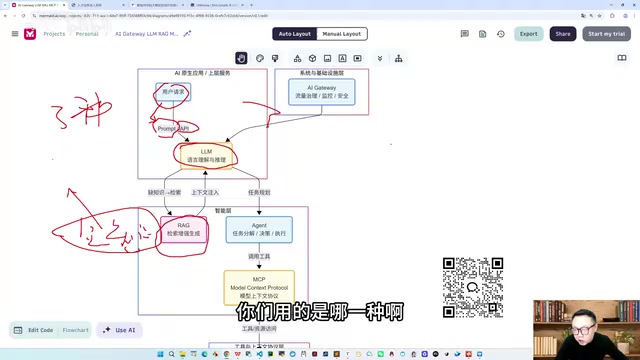
No matter how complex an AI system becomes, its core pipeline follows a relatively fixed path. Everything starts with a user request — when interacting with a large language model (LLM), this request is essentially a prompt. The system then calls the relevant API, passing the user's intent to the model for understanding and reasoning.
A critical question arises here: what happens when the LLM "lacks the knowledge" or "doesn't know how to answer"? This is the first key problem to solve in the entire architecture. Understanding this main pipeline is a prerequisite for selecting technical solutions and incrementally building a system. Without a clear grasp of the macro architecture, learning RAG, Agents, Coze, or Dify in isolation won't translate into real-world results.
RAG Knowledge Retrieval: More Than Just a Vector Database
When an LLM's built-in knowledge falls short, we turn to RAG (Retrieval-Augmented Generation) — commonly known in enterprise contexts as a "local knowledge base" or "enterprise knowledge base." RAG was formally introduced by the Meta AI Research team in 2020 in the paper Retrieval-Augmented Generation for Knowledge-Intensive NLP Tasks. Its core idea is to decouple and coordinate two modules: a retrieval module that finds the most relevant document fragments from external knowledge sources, and a generation module (the LLM) that uses those fragments as contextual clues to produce more accurate, grounded responses. This architecture fundamentally addresses the "frozen memory" problem of pure generative models, enabling them to dynamically access up-to-date information.
A common misconception is equating a knowledge base with a vector database. In reality, there are three mainstream approaches to knowledge retrieval.
Comparing Three Knowledge Retrieval Approaches
First: Vector Storage (VectorDB) — the most common approach. The core mechanism converts unstructured data like text and images into high-dimensional numerical vectors (typically 768 to 4096 dimensions) via an Embedding model and builds an ANN (Approximate Nearest Neighbor) index. At query time, the user's question is similarly converted into a vector, and the system quickly identifies the most semantically similar document fragments by computing cosine similarity or Euclidean distance. Popular vector databases include Pinecone, Weaviate, Milvus, Chroma, and pgvector. Unlike the exact matching of traditional relational databases, vector retrieval is essentially "fuzzy semantic matching" — capable of bridging literal differences to understand the semantic relationship between "buy coffee" and "purchase a latte."
Second: Knowledge Graph. Knowledge graphs originated from Google's 2012 project of the same name. Their data structure is built on "entity–relation–entity" triples that form a directed graph network. Compared to vector-based solutions, knowledge graphs are more complex to build, using a graph-based structured data format that can precisely express complex relationships between entities. They excel at multi-hop reasoning queries — for example, "Is the parent company of this product's supplier on the sanctions list?" This type of query, which requires traversing multiple steps along a chain of relationships, is nearly impossible for vector retrieval but is handled precisely by graph traversal algorithms. Knowledge graphs typically require a dedicated knowledge engineering team for entity extraction, relationship annotation, and ontology design, but their value in complex business logic and compliance/risk-control scenarios is irreplaceable.
Third: Full-Text Index (BM25) — keyword-based full-text search. BM25 (Best Match 25) is a classic ranking function introduced by the Okapi information retrieval system in 1994. It belongs to the TF-IDF algorithm family with two key improvements — a term frequency saturation function and document length normalization — effectively overcoming TF-IDF's over-sensitivity to high-frequency terms. Elasticsearch uses BM25 as its default relevance scoring algorithm. In RAG scenarios, BM25 is particularly well-suited for queries containing specialized terminology, product codes, or proper names, performing exceptionally well in exact keyword matching scenarios.
Each of these three approaches has its ideal use cases. Mature enterprise knowledge bases typically combine all three (known as Hybrid Search, merging results from multiple retrieval paths using the RRF reciprocal rank fusion algorithm) to improve both precision and recall.
Why Do LLMs Need an External Knowledge Base?
Without an additional knowledge base, the biggest risk is the model confidently producing fabricated information — what's commonly called hallucination. The root cause lies in the LLM's generation mechanism itself: under the Transformer architecture, a language model is essentially a probabilistic prediction engine. When generating the next token, the model selects the highest-probability output based on existing context, rather than retrieving "factually existing" knowledge. When the training data doesn't contain an accurate answer to a given question, the model tends to generate something that "sounds plausible" rather than admitting it doesn't know.
More fundamentally, LLM knowledge is "frozen" — the model's pre-training data has a cutoff date and generally excludes enterprise-internal private data. When you ask "analyze our company's financial performance this year," the model simply has no corresponding data and can only fabricate an answer. The core value of RAG lies precisely in transforming "generation from thin air" into "summaries backed by evidence" to suppress hallucination and improve response reliability — though it doesn't eliminate hallucination entirely, as the model can still misinterpret the provided documents.
From Chatbot to Agent: Giving LLMs the Ability to Act
An LLM plus RAG alone doesn't constitute a true intelligent AI system. This combination is "at best a search tool" — simply replacing web search with conversational search. It is still fundamentally a first-generation product: a Chatbot (Q&A bot).
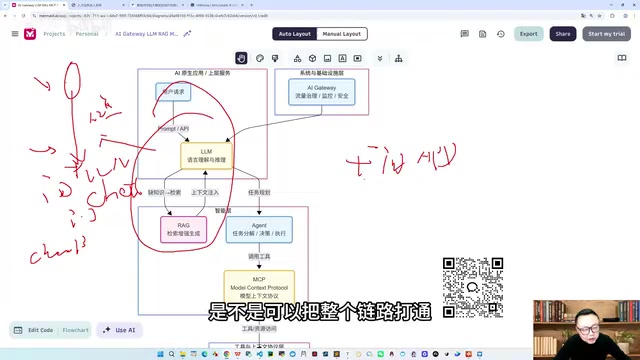
The core limitation of a Chatbot is that it can only give suggestions — it cannot take action. Take "order me a coffee" as an example: a Chatbot will only tell you "you can place an order at such-and-such coffee shop," but cannot actually complete the order, payment, and delivery.
The Core Capabilities of an AI Agent: Planning and Execution
Agents (intelligent agents) exist precisely to give LLMs real "hands and feet." The standard workflow includes:
- Environment Perception: Receiving and understanding user input
- Intent Understanding: Accurately grasping the user's true needs
- Task Planning: Breaking down complex goals into executable steps
- Taking Action: Calling tools to complete specific operations
Using the coffee order example, an Agent would automatically plan: locate a nearby store → create an order → complete payment → arrange delivery to the specified location. The entire process requires invoking different tools and APIs — which is exactly where MCP (Model Context Protocol) comes into play.
MCP is an open standard protocol released by Anthropic in November 2024, designed to solve the fragmentation problem of AI agent integration with external tools. Before MCP, every tool provider had to write custom adapter code for different AI frameworks, creating an "M×N" integration complexity problem (M models × N tools). MCP transforms this into "M+N": each AI framework only needs to implement an MCP client once, and each tool only needs to provide an MCP server once, enabling seamless interoperability. The MCP protocol defines three standard primitives: Resources (resource access), Tools (tool invocation), and Prompts (prompt templates). A growing number of mainstream tools — including GitHub, Google Drive, Slack, and PostgreSQL — have already released official MCP server implementations. Through MCP's standardized protocol, Agents can uniformly invoke various tools and external APIs to complete end-to-end task execution.
Production-Grade Infrastructure: AI Gateway and Observability
Even with a complete end-to-end flow, running an AI system reliably in production over the long term requires solid infrastructure. Two core objectives are: stability above all else, and continuous optimization and iteration.
AI Gateway
The AI Gateway is the "gatekeeper" of the entire system. It evolved from traditional API gateways (such as Kong and APISIX) but has been substantially extended for LLM-specific requirements. It handles rate limiting, monitoring, security interception, and authentication, while also addressing LLM-specific challenges: special handling of streaming responses (SSE/Streaming), token-level metering and rate limiting, multi-model load balancing and failover (automatically switching between OpenAI, Azure OpenAI, Anthropic, and other providers), as well as prompt injection attack detection and content safety filtering.
Semantic Cache is a distinctive feature of AI gateways — caching and reusing results for semantically similar historical queries can reduce response latency for repetitive questions from seconds to milliseconds, while significantly cutting API costs. Popular open-source AI gateways include LiteLLM Proxy, PortKey, and Kong AI Gateway, serving as a critical line of defense for system stability.
Observability
Observability solutions are equally indispensable. By continuously collecting real user feedback and invocation data, the system can iterate and improve effectively. You may not have noticed, but the content you pass when calling various APIs is often collected by the platform and used as training data for future model optimization.
This complete architecture — the LLM inference layer, RAG retrieval layer, Agent planning layer, plus the AI Gateway and observability layer — represents the full technical landscape that an AI application systems engineer needs to master.
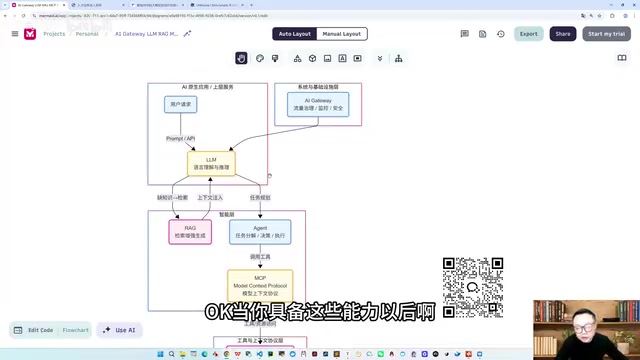
Engineers who can connect all these components and successfully deploy them to production typically command starting salaries of no less than 30K. This indirectly confirms that full-stack AI systems engineers with end-to-end capabilities remain in severely short supply.
The ReAct Pattern and the Evolution to Multi-Agent Systems
Among Agent implementation approaches, the ReAct (Reasoning + Acting) pattern is the most classic paradigm for autonomous single-agent planning, introduced in the 2022 paper ReAct: Synergizing Reasoning and Acting in Language Models by Princeton University and Google Research. Its core innovation is the interweaving of chain-of-thought reasoning with external tool invocation, forming a "Thought → Action → Observation" loop: the model first outputs its reasoning in natural language, explaining what it should do next; it then triggers a specific tool call; after the tool returns a result, the model receives and integrates the new information as an "Observation" and re-enters the reasoning phase — until it determines the task is complete and outputs a final answer. This pattern drives the agent to continuously advance the task through a think–act–observe cycle, with a transparent and interpretable reasoning process that is easy to debug.
However, this single-agent pattern has clear bottlenecks in complex scenarios: a single agent has a limited context window and can easily "lose its way" when handling very long task chains. When facing tasks that require multi-step, multi-role collaboration, the planning success rate of a single agent often falls short. This is the core driver behind the industry's continuous evolution toward more advanced architectures like Multi-Agent collaboration — decomposing complex tasks into sub-tasks handled by specialized agents working in concert, thereby improving the overall planning success rate and execution reliability of the system.
How do you achieve a task planning and execution success rate above 95% for an Agent? How do you make an agent "smarter with use"? These are the core challenges that must be addressed in depth when moving from prototype validation to production-grade applications.
Conclusion: Build a Global View First, Then Go Deep Layer by Layer
Many people complain that "AI is useless" or "the results are poor" — often because they haven't approached specific problems with an engineering mindset. For example, dumping unprocessed PDFs directly into a knowledge base and blaming the technology when retrieval fails.
The real path forward is to first establish a complete architectural understanding, then roll out and optimize in phases: making LLM capabilities more domain-specific, improving RAG retrieval accuracy, and making Agent planning and execution more reliable. Only then can an AI system truly reach production grade and deliver its intended business value.
Related articles

The Truth Behind Codex 'Build a Website in 5 Minutes': AI Isn't Creating Sites—It's Helping You Copy Them
Exposing the truth behind viral Codex 5-minute website videos: creators aren't building original sites with AI—they're copying shared prompts or scraping others' work. Learn AI coding tools' real limits.

Getting Started with AI Agent Development: A Complete Guide from Concept to Practice
A comprehensive guide to AI Agent architecture and development, covering automated marketing, intelligent customer service, and investment analysis scenarios with single and multi-agent collaboration.

The Truth Behind Codex 'Build a Website in 5 Minutes': AI Isn't Creating Sites — It's Helping You Copy Them
Exposing the truth behind viral Codex 5-minute website videos: creators aren't building original sites with AI — they're copying shared prompts or scraping others' work.