The Compute Gamble Gone Wrong: How OpenAI Is Striking Back Against Anthropic

Anthropic's compute shortfall is letting OpenAI undercut it on cost, quotas, and developer trust.
Despite Anthropic's revenue lead and having the world's most capable AI model, a conservative compute investment decision made two years ago is now costing them dearly. OpenAI is exploiting this weakness through generous quota resets, lower per-task costs, and savvy developer outreach — making its subscription a compelling alternative even as Anthropic's Fable remains marginally smarter.
In today's AI race, Anthropic appears to be leading on multiple fronts: its revenue has surpassed OpenAI's, and its latest-generation model (referred to here as "Fable") is widely considered the most capable AI model on Earth right now. Yet tech blogger Matthew Berman argues that a strategic miscalculation Anthropic made two years ago is now coming back to bite them — and OpenAI is exploiting it at every turn. The heart of this battle isn't just about model capability; it's a multidimensional contest of compute reserves, subscription value, and developer sentiment.
A Compute Misjudgment Two Years Ago — Planting Today's Seeds of Weakness
It all traces back to an interview with Anthropic CEO Dario Amodei. He openly admitted that he was unwilling to bet the entire company on compute: "Even if technology develops as fast as I expect, we don't know how quickly it will translate into revenue. If I'm off by a year in my growth estimate — if growth is 5x annually instead of 10x — you'd go bankrupt."
Driven by this caution, Dario opted for conservative infrastructure investment, leaving room for the possibility that "AI demand might not materialize as strongly as expected." As it turned out, AI demand surged far beyond anyone's projections. That "prudent" decision became Anthropic's biggest vulnerability today — it simply lacks the compute to generously serve its own most powerful model.
What makes this even more complex is that Anthropic was the first lab to release an ultra-large-scale parameter model. The inference cost of large language models doesn't scale linearly with parameter count — when model parameters leap from hundreds of billions to trillions, the GPU memory, bandwidth, and compute required for inference climb exponentially. In tech economics, this is known as the "capacity-demand scissors gap": when demand grows far faster than supply can expand, companies are forced to choose between service quality and service scale. The combination of "conservative compute investment" and "aggressively large models" created a perfect feedback loop of self-inflicted pain.
Subscription Quotas: OpenAI's Generosity Offensive
There are currently two ways to access these AI services: monthly subscriptions (ranging from $20 to $200) that provide fixed token quotas, or direct API access billed per token.
Tokens are the basic unit by which large language models process text — roughly 750 English words equates to about 1,000 tokens. The price difference between subscriptions and API pricing is essentially a consumer surplus redistribution strategy: subscriptions exchange a fixed monthly fee for "capped but generous usage," while APIs charge precisely for actual consumption. Crucially, API unit pricing is significantly higher than the equivalent subscription rate, which means the vast majority of users strongly prefer subscription quotas.
This is exactly where the two companies diverge. The OpenAI team resets ChatGPT account quotas almost every day or two — Berman even built a website showing that "OpenAI has a 94% chance of resetting your quota within the next 48 hours." From a business perspective, this frequent resetting is a "churn defense" mechanism: by continuously creating a sense of usage value, it reduces user motivation to migrate to competitors, while maintaining user stickiness at low marginal cost. After burning through a full week's quota, users find themselves "fully recharged" before long.

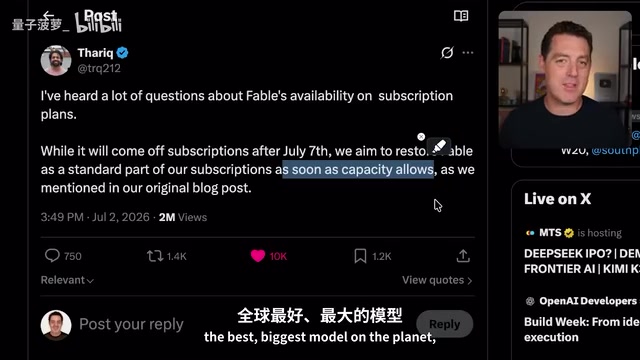
By contrast, Anthropic's quotas are not only stingier but almost never reset. Worse still, Anthropic at one point announced it would pull Fable from its subscription plan entirely, restricting access to the expensive API only. Berman called this "a massive mistake" — once Fable exits the subscription, using it would cost users roughly 10x more than GPT-5.6, which matches Fable on most benchmarks anyway.
The Numbers Don't Lie: Comparable Intelligence, Wildly Different Costs
Berman uses two charts to support his argument. On the Artificial Analysis intelligence index, Claude Fable ranks first with a score of 60, with GPT-5.6 right behind at 59 — a gap of just one point.
But on the "cost per task" metric, the gap is enormous: Fable costs approximately $2.75 to complete the same task that GPT-5.6 handles for just over $1.

From a user perspective: once Fable leaves the subscription tier, you don't even get the chance to use the world's most powerful model within your subscription. Your fallback options are still more expensive than GPT-5.6. Comparable intelligence, lower per-task cost, and more generous quotas — all these factors stack up to make an OpenAI subscription look extremely attractive.
Interestingly, Anthropic isn't oblivious to this. Every time it announces "Fable has one week left in the subscription," it extends the deadline at the last moment. An Anthropic researcher essentially confirmed the root cause: "Fable will be leaving the subscription... no, that's no longer accurate — we hope to restore Fable as a standard part of the subscription as soon as compute allows." The compute constraint is hiding in plain sight.
The Emotional Battlefield: Who's Winning Developer Hearts?
Beyond cost, Berman argues that OpenAI is also winning the "emotional battle." Sam Altman recently posted a shot across the bow: "Come use the best model... I genuinely love 5.6, because we don't treat you with contempt."
As someone who works with both companies, Berman admits he finds OpenAI's stance more appealing: more transparent, more generous, and better aligned with his own "ambitious and optimistic" vision for the future. He openly objects to Dario's fear-based marketing — repeatedly amplifying narratives around "white-collar job bloodbaths" — which he sees as not only inaccurate but damaging to the industry and public confidence.
Veteran vs. Rookie: Two Models and Their Trajectories
Berman uses a vivid sports analogy to describe the two models: GPT-5.6 is like a veteran athlete — likely the final model in the GPT-5 training lineage, yet the pinnacle of that series. Smart, efficient, reliable, it cuts straight to solutions. Fable, by contrast, is like a rookie just entering the league — raw talent that's astonishing, with post-training optimization barely underway and enormous room to grow.
The concept of "post-training" is key to understanding the gap between them. Modern large language model training is typically divided into two major phases: pre-training and post-training. Pre-training consumes the vast majority of compute, as the model learns general language patterns from massive text corpora. Post-training then uses techniques like supervised fine-tuning (SFT) and reinforcement learning from human feedback (RLHF) to transform "raw intelligence" into "usable assistant capabilities." As a rookie, Fable's post-training optimization has barely begun — its current performance may represent only a fraction of its capability ceiling. GPT-5.6, as the final iteration of a mature series, has been extensively refined through post-training, which is why it delivers higher "value for money" at equivalent parameter efficiency.
Berman predicts that OpenAI's GPT-5 series is approaching its growth ceiling, and GPT-6 has likely completed its base training and is currently in post-training. But if GPT-6 is also a larger, more expensive-to-serve model, OpenAI will eventually face the same supply-demand squeeze Anthropic is dealing with today. Fortunately, Sam Altman's early and aggressive bet on GPU compute means OpenAI has the capacity to smoothly serve its next-generation models.
Practical Advice: What Should You Choose Right Now?
For everyday users, Berman's recommendation is straightforward:
- If your budget allows for only one subscription, go with OpenAI. Fable is marginally stronger, but it's more expensive and there's significant uncertainty about whether it will remain on the subscription tier — which makes it difficult for developers to build stable applications on top of it.
- If you already have a ChatGPT subscription, use your quota to the fullest — don't hoard tokens. Quotas reset with a 30-day window and will expire anyway. With both companies competing fiercely, now is the time to build your applications.
The Ultimate Variable: Recursive Self-Improvement
So has Anthropic lost? Berman thinks "probably not," for two reasons. First, Fable has enormous room for efficiency gains, and as compute capacity expands, the service will eventually become more generous. Second — and more importantly, what he truly believes in — is the ultimate variable: Recursive Self-Improvement (RSI).
Recursive Self-Improvement is one of the core concepts in AI safety research, first proposed by I.J. Good in 1965, who called it an "intelligence explosion." Its central hypothesis is that once an AI system's intelligence surpasses a certain critical threshold, it can autonomously optimize its own architecture, training methods, or data processing capabilities — producing a more capable model than the previous generation, and so on in a loop. In theory, this could produce exponential capability gains in a very short time. Berman's reasoning: if Fable, as the current most capable model, can participate in developing the next generation, Anthropic's lead advantage will be "locked in" and self-reinforcing. "Once RSI kicks in, the leader tends to stay in the lead."
Finally, Berman offers a warning: developers are early adopters, and they're also the most likely to switch. Although many enterprises chose Anthropic over the past six months, those contracts are typically one year long — and they may flow back to OpenAI at renewal. Whatever developers choose, enterprises tend to follow — and in a race where Anthropic appears to be ahead, OpenAI is far from out of it.
Related articles

The Truth Behind Codex 'Build a Website in 5 Minutes': AI Isn't Creating Sites—It's Helping You Copy Them
Exposing the truth behind viral Codex 5-minute website videos: creators aren't building original sites with AI—they're copying shared prompts or scraping others' work. Learn AI coding tools' real limits.

Getting Started with AI Agent Development: A Complete Guide from Concept to Practice
A comprehensive guide to AI Agent architecture and development, covering automated marketing, intelligent customer service, and investment analysis scenarios with single and multi-agent collaboration.

The Truth Behind Codex 'Build a Website in 5 Minutes': AI Isn't Creating Sites — It's Helping You Copy Them
Exposing the truth behind viral Codex 5-minute website videos: creators aren't building original sites with AI — they're copying shared prompts or scraping others' work.