The Field Equation: Bringing Math Equations to Life with Real-Time Shaders

How The Field Equation uses real-time shaders and SDF ray marching to create breathing geometric art.
The Field Equation is an experimental project that uses real-time shaders and field equations to fold geometric structures into a "breathing" dynamic object. This article explores the technical principles of procedural generative art, including SDF ray marching, noise functions, and the aesthetics of creating math-driven visual life.
When Mathematical Equations Become Breathing Visual Objects
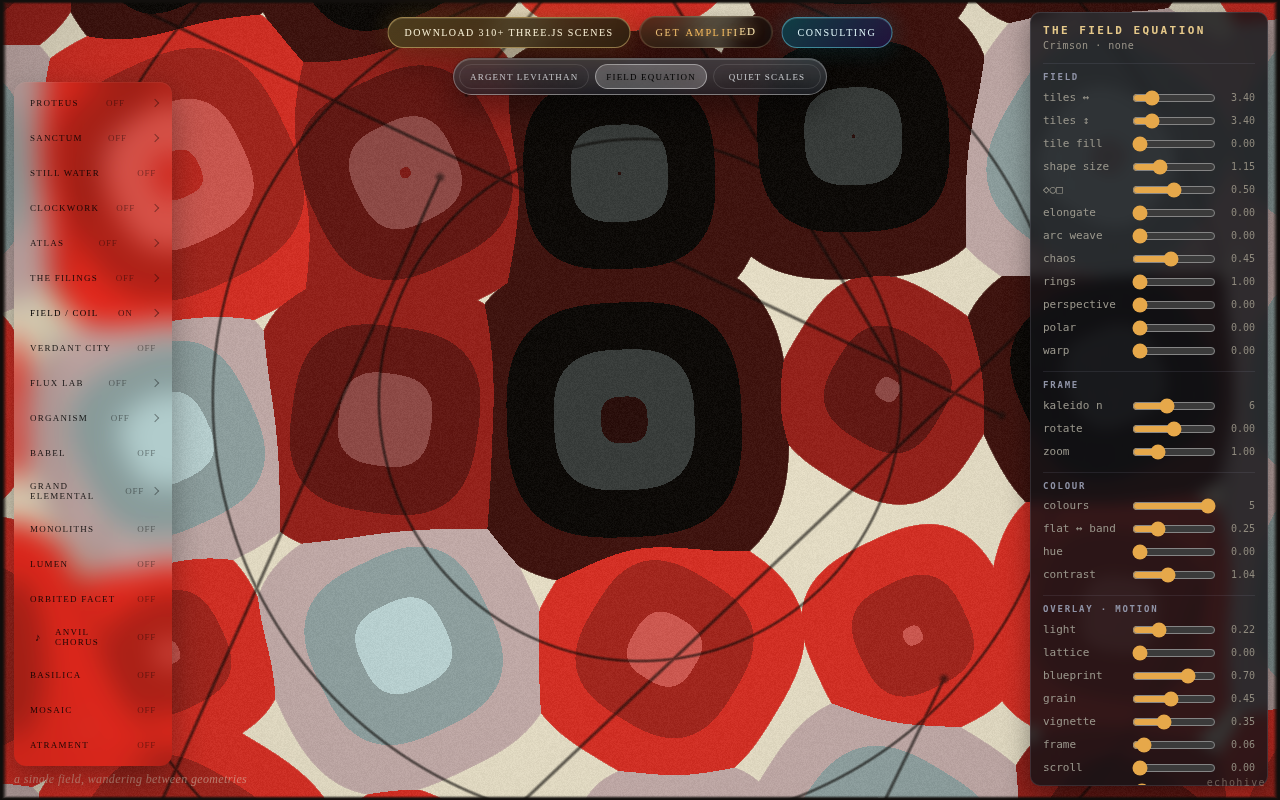
Recently, an experimental project called "The Field Equation" sparked discussion on Hacker News. Its positioning is quite unique—folding a geometric structure driven by real-time shaders into a dynamic object that seems to be "breathing." While the community discussion is still in its early stages, the technical direction it represents is worth exploring in depth: namely, how to generate visual forms with a sense of life using pure mathematics and GPU computation.
This type of project is not a 3D modeling work in the traditional sense, but rather a quintessential example of Procedural Generative Art. There are no pre-built mesh models—all forms, dynamics, and lighting are computed in real time by mathematical functions and shader code at runtime.
Procedural generative art has a history spanning more than half a century. As early as the 1960s, pioneering artists such as Vera Molnár and Manfred Mohr began creating with algorithms and mechanical plotters, exploring the possibilities of "rule-generated aesthetics." With the invention and popularization of the GPU, this field underwent a fundamental leap from serial CPU computation to highly parallel real-time rendering—the barrier to entry dropped dramatically, while the dimensions of expression extended from static images to dynamic living entities that continuously evolve along a timeline. It's worth mentioning that the Demoscene culture, which rose in Europe in the 1980s, has had a profound influence on modern shader art: Demoscene competitors pursued maximum visual impact under extreme hardware and size constraints (such as 64KB executables). This extreme challenge directly spawned and refined core techniques like SDF ray marching, evolving them from academic concepts into engineering-practical real-time rendering tools.
What Is a "Field Equation"
A "Field Equation" refers to a mathematical expression that describes the numerical state of every point in space. In computer graphics, such equations are often used for Implicit Surface modeling—for example, the well-known Signed Distance Field (SDF) technique.
A Signed Distance Field encodes the distance from each point in three-dimensional space to the nearest geometric surface as a numerical value. "Signed" means the value carries a sign: points inside the object return negative values, points outside return positive values, and the surface itself returns zero. This property gives SDFs a natural capacity for boolean operations—the union, intersection, and difference of two SDFs can be achieved simply by taking the min/max/negation of their values, without any mesh clipping operations. SDF was originally introduced by the computer vision field for font rendering (a classic 2007 Valve paper applied it to anti-aliasing game textures), and after promotion by Inigo Quilez and others, it became a core tool for real-time ray marching rendering. Modern game engines such as Unreal Engine also use SDF for global illumination (Lumen) and soft shadow computation.
By performing Ray Marching on field equations within a Fragment Shader, developers can directly "sculpt" complex three-dimensional geometry without using any polygon meshes. Ray marching differs from the analytical intersection solving of traditional ray tracing by adopting an iterative approximation strategy: starting from the camera, along the direction of each ray, the algorithm queries the SDF value at the current position—this value represents the maximum step size that can "safely advance without penetrating any surface"—and repeats this process until it hits a surface or exceeds the maximum step count. This "Sphere Tracing" method was formally proposed by John C. Hart in 1996; its advantage lies in requiring no stored geometric data, with the entire scene described by pure mathematical functions.
The "breathing" effect is typically achieved by injecting a time variable (time) into the equation's parameters—as time progresses, the shape of the field undergoes periodic expansion and contraction, creating a visual sensation similar to the rise and fall of a living organism.
The Technical Charm of Real-Time Shader Geometry
Visual Wonders Generated Purely from Code
The core appeal of The Field Equation lies in its "creation from nothing." Traditional 3D content relies on artists modeling, texturing, and rigging skeletons, while shader geometry art is defined entirely by code. A few hundred lines of GLSL code can render forms of infinite detail and continuous variation in a browser or on a GPU.
GLSL (OpenGL Shading Language) is a C-like shader programming language that runs on the GPU, and the fragment shader is the program unit responsible for determining the final color of each pixel. In SDF-based generative art, the fragment shader carries out all the rendering work: performing ray marching, lighting computation, color mapping, and other operations in parallel for every pixel on the screen. The GPU's thousands of computing cores make this "per-pixel independent computation" model possible. The works showcased on the Shadertoy platform often have at their core just a single mainImage() function, which takes pixel coordinates and time as input and outputs color values—behind this minimalist interface is the powerful support of the GPU's massively parallel computing architecture.
The browser-side shader ecosystem has been undergoing significant upgrades in recent years. WebGL (based on OpenGL ES 2.0/3.0) has been mature and widely adopted for many years, while its successor WebGPU represents a deeper leap in capability—it maps directly to modern low-level graphics APIs (Vulkan, Metal, Direct3D 12), providing lower driver call overhead, native Compute Shader support, and finer control over GPU resources. This means future in-browser shader art can carry more complex physical simulations, particle systems, and neural network inference. Experimental projects like The Field Equation are at the forefront of this capability leap.
This approach brings several notable advantages:
- Extremely small size: The entire work may be only a few KB of code, yet it can generate infinitely complex imagery.
- Resolution-independent: Because it is driven by mathematical functions, the imagery can be losslessly scaled to any resolution.
- Real-time dynamics: All changes are computed instantly, naturally supporting interaction and parameter adjustment.
The Dynamic Design Behind the "Sense of Breathing"
To make a geometric object appear "alive," the key lies in the design of its rhythm of motion. Truly excellent generative art does not simply make objects rotate or scale at a uniform speed, but rather simulates organic, irregular pulsation by superimposing multiple sine waves of different frequencies and noise functions (such as Perlin/Simplex Noise).
Perlin Noise was developed by Ken Perlin in 1983 for the film Tron, and he won an Academy Award for Technical Achievement for this technique. It generates a continuous field of pseudo-random values by defining random gradient vectors at grid points and then smoothly interpolating between them—compared to pure random numbers, it has a "band-limited" property, meaning the noise exhibits natural undulation at specific scales. Simplex Noise is an improved version proposed by Ken Perlin in 2001, with lower computational complexity in higher dimensions and elimination of directional artifacts along axis-aligned directions. In shader animation, developers typically superimpose noise at multiple different frequencies (octaves), called "Fractional Brownian Motion (fBm)," to simulate natural phenomena such as clouds, water surfaces, terrain, and muscle tremors. Injecting a time variable into the spatial coordinates of the noise generates flowing, non-periodic organic dynamics—which is precisely what fundamentally distinguishes the "sense of breathing" from simple sine wave animation.
The reason this "breathing" quality is so moving is that it approximates the natural rhythms of living organisms—non-mechanical, undulating, and slightly random. This is also the key step for procedural art to move from "technical demonstration" to "emotional expression."
The Technical Lineage and Community Culture of Generative Art
From Shadertoy to Independent Creation
The technical ecosystem in which The Field Equation resides can be traced back to online shader communities such as Shadertoy. Over the years, creators represented by Inigo Quilez have promoted the SDF ray marching technique, making it possible to "render an entire world with a single fragment shader."
Inigo Quilez (screen name iq) is one of the most influential technical evangelists in the field of generative art and real-time shaders. He has published numerous groundbreaking works on the Shadertoy platform (which he co-founded in 2013) and has systematically compiled dozens of analytical formulas for SDF primitives, smooth boolean operation (smooth union) techniques, and approximation algorithms for soft shadows and ambient occlusion on his personal website. Among them, the "smooth minimum" function (smin) allows two SDFs to blend naturally at their contact boundary rather than producing a hard edge—a key tool for simulating organic forms such as biological tissue and merging droplets. Quilez also popularized the technique of estimating normals based on SDF—approximating the gradient by sampling the SDF differences of neighboring points around a target point, thereby obtaining normal vectors for lighting computation without explicitly storing any normal data. This complete technical system forms the theoretical foundation of contemporary procedural shader art.
What Shadertoy reflects is a broader tradition of minimalist programming culture. This is of one spirit with the Demoscene: under self-imposed constraints (a single shader function, limited line count, no external resources), creators are forced to push algorithmic creativity to its extreme, often spawning unexpected technical breakthroughs and aesthetic discoveries. The constraint itself becomes a driving force for creation rather than an obstacle.
Such creation is both a programming challenge and an artistic practice. Developers need to possess both mathematical grounding (understanding distance fields, vector operations, and lighting models) and aesthetic intuition (grasping color, rhythm, and composition). The Field Equation is precisely a continuation of this tradition—transforming cold, hard field equations into visual experiences with warmth.
A Niche but Continuously Growing Creative Direction
Although the immediate popularity of such projects on Hacker News is limited, generative art is gaining increasingly widespread attention. From NFT generative art platforms to real-time VJ visual performances, and to procedural content generation in games, shader-driven technology is being applied across multiple fields.
Experiments like The Field Equation may appear to be merely a "toy," but they are in fact exploring the boundaries of computer graphics expression. They remind us that the simplest mathematics can often give birth to the richest forms.
The Intersection of Mathematics and Aesthetics
The value of The Field Equation lies not in the current volume of community discussion, but in the creative paradigm it represents—defining form with equations, imparting life with time, and presenting in real time with the GPU. This is a unique path lying between science and art.
For developers interested in creative coding, computer graphics, or generative art, such projects are excellent learning examples. They prove that in today's era where AI-generated content prevails, creation driven purely by hand-written code and mathematics still possesses irreplaceable beauty and depth of thought. When large language models can generate code and diffusion models can generate images, this creative process of "turning mathematics into breath with one's own hands" itself becomes a precious form of human expression—its value lies not only in the result, but even more in the complete journey of thought from equation to a sense of life.
Key Takeaways
Related articles

The Truth Behind Codex 'Build a Website in 5 Minutes': AI Isn't Creating Sites—It's Helping You Copy Them
Exposing the truth behind viral Codex 5-minute website videos: creators aren't building original sites with AI—they're copying shared prompts or scraping others' work. Learn AI coding tools' real limits.

Getting Started with AI Agent Development: A Complete Guide from Concept to Practice
A comprehensive guide to AI Agent architecture and development, covering automated marketing, intelligent customer service, and investment analysis scenarios with single and multi-agent collaboration.

The Truth Behind Codex 'Build a Website in 5 Minutes': AI Isn't Creating Sites — It's Helping You Copy Them
Exposing the truth behind viral Codex 5-minute website videos: creators aren't building original sites with AI — they're copying shared prompts or scraping others' work.