The Four Stages of AI Engineering Evolution: From Prompt to Loop Engineering Explained

From Prompt to Loop Engineering: how AI engineering evolves through four paradigm shifts.
This article systematically examines the four evolutionary stages of AI engineering — Prompt Engineering, Context Engineering, Runtime Environment Engineering, and Loop Engineering. It details how each stage addresses a distinct challenge, from crafting better prompts to building autonomous closed-loop AI systems. Loop Engineering, the final stage, enables AI to self-execute, self-evaluate, and self-correct within human-defined rules, fundamentally transforming the human-AI collaboration model.
Introduction: The Paradigm Shift in AI Engineering
From the hype around prompt engineering to the rise of Loop Engineering, AI engineering has undergone four critical paradigm shifts. This isn't merely a technology stack upgrade — it represents a fundamental restructuring of the human-AI collaboration model. Humans are gradually stepping back from being "hands-on operators" to becoming "rule-makers and supervisors," while AI evolves from a passive response tool into an intelligent collaborator capable of autonomous closed-loop operation.
Based on an in-depth analysis by an IEEE Associate Editor, this article systematically examines the core logic and bottlenecks of each of the four stages of AI engineering, and how the final stage — Loop Engineering — enables AI to truly "run on its own."
The Four Stages of AI Engineering Evolution: From Human-in-the-Loop to Human-on-the-Loop
Stage 1: Prompt Engineering — Solving the "AI Can't Understand Us" Problem
The central challenge of prompt engineering is how to ask questions. Whether AI delivers useful answers depends almost entirely on the quality of the human-written prompt. Users must constantly refine their wording and rely on techniques to improve results — even a slight deviation in the question can lead to drastically different outcomes.
The rise of Prompt Engineering is closely tied to the release of ChatGPT in 2022. Its underlying principle is the autoregressive generation mechanism of large language models (LLMs) based on the Transformer architecture — the model predicts the next most likely token based on the input token sequence. This means that even minor changes in wording, structure, or punctuation can cause significant differences in output. The industry developed classic prompting techniques such as Chain-of-Thought, Few-shot Learning, and Role-playing, all of which essentially leverage the model's conditional probability distribution to steer the output direction.
The more critical bottleneck is this: the model has no memory and cannot self-correct. For complex multi-step tasks, every step requires the human to re-enter context and verify results. Efficiency is highly dependent on human expertise, making large-scale scaling virtually impossible.
Stage 2: Context Engineering — Giving AI "the Right Information"
Context engineering shifts the focus from "how to craft the perfect question" to what background material to provide the AI. Documents, code snippets, chat history — the completeness of these materials directly determines the quality of AI responses.
The core technology behind context engineering is the RAG (Retrieval-Augmented Generation) architecture. RAG uses vector databases (such as Pinecone, Weaviate, Milvus) to convert enterprise knowledge base documents into high-dimensional vector embeddings, retrieving the most relevant document fragments in real time when a user asks a question and injecting them into the model's context window. With the emergence of ultra-long context windows like Claude's 200K and Gemini's 1 million tokens, the amount of background information models can process has increased dramatically. However, precisely selecting the most valuable context within a limited window remains the core engineering challenge.
At this stage, AI can already understand longer texts and even possesses short-term memory, but for complex requirements, humans still need to break tasks into segments and feed materials in batches. Efficient information feeding becomes the key capability for unlocking AI's potential.
Stage 3: Runtime Environment Engineering — Enabling AI to "Get Things Done"
This stage addresses the question of where to run. Only by building a secure, scalable runtime foundation for agents can they truly invoke external tools and execute real tasks. Building dedicated sandboxes, implementing resource scheduling, and ensuring permission isolation become top priorities.
The technical foundations of runtime environment engineering include containerization (Docker/Kubernetes), sandbox isolation (such as gVisor, Firecracker micro-VMs), and Function Calling mechanisms. Products like OpenAI's Code Interpreter and Anthropic's Computer Use are typical representatives of this stage. Sandbox environments ensure that AI code execution doesn't compromise host system security, while protocols like MCP (Model Context Protocol) standardize the interaction interface between AI and external tools, enabling agents to safely manipulate file systems, call APIs, execute database queries, and perform other real-world operations.
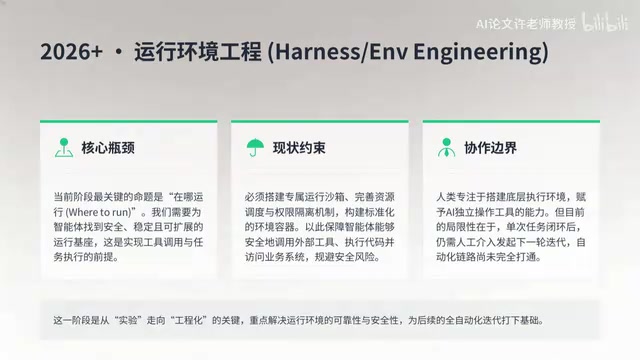
Having a smart model isn't enough — it also needs a "stage" where it can perform with confidence. But even so, each iteration still requires manual human triggering, and the automation pipeline hasn't been fully connected.
Stage 4: Loop Engineering — Making AI "Automatically Meet Standards"
Once prompt design, context preparation, and runtime environment setup are all mature, the only remaining non-automated step is humans manually issuing instructions. Loop Engineering aims to eliminate this final manual step.
The theoretical foundation of Loop Engineering traces back to the negative feedback loop concept in Cybernetics and the CI/CD (Continuous Integration/Continuous Deployment) pipeline philosophy in software engineering. In the AI domain, it aligns with the practices of autonomous coding agents like Devin and SWE-Agent. The core idea is embedding the OODA loop (Observe-Orient-Decide-Act) into AI systems, giving them the ability to self-evaluate and iteratively correct. Unlike traditional single-pass inference, Loop Engineering emphasizes convergence across multiple interaction rounds — the system must trend toward the target state within a finite number of steps, or trigger a circuit-breaker mechanism for human intervention.
Humans only need to set rules, goals, and validation criteria — all execution is handed off to AI. AI runs autonomously in loops, scales automatically, and humans shift from step-by-step operators to decision-makers, truly liberating their creativity.
Loop Engineering Deep Dive: Five Core Components
Loop Engineering is essentially a system architecture that enables AI to run in closed loops and continuously self-improve. It packages prompts, context, and runtime environments into an automated pipeline, enabling autonomous task initiation, result checking, error correction, and recording each correction as a reference for the next iteration.
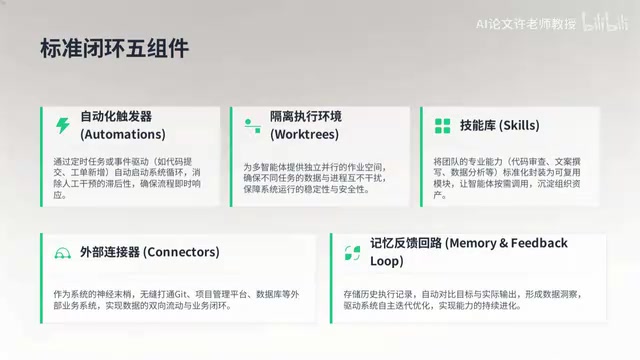
Component 1: Automated Triggers
Processes are automatically initiated based on time or events — running on a schedule or triggered instantly by a code commit. No manual operation needed; the system "finds time to start work" entirely on its own. This is similar to Webhook and Cron Job mechanisms in traditional DevOps, but in Loop Engineering, triggers also need intelligent judgment capabilities — such as identifying the priority of triggering events, determining whether the current system load is suitable for launching new tasks, and performing reasonable queue scheduling among multiple concurrent triggers.
Component 2: Isolated Execution Environments
Each agent is assigned a dedicated space where they run without interfering with each other, ensuring security and stability. This is a capability inherited and strengthened from the runtime environment engineering stage. In scenarios where multiple agents work in parallel, isolated execution environments must not only prevent resource contention and data contamination but also support rapid environment creation and destruction (typically completed in seconds) to handle the elastic demands of high-concurrency tasks.
Component 3: Skill Libraries
Common capabilities like code review and data analysis are encapsulated as reusable modules that agents can invoke at any time, enabling capability sharing and knowledge transfer. The design philosophy of skill libraries is similar to the service registration and discovery mechanism in microservices architecture — each skill module has standardized input/output interface definitions, and agents can dynamically combine multiple skills based on task requirements to form complex workflows. As the skill library continues to grow, the system's capability boundaries keep expanding.
Component 4: External Connectors
Serving as the system's "nervous system," these connect external systems like Git, project management tools, and databases, enabling automatic data flow and forming a complete business closed loop. External connectors are typically implemented using middleware technologies such as API gateways and message queues (like Kafka, RabbitMQ), and need to handle engineering details including authentication, rate limiting, data format conversion, and error retries. Emerging protocols like MCP (Model Context Protocol) are providing more unified standardization for this layer.
Component 5: Memory Feedback Loop
Every run is recorded, compared against objectives, and automatically adjusted once optimization opportunities are identified. The system gets better with each run — this is the core mechanism that enables Loop Engineering to achieve continuous evolution.
The memory feedback loop is typically implemented with a two-tier architecture combining short-term memory (working memory) and long-term memory. Short-term memory maintains current task progress through conversation context and state variables; long-term memory stores historical experience through vector databases or structured knowledge graphs. In practice, the system encodes the inputs, outputs, error logs, and correction strategies from each run as experience entries, which are automatically retrieved and applied when similar scenarios arise later. This shares similarities with the Experience Replay mechanism in reinforcement learning, but focuses more on symbolic rule accumulation rather than pure numerical optimization.
Practical Scenarios: How Loop Engineering Lands in the Real World
Software Development: A Fully Automated Closed Loop from Requirement Submission to Code Merge
In software development scenarios, top-level rule configuration is key. The delivery standards for each step — requirement modules, development, unit testing, code review, and bug fixing — need to be clearly defined. For example, unit test pass rate must be 100%, and static analysis must show zero warnings.
Once a requirement document is submitted, the automation mechanism kicks in immediately: the agent automatically pulls historical code and development standards as context, invokes coding skills in an isolated sandbox to generate code, autonomously runs tests, identifies defects, and fixes issues until code quality meets standards, then automatically submits a PR and archives the work. Developers can then invest their time in higher-value work like system design and business innovation.
This workflow aligns closely with current industry practices. Tools like GitHub Copilot Workspace and Cursor have already demonstrated the potential of AI-assisted coding, while Loop Engineering takes it to a higher level — not just code generation, but a complete software engineering closed loop encompassing testing, review, and repair. Static analysis tools (such as SonarQube, ESLint) and testing frameworks (such as Jest, PyTest) serve as validators for quality standards, providing AI with objective, quantifiable quality feedback signals.
After setting automatic termination conditions (e.g., triggering code merge after two consecutive validation rounds with zero defects), the entire process requires no human intervention, compressing what might have taken hours into minutes.
New Media Content Production: An Automated Pipeline for Daily High-Quality Content
In content production scenarios, the top-level design needs to clearly define the style of short video copy and covers, fully aligned with account positioning, audience perception, and brand image. Every piece of content must pass scoring for topic selection, keywords, and reading hooks (e.g., hook score ≥ 8 to pass).

The system automatically scrapes industry hot topics and real-time news daily. The agent automatically loads account positioning and viral content history as context, then batch-generates copy according to rules. The self-check phase reviews the copy's logic, appeal, and relevance — if it doesn't meet standards, it's automatically revised. After passing validation twice consecutively, it's automatically pushed to the operations dashboard. From topic selection to generation to validation, the entire process requires no human intervention.
It's worth noting that "validation standards" in content production scenarios are more challenging than in code scenarios. Code has clear pass/fail criteria (whether tests pass, whether there are syntax errors), while content quality assessment involves subjective aesthetics and communication principles. Loop Engineering in this scenario typically employs multi-dimensional scoring models — combining statistical features from historical viral content data (such as title word count, emotional word density, information density) with LLM-as-Judge approaches (using large models as reviewers) to convert subjective judgments into a quantifiable metric system as much as possible.
Four-Stage Comparison: Key Differences at a Glance
| Stage | Core Question | Human Role | AI Capability Boundary |
|---|---|---|---|
| Prompt Engineering | How to ask | Instruction designer | Single Q&A, no memory |
| Context Engineering | What materials to provide | Knowledge base maintainer | Short-term memory, cannot independently complete complex tasks |
| Runtime Environment Engineering | Where to run | Environment builder | Can invoke tools, but cannot autonomously close the loop |
| Loop Engineering | Who executes | Rule-maker / Supervisor | Autonomous loops, self-correction, continuous optimization |
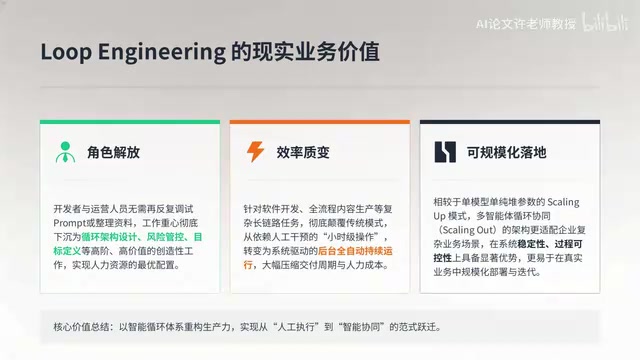
The most fundamental change is this: humans evolve from being hands-on at every step to only needing to set rules and acceptance criteria. AI transforms from a passive instruction-following tool into a collaborator that actively learns and improves. The entire work model shifts from reactive response to autonomous closed-loop operation, achieving exponential improvements in innovation and efficiency.
From an organizational management perspective, the evolution across these four stages also corresponds to different team capability requirements. The prompt engineering era needs "people who know how to ask questions"; context engineering needs "people who understand knowledge management"; runtime environment engineering needs "people who understand infrastructure"; and in the Loop Engineering era, the scarcest talent is "people who can design system-level rules, define quality standards, and manage exception boundaries" — this is fundamentally an architect's mindset, not an operator's mindset.
Summary and Outlook
Loop Engineering didn't appear out of thin air — it's a natural extension of the accumulated capabilities from prompt engineering, context engineering, and runtime environment engineering. Its core value lies in: completely liberating humans from repetitive operations, allowing AI to run autonomously and continuously evolve within a clearly defined rule framework.
Compared to simply scaling up model parameters, this multi-agent loop collaboration architecture is better suited for complex enterprise business scenarios, offering greater stability, easier monitoring and adjustment of execution processes, and more straightforward paths to large-scale deployment and continuous optimization. From a technology trend perspective, Loop Engineering is highly aligned with popular Multi-Agent frameworks (such as AutoGen, CrewAI, LangGraph), which are providing increasingly mature infrastructure support for loop engineering.
Of course, Loop Engineering's real-world implementation also faces practical challenges: How do you define rules that are precise enough without being overly constraining? How do you design effective circuit-breaker mechanisms to prevent AI from endlessly looping in the wrong direction? How do you find the optimal balance between automation and human oversight? The answers to these questions will gradually become clearer through practice.
For developers and operations professionals, the core competitive advantage of the future will no longer be "writing a good prompt," but rather designing efficient loop architectures, defining precise validation standards, and managing system-level risks — these are the truly high-value capabilities in the era of AI engineering.
Related articles

Disaster and Glory of the Apollo Program: The History We Must Revisit Before Returning to the Moon
From the fatal Apollo 1 fire to Apollo 8's daring lunar orbit to Apollo 11's successful landing—revisiting the disasters, fears, and compromises of the Apollo program and their lessons for today's return to the Moon.

Netflix Trust Exercise Turns Into Firing Trap: Where Are the Boundaries of Corporate Trust?
A Netflix employee was fired after sharing private info in a trust exercise. We analyze the risks of corporate trust exercises and how employees can protect themselves.

AMD CDNA5 Architecture Deep Dive: Technical Evolution and the AI Computing Competition Landscape
Deep analysis of AMD's CDNA5 architecture covering Chiplet packaging upgrades, HBM memory evolution, and low-precision compute optimization, examining how AMD challenges NVIDIA's AI chip dominance.