The Real Bottleneck for Conversational AI: Model Capability or Training Data Quality?

Is conversational AI limited by model capability, training data quality, or systems engineering?
Conversational AI performs well in the lab but stumbles in real conversations full of interruptions, hesitations, and language switching. This article explores whether the bottleneck is model architecture, overly clean training data, or system-level pipeline issues—covering ASR, VAD, speaker diarization, and practical advice for developers.
AI Is Smart in the Lab, Clumsy in the Real World
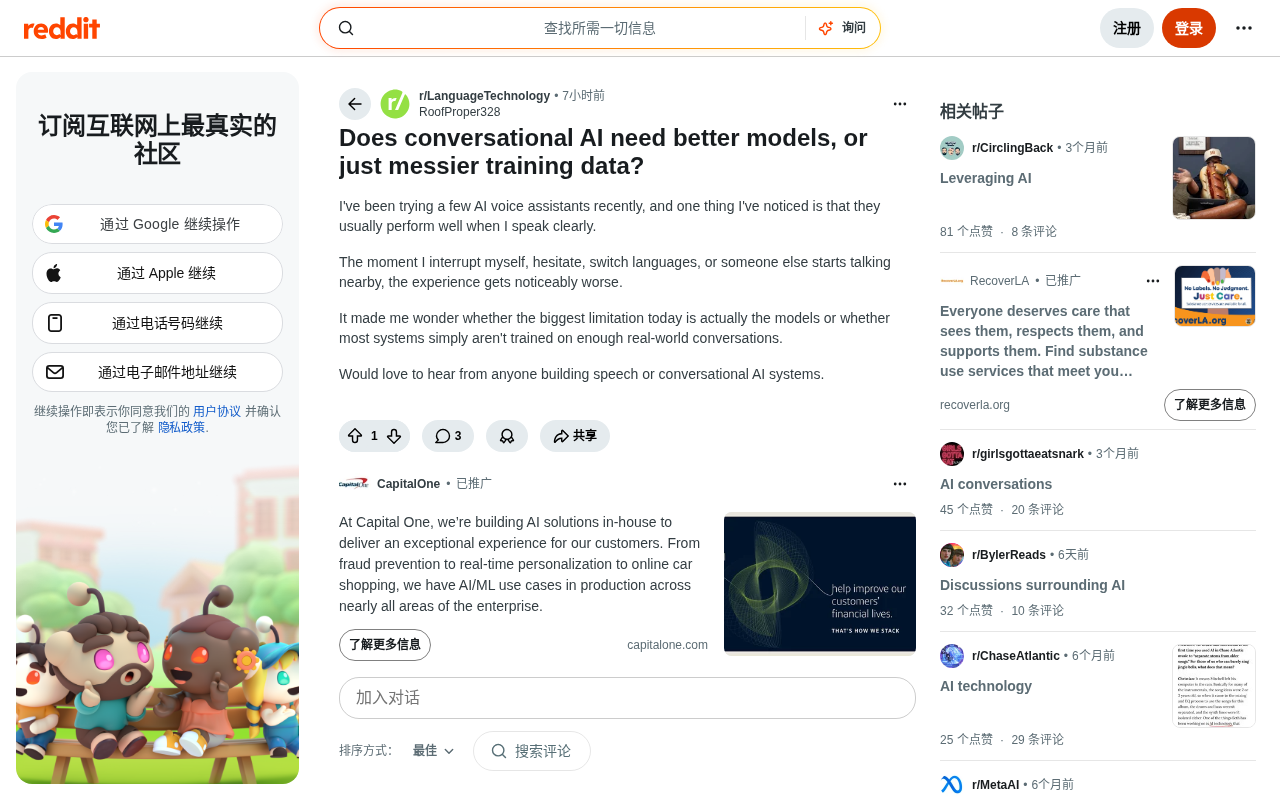
Recently on Reddit, a developer raised a question that cuts right to the industry's pain point: Does conversational AI really need better models, or does it just need "messier" training data?
He shared his experience using various AI voice assistants: when he spoke clearly and slowly, these systems performed quite well. But the moment he interrupted himself mid-sentence, hesitated and paused, switched languages, or someone nearby started talking, the entire interaction experience noticeably degraded. This seemingly simple observation reveals the most central contradiction in the real-world deployment of conversational AI today.
This question is worth digging into because it touches on the vast gap between an AI system's "paper capability" and its "real-world capability." On standardized test sets, today's speech recognition and dialogue models have reached or even surpassed human accuracy. But once they enter noisy, casual, non-idealized real conversation scenarios, performance drops off a cliff.
The "Chaos" of Real Conversations Far Exceeds Training Data
Human Conversation Itself Is Imperfect
Real human conversation is full of "noise" that machines struggle to handle:
- Self-interruption and restarts: "I want—no, wait, actually what I want is..."
- Fillers and hesitations: "Um... uh... you know"
- Language mixing: In multilingual environments, people often switch between two or three languages within a single sentence
- Overlapping speech: Multiple people speaking at once, with background conversations intertwined
- Incomplete sentences: Suddenly changing one's mind halfway through
These phenomena are ubiquitous in everyday conversation, yet they are systematically "cleaned out" of most training datasets. Researchers and engineers often prefer to train models on clean, well-annotated, structurally complete corpora, because this makes it easier to achieve impressive evaluation metrics.
It's worth noting that the "language mixing" mentioned above has a dedicated term in linguistics: Code-Switching, which refers to the phenomenon where bilingual or multilingual speakers fluently switch between two or more languages within a single conversation. It is extremely common in Southeast Asia, South Asia, Africa, and overseas Chinese communities. For example, Singapore's "Singlish" mixes Chinese and English, and India's Hinglish (Hindi + English) are both typical cases. Code-switching poses a fundamental challenge to ASR systems: traditional monolingual acoustic models cannot handle phoneme-level language switching, and a language model's vocabulary and grammatical assumptions also break down at switching boundaries. Current mainstream approaches include: training multilingual joint models (e.g., OpenAI Whisper supports 99 languages), building dedicated code-switching corpora (e.g., the SEAME dataset), and dynamically switching decoding strategies via a language identification module.
Data "Cleanliness Obsession" Creates Fragile Models
This is precisely where the problem lies. When a model is trained mainly on "idealized" clean data, what it learns is an oversimplified world. Once it encounters real-world chaos outside its training distribution, the model's generalization ability declines sharply. This is why that Reddit user found that the moment he stopped "cooperating" with the system, the experience immediately collapsed.
This phenomenon has a technical term in machine learning: Distribution Shift. When the distribution of a model's training data differs significantly from that of its actual deployment environment, model performance degrades systematically. Distribution shift is especially severe in conversational AI: mainstream speech recognition training sets (such as LibriSpeech and CommonVoice) mostly come from read recordings or controlled environments, with high signal-to-noise ratios, even speech rates, and complete sentences. Meanwhile, spontaneous speech in real deployment scenarios differs fundamentally from read speech in its linguistic characteristics—spontaneous speech is full of disfluency markers, including filled pauses, self-corrections, and sentence fragments, features that are severely underrepresented in existing mainstream training sets.
In other words, in many cases it's not that the model isn't smart enough, but that it has never seen the real world.
Model vs. Data: This May Be a False Dichotomy
The Two Are Deeply Coupled and Hard to Separate
Framing the problem as "either improve the model or improve the data" may itself be misleading. These two dimensions are deeply coupled and mutually constraining:
Those who support the "data is the bottleneck" view argue: The architecture of modern large models is already powerful enough—Transformers and their variants are far from saturated in capacity. What truly limits them is that they haven't seen enough diverse, messy real conversation samples. Incorporating more data containing interruptions, hesitations, multiple languages, and overlapping speech will naturally improve performance.
Those who support the "model is the bottleneck" view argue: Even with messy data, current model architectures still have fundamental limitations in handling real-time inference, context memory, speaker separation, and intent understanding. For example, real-time interruption handling requires low-latency streaming inference capability—which is exactly an inherent weakness of the standard Transformer architecture. The standard Transformer's self-attention mechanism requires global computation over the entire input sequence, making it naturally unsuited for the streaming scenario of "processing while receiving input." To address this, the industry has developed various variant approaches: streaming Transformers limit the attention scope through sliding windows; architectures based on State Space Models (SSM) such as Mamba achieve sequence modeling with linear complexity, making them more suitable for real-time inference; end-to-end speech language models (Speech LLM) attempt to bypass the ASR+NLU cascaded pipeline, modeling semantics directly from audio features to shorten the latency chain at the architectural level. This is more of an architecture and engineering problem than purely a data problem.
The More Likely Answer: A System-Level Pipeline Problem
The challenges of conversational AI often don't lie in a single component but constitute a system-level pipeline problem. A complete voice assistant typically includes:
- Voice Activity Detection (VAD): Determining who is speaking and when
- Automatic Speech Recognition (ASR): Converting speech to text
- Speaker separation: Distinguishing multiple sound sources
- Natural Language Understanding (NLU): Understanding user intent
- Dialogue management: Maintaining context and state
- Speech synthesis (TTS): Generating responses
Among these, "Speaker Diarization" is a key challenge in multi-person conversation scenarios, tasked with answering "who said what and when." Modern speaker diarization systems typically combine speaker embeddings (e.g., d-vector, x-vector) with clustering algorithms to segment the audio stream and label it to different speakers. However, in real scenarios, overlapping speech segments often cause diarization accuracy to drop significantly—and in human conversation, the overlap ratio can be as high as 20% or more. In recent years, end-to-end neural network diarization approaches (such as EEND) have begun to jointly optimize diarization and recognition, but they still face significant challenges in scenarios with more than four people speaking simultaneously. This is one of the fundamental reasons why multi-person meeting transcription products deliver such uneven experiences.
If any one component fails in a real scenario, the overall experience collapses. The user's perception that "the AI got dumber" may simply be VAD misjudging in a noisy environment, or ASR making errors during language switching—none of which is directly related to the intelligence level of the core language model.
Practical Advice for Developers
Actively Embrace "Dirty Data"
For teams building speech or dialogue systems, this discussion points to a clear direction: don't over-clean your training data. Deliberately incorporating real-world messy samples—corpora containing background noise, multi-person conversations, slips of the tongue, and language mixing—can significantly improve a model's robustness in deployment environments.
End-to-End Evaluation Matters More Than Single-Point Metrics
Don't just fixate on single-point metrics like ASR Word Error Rate (WER). Word Error Rate (WER) is calculated as (substitution errors + deletion errors + insertion errors) / total reference words, but it has obvious limitations: it treats all words equally and cannot distinguish the differing impacts of keyword errors versus filler-word errors. More importantly, WER's correlation with actual user satisfaction drops significantly in noisy scenarios—research shows that in spontaneous speech scenarios, when WER rises from 5% to 8%, the user-perceived task completion rate may drop by over 30%. This has driven the industry toward evaluation dimensions closer to user experience, such as Semantic Error Rate (SER) and Task Completion Rate. End-to-end evaluation should be conducted in real, noisy, non-cooperative scenarios, focusing on measuring the "task completion rate" and "interaction fluency" that users truly care about.
Streaming and Real-Time Capabilities Are Core Differentiators
The ability to support interruption at any time and dynamic interjection is becoming the watershed for high-quality voice assistants. This requires both streaming inference support at the model level and dynamic state updates at the dialogue management level—model capability and system engineering must evolve in tandem.
Conclusion: Not an Either/Or Choice, but a Comprehensive Upgrade
Returning to the original question: Does conversational AI need better models or messier training data? The answer is very likely—both, plus more solid systems engineering.
The biggest shortcoming of conversational AI today is precisely that it has been optimized to handle a world that doesn't exist—one that is too tidy. To truly integrate AI into people's messy, casual, real daily conversations, the industry needs to let go of its obsession with "clean metrics" and instead embrace the complexity of reality. Whoever can be the first to stay stable amid chaos will win the users of the next generation of voice interaction.
Key Takeaways
Related articles

Disaster and Glory of the Apollo Program: The History We Must Revisit Before Returning to the Moon
From the fatal Apollo 1 fire to Apollo 8's daring lunar orbit to Apollo 11's successful landing—revisiting the disasters, fears, and compromises of the Apollo program and their lessons for today's return to the Moon.

Netflix Trust Exercise Turns Into Firing Trap: Where Are the Boundaries of Corporate Trust?
A Netflix employee was fired after sharing private info in a trust exercise. We analyze the risks of corporate trust exercises and how employees can protect themselves.

AMD CDNA5 Architecture Deep Dive: Technical Evolution and the AI Computing Competition Landscape
Deep analysis of AMD's CDNA5 architecture covering Chiplet packaging upgrades, HBM memory evolution, and low-precision compute optimization, examining how AMD challenges NVIDIA's AI chip dominance.