The Truth Behind OpenAI's Massive Losses: How the AI Cost Paradox Threatens the Industry's Future

OpenAI's -122% operating margin reveals a brutal truth: the more AI is used, the more money is lost.
OpenAI generates billions in revenue while losing even more — a -122% operating margin means every dollar earned destroys value. From trillion-dollar hardware splurges to enterprises finding 95% of AI pilots yield no return, this deep dive exposes the AI cost paradox: pricing AI cheaply enough to be useful makes it unprofitable, while high prices make the ROI case impossible to justify.
A Brutal Financial Reality
OpenAI, widely regarded as the global leader in artificial intelligence, finds itself trapped in a seemingly absurd dilemma: the more its products are used, the more money it loses. According to leaked financial documents, OpenAI's annual losses run into the tens of billions of dollars — and that figure has continued climbing since 2024.
This stands in stark contrast to the vision Sam Altman has painted for the company. OpenAI's original business logic was simple: AI would replace human labor at minimal cost for tasks like writing emails, handling customer support, and generating code — no raises required, no vacations needed. This "cost reduction and efficiency" pitch drew enterprises from around the world. Reality, however, has delivered a harsh verdict.
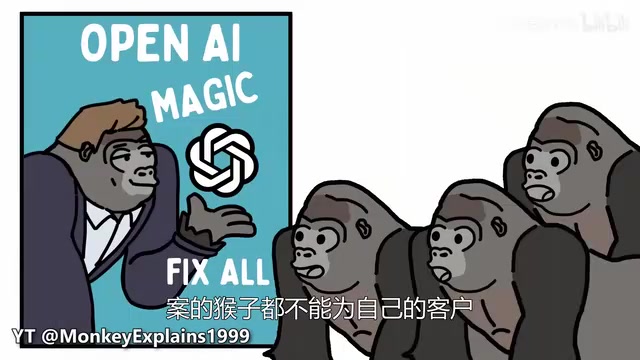
The irony is hard to miss: if a company selling "magical AI solutions" can't calculate the return on investment for its own customers, why should anyone trust it to manage its own books?
Selling More Means Losing More: The "Coconut Stand" Trap
Understanding OpenAI's loss logic is easier with a simple analogy. Imagine your friend runs a coconut stand, selling each coconut for $1. Customers are lining up, business looks booming. But if the actual cost of each coconut — labor, rent, electricity — exceeds $2, then higher sales mean greater losses.
Replace the coconut stand with OpenAI, and the AI cost paradox snaps into focus. In just the last quarter, OpenAI generated approximately $5.7 billion in revenue — impressive on paper. The problem is that every dollar of revenue coming in causes the company to lose even more.

Wall Street has a precise term for this: OpenAI faces an operating margin of negative 122%. That means to generate that $5.7 billion in revenue, the company burned through nearly $7 billion just to keep operating.
What Operating Margin Really Means Operating Margin = Operating Profit / Revenue × 100%. When this figure is negative, it means the company is still losing money after accounting for operating costs. A negative 122% is an extreme outlier even in the tech industry — even giants like Amazon and Google rarely pushed past negative 50% during their early expansion phases. Mature SaaS companies, by comparison, typically achieve operating margins of 20%–40%. What makes this number so alarming isn't that it represents a one-time investment loss — it's that every individual transaction is systematically destroying value.
The "nonprofit" label, it turns out, fits perfectly — because the company truly isn't profiting at all.
The Trillion-Dollar Spending Spree and Its Financial Black Hole
What's even more baffling is that despite this dire financial picture, OpenAI continues to expand aggressively. Over the past year, Altman has gone on what may be the largest "shopping spree" in AI market history:
- Approximately $300 billion in cloud services paid to Oracle
- Approximately $100 billion in chips purchased from NVIDIA
- Approximately $90 billion invested in AMD chips
- Approximately $250 billion in cloud service time secured from Microsoft
By rough estimates, OpenAI has signed deals worth nearly $1 trillion over the course of about a year. By conventional logic, capital flows of this scale should generate enormous profits. Instead, the opposite is happening — the company continues to drown in losses.
There is a deep technical rationale behind these astronomical expenditures. AI inference — the process by which a model generates a response each time a user interacts with ChatGPT or similar models — is intensely dependent on high-end GPU compute. Tokens are the fundamental unit by which large language models process text, with roughly 1,000 tokens corresponding to about 750 English words. Every user conversation represents real compute consumption: the capital cost of GPU clusters, ongoing electricity consumption, and data center cooling expenses all combine to form the real cost behind every token. As the user base continues to grow, the widening gap between these costs and revenue creates a structural trap — the more you sell, the more you lose.
Behind the Pretty Numbers: The Reality of Financial Optics
Altman may not be good at making OpenAI profitable, but he's very good at making it look healthy.
The Selective Presentation of Growth Narratives
When asked about the company's condition, Altman proudly highlights explosive revenue growth — from $3.7 billion a year ago to $13.1 billion, a growth rate that is genuinely rare in the market. What he conveniently omits is that costs have surged just as fast, climbing from $12.5 billion to $34 billion.

How OpenAI "Prettifies" Its Loss Figures
On the subject of annual losses, the official line is "only $14 billion." But this figure conveniently excludes compensation paid to employees in company stock — known as Stock-Based Compensation (SBC).
This is a widely used financial presentation strategy among Silicon Valley tech companies. Under GAAP (Generally Accepted Accounting Principles), SBC must be recorded as an expense. However, many companies use Non-GAAP metrics in external communications, stripping out SBC to make profitability look better. Critics argue that stock-based compensation is a real economic cost — it dilutes existing shareholders' equity and is essentially paying present-day expenses with future value. Once SBC is included, the actual loss jumps to approximately $26 billion. The gap between $14 billion and $26 billion is itself a revealing demonstration of the selective art of financial presentation.
Even the so-called "good news" — improving margins, reduced compute per message — still amounts to "losing less, but still losing."
The core issue is this: growth and sustainability are not the same thing. Altman is betting that the public won't notice the difference.
The Corporate AI Bill Shock: 95% of Projects Yield No Return
It's not just OpenAI itself — enterprises buying AI services are feeling the weight of staggering costs too:
- Uber's CTO publicly admitted the company burned through its entire annual AI budget in a matter of weeks.
- A company called GetsOne had four employees spend more than $113,000 on AI tokens in a single month — roughly $28,000 per person, approaching half the annual income of an average American worker.
- In more extreme cases, one developer burned through $1.3 million in OpenAI token fees in a single month.
For all this spending, the returns are deeply disappointing. An MIT study found that enterprises poured $30 to $40 billion into AI, yet roughly 95% of companies saw no return whatsoever — only about 5% of AI pilot projects actually translated into meaningful profit growth.
Behind this figure lies a deeper methodological challenge in evaluating AI return on investment (ROI). A six-month observation window may indeed underestimate long-term value — analogous to early internet adoption, where investments in corporate websites circa 1998 were similarly difficult to quantify in the short term. Yet AI investment evaluation faces unique challenges: AI's value often manifests as efficiency gains that are difficult to monetize rather than as direct revenue; AI systems require extensive customized integration to generate business value, and these hidden costs are routinely underestimated; and there is a massive engineering and organizational chasm between a "pilot project" and "scaled deployment." This makes it difficult to establish a clear causal chain between AI investment and returns, and the industry still lacks a universally accepted framework for evaluating AI's commercial value.
When 19 out of 20 pilot projects come up empty, the trend speaks for itself.
The Dead End of the AI Cost Paradox

This is the core contradiction of what's being called the "AI cost paradox" — and it may become the vulnerability that swallows OpenAI's business model whole:
- If enterprises need AI to be cheap enough to justify using it, and OpenAI loses money every time a user calls ChatGPT, how does it ever reach a price point that makes sense?
- If AI ultimately cannot solve the problems enterprises were promised it would, and costs remain prohibitively high, what was the justification for pouring in billions of dollars in the first place?
This is a self-contradicting business loop: price too low, and OpenAI bleeds money; price too high, and enterprises can't make the math work. How the profitability model breaks out of this trap remains an open question.
Who Pays the Bill: AI Boom Costs Are Quietly Shifting to Ordinary People
The costs of this AI frenzy are being quietly transferred to everyday people. The energy demands of AI data centers are reshaping the global electricity market. According to the International Energy Agency (IEA), global data center power consumption could double to 1,000 terawatt-hours by 2026 — equivalent to Japan's entire annual electricity consumption. Less widely known is the fact that training and running large language models also consumes enormous amounts of cooling water — training a GPT-3-scale model consumes approximately 700,000 liters of fresh water. These resource demands translate directly into infrastructure investment costs, which are partially passed on to local utility customers through grid upgrade fees and water resource management charges.
Residents in Maryland are reportedly facing steep fees to fund grid upgrades for out-of-state data centers that they will never use. Grassroots resistance is growing:
- Nearly half (approximately 47%) of Americans say they do not want a data center built near their community.
- Voters in Festus, Missouri recalled city council members who approved the construction of an AI data center.
- The Seattle City Council voted 9–0 to pause large-scale AI data center construction for one year.
- Multiple local community utility boards have passed year-long moratoriums on water and sewer permits for data centers.
Meanwhile, tech companies have begun suing the towns that stand in their way, and some states have passed legislation stripping local governments of the authority to refuse. This battle over AI infrastructure is far from over.
Conclusion: The Widening Gap Between Powerful PR and Commercial Reality
This story exposes a profound irony in Big Tech: if AI is truly as powerful as advertised, why are so many companies working so hard to pressure their employees into using it? Perhaps this is nothing more than desperate self-persuasion — an attempt to rationalize the billions already invested with nothing to show for it.
For OpenAI, revenue is indeed growing — but costs are growing just as fast, if not faster. Until a genuinely viable profit model emerges, every impressive-looking financial figure may simply be the PR-friendly version of a much grimmer story lurking underneath. Whether the AI industry's ongoing "money-burning race" can ever break free from the cost paradox remains the central question everyone is watching.
Note: This article is based on analytical content circulating online. Some figures are estimates or citations from third-party research. For specific financial data, please refer to official disclosures.
Key Takeaways
Related articles

Disaster and Glory of the Apollo Program: The History We Must Revisit Before Returning to the Moon
From the fatal Apollo 1 fire to Apollo 8's daring lunar orbit to Apollo 11's successful landing—revisiting the disasters, fears, and compromises of the Apollo program and their lessons for today's return to the Moon.

Netflix Trust Exercise Turns Into Firing Trap: Where Are the Boundaries of Corporate Trust?
A Netflix employee was fired after sharing private info in a trust exercise. We analyze the risks of corporate trust exercises and how employees can protect themselves.

AMD CDNA5 Architecture Deep Dive: Technical Evolution and the AI Computing Competition Landscape
Deep analysis of AMD's CDNA5 architecture covering Chiplet packaging upgrades, HBM memory evolution, and low-precision compute optimization, examining how AMD challenges NVIDIA's AI chip dominance.