TigrimOSR: An Open-Source Agent Framework in Rust with Configurable Agent Loops

A Rust-built open-source agent framework where the entire agentic loop is defined via YAML config.
TigrimOSR is a Rust-written open-source multi-agent framework whose entire agentic loop can be defined through YAML config files—no code required. With single-binary deployment, ~250MB memory usage, a built-in browser, and native MCP support, it targets self-hosted, transparent, and controllable Agentic AI experimentation.
When Agent Orchestration Is No Longer Hidden Behind APIs
In today's rapidly evolving landscape of Agentic AI, mainstream orchestration frameworks—whether LangGraph, Claude Code, OpenAI Agents, or OpenHands—largely encapsulate their core orchestration logic behind code or APIs. If developers want to adjust an agent's operating loop, they often need to dig deep into the source code or rely on the limited interfaces the framework provides.
Agentic AI represents a fundamental paradigm shift in current AI applications: it's no longer a question-and-answer system with single input-output exchanges, but an autonomous system capable of self-directed planning, tool use, memory management, and multi-step reasoning. What distinguishes Agentic AI from traditional LLMs is the "Agentic Loop"—the iterative process by which an agent continuously perceives its environment, formulates plans, executes actions, and adjusts strategies based on feedback. It is precisely the design of this loop that determines whether an AI system can complete complex, multi-step, real-world tasks. The orchestration framework, then, is the infrastructure layer that manages this loop, responsible for coordinating core logic such as model invocation, tool execution, context passing, and error recovery.
The recently trending open-source project TigrimOSR on Reddit attempts to break this convention. It's a native desktop application written in Rust, focused on building and running multi-agent AI workflows. Its core highlight: the entire agentic loop can be defined through YAML configuration files, without touching a single line of Rust source code.
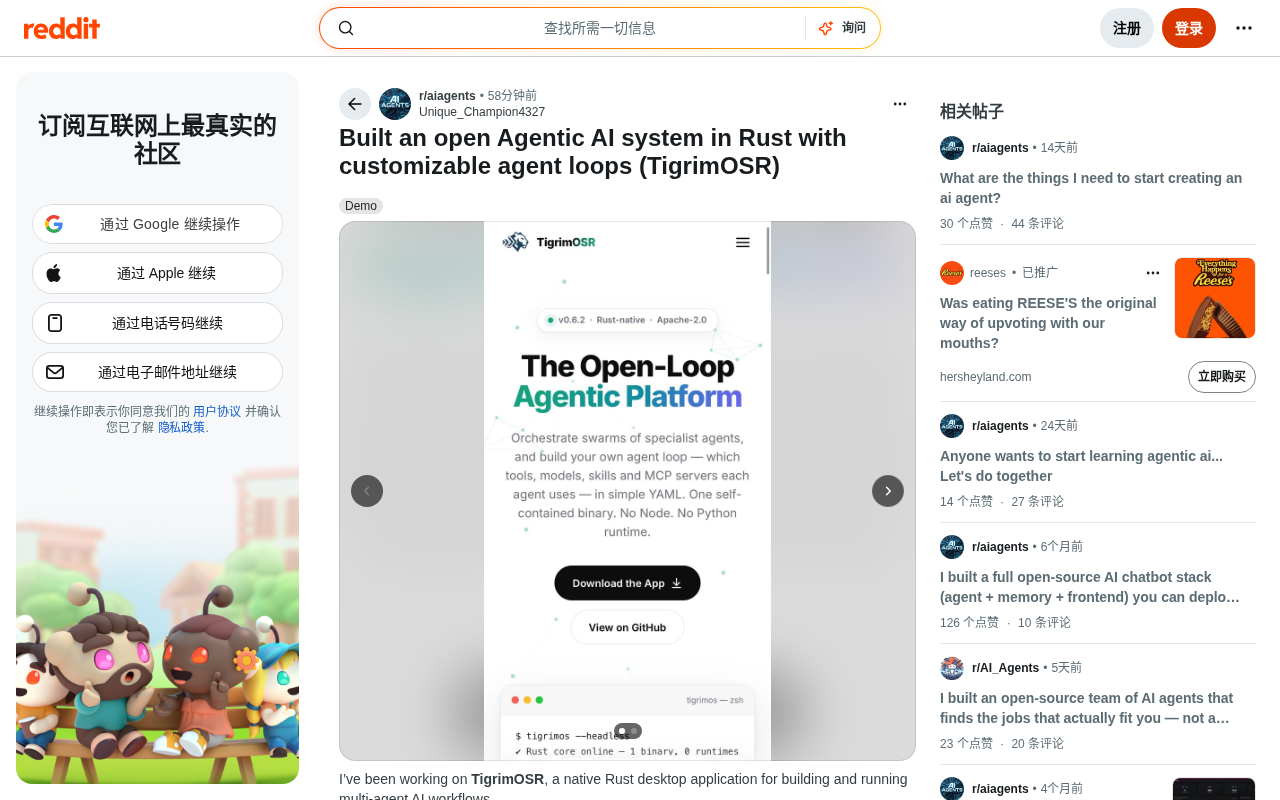
The author calls this design philosophy Loop Engineering—making the orchestration logic itself a first-class citizen, allowing developers to freely experiment with different orchestration strategies as easily as adjusting parameters. This concept shares the same lineage as the "Infrastructure as Code" (IaC) philosophy in software engineering: IaC transforms infrastructure—such as server configuration and network topology, previously managed manually by operations staff—into version-controllable, auditable, and reproducible code files, thereby achieving environmental consistency and automated deployment. Loop Engineering applies the same thinking to the AI orchestration layer—externalizing the agent collaboration logic that was previously hardcoded within frameworks, making it an engineering artifact that can be independently designed, rapidly iterated, collaboratively worked on, and version-tracked. This is especially important for researchers: the experimental results of different orchestration strategies can be reproduced and shared by comparing different versions of YAML configurations, without needing to rebuild code environments.
Everything Is Configurable: YAML-Driven Agent Loops
Core Configurable Dimensions
TigrimOSR exposes nearly all key dimensions of agent operation as YAML configuration options—a fairly radical approach among similar frameworks. Specifically, it covers:
- Agent loop behavior: defining how the agent thinks, executes, and iterates
- Available tools: mounting different capabilities to agents on demand
- MCP servers: supporting the Model Context Protocol to connect external data and tools
- Skills: modular capability units
- Model selection: flexibly switching between different underlying large models
- System prompts: customizing the agent's role and behavioral guidelines
- Self-verification rules: enabling agents to validate their own outputs
- Loop limits: controlling the number of iterations to prevent runaway behavior
What "Configuration as Architecture" Means
Separating orchestration logic from code essentially returns the decision-making power over "how to organize agent collaboration" to the user. For researchers and developers who want to rapidly experiment with different orchestration strategies, this approach dramatically lowers the cost of experimentation—no recompilation needed, no need to deeply understand Rust's ownership mechanism; simply modifying a few lines of YAML switches the entire workflow.
This also addresses an increasingly prominent pain point in the Agentic AI field: different tasks often require different orchestration paradigms, and hardcoded frameworks struggle to accommodate this flexibility. The mainstream orchestration paradigms in the industry can be divided into several categories: ReAct (Reasoning + Acting) is the most classic paradigm, proposed by Google and Princeton University in 2022. It has the model alternate between generating reasoning chains and tool-calling actions, observing environmental feedback after each action before continuing to reason—suitable for tasks requiring real-time information feedback. Plan-and-Execute has a Planner generate complete task decomposition steps first, then hands them to an Executor to complete step by step, making it suitable for long tasks with relatively clear structure. Reflexion loops introduce self-critique and memory mechanisms after execution, allowing agents to learn from failures and correct their strategies, making them suitable for scenarios with high output quality requirements. Each of these paradigms has its own applicable boundaries—ReAct responds quickly to dynamic environments but easily falls into local loops; Plan-and-Execute offers clear planning but adapts poorly to plan changes.
It's worth noting that these orchestration paradigms are essentially different engineering interpretations of the "Exploration-Exploitation Tradeoff" in sequential decision-making scenarios. ReAct tends toward fine-grained real-time exploitation (adjusting based on observations at every step), while Plan-and-Execute leans toward macro-level exploration followed by concentrated execution. Because different tasks have different information structures and uncertainty distributions, no single paradigm can be universally optimal—which is precisely the core value of the "switchable, configuration-driven orchestration" direction. YAML-configuration-driven agent loops offer a pragmatic solution to this tension.
Engineering Advantages Brought by Rust
Single-Binary Deployment and Low Memory Footprint
TigrimOSR's choice of Rust as its implementation language brings a series of solid engineering benefits:
- 🦀 Native Rust: compiled into a single binary file, simple to deploy, with no complex runtime dependencies
- 💾 Low memory footprint: normal operation consumes only about 250–270 MB of memory
- ⚡ Optimized for long-running tasks: designed specifically for agent tasks that need to run continuously, balancing stability and resource efficiency
Rust is increasingly valued in system-level AI infrastructure fundamentally because of its unique memory management model. Unlike Python, which relies on a garbage collector (GC) to dynamically manage memory, Rust determines memory allocation and release at compile time through its "Ownership System." This avoids both the pause overhead of GC (Stop-the-World Pause) and the memory leaks and dangling pointers common in C/C++.
Specifically, Rust's ownership system consists of three core rules: each value has one and only one owner; when the owner goes out of scope, the value is automatically released; and values can be borrowed but cannot have multiple mutable borrows simultaneously. The Borrow Checker in the compiler statically verifies these rules at compile time, converting potential memory errors into compilation errors rather than runtime crashes. This mechanism is particularly critical in long-running agent scenarios: Python's GC may accumulate memory fragmentation in high-concurrency or long-lifecycle-object scenarios, causing process memory to continuously balloon over runtime (RSS Bloat); whereas Rust programs' memory footprint is typically more stable and predictable. Compared to mainstream Python-based frameworks (such as LangChain and AutoGen), which routinely consume several GB of memory, a footprint of around 250MB offers significant advantages for scenarios requiring agents to run continuously over long periods (such as automated monitoring and ongoing research tasks), and also makes deployment possible on resource-constrained edge devices or low-spec cloud instances.
Built-in Browser and Multi-Endpoint Access Support
The project includes a built-in browser written in Rust for web searching, eliminating the need for external automation tools like Selenium or Playwright. This design reduces external dependencies, lowers environment configuration complexity, and means web interaction capabilities are natively integrated into the agent loop.
Traditionally, if an AI agent needs to access web content, it typically relies on tools like Selenium (which drives a real browser via the WebDriver protocol) or Playwright (a modern browser automation framework developed by Microsoft). Both require separately installing browser binaries, managing driver version compatibility, and introducing extra latency in inter-process communication. TigrimOSR's built-in Rust-native browser component (likely implemented based on something like headless_chrome or a similar lightweight rendering engine) internalizes web-fetching capabilities as in-process calls, eliminating cross-process communication overhead and avoiding the deployment complexity brought by external dependencies—consistent with its overall "single-binary deployment" design philosophy.
Additionally, TigrimOSR supports desktop and remote access and is natively compatible with the MCP protocol. The Model Context Protocol (MCP) is an open standard protocol proposed and open-sourced by Anthropic in November 2024, aimed at solving the fragmentation of integration between AI models and external data sources and tools. Before MCP existed, every AI application needed to write custom integration code for each type of tool (databases, file systems, API services, etc.), creating an "M×N problem"—M applications and N types of tools required maintaining M×N sets of integrations. MCP defines a unified client-server communication protocol that exposes tools as standardized "MCP servers," which any MCP-compatible AI client can directly invoke, reducing integration complexity from M×N to M+N.
At the technical level, MCP uses JSON-RPC 2.0 as its underlying communication protocol and supports three core capability types: Tools (functions that can be invoked by the model), Resources (data sources that can be read), and Prompts (predefined prompt templates). MCP servers can communicate with clients via either standard input/output (stdio) or HTTP+SSE transport methods, allowing both local processes and remote services to be incorporated into a unified tool ecosystem. Currently, the MCP ecosystem already includes hundreds of official and community servers—including database connectors, code execution environments, file system access, and web search—and is rapidly becoming the de facto standard for Agentic AI tool integration. TigrimOSR's native MCP support means it can directly plug into this ever-expanding tool ecosystem without needing to repeatedly develop integration layers.
Positioning: An Experimental Platform for Self-Hosting and Loop Engineering
TigrimOSR explicitly targets three user groups:
- Developers with in-depth research needs in Agentic AI
- Researchers focused on Loop Engineering
- Users pursuing self-hosted AI systems—especially teams who want their orchestration logic to be transparent and controllable, rather than locked away in a closed API black box
This positioning hits on current real-world needs: as pressure over data privacy and cost control rises, more and more teams want to run agent systems in local or private environments while demanding higher levels of interpretability and controllability. The rise of self-hosted AI systems is driven by enterprises' growing emphasis on Data Sovereignty—against the backdrop of increasingly strict data protection regulations such as GDPR and CCPA, sending user data and business logic to third-party API services carries compliance risks, whereas localized deployment ensures data never leaves a controlled environment. Additionally, for high-frequency invocation scenarios, self-hosting can significantly reduce API call costs and eliminate performance instability caused by network latency or provider rate-limiting. TigrimOSR's combination of "configuration-driven + self-hosted + low resource usage" precisely targets this niche scenario.
Worth Pondering: How Should Configurable Agent Loops Evolve?
In his Reddit post, the project's author specifically mentioned that he most wants feedback at the architectural level, and posed a question to developers with experience in frameworks like LangGraph, Claude Code, OpenAI Agents, and OpenHands: How should configurable agent loops evolve in the future?
This is a direction worth serious consideration by the entire community. The current real-world tension lies in:
- Overly hardcoded frameworks lack flexibility and struggle to adapt to diverse tasks
- Excessive configurability may lead to an explosion of complexity, and the YAML configuration itself may become difficult to maintain
Finding the balance between flexibility and usability is the core challenge every orchestration framework must face. As a configuration language, YAML performs excellently when expressing simple key-value parameters and linear workflows, but it has fundamental limitations when facing complex conditional branching (such as "switch to a backup model when tool calls fail more than 3 times"), dynamic loop structures, and stateful communication across agents—YAML itself is not Turing-complete and cannot natively describe arbitrarily complex control flow logic. This often leads to a great deal of conventionally agreed-upon "pseudo-code" writing appearing in configuration files, with maintainability rapidly declining.
From the perspective of programming language theory, the essence of this problem is the "expressiveness boundary of configuration languages": pure data description languages (such as YAML and JSON) excel at declaring static structures but lack native control flow, variable binding, and abstraction mechanisms; while general-purpose programming languages (such as Python) offer complete expressiveness but come with a steep learning curve and are prone to introducing security risks. Compromise solutions being explored in the industry include: Directed Acyclic Graph (DAG) descriptions, such as LangGraph modeling workflows as graph structures of nodes and edges, using graph-theoretic semantics to replace sequential execution semantics, naturally supporting parallel branches and conditional routing; dedicated orchestration DSLs, such as Temporal's workflow definition language, which provides orchestration-specific abstraction primitives on top of a general-purpose language; and hybrid code-first + visual editor modes, which allow technical users to define complex logic in code while providing non-technical users with graphical interfaces to operate simple workflows. Each of these directions has its own trade-offs, and they may well be the key technical decisions that TigrimOSR's subsequent evolution needs to confront head-on—when YAML is sufficient, and when a more expressive abstraction layer needs to be introduced.
Conclusion
TigrimOSR offers a noteworthy approach: liberating the agent's orchestration logic from code and handing it over to declarative configuration management. Combined with the engineering advantages that Rust brings—single-binary deployment, low memory footprint, and a built-in browser—it builds a lightweight yet controllable experimental platform for self-hosted Agentic AI.
For developers who want to dive deep into Loop Engineering and are unwilling to be constrained by API black boxes, this open-source project offers at least a new perspective. The project is already open-sourced on GitHub; interested readers can explore further at the project's official website (tigrimosr.github.io) and GitHub repository (github.com/Sompote/TigrimOSR).
Key Takeaways
Related articles

WebMCP in Practice: How MakeMyTrip Is Reshaping the Travel Booking Experience
India's largest OTA platform MakeMyTrip uses WebMCP to standardize AI Agent interactions with web apps, replacing fragile DOM scraping with natural language-driven test automation and simplified complex booking scenarios.

Deep Dive into the EYG Programming Language: A New Portable Programming Paradigm Designed for Humans
Deep analysis of the EYG programming language's core design, including algebraic effects, program state persistence, and cross-platform portability, exploring how it addresses modern software fragmentation.

WebMCP in Practice: How MakeMyTrip Is Reshaping the Travel Booking Experience
India's largest OTA platform MakeMyTrip uses WebMCP to standardize AI Agent interaction with web apps, solving DOM scraping fragility, enabling natural language test automation, and simplifying complex international flight bookings.