Tongyi Qianwen Qwen-Image-3.0: The Leap of AI Image Generation from Toy to Productivity Tool

Qwen-Image-3.0 marks AI image generation's leap from demo toy to practical productivity tool.
Tongyi Qianwen's Qwen-Image-3.0 pursues practicality over mere aesthetics, with three core capabilities: handling 4,500-token ultra-long instructions, pixel-level detail rendering (including LaTeX formulas and ink wash restoration), and multilingual knowledge understanding with real-time information fusion—signaling AI image generation's shift from demo to real-world deployment.
From Demo to Tool: The Qualitative Transformation of AI Image Generation Technology
From toy to tool, AI image generation technology is undergoing a critical qualitative transformation. The Qwen-Image-3.0 image generation model recently released by Tongyi Qianwen can have its core breakthrough summed up in one word—"practical." If version 1.0 solved the problem of "precision" and version 2.0 pursued "aesthetics," then version 3.0 truly targets "usability," transforming AI image generation from a demo-level toy into a productivity tool that can be integrated into daily workflows.
It's worth noting that this shift is no accident. AI image generation has experienced explosive expansion since Stable Diffusion was open-sourced in 2022, but the problem of being "good-looking but not useful" has always constrained its commercial adoption. The core contradiction lies in this: early models were optimized for visual aesthetic scores (such as FID and CLIP Score) rather than the functional requirements of real-world work scenarios. FID (Fréchet Inception Distance) measures the distributional distance between generated images and real images in feature space—the lower the value, the higher the generation quality; CLIP Score, on the other hand, uses OpenAI's CLIP model to evaluate the semantic match between text descriptions and generated images. While these two metrics can reflect the overall visual quality of images, they cannot measure "engineering-level" requirements such as text clarity, layout accuracy, and predictable output consistency, resulting in a fundamental mismatch between "good-looking" and "useful" that persisted in models for a long time.
It's worth noting that FID and CLIP Score, as evaluation benchmarks, also have their own limitations: FID relies on the Inception network to extract features, and since this network is pretrained on ImageNet, its perceptual capability is limited for non-natural image scenarios such as artistic styles and text rendering; CLIP Score, meanwhile, is constrained by the CLIP model's own training distribution, lacking depth in understanding Chinese contexts and specialized domain semantics. This means that even if a model performs excellently on these metrics, it may not necessarily satisfy users in actual creative scenarios—this is precisely the deeper reason why the industry's evaluation system urgently needs an upgrade. As products like Adobe Firefly and Canva AI embed generation technology into design workflows, the market has begun using actual demand to reverse-engineer the direction of technological development. Between 2024 and 2025, major domestic and international vendors have coincidentally prioritized "controllability" and "practicality" as the focus of iteration, marking a systematic transition of the entire field from the "technology showcase" stage to the "product implementation" stage. The release of Qwen-Image-3.0 is a concrete manifestation of this industry trend.
Three Core Capabilities: Holds More, Renders Finer, Understands Deeper
Qwen-Image-3.0's capability upgrade can be understood along three dimensions: holds more, renders finer, understands deeper. These three points correspond respectively to the model's comprehensive evolution in instruction understanding capacity, detail rendering capability, and knowledge application.
Compared to previous products, version 3.0 is no longer content with generating a "nice-looking" image, but aims to hold up under scrutiny in complex scenarios, professional content, and real-world requirements. Behind this shift lies the model's systematic improvement in long-instruction processing, pixel-level detail, and world knowledge understanding.
Holds More: Digesting Ultra-Long Instructions of 4,500 Tokens at Once
In terms of instruction understanding, Qwen-Image-3.0 demonstrates an astonishing "appetite." According to real-world testing, the model can handle ultra-long instructions, digesting a complex description of 4,500 tokens at once and harmoniously presenting 9 unrelated subjects within the same image.
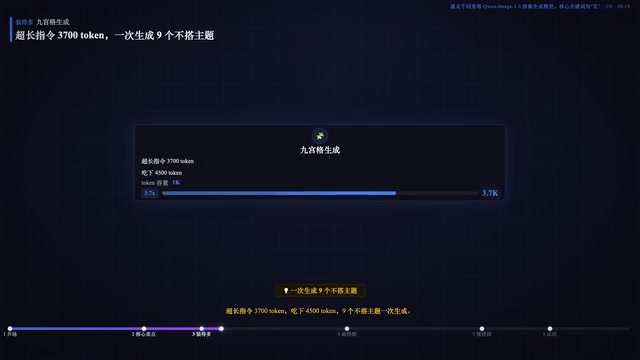
Understanding this breakthrough requires knowing the significance of the token in AI models. A token is the basic unit through which large language models process text, roughly corresponding to one Chinese character or half an English word. 4,500 tokens roughly equal a detailed description of 3,000 Chinese characters, whereas early mainstream image generation models like Stable Diffusion, based on the CLIP text encoder, could only accept about 75 tokens—meaning users could only provide brief, keyword-style prompts, making precise control of complex scenes nearly impossible.
CLIP (Contrastive Language-Image Pre-training), released by OpenAI in 2021, embeds text and images into the same semantic space through contrastive learning, greatly advancing text-to-image generation technology. Its training process used 400 million internet image-text pairs, establishing cross-modal semantic associations by maximizing the cosine similarity of matching image-text pairs and minimizing that of non-matching pairs—this "contrastive" mechanism gives the model the ability to understand natural language descriptions of images. However, its hard limit of 77 tokens (stemming from the design constraints of Transformer positional encoding) became a long-standing bottleneck restricting creative precision.
To break through this limitation, researchers followed a clear technological evolution path: the first stage was introducing larger-scale language models as text encoders, such as Google's T5 (Text-to-Text Transfer Transformer, supporting context up to 512 tokens) and BERT (Bidirectional Encoder Representations from Transformers, known for its bidirectional attention mechanism); the second stage replaced the text encoder directly with large language models like LLaMA and Qwen, which possess context windows of thousands or even tens of thousands of tokens, and injected the deep semantic representations of the language model into the image generation denoising process via cross-attention mechanisms. Cross-attention allows each spatial position of the image to dynamically "query" the most relevant semantic fragments in the text sequence, rather than simply compressing the entire text into a fixed vector—this is the key mechanism enabling long instructions to truly take effect. The move from CLIP's 75 tokens to modern multimodal architectures supporting thousands of tokens reflects a generational leap in AI image generation technology at the level of text understanding.
It's worth mentioning that behind this architectural evolution lies another important trend: the DiT (Diffusion Transformer) architecture is replacing the traditional U-Net as the backbone network of the new generation of diffusion models. DiT, proposed by Peebles and Xie in 2023, uses a Transformer instead of a convolutional U-Net to handle the denoising task in the diffusion process. Compared to U-Net, DiT's advantage lies in its excellent scalability (scaling law)—increases in parameter count translate more linearly into improvements in generation quality, which highly aligns with the scaling rules of Transformers in the language model domain. When the LLM text encoder and the DiT image backbone are deeply fused via cross-attention, the parameter scale and expressive power of the entire multimodal system can be synergistically amplified, laying the architectural foundation for handling ultra-long, complex instructions. Mainstream large image generation models such as SD3, FLUX, and Qwen-Image-3.0 have generally shifted to such architectures, which is a direct manifestation of this trend.
Qwen-Image-3.0's ability to handle such ultra-long instructions relies on a more powerful text understanding module and image-text alignment training strategy behind the scenes. Image-text alignment is one of the core challenges in training multimodal models—it refers to enabling the model to genuinely establish correspondence between text descriptions and visual content at the semantic level, rather than relying on keywords to trigger fixed templates. Mainstream methods include contrastive learning (pulling matching image-text pairs closer and pushing non-matching ones apart), masked prediction, and reinforcement learning from human feedback (RLHF). RLHF trains a reward model by collecting human preference annotations for generated results, then uses reinforcement learning algorithms (such as PPO) to optimize the generation strategy, making model outputs better align with human expectations. This method has been widely adopted by large language models like ChatGPT and Claude, and is gradually being transferred to the image generation domain. Handling ultra-long instructions also requires introducing hierarchical attention mechanisms or sliding window strategies to ensure the model can maintain global semantic coherence while not overlooking local detail constraints. This allows the model to truly "understand" a detailed creative specification at the semantic level, rather than merely triggering style templates through keyword matching.
The practical value of this capability lies in this: creators can use an extremely detailed passage of text to precisely control every element of an image, without needing to repeatedly adjust prompts. For complex creative scenarios requiring the integration of multiple elements and subjects within a single image, this substantially lowers the barrier to creation.
Renders Finer: Pixel-Level Detail Rendering, a Comprehensive Breakthrough in Realism
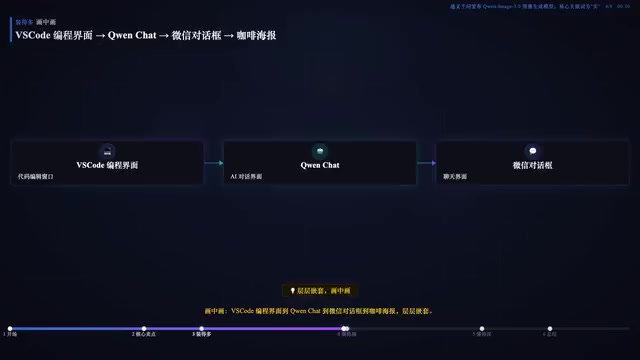
One of the most impressive capabilities of Qwen-Image-3.0 is its ultimate control over detail. The model can achieve layer-upon-layer nesting of "picture-in-picture"—from the VS Code programming interface, chat applications, to WeChat dialog boxes, and further to coffee posters, the details across multiple layers of nested interfaces can all be rendered clearly.
Breakthroughs in AI image generation's detail rendering are not to be taken for granted. Current mainstream image generation technology employs the diffusion model: starting from random noise, it gradually restores the image through hundreds of denoising iterations. Diffusion models rose to prominence around 2020, quickly replacing GANs (Generative Adversarial Networks) as the mainstream paradigm for image generation. GANs, proposed by Goodfellow et al. in 2014, drive image quality improvement through an adversarial game between a Generator and a Discriminator—the generator strives to produce images convincing enough to pass as real, while the discriminator strives to distinguish real from fake, and the two co-evolve through competition. Although GANs once created stunning high-definition face generation results (such as the StyleGAN series), problems such as training instability and mode collapse (where the model only generates a few types of outputs and loses diversity) long constrained their application ceiling. Diffusion models replaced them with a more stable training process and higher generation diversity. Their core principle achieves image generation through a two-stage Markov chain process: the forward process gradually adds Gaussian noise to the original image until it is fully randomized, while the reverse process trains a neural network to learn to restore the image step by step from noise. Mainstream products such as DALL-E 2, Stable Diffusion, and Midjourney are all based on this framework.
However, this mechanism is naturally adept at generating macroscopic composition and textural atmosphere, but has long underperformed on details such as pixel-level small text, precise mathematical formulas, and nested UI interfaces—these elements account for an extremely low proportion of training data and demand extremely high spatial precision. Each denoising operation acts on the latent representation of the entire image, making it difficult to impose precise constraints on specific regions—this is an inherent limitation of the diffusion model architecture. The Latent Diffusion Model (LDM)—the architecture adopted by Stable Diffusion—improves computational efficiency by conducting the diffusion process in a low-dimensional latent space rather than pixel space: the original image is first encoded by a VAE (Variational Autoencoder) into a latent vector about 1/8 the size of the original, the diffusion process takes place in this low-dimensional space, and finally the VAE decodes it back into pixel space. Although this compression operation dramatically reduces computational cost (enabling consumer-grade GPUs to run generation models), it also means that high-frequency detail information suffers irreversible loss at the encoding stage—the stroke structure of small text and the high-frequency components of fine textures are often the first to be sacrificed when compressed into the latent space.
In recent years, researchers have explored multiple technical paths to resolve this inherent contradiction. One is to increase the resolution of the VAE's latent space—reducing the compression ratio from 1/8 to 1/4 or even lower, in exchange for retaining more high-frequency details, at the cost of significantly increased VRAM usage and computation. Another is to introduce a "super-resolution restoration" post-processing stage, first generating the semantic structure in low-resolution space, then completing high-frequency information in pixel space through a dedicated detail enhancement network. A third is to design specialized loss functions targeting text regions, imposing higher weights on the restoration accuracy of text strokes during training, so the model develops stronger dedicated memory for character structures. In addition, the Flow Matching framework (adopted by the SD3 and FLUX series) provides a more direct flow-field trajectory from noise to data than DDPM, theoretically helping achieve more precise detail restoration within the same number of steps. Qwen-Image-3.0's ability to clearly render LaTeX formulas and multi-layer nested interfaces means it has made targeted systematic optimizations in the aforementioned directions.
This detail capability stands out especially in practical applications: pixel-level small text is clearly legible, and it can even render LaTeX mathematical formulas and paper layouts, making AI-generated images directly usable in professional document scenarios. Furthermore, the model can finely depict microscopic features such as pores and hair strands in portrait photos, significantly improving the level of realism.
Ancient Painting Restoration: Style-Consistent Reconstruction from Damaged to Complete
Beyond brand-new creation, Qwen-Image-3.0 also performs impressively in the field of image restoration. The model can repair damaged ink wash paintings, complete missing brushstrokes, and maintain consistency in overall style—whether it's a brow spot or a crack, both can be naturally removed and restored.

The core challenge of AI image restoration lies not in "filling blanks," but in maintaining style consistency. Image restoration (Inpainting) technology has undergone a fundamental shift from traditional algorithms to deep learning. Early methods relied on block-matching algorithms like PatchMatch, filling missing portions by searching for similar textures in other regions of the image—essentially the stitching of local textures, unable to understand the semantic structure of the image. In the deep learning era, convolutional networks based on encoder-decoders (such as Partial Convolution and Gated Convolution) could perceive a wider range of contextual information and avoid incorporating invalid pixels from missing regions into computation through mask-aware mechanisms, greatly improving restoration results—but the receptive field was still limited by the locality of convolutional kernels.
Transformer-based diffusion models, on the other hand, incorporate all pixels of the entire image into self-attention computation, fundamentally changing the "way of thinking" in restoration—the self-attention mechanism allows any two positions in an image to exchange information directly without distance limitations, enabling the model to simultaneously reference the ink shading in the upper-left of a painting, the compositional blank space in the lower-right, and even the rhythm of brushwork across the whole when completing missing regions. This contrasts sharply with the "local perception" of traditional convolutional neural networks: a convolutional kernel can only see pixels within a small window at a time and needs multiple stacked layers to indirectly acquire global information, whereas self-attention can establish global dependencies in a single computation. The model no longer asks "what nearby textures can be copied," but rather "what should be here as required by the artistic language of the entire image."
Ink wash painting restoration is especially complex—ink shading, flying-white (feibai), and texturing strokes (cunfa) are all highly stylized information, requiring the model to genuinely understand "ink wash" as an artistic language at the level of cultural knowledge, rather than simply imitating textures. In actual cultural preservation scenarios, one of the biggest challenges AI restoration faces is the "hallucination risk": the model may "reasonably" fill in elements that don't belong to the original work in missing regions, thereby altering the historical authenticity of the piece. Therefore, when institutions such as the National Cultural Heritage Administration explore incorporating AI restoration into cultural heritage digitization workflows, they typically require AI-output results to be reviewed by cultural relic experts and preserved as digital overlay layers rather than by directly overwriting the original data, to ensure the traceability and reversibility of restored content. This paradigm shift has practical significance for scenarios such as cultural relic digital restoration and old photo restoration. Compared to the high cost and long cycles of traditional manual restoration, AI restoration offers an efficient and stylistically consistent solution—and how to strike a balance between efficiency and historical accuracy is the core proposition that must be solved before this technology can be applied at scale.
Understands Deeper: Multilingual Knowledge Understanding and Real-Time Information Fusion
If detail rendering is about "painting well," then knowledge understanding is about "painting correctly." Qwen-Image-3.0 supports 12 languages, possesses a rich reserve of world knowledge, and can even query real-time information such as weather online, incorporating dynamic real-world data into the image generation process.
The model also possesses style recognition and summarization capabilities, able to understand the characteristics of different artistic schools and design styles and accurately apply them during generation. This leap from "understanding semantics" to "applying knowledge" marks AI image generation evolving from a mere visual tool toward an intelligent assistant with cognitive capabilities. Multilingual support involves more than just translation-level processing behind the scenes; it also requires the model to understand the conventions of image expression across different cultural contexts—for example, even when describing "festivity," Chinese and Western contexts have entirely different expectations regarding color and composition. This cross-cultural visual semantic difference is especially critical at the training data level: the model needs to learn each community's visual expression conventions from image-text pairs produced by different language communities, rather than simply translating English prompts and applying Western visual aesthetics. This problem is known in academia as "Visual Cultural Bias"—the training data of most overseas models is overwhelmingly dominated by English and Western cultural content, causing them to often produce cultural mismatches when handling scenarios such as Chinese poetic expression, Eastern landscape moods, and Chinese calligraphy. Domestic models have a natural advantage in the scale and quality of Chinese training corpora, which is one of the deeper reasons they often perform better in Chinese creative scenarios.
In addition, the ability to query real-time information online involves the fusion of Retrieval-Augmented Generation (RAG) with the image generation pipeline—RAG (Retrieval-Augmented Generation) was first proposed by Lewis et al. at Facebook AI Research in 2020. Its core idea is to retrieve relevant information from an external knowledge base during model inference and inject it into the context, thereby breaking through the limitation of the model's training data cutoff date. A typical RAG architecture contains three core stages: the vectorized retrieval module (mapping the query and knowledge base content into semantic vectors before computing similarity), the context injection module (concatenating retrieval results into the prompt), and the generation module. Extending RAG to image generation faces unique challenges: retrieved structured data (such as temperature values and weather status codes) needs to go through a "data-to-visual-description" translation step before it can become a semantic condition understandable by the image generation model. This translation process forms a three-stage chain of "retrieval → language description → image generation," enabling generated content to reflect the world's state "in the present" rather than "at training time"—this is significant for scenarios with high timeliness requirements such as news illustrations and event posters, and it is also an important exploration direction for dynamically connecting multimodal AI systems with the external world.
From Demo to Deployment: The Inflection Point of Practicality for AI Image Generation
The release of Qwen-Image-3.0 represents an important milestone in AI image generation technology. Reviewing its evolutionary path—1.0 pursued precision, 2.0 pursued aesthetics, 3.0 pursues practicality—one can clearly see the step-by-step improvement in technological maturity.
What truly determines whether a technology can enter daily production has never been whether it can generate stunning "sample shots," but whether it can stably and reliably meet the needs of real-world work scenarios. Clearly legible small text, accurate formula rendering, multilingual support, image restoration capabilities... these seemingly "not-so-flashy" features are precisely the key to moving AI image generation from demo to deployment. This highly aligns with the macroscopic trend of the entire AI image generation industry: the shift in technology evaluation dimensions from pursuing "stunning sample shots" to pursuing "stable usability" is itself a mark of maturity. This shift is directly reflected in both product form and evaluation systems: industry evaluation benchmarks are migrating from pure visual quality scores (such as FID and IS) toward functional testing closer to actual use cases, including text rendering accuracy, instruction-following consistency, and multi-round editing stability. Notably, the establishment of these emerging evaluation dimensions is itself a systematic undertaking—requiring the construction of standardized test sets covering multiple languages, scenarios, and difficulty levels, and the definition of clear scoring rules. The degree to which this "evaluation infrastructure" is refined often reflects the true level of commercial maturity in a technological field. The rise of emerging evaluation dimensions indirectly confirms the market's shift toward "usability" rather than "aesthetic appeal," and also foreshadows that the core of future competition will fall on engineering reliability and depth of scenario adaptation, rather than mere visual dazzle.
For designers, content creators, document processors, and even cultural relic restoration workers, Qwen-Image-3.0 no longer offers a "toy" that requires repeated tuning and yields unpredictable results, but a "tool" that can genuinely integrate into workflows. This may well be a microcosm of domestic large models moving from catching up to practical innovation in the image generation field.
Related articles

Disaster and Glory of the Apollo Program: The History We Must Revisit Before Returning to the Moon
From the fatal Apollo 1 fire to Apollo 8's daring lunar orbit to Apollo 11's successful landing—revisiting the disasters, fears, and compromises of the Apollo program and their lessons for today's return to the Moon.

Netflix Trust Exercise Turns Into Firing Trap: Where Are the Boundaries of Corporate Trust?
A Netflix employee was fired after sharing private info in a trust exercise. We analyze the risks of corporate trust exercises and how employees can protect themselves.

AMD CDNA5 Architecture Deep Dive: Technical Evolution and the AI Computing Competition Landscape
Deep analysis of AMD's CDNA5 architecture covering Chiplet packaging upgrades, HBM memory evolution, and low-precision compute optimization, examining how AMD challenges NVIDIA's AI chip dominance.