Uncensored AI Models Deep Dive: How They Work, Local Deployment, and the Truth About Self-Learning
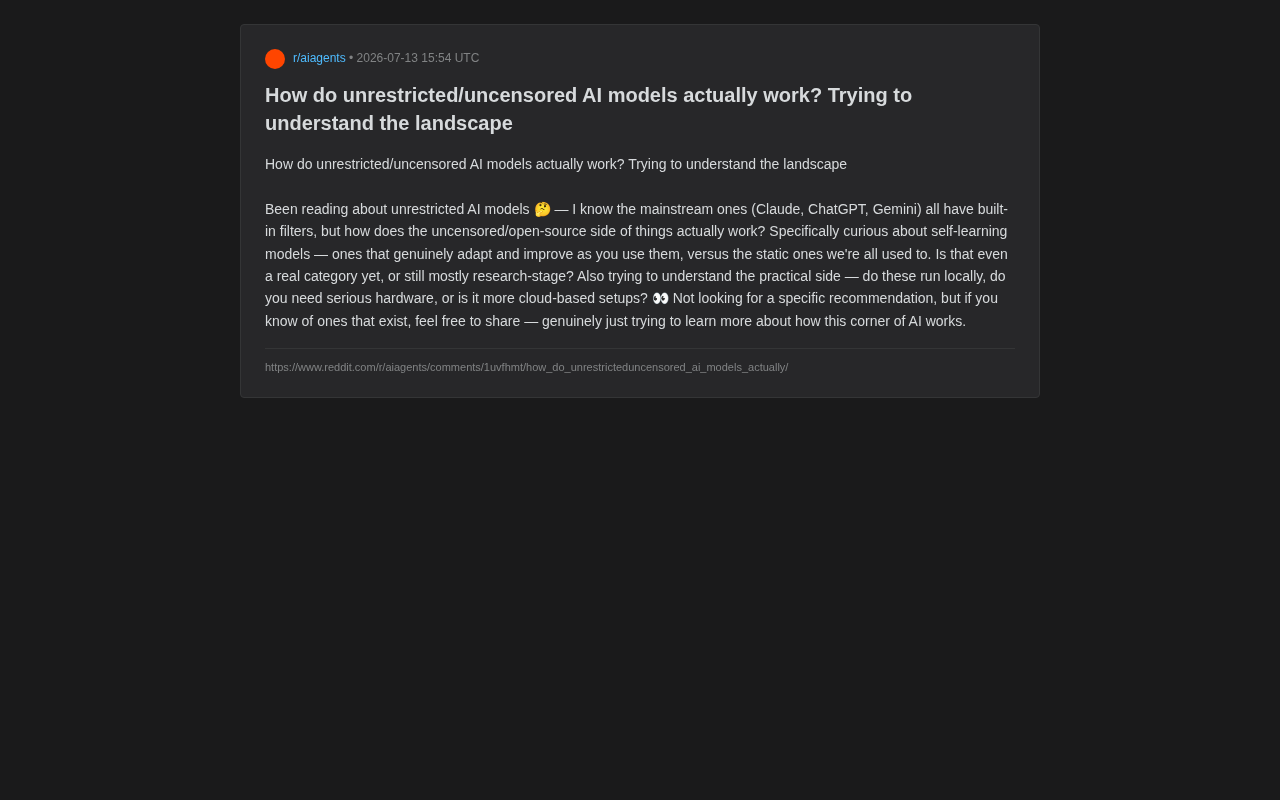
How uncensored AI models work, what hardware you need to run them locally, and the truth about self-learning.
Uncensored AI models are not a new architecture — they're fine-tuned open-source models with safety alignment removed via techniques like RLHF override and de-censorship datasets. True self-learning doesn't exist in consumer models; what looks like memory is context windows or RAG. Local deployment via Ollama or LM Studio is increasingly viable thanks to quantization technologies like GGUF and AWQ.
What Are "Uncensored" AI Models
Mainstream large language models like Claude, ChatGPT, and Gemini all come with strict built-in content filtering mechanisms (commonly known as "alignment" or "safety guardrails") that refuse to generate violent, illegal, adult, or otherwise harmful content. The "uncensored" or "unrestricted" AI models widely discussed in communities like Reddit attempt to bypass or remove these restrictions.
To understand this space, it's important to clear up a common misconception: so-called "uncensored" models are not a new AI architecture — they are a form of post-processing applied to existing open-source models. They still rely on the same Transformer-based large language model architecture as mainstream products; the difference lies solely in how they are handled during training and fine-tuning.
How Is Censorship "Removed"?
A model's safety behavior comes primarily from two stages: the curation of training data, and the application of Reinforcement Learning from Human Feedback (RLHF) combined with instruction tuning.
RLHF and instruction tuning form the core technical combination behind modern model "alignment." The basic RLHF pipeline works like this: first, a "reward model" is trained to predict human preference scores for various outputs; then a reinforcement learning algorithm (such as PPO) is used to iteratively adjust the main model so its outputs trend toward higher scores — during this process, the model gradually learns to refuse "harmful" content that human annotators rated poorly. Instruction tuning, meanwhile, uses large amounts of instruction-response pairs to teach the model to follow human instructions while internalizing safety boundaries. Together, these techniques make the model both capable of understanding intent and inclined to proactively avoid sensitive outputs. The core of "uncensored" modification is to overwrite this layer of behavior shaping with different data.
The open-source community typically uses the following approaches to weaken or remove these restrictions:
- Fine-tuning: Retraining an open-source base model (such as Meta's Llama or Mistral) on unfiltered datasets to overwrite the original refusal behaviors.
- De-censorship datasets: Datasets specifically curated to remove refusal samples like "I can't answer that" circulate in the community, teaching the model to stop refusing.
- Prompt jailbreaking: Using specific system prompts to induce the model to bypass safety policies — a runtime technique rather than a modification to the model itself.
The open-source base model ecosystem is what makes all of this possible. Meta's Llama series, released in 2023, is currently the most common foundation for open-source "uncensored" modifications. Its open-weight policy has spawned a massive community fine-tuning ecosystem. Models from Mistral AI such as Mistral 7B and Mixtral 8x7B further lowered the barrier to secondary development with their more permissive Apache 2.0 license. Hugging Face, as the primary distribution channel for these models, hosts tens of thousands of fine-tuned variants — including many with safety alignment removed — forming a highly active, decentralized modification ecosystem.
One important detail: most of these operations can only be performed on open-weight models. Closed-source models like GPT-4 and Claude don't expose their underlying weights, making genuine "uncensoring" impossible — only prompt-level jailbreaking can be attempted.
The Truth About "Self-Learning" Models
Many people wonder: do models exist that truly evolve through use, as opposed to the static models we're familiar with?
Here's an important fact to clarify: the vast majority of available AI models today are "static." Once training is complete, model weights are frozen, and the inference process does not "learn" or modify any parameters. What looks like "memory" and "adaptation" during a conversation is essentially the context window at work — the model is simply referencing earlier inputs within the current session. Once the context length is exceeded or a new session begins, that "memory" disappears entirely.
How Self-Learning-Like Behavior Is Actually Achieved
True online continual learning remains primarily in the research stage and has yet to become a standard feature of consumer products. However, the industry simulates the experience of "self-evolution" through several engineering approaches:
-
RAG (Retrieval-Augmented Generation): User data is stored in a vector database, and the model retrieves relevant information at inference time. It appears to "remember" new knowledge, but the model itself hasn't changed.
The underlying mechanics of RAG are worth understanding. The system first splits text into chunks, converts them into high-dimensional vectors via an embedding model, and stores them in a dedicated vector database (such as Chroma, Pinecone, or Qdrant). When a user asks a question, the system vectorizes the query and retrieves the semantically closest document chunks via algorithms like cosine similarity, then injects those chunks into the prompt so the model can answer based on "real-time reference material." This mechanism essentially extends the model's context input dynamically — it does not change any of the model's parameters. The weights remain frozen; only what the model sees as input changes with each inference.
-
Long-term memory systems: Some applications persistently store important information and re-inject it into the prompt in later conversations, creating a sense of cross-session "memory."
-
LoRA incremental fine-tuning: Users can perform lightweight fine-tuning on a model using their own data, but this is an offline batch process — not real-time "learning while using."
LoRA is the key technology that enables individual users to "customize" a model. Proposed by Microsoft Research in 2021, LoRA (Low-Rank Adaptation) is built on the insight that full fine-tuning of a model with billions of parameters is prohibitively expensive — but you can insert a pair of low-rank matrices alongside the original weight matrices (with as little as 0.1%–1% of the original model's parameter count), and train only those lightweight matrices to capture domain-specific knowledge preferences. After fine-tuning, the LoRA weights can be "merged" with the original model or loaded separately as a plugin, making personal customization on consumer-grade GPUs a reality. But this is still a manually triggered offline process — far from "real-time self-evolution."
So if a product claims that a model "gets smarter the more you use it" through automatic evolution, be skeptical. Under current technical conditions, this is more often a marketing claim — or it refers to the engineered memory-retrieval mechanisms described above, not actual self-updating of model parameters.
Local Deployment vs. Cloud Inference: Hardware Requirements Explained
For those who actually want to use uncensored open-source models, one unavoidable question is: should you run them locally or in the cloud, and how powerful does the hardware need to be?
The answer depends on model size and use case. The open-source model ecosystem gives users tremendous flexibility.
Local Deployment: The Privacy-First Choice
Running models locally is the most popular approach for uncensored open-source models, for one core reason: your data stays completely private and is not subject to any provider's content policies. Common local deployment tools include:
- Ollama: A command-line tool that lets you pull and run various open-source models with just a few commands — extremely low barrier to entry.
- LM Studio: A graphical interface tool, ideal for users unfamiliar with the command line.
- text-generation-webui: A feature-rich open-source frontend suited for more advanced users.
Here's a rough hardware reference guide:
- 7B parameter models (e.g., Mistral 7B): After quantization, a consumer GPU with 8GB of VRAM can run these smoothly — some configurations even work on CPU alone.
- 13B–34B models: Require 16GB–24GB of VRAM; GPUs at the RTX 3090 / 4090 level can handle these.
- 70B and above: Require multi-GPU or professional-grade hardware, which is difficult for most individual users to afford.
Quantization is the key technology that enables large models to run on consumer hardware — by reducing weight precision (e.g., compressing from FP16 to 4-bit), VRAM requirements are dramatically reduced, at the cost of a slight quality loss that has minimal impact on most everyday use cases.
The mechanics and real-world impact of quantization are worth understanding in depth. Standard model weights are stored in FP16 (16 bits, or 2 bytes per parameter), meaning a 70B parameter model requires roughly 140GB of VRAM — far beyond consumer hardware limits. Quantization compresses weights to INT8 (8-bit) or even INT4 (4-bit), reducing the same model's VRAM requirements to approximately 70GB and 35GB respectively. Current mainstream quantization formats include GGUF (optimized for CPU and hybrid inference, led by the llama.cpp project), as well as GPTQ and AWQ for GPU inference. A 70B model quantized to 4-bit AWQ, for example, can run on dual RTX 4090 cards (24GB VRAM each), with quality loss measured at under 5% in most benchmarks. Quantization has become one of the key technological drivers of open-source model democratization.
Cloud Deployment: Flexible but Privacy Trade-offs Apply
For users who don't want to deal with hardware, there are cloud service providers that offer APIs for open-source models, typically with more permissive content policies than major commercial players. However, cloud solutions mean your data passes through third-party servers, offering less privacy than local deployment — a trade-off to evaluate based on your actual needs.
A Balanced Perspective on This Space
The existence of uncensored AI models reflects a deep tension within the broader ecosystem between open-source and closed-source commercial models: one side pursues safety and control, the other pursues freedom and privacy. For those looking to understand this space more deeply, the following points are worth keeping in mind:
- Shared foundations: Uncensored models and mainstream models share the same underlying technology — the only differences lie in fine-tuning strategies and whether safety guardrails are retained.
- De-censoring comes at a cost: Removing safety alignment often leads to degraded output quality, increased factual errors, and other side effects — it's not a free lunch.
- "Self-learning" is mostly an engineering illusion: True real-time self-evolution remains on the academic frontier; what users encounter in practice is typically RAG retrieval or LoRA fine-tuning mechanisms wrapped in marketing language.
- The barrier to local deployment keeps dropping: Thanks to quantization technologies (GGUF/GPTQ/AWQ) and mature tools like Ollama, running open-source models on consumer hardware is increasingly within reach.
As open-source model capabilities continue to improve, striking the right balance between freedom and safety will remain a central, long-term challenge for the entire AI community. Understanding how these systems work is itself the first step toward using this technology responsibly.
Key Takeaways
Related articles

The Truth Behind Codex 'Build a Website in 5 Minutes': AI Isn't Creating Sites—It's Helping You Copy Them
Exposing the truth behind viral Codex 5-minute website videos: creators aren't building original sites with AI—they're copying shared prompts or scraping others' work. Learn AI coding tools' real limits.

Getting Started with AI Agent Development: A Complete Guide from Concept to Practice
A comprehensive guide to AI Agent architecture and development, covering automated marketing, intelligent customer service, and investment analysis scenarios with single and multi-agent collaboration.

The Truth Behind Codex 'Build a Website in 5 Minutes': AI Isn't Creating Sites — It's Helping You Copy Them
Exposing the truth behind viral Codex 5-minute website videos: creators aren't building original sites with AI — they're copying shared prompts or scraping others' work.