Unsloth v0.1.462-beta: Keyboard Navigation and Accessibility Improvements for Model Picker

Unsloth v0.1.462-beta brings keyboard navigation and accessibility fixes to the Studio Model Picker.
Unsloth v0.1.462-beta delivers keyboard navigation support for the Studio Model Picker, including arrow key browsing and corrected Tab focus order. While a minor update, it improves workflow efficiency and WCAG accessibility compliance, reflecting the project's broader evolution toward a more polished, production-ready LLM fine-tuning tool.
Release Overview
Unsloth has released v0.1.462-beta, with the core change being a complete keyboard navigation implementation for the Model Picker component in Studio (PR #5628). While this may seem like a minor interaction detail, smooth keyboard operation meaningfully reduces friction and boosts efficiency for developers and researchers who rely on streamlined workflows.
Unsloth is an open-source framework focused on efficient LLM fine-tuning. Its core technical advantage lies in using handwritten Triton Kernels and dynamic quantization strategies to speed up model fine-tuning by 2–5x while reducing VRAM usage by approximately 70%.
Technical Background: Triton Kernels and Quantization Triton is an open-source programming language and compiler developed by OpenAI, optimized for GPU parallel computing. Compared to CUDA, Triton offers higher-level abstractions, allowing developers to write high-performance kernels without deep knowledge of GPU architecture. Unsloth uses handwritten Triton kernels to bypass certain generic layers in PyTorch and HuggingFace, applying fine-tuning-specific optimizations. Dynamic quantization adjusts weight precision in real time during training (e.g., from FP16 to INT8/INT4), combined with parameter-efficient techniques like LoRA (Low-Rank Adaptation) to drastically reduce VRAM requirements. LoRA, proposed by Microsoft in 2021, injects low-rank matrix pairs alongside pre-trained weight matrices, training only these additional parameters while freezing the original weights — typically reducing trainable parameters to just 0.1%–1% of full fine-tuning. Unsloth builds on LoRA with QLoRA (Quantized LoRA), loading the base model at 4-bit precision and using the bitsandbytes library for quantized inference, enabling fine-tuning of 70B-scale models on consumer GPUs.
This makes fine-tuning mainstream models like LLaMA, Mistral, and Gemma — tasks that previously required high-end GPUs like A100s — feasible on consumer cards such as the RTX 3090/4090. Unsloth Studio is its visual interface, designed to let researchers without coding backgrounds easily handle model selection, parameter configuration, and training monitoring.
With over 67,000 GitHub Stars and more than 6,100 forks, Unsloth is a widely used open-source project focused on accelerating LLM fine-tuning and training. Every toolchain improvement directly affects the daily experience of its large user community.
What's New in This Update
Comprehensive Keyboard Navigation
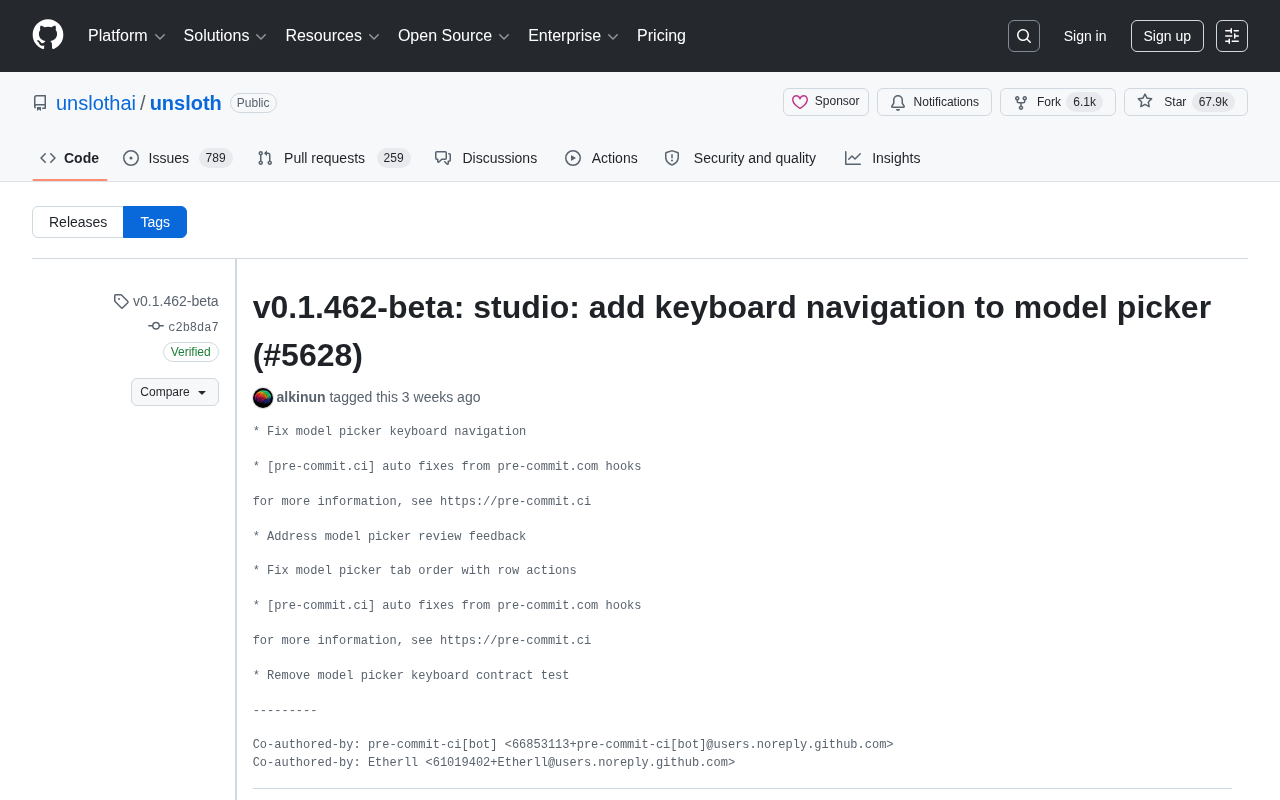
The highlight of this release is a fix and full implementation of keyboard operation support in the Model Picker. Based on commit records, the changes span multiple dimensions:
- Arrow key navigation through the model list: Users can navigate the model list with up/down arrow keys without switching to the mouse.
- Iterative review feedback: Targeted adjustments were made based on code review feedback, indicating the feature went through rigorous community collaboration.
- Fixed Tab key focus order: Specifically addressed Tab key jump logic when row actions are present, ensuring focus flows intuitively across interactive elements.
For workflows that require frequently switching between models for testing, keyboard navigation significantly reduces hand movement between keyboard and mouse — a detail that often makes a real difference in development efficiency.
The Real Meaning of Accessibility
Keyboard navigation isn't just an efficiency tool — it's a core component of accessibility. For users who cannot or prefer not to use a mouse, full keyboard support means they can use Unsloth Studio just as smoothly as anyone else.
WCAG (Web Content Accessibility Guidelines), the international standard developed by the W3C, currently has mainstream versions 2.1 and 2.2. Its core principles are summarized as POUR: Perceivable, Operable, Understandable, and Robust. Keyboard navigation is a key requirement under the "Operable" principle — the standard explicitly states that all functionality must be operable via keyboard alone, without relying on a mouse. The Tab key focus order fix directly addresses WCAG 2.4.3: incorrect focus order causes serious confusion for screen reader users and keyboard users alike. For open-source tools serving a global developer community, meeting WCAG AA compliance is increasingly becoming a baseline quality standard.
Extended Background: Accessibility Compliance Pressure Beyond technical considerations, accessibility compliance carries legal obligations in several regions. The EU's European Accessibility Act takes full effect in June 2025, and Section 508 of the US Rehabilitation Act requires software tools procured by federal agencies to meet accessibility standards. For open-source tools like Unsloth that are widely used by academic institutions, enterprise R&D teams, and government agencies, proactively improving WCAG compliance is both a UX enhancement and a forward-looking way to reduce legal risk.
Development Collaboration in the Commit History
This release was tagged by contributor alkinun and published on June 12. The commit history reflects a typical open-source collaboration workflow:
- After the feature was submitted, pre-commit.ci automated hooks corrected code formatting;
- Multiple rounds of iteration were completed based on review feedback;
- Keyboard contract tests for the Model Picker were ultimately removed, likely to reduce maintenance overhead or in favor of alternative validation approaches.
pre-commit.ci is a continuous integration service designed for open-source projects. Based on the pre-commit framework, it automatically runs code formatting, static checks, and style validation on every Pull Request. Unlike traditional CI/CD pipelines, pre-commit.ci pushes formatting fixes directly as new commits back to the PR branch, eliminating the need for developers to manually adjust their code — significantly lowering the barrier to contributing. These automation tools standardize team code style (using tools like Black, isort, and flake8 in the Python ecosystem), allowing code reviews to focus on logic and architecture rather than formatting details.
The commit history also credits collaborators such as Etherll, reflecting the multi-person effort behind even this small feature. Notably, the relevant commits carry GitHub's Verified signature (GPG key ID: B5690EEEBB952194), ensuring the trustworthiness of the code's origin.
GPG (GNU Privacy Guard) signature verification is increasingly important. Against a backdrop of growing concern about open-source supply chain security — especially following the 2020 SolarWinds incident and the 2024 XZ Utils backdoor — GPG signatures have become a key tool for verifying code provenance.
Extended Background: Open-Source Supply Chain Security Threats The 2024 XZ Utils backdoor is the most prominent recent example of an open-source supply chain attack: an attacker used social engineering over two years to infiltrate a project's maintainer team, ultimately planting malicious code in a widely used compression library. The goal was to achieve remote code execution on millions of Linux servers via the SSH daemon — and it was only accidentally discovered by Microsoft engineer Andres Freund during a performance anomaly investigation. This incident prompted the industry to reassess the importance of code signing and identity verification. GPG signatures use asymmetric encryption to bind each commit to a known developer's public key; any tampering causes verification to fail. GitHub's Verified badge reflects validation of the committer's GPG public key and, combined with branch protection rules and CODEOWNERS mechanisms, forms a multi-layered defense. For AI tools like Unsloth that are referenced by many production environments, signature verification means users can confirm that every change entering the codebase was authorized by a vetted developer, effectively guarding against malicious code injection.
The Product Philosophy Behind Small Improvements
Despite being a minor beta iteration, this update reflects Unsloth's team beginning to consciously polish the user interface and interaction experience beyond core training performance. For an open-source tool, the ability to balance technical leadership with usability often determines whether it can grow from a "developer toy" into a genuine productivity tool.
At version number v0.1.462-beta, Unsloth is still in a rapid iteration phase with a fast feature release cadence. This incremental release approach, paired with an active community feedback loop, is a hallmark of many successful open-source projects. It's worth noting that similar tools like HuggingFace Transformers and vLLM followed a comparable "performance first, experience later" evolution path in their early days, ultimately expanding their user base through improved documentation and UI tooling. Unsloth's current trajectory closely mirrors that pattern.
Summary and Recommendations
For users currently using Unsloth Studio for LLM fine-tuning, it's worth exploring the keyboard navigation improvements in this update — especially in workflows that involve frequent model switching. As a beta release, some edge cases may still need refinement; feel free to report issues to the community.
Overall, while this update is small, it's a snapshot of Unsloth's evolution toward a more mature and user-friendly product. Keeping track of its iteration cadence helps developers capture efficiency gains as early as possible.
Key Takeaways
- Technical core: Unsloth achieves high-end model fine-tuning on consumer GPUs via handwritten Triton kernels + QLoRA quantization, compressing VRAM usage by ~70%
- This update: v0.1.462-beta adds full keyboard navigation to the Studio Model Picker, including arrow key browsing and Tab focus order fixes
- Accessibility value: Keyboard support aligns with WCAG 2.4.3, delivering both efficiency and compliance benefits — especially forward-looking given tightening EU and US regulations
- Collaboration quality: pre-commit.ci automated formatting + GPG signature verification reflect a growing awareness of open-source supply chain security
- Product direction: Evolving from a performance tool toward a user-friendly product, closely mirroring the development paths of mature projects like HuggingFace and vLLM
Related articles

The Truth Behind Codex 'Build a Website in 5 Minutes': AI Isn't Creating Sites—It's Helping You Copy Them
Exposing the truth behind viral Codex 5-minute website videos: creators aren't building original sites with AI—they're copying shared prompts or scraping others' work. Learn AI coding tools' real limits.

Getting Started with AI Agent Development: A Complete Guide from Concept to Practice
A comprehensive guide to AI Agent architecture and development, covering automated marketing, intelligent customer service, and investment analysis scenarios with single and multi-agent collaboration.

The Truth Behind Codex 'Build a Website in 5 Minutes': AI Isn't Creating Sites — It's Helping You Copy Them
Exposing the truth behind viral Codex 5-minute website videos: creators aren't building original sites with AI — they're copying shared prompts or scraping others' work.