What Is an AI Agent? The Core Leap from "Talking" to "Doing"

AI Agents go beyond chatting — they pursue goals, call tools, and act autonomously in continuous loops.
Unlike chatbots that respond and stop, AI Agents operate inside a goal-driven action loop: they break down objectives, call external tools, observe results, and dynamically adjust their next steps. Powered by frameworks like ReAct and Function Calling, they bridge the gap between conversation and execution — best suited for multi-step tasks where the path can change.
If you asked an AI to help you prepare for a business trip, a regular chatbot would tell you to "check flights, pick a hotel, and organize your schedule" — it hands you the steps, but everything still falls on you. An AI Agent is built to solve a fundamentally different problem: within the boundaries you set, it figures out what to do first and what comes next on its own, actively calling tools to get results when needed.
The point isn't being better at conversation — it's turning a single goal into a sequence of executable actions. That one sentence nearly captures the essential divide between AI Agents and traditional chatbots.
AI Agents vs. Chatbots: What's the Difference?
Many people's first instinct is: is an AI Agent just powered by a stronger underlying model? The answer is no.
A standard ChatGPT is essentially a "conversation window" — you ask something, it responds based on the current exchange, and that's pretty much the end of that round. An AI Agent is more like having a task execution engine wrapped around that conversation window: it retains the goal, tracks progress, decides on next actions, and keeps moving forward as new results come in.
Underpinning this task execution engine is a key technical framework — ReAct (Reasoning + Acting). Proposed by Google researchers in 2022, the core idea is to move large language models beyond passive text generation. Instead, they alternate between "reasoning" (analyzing the current state, planning the next step) and "acting" (calling external tools, observing results), with each phase driving the other in a continuous loop. This cycle is what gives Agents that sense of "always working toward something," rather than delivering an answer and stopping.
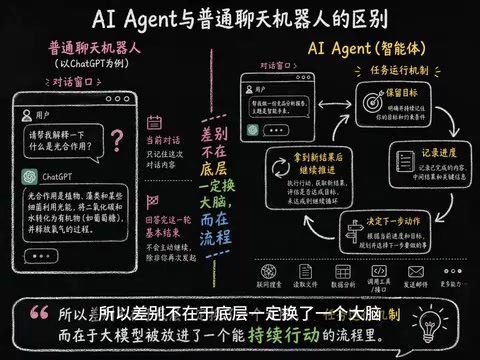
So the real difference isn't whether a stronger model is under the hood — it's that the model has been placed inside a process that enables continuous action. The same model, slotted into different runtime frameworks, produces the distinction between a "responder" and an "executor." This is why understanding Agents means looking beyond model parameters to the orchestration logic surrounding them.
The Four Core Capabilities of an AI Agent
To go from "saying" to "doing," an AI Agent generally relies on four things:
Understanding the Goal
It needs to grasp what the user actually wants to achieve — not just interpret words literally.
Breaking Down the Task
Splitting a big goal into smaller, executable steps. This is the key move that sets Agents apart from chatbots — a chatbot gives you advice; an Agent turns that advice into a step-by-step path that can actually be followed.
Selecting and Calling Tools
This includes searching for information, running code, reading databases, and processing documents. An Agent doesn't magically open webpages or edit files on its own — it interacts with the outside world through tool interfaces.
It's worth understanding the technical mechanism behind this. Function Calling is the foundational layer, first introduced by OpenAI into the GPT model series in 2023. Developers pre-define a set of structured tool descriptions (for example: "a search tool that takes a keyword and returns a list of results"). During inference, the model determines whether the current step requires a tool, then automatically generates a properly formatted call request. The system executes the tool and returns structured results to the model, which then continues its reasoning. This mechanism transforms large language models from "pure text generators" into "decision hubs" capable of operating external systems — and it's the technical key to making Agents actually move.
Observing Results and Making Dynamic Decisions
It needs to read the results returned by tools, remember where things stand, and judge whether to keep going, try a different approach, or pause and ask for human confirmation.
An Agent's ability to "remember progress and keep moving" also depends on two types of memory mechanisms. The first is short-term memory — the context window of the current task, which records completed steps and intermediate results so the model always knows "where it left off." The second is long-term memory, typically implemented using external vector databases (such as Pinecone or Weaviate) to store historical task information that Agents can retrieve across sessions. Context window length limits (currently around 128K tokens for leading models) represent one of the most significant bottlenecks in Agent capability today — and a frontier that major model providers are actively racing to push further.
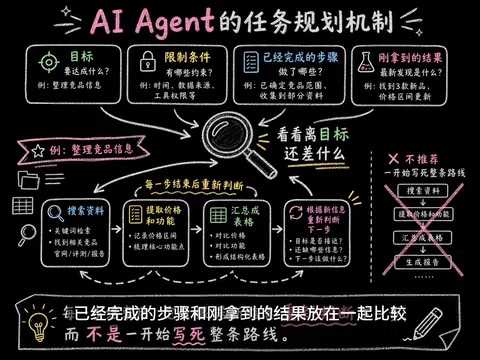
The most important point here: an Agent doesn't "write a plan once and walk away." It holds the goal, constraints, completed steps, and freshly retrieved results together and continuously evaluates how far it still is from the objective.
Take this example: the goal is to "compile a competitive analysis." The Agent might first search for information, then extract pricing and features, then consolidate everything into a table. But after each step, it reassesses the next move based on new information rather than locking in the entire route from the start. This "watch as you walk" dynamic planning is the true source of an Agent's sense of intelligence.
Tool Calling: What Makes an AI Agent Actually Move
What truly brings an AI Agent to life is the ability to call tools.
It sends clear requests through system-provided interfaces — searching a question, executing code, querying a table, generating a document. After the external tool completes its action, it returns results to the Agent; the Agent reads those results and judges whether the goal has been met. If not, it adjusts the request or advances to the next step.
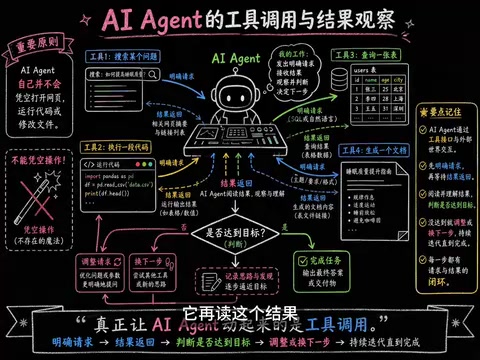
This "request → execute → read results → re-evaluate" loop forms the Agent's action cycle. It doesn't recite an answer for you — it continuously interacts with the outside world and adjusts its behavior until the goal is met or a boundary is reached.
When task complexity increases further, a single Agent often falls short, which has led the field to develop Multi-Agent Systems. In these architectures, an Orchestrator Agent breaks down the overall goal and distributes subtasks, while multiple specialized sub-Agents each handle their domain — one dedicated to information retrieval, another to code generation, another to result verification — with their outputs ultimately consolidated. Microsoft's open-source framework AutoGen and Stanford's "Smallville" virtual society experiment (25 Agents simulating small-town residents interacting) are representative explorations in this direction, revealing the possibility of emergent social-like behaviors in multi-Agent collaboration and hinting at where Agent systems are headed next.
Are AI Agents and Automation Scripts the Same Thing?
Since Agents can also call tools and execute processes, are they just the same as pre-written automation scripts?
Again, no.
Automation scripts work best for stable, rule-based workflows: inputs and next steps are defined in advance. They're like trains on fixed tracks — fast and reliable, but the moment conditions go beyond what's been anticipated, they stall.
AI Agents operate with more open-ended goals and can flexibly change course based on intermediate results. A fitting analogy: an Agent is more like driving with GPS navigation — it recalculates routes in real time when conditions change. But precisely because of this, it requires clearer boundaries and human checkpoints.
In short, scripts trade flexibility for predictability; Agents trade predictability for adaptability. They serve fundamentally different types of tasks — neither is replacing the other.
Which Tasks Are Right for an AI Agent?
Understanding this boundary makes it easier to judge which tasks suit an Agent and which shouldn't be handed over blindly.
Well-suited tasks typically involve multiple steps, require processing information, and allow for course corrections based on feedback:
- Research and report drafting
- Customer service ticket triage and initial handling
- Code assistance and troubleshooting
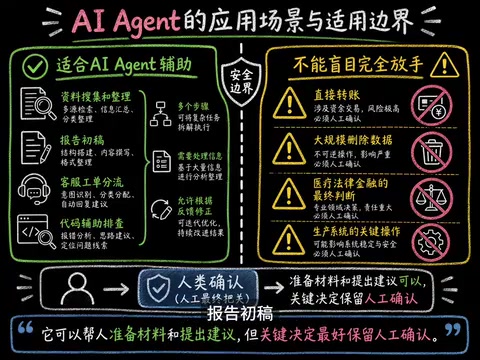
Tasks that shouldn't be fully delegated involve irreversible or high-stakes decisions:
- Direct fund transfers or large-scale data deletion
- Final judgments in medical, legal, or financial domains
- Critical operations on production systems
For the latter, an Agent can help prepare materials and surface recommendations, but key decisions should stay with a human. This isn't a question of technical capability — it's a necessity for risk management. The industry refers to this design principle as "Human-in-the-Loop": placing human review checkpoints at critical nodes in the Agent's action chain to ensure high-risk actions receive explicit human authorization before execution. This is also one of the most important engineering practices in AI safety today.
AI Is Starting to Move from "Answering" to "Acting"
To sum up: an AI Agent isn't "a chatbot that's better at conversation." It's a large language model placed inside a goal-driven action loop — understanding the goal, breaking down the steps, calling tools, observing results, and deciding what comes next.
- A regular chatbot mainly tells you the answer.
- An automation script mainly runs a fixed process.
- An AI Agent's value lies in handling tasks where the goal is clear but the path will change.
The next time you hear "AI Agent," don't think of it as just a smarter chat window. The truly important shift is this: AI is beginning to move from answering questions to taking sustained action. That leap may reshape how we collaborate with AI far more profoundly than any increase in model parameters.
Related articles

The Truth Behind Codex 'Build a Website in 5 Minutes': AI Isn't Creating Sites—It's Helping You Copy Them
Exposing the truth behind viral Codex 5-minute website videos: creators aren't building original sites with AI—they're copying shared prompts or scraping others' work. Learn AI coding tools' real limits.

Getting Started with AI Agent Development: A Complete Guide from Concept to Practice
A comprehensive guide to AI Agent architecture and development, covering automated marketing, intelligent customer service, and investment analysis scenarios with single and multi-agent collaboration.

The Truth Behind Codex 'Build a Website in 5 Minutes': AI Isn't Creating Sites — It's Helping You Copy Them
Exposing the truth behind viral Codex 5-minute website videos: creators aren't building original sites with AI — they're copying shared prompts or scraping others' work.