Why Are China's Open-Source AI Models Getting Stronger? A Deep Dive into Three Comeback Paths

Three paths behind why China's open-source AI models keep getting stronger despite US chip restrictions.
As the US leverages hardware advantages and closed-source monopolies to complete its commercial loop, China counters with open-source models and extreme cost-effectiveness. This article breaks down three core paths—dismantling closed-source pricing power via open source, positioning for next-gen optical interconnect, and leveraging edge-side use cases and data flywheels—to explain the resilience of domestic large models.
A Critical Juncture in the New Round of the US-China AI Rivalry
We've entered a critical juncture in the new round of the US-China AI rivalry. The US is trying to open a gap through hardware generational advantages and ecosystem fragmentation, completing the closed loop of its own commercial pathway; meanwhile, China keeps launching cost-based counterattacks with open-source models and extreme cost-effectiveness, wave after wave. On the surface it looks like a routine competition, but beneath lies turbulent undercurrents. According to in-depth analysis by a relevant Bilibili content creator, this is no longer a simple technology race, but a gamble over tech hegemony that neither side can afford to lose. Drawing on the original material, this article offers a forward-looking breakdown of the logic behind China's AI industry "blazing its own trail" to stage a comeback.
The Status Quo: No One Is Truly Ahead, but Everyone Is Going All Out
If we still regard AGI as the sole benchmark of this AI revolution, then the current situation can be summed up in one sentence: no one is truly ahead, but everyone is going all out.
Within just 8 days in July, four top-tier models were released in rapid succession: Musk's Grok 4.5, OpenAI's GPT-5.6, Meta's Muse Spark, and Moonshot's Kimi K3. According to Artificial Analysis scores, the number of vendors crossing the 50-point threshold jumped from two in June to six, while the gap between the top three was a mere 3 points. The shelf life of the word "leading" has shrunk from the "monthly" cadence following DeepSeek V3's breakout to today's "weekly race" level.
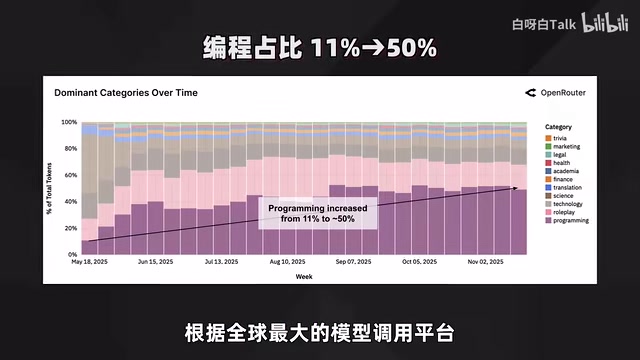
More important than rankings is that the rules of the game themselves are changing. According to data from OpenRouter, the world's largest model-calling platform, the share of coding-type workloads has surged from 11% in early 2025 to over 50%, while a single agent request consumes roughly 15 times the tokens of a typical conversation.
The Deeper Logic of the Shift to the Inference Side: The transition from the training side to the inference side is essentially a paradigm leap in the AI industry from being "R&D-driven" to "deployment-driven." The training-side race centers on metrics like parameter count and FLOP consumption, while the inference-side race centers on tokens per second (TPS), energy per token (Joules/Token), and latency (TTFT, time to first token). The rise of agent workflows has vastly amplified inference demand—a typical ReAct-framework agent, in completing a single task, requires multiple rounds of the "think-act-observe" loop, each requiring an LLM call, causing token consumption to grow exponentially. The surge in coding workloads in OpenRouter's data is a direct reflection of the massive rollout of coding agents (such as Cursor, Devin, etc.). This trend means that the strategic value of inference chips, KV cache optimization, and speculative decoding is rapidly surpassing that of training chips themselves.
This means the entire industry is shifting from the "training side" to the "inference side" at a speed beyond imagination, and the main battlefield of the race has moved from the lab to a comprehensive contest of combined combat power involving chips, electricity, capital, and use cases.
America's Open Advantages and China's Real-World Predicament
America's current advantages are on full display, stacked like buffs. In AI chips, the US controls more than 70% of 2nm capacity and holds absolute control over HBM, further boosted by over 20 years of the CUDA software ecosystem. According to CFR statistics (on a quality-adjusted basis), US advanced AI chip capacity is about 35 times that of China.
The Deeper Logic of the CUDA Ecosystem Moat: CUDA (Compute Unified Device Architecture), launched by NVIDIA in 2006, is currently the de facto programming standard in AI training and inference. Its moat comes not merely from hardware performance, but from the software ecosystem accumulated over 20 years: mainstream frameworks like PyTorch and TensorFlow are deeply bound to CUDA operator libraries (cuDNN, cuBLAS), and tens of thousands of open-source models and pretrained weights are optimized in CUDA format by default. For developers to migrate to other platforms (such as Ascend's CANN or Cambricon's MLU), they must rewrite or adapt large numbers of low-level operators, incurring extremely high migration costs. There are usually two paths to breaking through the CUDA moat: one is building a compatibility layer (such as ZLUDA, Triton, etc.), and the other is leveraging the open-source community to drive native framework support—but both require trading time for space.
In terms of capital density, America's five largest tech giants have poured over $700 billion (roughly RMB 5 trillion) into AI in the past year—more than the GDP of the vast majority of countries in the world. Wall Street statistics show that from 2025 to 2027, the tech sector will add about $1.5 trillion in new debt, almost all of it going all in on AI. The result: in core capabilities such as parameter scale, multimodality, and long-context consistency, America's leading closed-source models still occupy the first tier.
China's difficulties, on the other hand, are stuck at the root. While DUV multi-patterning can squeeze out capacity, its costs are relatively high, and domestic HBM lags roughly two generations behind the world's most advanced technology, severely limiting memory bandwidth.
The Physical Bottleneck of HBM and Memory Bandwidth: HBM (High Bandwidth Memory) is one of the core physical bottlenecks in large-model inference. During inference, large language models need to repeatedly read hundreds of GB of model weights into the compute units (the "memory wall" problem), and memory bandwidth—rather than compute power—is often the true bottleneck determining inference speed. Take the H100 for example: its HBM3 provides 3.35TB/s of memory bandwidth, whereas ordinary GDDR6X offers only about 1TB/s. HBM production is highly concentrated among three companies—SK Hynix, Samsung, and Micron—and is deeply coupled with wafer foundry, requiring advanced packaging technology (such as CoWoS) to tightly integrate HBM with the GPU die. China lagging roughly two generations in HBM means that even if it closes the gap with NVIDIA on compute cores, the memory bandwidth bottleneck will still systematically drag down large-model inference efficiency—this is one of the hardest chokepoints.
In single-card compute, inter-chip interconnect efficiency, and software ecosystem maturity, China still needs time to catch up. This is not a question of "whether it can catch up," but a question of "having its hands and feet bound."
Yet reality is exactly the opposite—each time Anthropic or OpenAI releases a flagship model, China's open-source products always manage to deliver answers close to flagship level on certain performance points or experiences. Why? The answer lies in three paths.

Path One: Open Source—Dismantling the Closed-Source Pricing-Power Loop
To understand the open-source move, first understand the business logic of America's closed-source approach: use massive capital expenditure to train the strongest model, then recoup costs through monopoly pricing (selling APIs or subscriptions), and invest in the next round. The key premise for this chain to hold is forming a de facto absolute monopoly over model capability—only monopoly grants pricing power. According to Bain's estimates, maintaining the current pace requires investing about $500 billion in capital annually, corresponding to a roughly $2 trillion capital pool to keep the game running.
China's open source strikes exactly at this weak point. The logic is simple: when the world always has a "second option," monopoly naturally cannot close the loop in a market-driven environment. Once the loop fails to complete, the hundreds of billions of dollars in annual capital expenditure become a Sword of Damocles hanging overhead.
The data speaks for itself: DeepSeek V4 Flash's input price is only $0.14 per million tokens, and with caching, the actual cost can be compressed to under 3 cents; whereas GPT-5.5 is around $5, with the output-side price difference exceeding 100 times at its peak. On OpenRouter, the share of tokens from US companies calling Chinese models has surged from an average of 4.5% in the first half of 2025 to a peak of 46% in April, and total calls to Chinese models have surpassed those to US models. Palantir CEO Karp warned in an interview: if US vendors continue to respond by charging per token, there's a problem at the very root.
The Price-Anchoring Mechanism
China's open-source models don't need to become the sole hegemon—they only need to be "close to, or with a hope of catching up to" the leaders to create enormous price pressure. Especially in commercial tasks such as customer service, coding, document translation, and agent workflows, once the "good enough" threshold is crossed, users become extremely price-sensitive, and the allure of open source is amplified infinitely.
The Sovereignty-Boundary Mechanism
What open source opens up is the weights, meaning users can fully deploy locally, with data never leaving the data center, free from the censorship and value tilts of US tech companies. This effectively hands the regulatory power over AI back to individual nations, enterprises, and individuals. For the vast majority of countries in the world, this is not just a security consideration but a defense of the deployer's freedom to make decisions.

Path Two: Optical Interconnect—On the Same Starting Line for the Next Generation of Interconnect
After two years of intense industry competition, an awkward fact has emerged: single-card compute is actually already strong enough, and data centers are being built frantically, yet effective compute just won't scale up. The reason: the more cards there are, the more fatal inter-card communication becomes.
The Physical Essence of MoE Architecture and Inter-Card Communication: The MoE (Mixture of Experts) architecture is the scaling paradigm widely adopted by today's top large models. Its core idea is to split the model into dozens or even hundreds of "expert sub-networks," activating only a few of them per inference, thereby drastically reducing the compute per inference while maintaining an enormous parameter count. However, MoE's cost is communication overhead—when experts are distributed across different GPUs, each token must be routed over the network to the GPU hosting the corresponding expert, and the results aggregated back (i.e., the All-to-All communication primitive). As cluster scale expands from a single machine's 8 cards to thousand-card clusters spanning racks, this communication overhead grows roughly quadratically, causing effective compute utilization (MFU, Model FLOP Utilization) to plummet. This is precisely why, in current large-scale MoE model inference scenarios, improving inter-card interconnect bandwidth carries even greater strategic value than improving single-card compute.
MoE model expert parallelism and the back-and-forth movement of the KV cache all consume inter-card bandwidth—the more cards, the more effective compute is lost. Interconnect is always the shortest board. By the 224G generation, the effective transmission distance of copper wire has shrunk to the meter scale; once you leave the rack, you have to rely on optics. Every stretch of copper wire an electrical signal travels adds more loss, more power consumption, and more latency.
The Industry Background of CPO and Silicon Photonics: CPO (Co-Packaged Optics) is the core technology route for next-generation data center interconnect. It refers to packaging the optical engine and switch chip on the same substrate, using extremely short copper wires to replace the long-distance copper connections between traditional pluggable optical modules and chips. Traditional pluggable optical modules (such as QSFP-DD) require the electrical signal to undergo multiple conversions of "chip → copper wire → SerDes → optical module," each conversion bringing loss and latency. By moving the optical-electrical conversion point as close to the chip as possible, CPO can theoretically reduce power consumption by 30–50% and support higher transmission rates (currently, mass-produced 800G is evolving toward 1.6T and 3.2T). Chinese optical module manufacturers (Innolight, HGTech, Eoptolink, etc.) have deep accumulation in this segment, mainly because optical modules belong to the intersection of precision manufacturing and optoelectronic integration, with far lower dependence on EUV lithography than logic chips. Therefore, the impact of export controls is relatively limited, and Chinese companies can hold a dominant share in global competition.
As a result, silicon photonics, CPO, and even photonic computing are a shared path for both the US and China, and Jensen Huang has also listed silicon photonics as a focus for the next-generation platform. And when it comes to "playing with light," China holds quite a few strong cards: Chinese manufacturers occupy more than 70% of the global optical module market, about half of the global 800G silicon photonic module share, and have already mass-produced 1.6T. The Ascend 950's 1024-card TB-level bandwidth and three-microsecond latency are themselves products of optoelectronic hybrid interconnect. The conclusion is clear: in single-card compute, China may need to wait a generation or two to catch up, but on the optical interconnect battlefield, everyone stands on the same starting line when it comes to many rules, paradigms, and visions.
Path Three: Edge-Side Use Cases and Talent—What China Can Truly Grasp
If open source has locked down the opponent's pricing power and optical interconnect has staked out the next-generation architecture, then use cases, engineering talent, and edge-side services are what China can truly grasp right now.
China's fundamental market base is large enough. The user scale of generative AI has reached 515 million.
The Data Flywheel Effect and the Strategic Significance of the Edge-Side Market: The "data flywheel" is a classic positive-cycle model for internet product growth, given new meaning in the AI era: user usage generates interaction data → data is used for model fine-tuning and reinforcement learning (RLHF/RLAIF) → model capability improves → attracts more users → generates more high-quality data. This mechanism enables products with large user bases to form hard-to-replicate "experience barriers" in model capability. The diverse, high-frequency, and localized interaction data generated by China's 515 million generative AI users is a structural advantage that US closed-source vendors find difficult to make up through technical means. The penetration of products like Doubao and Kimi in vertical scenarios such as gaokao (college entrance exam) major selection, career planning, and local content creation means the data they accumulate is not only large in volume but also strongly culturally and contextually specific, forming a significant differentiation advantage in local application scenarios over closed-source models trained on general English data.
A vivid example: ordinary users are already using Doubao, asking Kimi, and even using different large models to compare arguments; when filling out gaokao applications, examinees directly ask AI and report that it's "better than the vast majority of career planners on the market." The overall market value of edge-side AI applications has reached RMB 500 billion.
This shows that China doesn't necessarily have to stubbornly chase leaderboards and benchmark scores entirely in step with America's closed-source models. Instead, it should combine its own economic model, market characteristics, and user needs to make the business model work, letting domestic models grow "stronger the more they're used" and letting commercialization run "smoother the further it goes." The price hikes by vendors like Kimi also reflect, from another angle, the market's recognition.
In addition, a series of physical-layer explorations are worth watching: China's first 8-inch diamond heat-sink wafer production line has been launched for chip cooling; attempts at carbon-based paths, compute-electricity coordination, and green-power support are all trying to reshuffle the deck at the physical level, further pushing down token prices.

Two Narratives, Converging on the Same Destination
Returning to the original question: with the most expensive chips, sky-high investment, and the strongest models, why has America failed to crush China's AI industry—and even made domestic open-source models increasingly resilient?
The answer is already clear—powerful chips and higher scores are only part of the AI race, not all of it. Using open source to counter closed source, preventing the monopoly ecosystem from closing its loop; using optical interconnect to break through the physical limits across racks; using power and cooling innovation to make up for the single-card gap; using a massive market to drive one's own data flywheel—these are all proven, effective means.
Of course, every variable could rewrite the ending: whether advanced processes can break through, whether HBM can bear fruit, whether open source can persist, and whether optical interconnect can deliver on its promises. But what's certain is that the US and China on this track have never been simply "chasing each other." Rather, they are walking their own paths toward the popularization of intelligence in entirely different narrative styles. That, in itself, is a story interesting enough.
Key Takeaways
Related articles

The Truth Behind Codex 'Build a Website in 5 Minutes': AI Isn't Creating Sites—It's Helping You Copy Them
Exposing the truth behind viral Codex 5-minute website videos: creators aren't building original sites with AI—they're copying shared prompts or scraping others' work. Learn AI coding tools' real limits.

Getting Started with AI Agent Development: A Complete Guide from Concept to Practice
A comprehensive guide to AI Agent architecture and development, covering automated marketing, intelligent customer service, and investment analysis scenarios with single and multi-agent collaboration.

The Truth Behind Codex 'Build a Website in 5 Minutes': AI Isn't Creating Sites — It's Helping You Copy Them
Exposing the truth behind viral Codex 5-minute website videos: creators aren't building original sites with AI — they're copying shared prompts or scraping others' work.