Why Claude Code Ditched RAG in Favor of Grep for Code Search

Claude Code uses Grep and Agentic Search over RAG because code retrieval demands precision, not fuzzy semantic matching.
Claude Code skips RAG in favor of RipGrep and Agentic Search — a decision rooted in code retrieval's need for exact matching, real-time freshness, and explainability. Rather than relying on vector similarity, Claude uses its own reasoning ability to iteratively explore codebases like a human developer, a paradigm built on the ReAct framework of alternating reasoning and action.
A Counterintuitive Technical Choice
After Claude Code gained popularity, many developers noticed something surprisingly counterintuitive: this AI coding tool doesn't use RAG (Retrieval-Augmented Generation) — the hottest approach in AI today — to search code. Instead, it falls back on the traditional Grep command, scanning through code line by line.
In an era where vector search is widely considered the go-to solution, why did the Anthropic team choose what appears to be a "dated" approach? The answer reveals a deep understanding of what code retrieval actually demands. Grasping this trade-off helps us see a common evolutionary direction emerging across today's AI coding tools.
What RAG Is — and Why It Breaks Down for Code
The RAG (Retrieval-Augmented Generation) workflow is straightforward: documents are vectorized and stored in a vector database; when a user asks a question, the system performs a semantic search to find relevant chunks, then feeds those chunks to a large language model to generate a response.
RAG's core dependency is vector embedding technology — converting text into high-dimensional numerical vectors so that semantically similar content sits closer together in vector space. This works beautifully for natural language, which naturally has synonyms and paraphrases. Code, however, is a formal language where precision is fundamental: getUserById(id) and fetchUserData(userId) may be semantically similar, but in a code-tracing context they are two entirely different function calls. The fuzzy-matching nature of vector search — an advantage in natural language — becomes a source of noise in code.
RAG excels at enterprise knowledge base Q&A and document retrieval, precisely because those scenarios call for fuzzy semantic understanding. But bring it into a coding context and problems start stacking up.
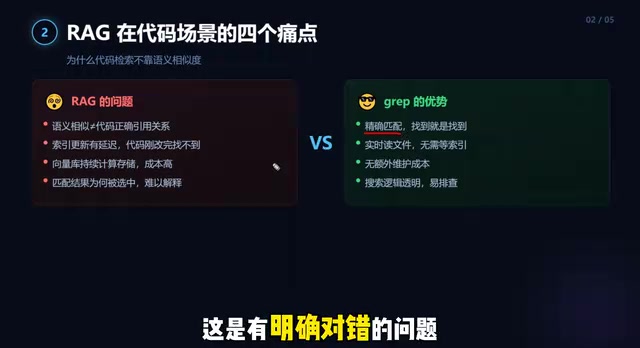
Four Core Pain Points of Code Retrieval
First, exact matching. When a developer needs to find where a function is defined or where a variable is referenced, there's a definitive right answer — "close enough" won't do. RAG relies on semantic similarity, and that fuzziness is a liability when you need precise location.
Second, real-time freshness. Code changes constantly. The moment you edit a line, the vector index hasn't caught up yet — and that lag is a fundamental flaw. Coding is a high-frequency interactive process; there's no time to wait for index rebuilds.
Third, cost. Maintaining a vector database carries ongoing compute and storage overhead. At scale, the economics don't necessarily pencil out.
Fourth, explainability. It's hard to articulate why RAG returned a particular set of results. When something goes wrong, debugging is a headache.
Grep, by contrast, is pure text matching — transparent search logic that makes failures immediately obvious. It's worth noting that Claude Code actually uses RipGrep under the hood — a modern text search tool written in Rust by Andrew Gallant that's significantly faster than native Grep. Its core advantages come from three areas: Rust-powered performance, recursive search by default with automatic .gitignore respect (a natural fit for code repository structures), and a regex engine optimized with SIMD instructions. These qualities have made it the de facto built-in search backend for VS Code, Neovim, and other mainstream editors — and when combined with file-finding tools, it handles large codebases with impressive efficiency.
The Truth Behind the Misunderstood "Hybrid Strategy"
There's one particularly common misconception about how Claude Code works that deserves clarification.

Many sources claim Claude Code uses a "Grep-primary, RAG-secondary" hybrid strategy — this is inaccurate.
The reality: the Anthropic team did experiment with a local vector search layer early on, but testing showed it actually performed worse than simply letting the AI operate search tools on its own. The current approach has the large model rely entirely on its own reasoning ability, exploring the codebase step by step — just like a human developer would.
How Agentic Search Works
Agentic Search is a specific application of the broader AI Agent paradigm to information retrieval. Traditional RAG is a form of "passive retrieval" — the system decides the retrieval logic in advance. Agentic Search, by contrast, gives the large model tool use (Tool Use / Function Calling) capabilities, letting the model autonomously decide when to search, what to search for, and whether the results are sufficient. The theoretical foundation traces back to the ReAct (Reasoning + Acting) framework — the model alternates between "thinking" and "acting" during inference, with each action's result feeding back into the next round of reasoning, forming a closed iterative loop.
The workflow looks roughly like this:
- The AI analyzes the task and constructs a search strategy;
- It uses file-finding tools to narrow down the general scope;
- It uses text search tools to pinpoint exact content;
- It reads the relevant files and gathers context;
- After reading, the AI decides on its own — keep searching, or is the answer found?
This process iterates multiple rounds until the problem is resolved.
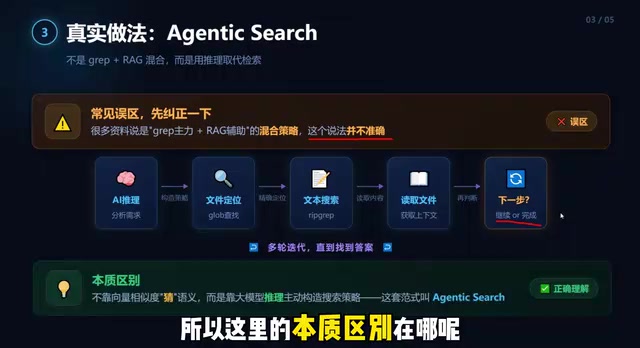
Here's the fundamental difference: it's not guessing semantics via vector similarity — it's using the model's reasoning ability to actively construct search strategies. Anthropic deeply adopted this approach when building Claude's tool-use capabilities, which is why Claude Code's code exploration process more closely mirrors how a real developer thinks, rather than mechanical vector matching. This entire approach has a dedicated name: Agentic Search.
Agentic Search Has Its Limits Too
Objectively, this approach has its own shortcomings.
First, token consumption. Having the AI repeatedly read files and run searches consumes a significant number of tokens. Research suggests roughly one-third of file reads are redundant. The root cause: large models process information in tokens, and repeatedly reading files means stuffing large amounts of raw code into the model's context window. Claude 3.5, for example, supports a context window of around 200,000 tokens — which sounds generous, but the core code of a medium-sized real-world project can easily exceed that limit. Agentic Search is therefore highly dependent on the quality of the underlying model's reasoning: a weaker model will compound token waste through inefficient exploration.
Second, very large codebases. When the codebase is enormous, pure step-by-step exploration may not be the most efficient path. Whether vector search still has a role to play in such scenarios remains an open discussion in the industry.

You may not have noticed, but this approach isn't unique to Claude Code — many mainstream AI coding tools are converging in this direction, and it can be considered a defining trend for this generation of tools.
Applicable Boundaries
- Small-to-medium, well-structured codebases: Agentic Search performs better;
- Very large, cross-module complex scenarios: the verdict is still out.
Summary: It's Not That RAG Is Bad — It's Just the Wrong Tool for This Job
The core reason can be summed up in one sentence: code retrieval demands precision, real-time freshness, and explainability — the exact strengths of Grep and the exact weaknesses of RAG.
The technical approach at heart is using AI reasoning ability to drive traditional search tools, iterating through the codebase across multiple rounds — that's Agentic Search. It draws from the "alternating reasoning and action" paradigm advocated by the ReAct framework, elevating the large model from a passive content generator to an intelligent explorer capable of actively planning, executing, and verifying.
So ultimately: it's not that RAG is bad — it's that Agentic Search is a better fit for the specific context of code retrieval. This conclusion has clear contextual boundaries and is not a universal answer for every situation.
For very large codebases, how RAG and Agentic Search might work together may well be the central question that the next generation of AI coding tools will need to answer.
Key Takeaways
Related articles

The Truth Behind Codex 'Build a Website in 5 Minutes': AI Isn't Creating Sites—It's Helping You Copy Them
Exposing the truth behind viral Codex 5-minute website videos: creators aren't building original sites with AI—they're copying shared prompts or scraping others' work. Learn AI coding tools' real limits.

Getting Started with AI Agent Development: A Complete Guide from Concept to Practice
A comprehensive guide to AI Agent architecture and development, covering automated marketing, intelligent customer service, and investment analysis scenarios with single and multi-agent collaboration.

The Truth Behind Codex 'Build a Website in 5 Minutes': AI Isn't Creating Sites — It's Helping You Copy Them
Exposing the truth behind viral Codex 5-minute website videos: creators aren't building original sites with AI — they're copying shared prompts or scraping others' work.