Why Is Learning AI Agents So Hard? A Smarter Approach to Beginner Tutorials

A concise, beginner-friendly tutorial philosophy for getting started with AI Agent development.
Learning AI Agent development intimidates many beginners due to jargon overload and bloated tutorials. This article explores a smarter approach: use real-world examples and visuals to build intuition, keep content concise to reduce cognitive load, and prioritize core thinking over memorizing details — so beginners can finally clear that first hurdle.
Why AI Agents Intimidate Beginners
When people talk about AI Agent development, the words that often come to mind are: high barrier to entry, confusing terminology, no idea where to start. This isn't just a perception — it's an accurate reflection of the current state of AI agent learning resources.
At its core, an AI Agent is an AI system capable of perceiving its environment, making autonomous decisions, and taking actions. Unlike traditional one-shot Q&A AI, an Agent operates in a "Plan-Act-Observe" loop — breaking complex tasks into steps, calling external tools (such as search engines, code executors, databases, etc.), and dynamically adjusting its strategy based on intermediate results. Mainstream Agent frameworks today include LangChain, AutoGen, and CrewAI, most of which are built on the reasoning capabilities of large language models (LLMs) and implement autonomous task execution through techniques like Tool Use and Chain of Thought. This complex tech stack is precisely why many beginners find themselves drowning in jargon before they've even grasped the basics.
On one hand, more and more people dream of building their own AI agent — a program that can autonomously plan, call tools, and complete complex tasks. On the other hand, they hesitate to take that first step. While there are paid and free Agent tutorials available, very few actually help beginners clear the initial learning hurdle.
According to the creator of one Bilibili tutorial series, existing tutorials tend to fall into two traps: some immediately pile on technical jargon, leaving learners more confused after days of study; others are bloated and overly detailed, making it hard to stay engaged. Both extremes are among the most common "quit triggers" for new learners.

Struggling to Learn Isn't Always About Difficulty
This tutorial series offers a thought-provoking perspective: When we don't understand a concept, it's not necessarily because the knowledge itself is hard — it's that we haven't connected it to something we already know, or we've been misled by overly abstract technical descriptions.
This gets at the core pain point of technical education. Many tutorials default to API-documentation-style language, describing how an Agent works in ways that feel opaque and inaccessible. What beginners actually need is a bridge — something that links unfamiliar new concepts to familiar, existing knowledge.
Lowering the Cognitive Cost with Real Examples and Visuals
The first key feature of this tutorial is its use of real-world examples and visual aids to aid understanding. The goal is to break down an agent's operational logic into "clearly understandable processes" rather than leaving learners with abstract text descriptions.
The reasoning here is solid: the core logic of an AI Agent typically follows the ReAct (Reasoning + Acting) paradigm — alternating between reasoning and action. The Agent first analyzes the task goal and generates an action plan, then calls tools to execute specific operations, then observes the results and decides whether to adjust its strategy — repeating this loop until the task is complete. This cycle is essentially a workflow: how it receives a request, how it thinks, how it calls tools, and how it produces output. When these steps are presented visually as a clear flowchart, beginners can understand how the agent works the same way they'd read a process diagram — without being buried in terminology. Understanding this underlying architecture has an added bonus: the core paradigm is consistent across frameworks. Once you've internalized the way of thinking, switching between tools becomes much less costly.

For Beginners, Conciseness Is Everything
The second defining feature of this tutorial series is conciseness. The entire series runs about two hours in total, with each video lasting three to five minutes, focused squarely on the most essential concepts for getting started with AI Agents.
Why Beginners Shouldn't Learn the "Fine Print"
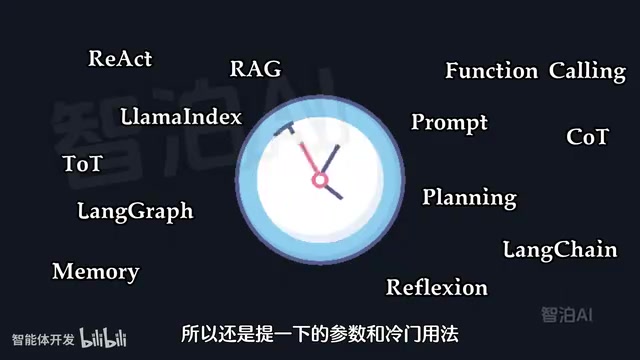
Many tutorial videos run long because they cover extensive detail — including rarely used parameters and obscure features that get mentioned just in passing. But the author argues that at the beginner stage, spending time on these peripheral details actually pulls focus away from understanding the core logic — and that rarely used knowledge is easily forgotten anyway.
This judgment has solid cognitive science backing. Cognitive Load Theory, proposed by Australian educational psychologist John Sweller in 1988, holds that human working memory has limited capacity, and when the amount of information being processed during learning exceeds a threshold, learning efficiency drops significantly. Good introductory courses should prioritize reducing "extraneous cognitive load" (the extra burden created by how information is presented), so learners can direct their limited cognitive resources toward "intrinsic cognitive load" (the inherent complexity of the knowledge itself). When beginners are simultaneously confronted with core concepts and an avalanche of supporting details, they often fail to grasp either. Building the skeleton first, then adding flesh, is a learning path that better aligns with how cognition works.
Real Development Doesn't Require a Perfect Memory
The author also makes a pragmatic point: Real-world Agent development isn't a standardized exam — you don't need to memorize every framework detail and API parameter, because documentation and search are always available.
Anyone with actual development experience eventually realizes that what matters most isn't memorization, but three core abilities:
- The ability to break down requirements
- The ability to design workflows
- The ability to solve problems efficiently
Mastering the core mindset is far more valuable than becoming a "parameter dictionary." In an age where search engines and AI assistants are always at hand, the marginal value of rote memorization is declining rapidly.
Once You Grasp the Core Logic, Learning New Tools Gets Faster
This tutorial series has a clear positioning: helping you clear the beginner hurdle and build the core mental model for AI agent development. It doesn't try to be an encyclopedia — it aims to provide "a relatively smooth starting point."
After completing the introductory series, the author suggests learners can:
- Find longer tutorials to fill in the gaps
- Learn by building real-world projects
- Explore more complex development patterns like multi-agent collaboration
On that last point: Multi-Agent Collaboration is an important advanced direction in the AI Agent space, where multiple agents with different specializations work together to complete complex tasks. Common patterns include a hierarchical architecture where a "coordinator agent" delegates subtasks to "executor agents," and a "debate" architecture where multiple agents work in parallel, discussing and reviewing each other's outputs. Frameworks like AutoGen, CrewAI, and MetaGPT all provide multi-agent orchestration capabilities, using role-based division of labor to push beyond the limits of a single agent. But the reason these advanced concepts can be picked up quickly is precisely because of a solid understanding of single-agent core logic.
The underlying rationale here is compelling: once you've internalized the core logic, learning new tools and frameworks takes far less time. Across different frameworks, the foundational Agent design principles are largely the same. Learn how to think, and the tools are just implementation details.

Final Thoughts: Taking That First Step Is What Matters
The philosophy behind this tutorial series reflects a more mature approach to learning technology: For beginners, the most important thing isn't to learn everything — it's to get past the initial barrier first.
In the fast-evolving field of AI Agents, frameworks and tools update every few months. Rather than chasing an endless stream of details, it's better to first build an intuitive understanding of how agents work, and develop the mental models for breaking down problems and designing workflows. After all, the core ideas behind the ReAct paradigm won't become obsolete just because LangChain releases a new version — the underlying cognitive framework is the truly transferable asset.
For those who've long wanted to build their own AI agent but haven't yet dared to start, this may be exactly the kind of starting point worth considering — take that first step, and the road ahead gets smoother from there.
Key Takeaways
Related articles

Transformer²: Achieving Co-Design of Robot Morphology and Control with a Unified Architecture
Deep dive into how Transformer² uses a unified Transformer architecture to integrate robot morphology design and motion control into one model, enabling task-driven end-to-end co-design for embodied AI.

Tutorial: Installing Tailscale on a Jailbroken Kindle to Create a Private Network Node
Learn how to deploy Tailscale on a jailbroken Kindle, turning an idle e-reader into a private network node. Covers cross-compilation, power optimization, and risk considerations.
Tutorial: Installing Tailscale on a Jailbroken Kindle to Create a Private Network Node
Learn how to deploy Tailscale on a jailbroken Kindle to turn an idle e-reader into a private network node. Covers cross-compilation, power optimization, and risk considerations.