Zero-Basis Learning Path for AI Agents: A Three-Stage Journey from Beginner to Deployment

A scientific three-stage path to learn AI Agent development from scratch to real-world deployment.
This article outlines a clear three-stage learning path for AI Agent development from zero: building Python and LLM fundamentals, mastering five core capabilities (task planning, tool calling, memory, self-reflection, context optimization) and frameworks like LangChain/LangGraph, and completing hands-on RAG projects to gain deployment and job-seeking competitiveness.
Why Do Some People Deploy Agents Quickly While Others Keep Stumbling?
With the maturation of large model technology, AI Agents have become one of the hottest technical directions in recent years. An AI Agent is an AI system capable of autonomously perceiving its environment, making decisions, and executing actions to accomplish goals. Unlike traditional single-turn Q&A large models, it possesses a "perceive-think-act" loop capability—it can call external tools, access databases, execute code, and even coordinate multiple sub-agents to collaboratively complete complex tasks.
Extended Background: The Cognitive Science Origins of the Agent Loop The "perceive-think-act" loop of AI Agents has deep theoretical roots in the "Perception-Action Cycle" of cognitive science. As early as the 1990s, Rodney Brooks of the MIT Artificial Intelligence Laboratory proposed a layered reactive control concept in his Subsumption Architecture—behavior layers of different priorities compete with each other, and low-level reflexive behaviors can suppress high-level planning behaviors. Modern LLM-based Agents elevate this loop to the level of language reasoning, using natural language as an internal representation to grant them symbolic planning and cross-domain generalization capabilities, thereby overcoming the fundamental limitation of early reactive architectures in handling abstract goals.
Worth mentioning is that Multi-Agent Systems (MAS) represent an important extension direction of Agent technology, referring to multiple autonomous Agents collaborating to accomplish complex tasks that a single Agent would struggle to handle. Typical architectures include: the Orchestrator-Worker model, where a master Agent decomposes tasks and assigns them to specialized sub-agents; the Peer-to-Peer model, where multiple Agents negotiate and collaborate on equal footing; and the competitive model, where multiple Agents optimize output quality through game-theoretic interactions. Frameworks like AutoGen and CrewAI are designed specifically for Multi-Agent scenarios, solving engineering challenges such as inter-Agent communication protocols, task allocation, and result aggregation.
The core challenges Multi-Agent Systems face in practical engineering deployment go far beyond task allocation. The design of inter-Agent communication protocols directly affects system throughput: synchronous communication (request-response pattern) is simple and reliable but poses blocking risks, while asynchronous message queues (such as Kafka, RabbitMQ) support high concurrency but increase state synchronization complexity. Additionally, "deadlock" and "livelock" problems in multi-Agent collaboration—where Agents wait on each other or repeatedly trigger without converging—are failure modes that frequently occur in production environments yet are rarely discussed. They must be prevented through timeout mechanisms, priority scheduling, and global state monitoring. Understanding this extension direction helps facilitate a natural transition from learning monolithic Agents to designing more complex collaborative systems.
Since 2023, with the leap in capabilities of foundation models like GPT-4 and Claude, along with the maturation of reasoning paradigms such as ReAct and CoT, Agents have rapidly moved from laboratory concepts to engineering deployment. Among them, ReAct (Reasoning + Acting) was jointly proposed by Google and Princeton University in 2022. Its core idea is to have the model first output a "thought trace" (Thought) before acting, then decide what action to execute (Action), and subsequently observe environmental feedback (Observation), forming an alternating loop of Thought-Action-Observation. CoT (Chain-of-Thought) was proposed by the Google Brain team in the same year, first published in the paper Chain-of-Thought Prompting Elicits Reasoning in Large Language Models. By adding step-by-step reasoning examples to the prompt, it guides the model to think in steps rather than output answers directly—experimental data showed that on the 540B-parameter PaLM model, CoT prompting dramatically increased mathematical reasoning accuracy from 18% to 57%.
The ReAct paradigm requires special attention to format consistency in the Thought-Action-Observation sequence during engineering implementation. Since the model may prematurely "imagine" Action results when generating Thoughts and skip actual tool calls, a Parser is usually needed to forcibly intercept Action outputs and actually execute the tools before injecting the Observation. The selection of Few-Shot examples for CoT also requires careful consideration: the number of reasoning steps in examples, domain relevance, and the proportion of erroneous examples all affect the model's generalization performance—this is an easily overlooked tuning dimension in prompt engineering.
Around prompt engineering, academia has developed even more reasoning paradigms: Tree-of-Thought (ToT) extends the linear chain of thought into a tree-shaped multi-path search, allowing the model to explore multiple possibilities at critical decision nodes before selecting the optimal path; Self-Consistency improves accuracy by sampling the same question multiple times and taking the majority result. In Agent systems, the design of the System Prompt is especially critical, requiring precise definition of the Agent's role, capability boundaries, output format, and safety constraints, directly determining the stability and controllability of the Agent's behavior—this is often the hidden skill that distinguishes professional Agent engineers from beginners. ReAct further deeply combines CoT's "thinking" with external tools' "acting," enabling the model to not only reason but also interact with the real world. Together, they lay the theoretical foundation for Agents to autonomously execute complex tasks and form the reasoning cornerstone of modern Agent systems.
A growing number of developers hope to get started with Agent development, but a common dilemma is: with the same time investment in learning, some can quickly build deployable projects, while others keep stumbling and waste their energy.
The core difference behind this often lies not in intelligence or time invested, but in whether the learning path is scientific. Learning without systematic planning easily falls into the pitfalls of blindly chasing new frameworks, neglecting fundamentals, and skipping hands-on practice. Based on curated Agent zero-basis tutorial content from Bilibili, this article outlines a clear three-stage learning path to help beginners avoid detours.
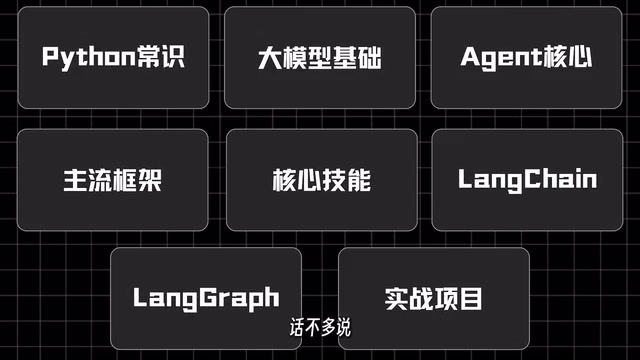
Stage One: Building a Solid Foundation
Many people rush to dive into frameworks and projects while overlooking the importance of the foundation. The first stage of AI Agent development centers on building a strong foundation in three areas.
Python and Large Model Fundamentals
Python is the mainstream language for Agent development. Mastering basic syntax, data structures, and the use of functions and classes is the entry threshold. In addition, understanding the fundamental working principles of large models (LLMs) is equally critical—including concepts such as the Token mechanism, context window, and prompt design.
Tokens are the basic units by which large models process text, and they are not equivalent to words or characters—in English, one word is roughly 1-2 Tokens, and in Chinese, one character is roughly 1-2 Tokens. A large model's Tokenizer typically uses algorithms like BPE (Byte Pair Encoding) or SentencePiece to break text down into subword units; BPE builds its vocabulary by iteratively merging high-frequency byte pairs, which also explains why content like code, mathematical formulas, and special symbols often consumes far more Tokens than ordinary natural language text—the rare character combinations in such content cannot be efficiently compressed and require more Token units to represent. The Context Window determines the total amount of information the model can "remember" in a single interaction. Early GPT-3.5 had only 4K Tokens, while GPT-4 Turbo has expanded to 128K Tokens, and the Claude 3 series reaches as high as 200K Tokens. In Agent development, context window management is crucial: overly long conversation history, tool call results, and retrieved content all consume window capacity, and how to compress and prioritize is one of the core challenges in practice. This does not require you to train models from scratch, but rather to clearly understand the model's capability boundaries and how to invoke it.
Extended Background: The Transformer Architecture and the Physical Constraints of the Context Window The limitations of the context window are not arbitrarily set but stem from the computational complexity of the Self-Attention mechanism in the Transformer architecture—its time and space complexity are both O(n²), where n is the sequence length (number of Tokens). This means that doubling the sequence length quadruples the computational load. For this reason, expanding the context window requires dedicated engineering optimizations, such as the FlashAttention algorithm, which significantly reduces memory usage through block-wise computation, and RoPE (Rotary Position Embedding), which supports the extrapolation of longer sequences through relative position encoding. Understanding this underlying constraint helps developers make more rational engineering decisions when designing Agent memory strategies, rather than blindly pursuing the longest context.
Master the Core Concepts of Agents
Before getting hands-on, you need to understand the core terminology and essential characteristics of Agents. The fundamental difference between an Agent and a traditional program lies in its autonomous decision-making capability: it can perceive the environment, plan tasks, call tools, and adjust behavior based on feedback. At the same time, understanding the differences in design philosophy among mainstream frameworks helps you make more reasonable choices during subsequent selection.
The tutorial particularly emphasizes that the more solid this step is, the smoother the subsequent enterprise deployment practice and career-transition-related practice will be. If the foundation is not solid, the further you go, the harder it becomes.
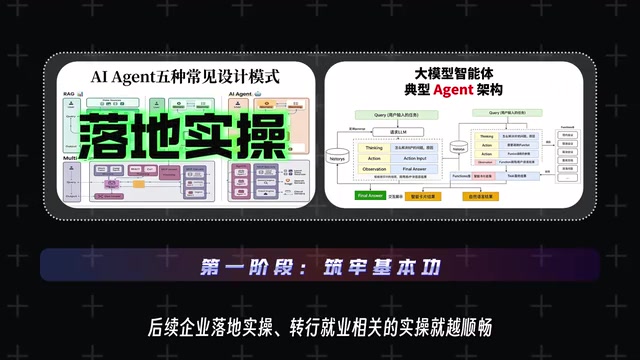
Stage Two: Mastering Core Skills and Tools
After building a solid foundation, you enter the capability-building stage. The goal of this stage is to conquer the five core capabilities of Agents and master the basic usage of mainstream frameworks.
The Five Core Capabilities of Agents
A complete AI Agent typically needs to possess the following five capabilities:
-
Task Planning: Decomposing complex goals into executable subtask sequences. This capability relies on planning paradigms such as Plan-and-Solve and HuggingGPT in engineering implementation. The core is to have the Agent first generate an overall execution plan and then implement it step by step, avoiding the directional deviations caused by "taking it one step at a time" in complex tasks.
-
Tool Calling: Extending its own capability boundaries through external tools such as APIs and functions. The Function Calling mechanism launched by OpenAI in 2023 is currently the most mature tool-calling standard—developers declare available tools (including function names, parameter types, and descriptions) in JSON Schema format within API requests, and the model, after specialized RLHF alignment training, can determine whether the current task requires calling a tool, choose which tool to use, and output parameters in structured JSON format.
Extended Background: RLHF Alignment Training and Tool-Calling Reliability The high reliability of Function Calling does not come out of nowhere but is the result of substantial engineering investment. RLHF (Reinforcement Learning from Human Feedback) was systematically expounded by OpenAI in the InstructGPT paper: annotators first score the model's output preferences in tool-calling scenarios (correct JSON format and reasonable parameter choices score high, while format errors or parameter hallucinations score low). These preference data train a Reward Model, and then the PPO (Proximal Policy Optimization) algorithm continuously reinforces the base model's tool-calling behavior. Compared to earlier approaches of "inducing" the model to output tool instructions through pure prompt engineering, Function Calling specifically aligned through RLHF reduced the format hallucination rate (the probability of the model outputting illegal JSON) by an order of magnitude, marking a key engineering milestone in the transition of Agents from experiment to production.
Compared to the earlier approach of "inducing" the model to output tool-calling instructions through prompt engineering, official Function Calling significantly reduces the occurrence of format hallucinations (the model outputting illegal JSON), making type validation of tool parameters and error handling more standardized—an important milestone in the transition of Agents from experiment to production. Worth noting is that in late 2024, Anthropic proposed MCP (Model Context Protocol), aimed at standardizing the interface specifications between large models and external tools and data sources, similar to a "USB interface" in the AI field. MCP defines three types of standardized interfaces: Resources (data resources), Tools (callable tools), and Prompts (prompt templates), enabling the same set of tool implementations to be reused across different models and frameworks. It forms a complementary competitive landscape with OpenAI Function Calling and is expected to become a unified standard in the tool-calling field, making it an emerging specification worth closely watching in the 2025 Agent ecosystem.
-
Memory Management: Maintaining short-term and long-term memory to support continuous dialogue and context association. It is usually divided into four categories: conversation buffer (short-term), summary-compressed memory (mid-term), vector database storage (long-term semantic memory), and structured knowledge graphs (entity relationship memory), with different scenarios requiring different combinations of strategies.
-
Self-Reflection: Evaluating and correcting execution results to improve output quality. This capability originates from academic research paradigms such as Reflexion and Self-RAG—after executing a step, the Agent does not directly output the result but instead critically evaluates its own output, judging whether the task is complete, whether the result meets expectations, and whether re-planning is needed, forming a closed loop of "execute → evaluate → correct." A lack of reflection capability often leads to the amplification of accumulated errors in multi-step tasks, which is also one of the important dividing lines between a "toy Demo" and a production-grade application.
-
Context Optimization: Efficiently organizing key information within a limited context window. Common strategies include sliding window truncation, conversation summary compression, and pinning key information to the top (the Lost-in-the-Middle research shows that the model pays significantly more attention to the beginning and end of the context than to the middle section). These engineering techniques often determine system performance more than algorithm selection in real projects.
These five capabilities constitute the core of Agent intelligence and are also the key to distinguishing a "toy Demo" from a "deployable application."
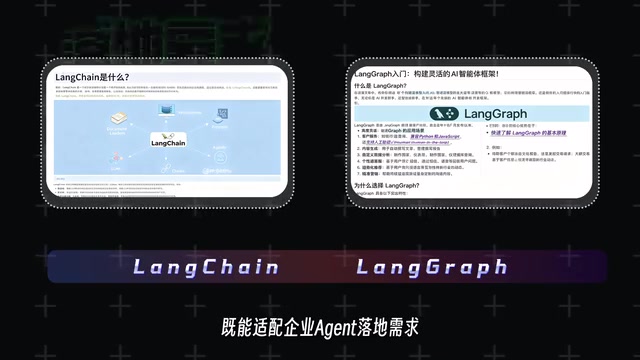
Mainstream Frameworks: LangChain and LangGraph
Regarding framework selection, the tutorial recommends focusing on mastering LangChain and LangGraph.
LangChain was released by Harrison Chase in October 2022 and is currently one of the most influential LLM application development frameworks, with over 90,000 GitHub stars. It connects LLMs with tools, memory, and data sources through "Chain" calls, providing a complete tool integration ecosystem that significantly lowers the barrier to Agent development, making it suitable for rapid prototyping. LangChain's core abstraction—LCEL (LangChain Expression Language)—allows developers to declaratively combine various processing components using the pipe operator (|), enabling complex multi-step pipelines to be clearly expressed with minimal code, and it comes with built-in production-grade features such as streaming output, asynchronous execution, and batch processing.
LangGraph was launched by the LangChain team in 2024, modeling Agent workflows with a graph structure—Nodes represent processing steps, and Edges represent state transition conditions, supporting conditional branching, parallel execution, and loop feedback. Its design draws on the concepts of directed acyclic graphs (DAGs) and state machines: each node receives a global State object and returns an updated State, and edges can be fixed jumps or conditional routing based on State content. This design makes the Agent's behavior fully traceable and debuggable. Compared to early Agent frameworks like BabyAGI and AutoGPT, LangGraph avoids common production failures such as "infinite loops" and "task drift" by explicitly modeling workflows. Its persistent Checkpoint mechanism not only supports resuming from breakpoints after task interruption but also naturally supports Human-in-the-Loop nodes, meeting the practical needs of enterprise compliance review. The two form a complementary relationship, together covering the complete development pipeline from prototype to production.
Extended Background: The Engineering Heritage of Directed Acyclic Graphs (DAGs) in Workflow Scheduling The DAG concept LangGraph draws upon is not an AI-field original but has deep engineering heritage. Data engineering tools like Apache Airflow and Luigi have long used DAGs as the core abstraction for task scheduling, and Spark's execution plans and TensorFlow's computation graphs follow the same principle. The core value of DAGs lies in: they make execution dependencies visualizable and verifiable (detecting circular dependencies through topological sorting) and naturally support parallel scheduling (nodes with no dependencies can execute in parallel). LangGraph introduces this mature paradigm into Agent workflow design, endowing AI systems with the observability and reliability engineering experience accumulated over decades in the data engineering field—this is also the deeper reason why it has an advantage over early Agent frameworks in production stability.
Becoming proficient in these two frameworks can both meet the practical needs of enterprise Agent deployment and accumulate solid core skills for a career transition.
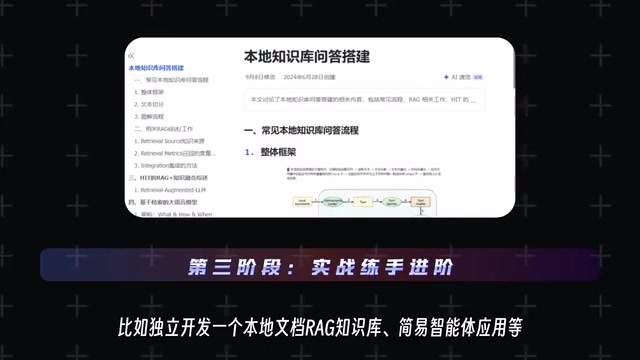
Stage Three: Hands-On Practice and Advancement
The endpoint of technical learning is inevitably hands-on practice. Stage Three follows the principle of "from shallow to deep, step by step."
The Advancement Path from Demo to Project
Hands-on practice should start with simple Demos, such as a chatbot capable of calling a weather API, gradually transitioning to a simple project with complete functionality. After accumulating some experience, you can then challenge more difficult advanced projects.
The typical advanced case given in the tutorial is: independently developing a local document RAG knowledge base Agent application.
RAG (Retrieval-Augmented Generation), proposed by the Meta AI Research team in 2020, is one of the most widely adopted technical paradigms for enterprise-grade Agent deployment. Its core process consists of four steps: first, documents are chunked and converted into vector embeddings stored in a vector database; when a user asks a question, the question is likewise vectorized, and the most relevant text fragments are retrieved from the database; the retrieval results are then concatenated into the prompt as context, and the large model generates an answer based on the real document content.
Extended Background: The Technical Trade-off Between RAG and Fine-tuning RAG and model Fine-tuning are the two main technical paths to address the knowledge limitations of large models. Each has its applicable scenarios, and a trade-off must be made based on business characteristics. The core advantage of RAG lies in the dynamic updatability of knowledge—there is no need to retrain the model; new knowledge can be injected simply by updating the vector database. Moreover, each retrieval result has a clear document source, naturally providing traceability, making it suitable for compliance-heavy scenarios in finance and law. Its cost is the increased system complexity and retrieval latency, as well as a high dependence on retrieval quality ("Garbage In, Garbage Out" is especially prominent in RAG). Fine-tuning, on the other hand, enables the model to internalize the language style, implicit knowledge, and reasoning patterns of a specific domain, with no additional retrieval overhead at inference time, but updating knowledge requires retraining, which is costly and carries the risk of "catastrophic forgetting" (new knowledge overwriting old capabilities). Production-grade systems often combine the two: using Fine-tuning to endow the model with domain language habits and output style, and using RAG to dynamically supplement real-time knowledge and private data.
The vector embeddings and vector databases involved here are the technical cornerstones of RAG systems and deserve in-depth understanding. Vector embeddings map text into high-dimensional numerical vectors, with semantically similar content being closer in vector space—this characteristic enables "how to cancel an order" and "unsubscribe process" to be identified as semantically equivalent queries. Commonly used Embedding models include OpenAI's text-embedding-3 series, and open-source ones like BGE and E5. In Chinese scenarios, BGE-M3 is widely recognized for its multilingual, multi-granularity characteristics. Vector databases (such as Pinecone, Chroma, Weaviate, and Milvus) are designed specifically for the storage and similarity retrieval of high-dimensional vectors. Mainstream ANN (Approximate Nearest Neighbor) algorithms include HNSW (Hierarchical Navigable Small World graphs, with higher retrieval accuracy) and IVF-PQ (Inverted File + Product Quantization, with lower memory usage). In actual projects, the choice must be weighed based on data scale and latency requirements, and the results are far superior to traditional keyword-based inverted index retrieval.
Regarding vector database selection, two dimensions—operational cost and data sovereignty—must also be comprehensively considered: Chroma is suitable for local development and small-scale scenarios, being lightweight and easy to deploy, making it the first choice for the learning stage; Milvus supports distributed deployment, is suitable for enterprise scenarios with billions of vectors, and has an active open-source community; Pinecone, as a fully managed cloud service, reduces the operational burden but poses data cross-border compliance risks, making it unsuitable for industries with data localization requirements such as finance and healthcare. Worth noting is that Hybrid Search is an important means of improving RAG recall—merging vector similarity retrieval and BM25 keyword retrieval results through the RRF (Reciprocal Rank Fusion) algorithm can effectively compensate for the shortcomings of pure vector retrieval in exact vocabulary matching, with particularly significant improvements in professional-terminology-dense scenarios such as finance and law.
In the engineering practice of RAG systems, the Chunking Strategy is often an underestimated yet crucial link. The settings of Chunk Size and Overlap directly affect retrieval quality: overly small chunks (e.g., 128 Tokens) lose paragraph context semantics, while overly large chunks (e.g., 2048 Tokens) introduce noise and dilute key information, so experimental tuning is usually needed for specific document types. Advanced chunking strategies also include: splitting based on semantic boundaries (rather than a fixed number of characters), parent-child document retrieval (small chunks for precise matching, large chunks for context completion), and specialized processing of structured content such as tables and code. Additionally, the Reranker reranking model (such as BGE-Reranker and Cohere Rerank), as a fine-ranking step after retrieval, can further improve relevance ranking quality after vector retrieval has recalled candidates, making it an important optimization method for production-grade RAG systems. These tuning details are often the key to taking a RAG system from "usable" to "good to use."
RAG effectively addresses two major pain points of large models: the knowledge cutoff date limitation (inability to access real-time information) and the hallucination problem (generating non-existent content). Typical application scenarios include enterprise internal knowledge base Q&A, legal/medical document retrieval, and intelligent customer service systems.
Being able to independently complete such a project means you have mastered the complete pipeline of document parsing, vectorization, retrieval, and generation integration.
The Dual Value of Hands-On Experience
This hands-on experience has dual value: on one hand, it can directly serve enterprise business deployment, and on the other hand, it can serve as a core credential for career-change job seeking, significantly enhancing personal competitiveness. Compared to empty talk about concepts, a complete, working project is often more compelling to recruiters.
Conclusion: A Scientific Path Is the Key to Efficiency
Returning to the initial question—why is there such a huge difference in results when learning Agents with the same effort? The answer is now clear: a scientific learning path lets you avoid detours.
From building a solid foundation in Python and large models (Token mechanism, context window management), to mastering the five core capabilities (especially self-reflection, a key feature of production-grade applications) and mainstream frameworks like LangChain and LangGraph, and then to independently deploying RAG hands-on projects, this three-stage path forms a complete closed loop from zero-basis to employment competitiveness. For beginners, rather than blindly chasing every new framework, it is better to settle down and systematically progress along this path.
Interestingly, Agent technology is still evolving rapidly, with frameworks and tools continuously updating—from LangChain and LangGraph to AutoGen and CrewAI, from Function Calling to the MCP protocol, from monolithic Agents to Multi-Agent collaborative systems, new paradigms keep emerging. But the core capability model (task planning, tool calling, memory management, self-reflection, context optimization) and engineering mindset are relatively stable. Grasping these unchanging essentials is what allows you to maintain lasting competitiveness amid change.
Related articles

Disaster and Glory of the Apollo Program: The History We Must Revisit Before Returning to the Moon
From the fatal Apollo 1 fire to Apollo 8's daring lunar orbit to Apollo 11's successful landing—revisiting the disasters, fears, and compromises of the Apollo program and their lessons for today's return to the Moon.

Netflix Trust Exercise Turns Into Firing Trap: Where Are the Boundaries of Corporate Trust?
A Netflix employee was fired after sharing private info in a trust exercise. We analyze the risks of corporate trust exercises and how employees can protect themselves.

AMD CDNA5 Architecture Deep Dive: Technical Evolution and the AI Computing Competition Landscape
Deep analysis of AMD's CDNA5 architecture covering Chiplet packaging upgrades, HBM memory evolution, and low-precision compute optimization, examining how AMD challenges NVIDIA's AI chip dominance.