Zero-Code AI Voice Agents with Claude Code: 5 Real-World Business Scenarios Unpacked

Build production AI voice agents with Claude Code + Telnyx in minutes, no coding required.
Using Claude Code and Telnyx's single-stack architecture, this article shows how to build a production-grade AI voice assistant on a real phone number without writing any code. It unpacks the core architectural trade-offs of multi-vendor "Franken-stacks" versus unified platforms, then walks through five ready-to-deploy business scenarios: appointment booking, missed call recovery, lead qualification, support triage, and quote collection.
From a Single Prompt to Answering Real Phone Calls
"Thank you for calling — I'd be happy to help you schedule an appointment. Could I start with your name?" This smooth, natural exchange isn't handled by a human. It's an AI voice assistant built just 20 minutes before the demo went live.
This is the reality of AI voice agent deployment today: no stitching together code, no deployment scripts, no need to master complex orchestration tools. With Claude Code's deep integration with Telnyx, developers can type a few natural language instructions and get a production-grade voice assistant running on a real phone number — live, ready to answer calls.
This article unpacks the key architectural decisions behind that build process and walks through five ready-to-deploy business scenarios you can copy directly.
Stop Building "Franken-Stacks"
There's a concept every voice AI developer should be wary of: the "Franken-stack." It's the approach most people default to when building voice agents:
- One vendor for STT (speech-to-text)
- A third-party LLM API as the "brain"
- Another provider for TTS (text-to-speech)
- A separate carrier to get an actual phone number
To understand why this is problematic, you need to understand how the voice AI pipeline actually works. A complete voice interaction involves three serial processing stages: the STT layer transcribes the caller's audio stream in real time — typically using models like Whisper or DeepSpeech — with best-in-class real-time transcription latency around 200–400ms. The LLM inference layer receives the transcribed text and generates a response; models like GPT-4o have a time-to-first-token of roughly 300–600ms under good network conditions. The TTS layer synthesizes text into a speech stream; modern neural TTS (ElevenLabs, Azure Neural Voice, etc.) has a time-to-first-byte of around 150–300ms. Stack those three serially and you're already past 650ms of processing latency — before accounting for any network hops between services.
This setup looks fine in local demos, but the moment it faces real calls, three problems surface immediately:
Latency compounds. Every call hops across four or five services before audio reaches the caller, with each hop adding network round-trip time (RTT). When services sit in different regional data centers, cross-region RTT easily adds 50–150ms per hop. Stacked together, the assistant sounds sluggish and unnatural. Humans tolerate about 500ms of pause in conversation; anything beyond 1 second feels noticeably "stuck."
Reliability is fragile. If any single vendor degrades, the call drops or the AI freezes mid-sentence. Overall availability across a distributed chain is the product of each node's availability — even if every service individually achieves 99.9% SLA, four nodes in series brings overall availability down to 99.6%, adding roughly 26 more minutes of potential downtime per month.
Debugging is expensive. When something breaks, you're hunting across five different dashboards to find the root cause. Worse, log timestamps often don't align across vendors, making distributed tracing nearly impossible and turning intermittent failures into a nightmare.

The Core Value of a Single-Stack Architecture
Telnyx's answer is a "single stack" architecture: carrier lines, STT/TTS, and LLM inference all consolidated on one platform. More importantly, the inference and telephony layers are co-deployed across 18 global network nodes, so audio never has to leave the stack between processing steps. This "same-datacenter co-deployment" design compresses inter-stage communication latency from 50–150ms cross-service network hops down to millisecond-level local IPC (inter-process communication) or shared memory calls. When something goes wrong, there's only one place to look — unified logging and request tracing shrinks incident resolution from hours to minutes.
This is an intentional architectural trade-off, not just a product endorsement. For teams prioritizing production stability, reducing the number of service hops is a direct lever for cutting latency and shrinking the failure surface.
Your First AI Voice Agent in Five Minutes
The build process is almost counterintuitively simple.
Setup: Three Steps
- In the Telnyx dashboard, click your account name, go to API Keys, and copy your key (about 30 seconds — the only time you'll need to touch the dashboard).
- Open Claude Code and run two commands to load the plugin:
/plugin→marketplace add team-telnyx/AI, then/plugin install telnyx@telnyx. - Set the key in your terminal:
export TELNYX_API_KEY=<your-key>.
The plugin installation step is critical — understanding why helps clarify what makes it so powerful. Claude Code's plugin system is essentially a "tool-call specification injection" mechanism: the plugin loads the target platform's API spec, parameter structures, authentication methods, and common usage patterns into Claude's context window in a structured format. This lets the model generate code that precisely references verified, up-to-date interface definitions — rather than relying on potentially stale memories from training data. Without the plugin, Claude is writing Telnyx code from memory — getting method names wrong, guessing at parameter structures, even hallucinating API endpoints that don't exist. This is a universal problem with any LLM calling third-party APIs from training data, since APIs iterate faster than model training cycles. The 234 skills loaded by the plugin are verified, current API specs — and that's the difference between "works the first time" and "an hour of debugging."
Generate an Agent with One Natural Language Request
Just type your requirements into Claude Code:
"Build me a voice AI appointment assistant on Telnyx. It should greet callers, collect their name and preferred time, verbally confirm the appointment, then say goodbye."
Claude reads the freshly installed skills and auto-generates the agent's name, model, instructions, and greeting. Run the provisioning command and you get three things: an assistant ID, a real phone number, and a test command.
At this point, that number is live — even before any configuration or testing, it can already answer calls.
Connect a Calendar and Iterate in Real Time
Tell Claude to integrate cal.com: when the agent confirms a booking, fire a webhook carrying the caller's name, service, and time slot. Claude automatically adds the webhook tool and maps the fields.
The debugging loop is equally fast: hit Call in the Test tab of the dashboard, say "I'd like to book a haircut for Friday at 3pm," and the logs on the right show the agent's response and webhook trigger status in real time. Need a tweak? Go back to Claude, describe the change — each iteration takes about 30 seconds.
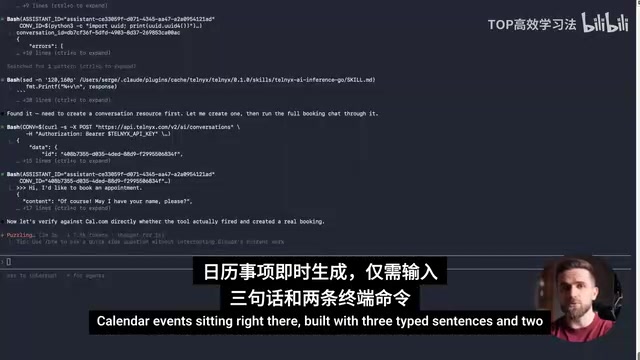
In the final live demo call, the AI voice assistant picked up within 1 second, completed the booking end-to-end, and the calendar event appeared instantly. The whole thing took three natural language prompts and two terminal commands — no Python, no n8n, no dashboard clicking.
Four Ready-to-Deploy Business Scenarios
Beyond the live-built appointment assistant, the following four agents come with full prompts and configurations available to fork directly from the GitHub repo.
Scenario 1: Missed Call Recovery
This might be the highest-ROI scenario of them all. When a call goes unanswered, the AI automatically calls back within 60 seconds, introduces itself as the business's automated assistant, then either leaves a message or transfers to the right department. This outbound flow is powered by Telnyx's native "AI Missions" feature — Telnyx's abstraction for autonomous, task-driven voice agents. Developers define the agent's goals, constraints, and success exit criteria in a script-like format; the platform handles the conversation state machine, call exceptions, and task-completion callbacks. It can be triggered directly by a "missed call" trigger, with no need to implement complex state management yourself.
For clinics, contractors, and real estate agents, missed calls are literally lost revenue — this agent recovers most of it.
Scenario 2: Sales Lead Qualification
Built for teams running paid ads or handling inbound sales. The AI answers the call and asks 4–5 qualification questions — budget, timeline, use case, decision-maker — then scores the lead and exports it to CSV or CRM. Human sales reps only intervene when a genuinely high-value call comes through, dramatically improving funnel conversion efficiency.
Scenario 3: Support Triage
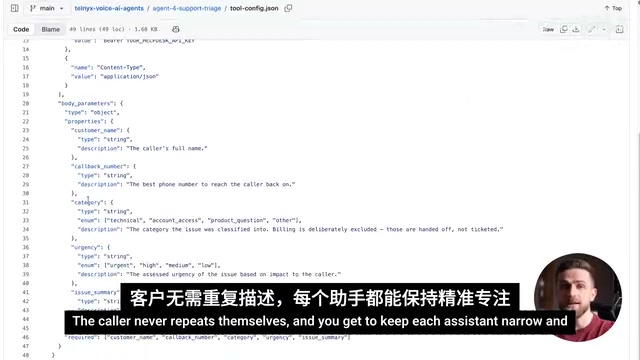
Think of it as a next-generation IVR. Traditional IVR (Interactive Voice Response) relies on pre-set keypress menus — callers navigate fixed options, and the moment their need isn't in the menu tree, they're stuck in a loop. This AI triage solution lets callers describe their issue in natural language; the AI uses intent recognition to dynamically route them to the right team, eliminating the rigid "press 1 for billing, press 2 for technical support" interaction model entirely. The core is Telnyx's multi-agent handoff — once the front-end triage assistant identifies a billing or refund request, it transfers the call along with full context (recognized intent tags, sentiment state, conversation summary) to a specialized assistant. Callers never have to repeat themselves, and each agent stays narrowly focused for high accuracy. This context-aware agent switching is a direct advantage of the single-stack architecture: cross-agent state transfer happens entirely within one platform, no serialization across service boundaries required.
Scenario 4: Quote Collection
Designed for contractors, agencies, and consultants — service businesses where the first call is essentially an intake form. The AI walks callers through a series of scoping questions and writes the summary to a Google Sheet or CRM. Also runs as an AI Mission, can be chained after a website form submission or a missed call, and automatically calls back to complete the full intake — no human follow-up needed.
The Real Business Value: Turning Conversations into Structured Data
There's a critical point that's easy to overlook and worth calling out on its own. When you replay a lead qualification call, you see: transcribed text with word-level timestamps, intent tagged as "high-priority lead, budget confirmed," and sentiment analysis returning a positive signal.
This points to an important engineering capability in voice AI: structured extraction from conversation understanding. Raw voice conversations are unstructured free-text streams. Converting them into structured database fields requires the LLM inference layer to simultaneously accomplish two things — generating a natural language response (for the caller) and extracting structured entities (for the system backend). The modern approach uses "dual-output prompting" or Function Calling: while generating the conversational reply, the LLM in parallel triggers a JSON-schema structured extraction call, writing named entities (name, amount, date), intent classifications, and sentiment scores into a predefined schema. This is entirely transparent to the caller, but leaves the business with a complete data snapshot of every conversation.
Better yet, no manual exports needed — just point that structured payload at a webhook and every call from every agent writes the same fields directly into Google Sheets or your CRM the moment it ends. Here's how it works: when a call completes, the platform sends an HTTP POST request to a pre-registered URL, with the request body containing the full structured data from that call. The receiving end (Zapier, Make, or a custom service) parses the payload and executes downstream actions — the entire chain is event-driven, no polling required, with latency typically under a second.
"This is what turns a voice agent from a cool demo into a real business tool. You're not just automating calls — you're generating structured data from every conversation your business has."
This is exactly the capability that Franken-stacks struggle to deliver cost-effectively. When every conversation can be logged as analyzable, queryable data, AI voice assistants truly cross the threshold from demo to production.
Wrapping Up
Five production-ready AI voice agents, one live demo call, four forkable business configurations — all running on a single stack, deployable to a real phone number tonight without writing a single line of code.
For developers and small businesses, the lesson here isn't about any specific product. It's about two converging trends: AI coding tools are reducing API calls to natural language instructions — the core shift is compressing the "barrier to entry" from "understand the API docs" down to "describe your business intent," letting developers focus on expressing business logic rather than mastering low-level call details; and vertical platform single-stack consolidation is eliminating the latency and reliability problems inherent in distributed architectures — representing a paradigm shift from "best-of-breed components freely composed" toward "optimally designed systems as a whole," trading some vendor lock-in for predictability and maintainability in production. Together, they've compressed what once took an engineering team weeks to build into a few sentences and a few minutes.
Related articles

The Truth Behind Codex 'Build a Website in 5 Minutes': AI Isn't Creating Sites—It's Helping You Copy Them
Exposing the truth behind viral Codex 5-minute website videos: creators aren't building original sites with AI—they're copying shared prompts or scraping others' work. Learn AI coding tools' real limits.

Getting Started with AI Agent Development: A Complete Guide from Concept to Practice
A comprehensive guide to AI Agent architecture and development, covering automated marketing, intelligent customer service, and investment analysis scenarios with single and multi-agent collaboration.

The Truth Behind Codex 'Build a Website in 5 Minutes': AI Isn't Creating Sites — It's Helping You Copy Them
Exposing the truth behind viral Codex 5-minute website videos: creators aren't building original sites with AI — they're copying shared prompts or scraping others' work.