Zero-Dependency AI Decision Record Auditor: A Practical Guide to Building Traceable AI Systems

How a zero-dependency decision record auditor enables traceable, accountable AI systems through Governance as Code.
As AI enters core business decisions, traceability becomes essential. This article explores a zero-dependency decision record auditor, covering EU AI Act compliance, supply chain security, Governance as Code, and the limits of AI explainability—offering a practical guide to building trustworthy, auditable AI systems.
Introduction: When AI Enters Decision-Making, How Do We Trace It?
As AI systems become deeply embedded in core enterprise business processes, an increasingly sharp question confronts engineers and decision-makers: when a decision aided or driven by AI goes wrong, can we clearly reconstruct "who made this judgment, at what time, and based on what grounds"?
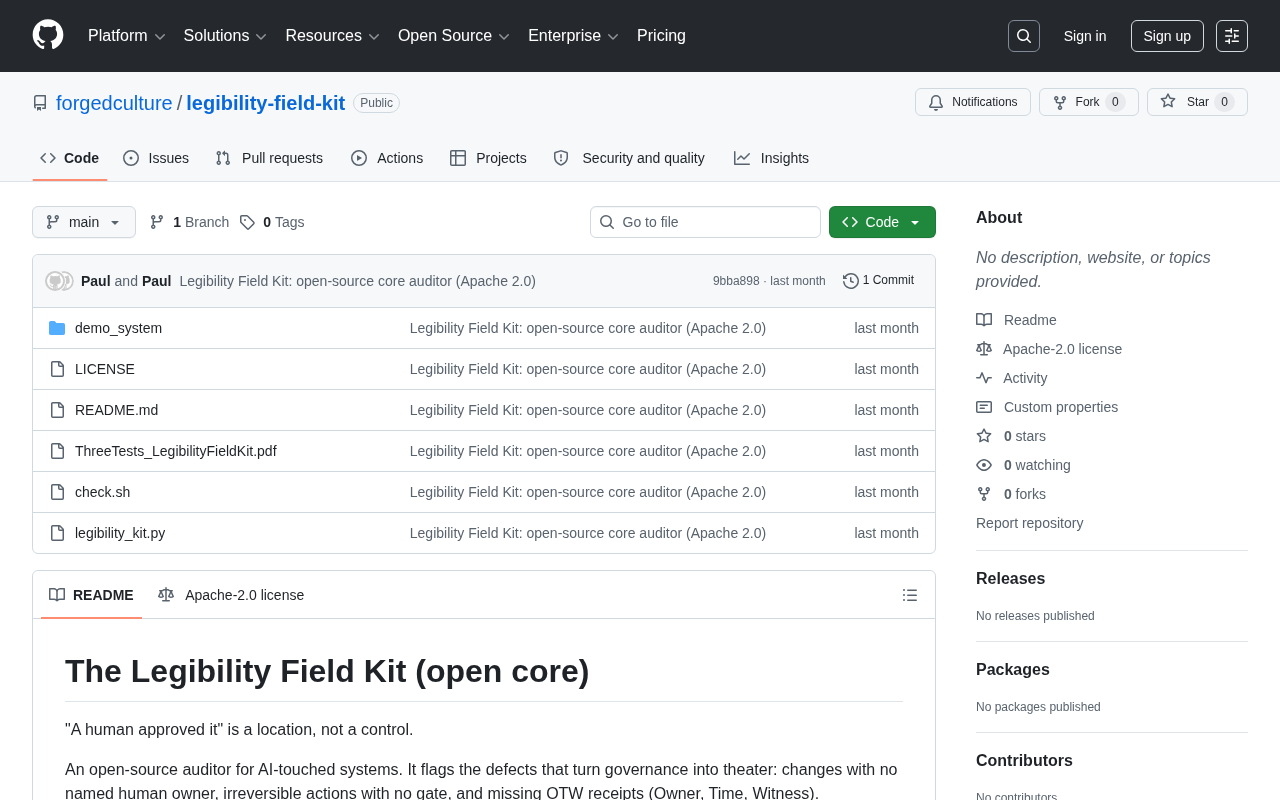
Recently, a developer posted an open-source project on Hacker News called the "zero-dependency auditor for decision records," directly targeting the core pain point of decision traceability in AI systems. The project drew little attention initially, but the problem it addresses is a severely underestimated domain in today's practical AI engineering—decision auditing and compliance tracking.
What Is a "Decision Record Auditor"?
The Origin and Evolution of Decision Records
In software engineering practice, "Architecture Decision Records" (ADRs) have long been a mature pattern for documenting the context, alternatives, rationale, and expected consequences of important technical decisions.
The concept of ADR was first systematically proposed by Michael Nygard in 2011. Its core insight is that the most dangerous knowledge in software architecture is not the decisions that get recorded, but the implicit reasoning behind "why we didn't do it this way"—knowledge that often exists only in the memories of a few engineers and disappears permanently as they leave. ADRs record the Context, Forces, and Consequences of a decision together, enabling future maintainers to understand the full context of a decision rather than merely seeing the outcome. Promoted by consulting firms such as ThoughtWorks, it gradually became a software engineering best practice and spawned structured variants like MADR (Markdown Architectural Decision Records) as well as supporting toolchains such as adr-tools. Each ADR typically contains four basic elements: status (proposed/accepted/deprecated), context, decision content, and consequences.
In AI systems, this concept has been further extended: not only must we record architectural choices made by humans, but also every critical judgment node in which AI models participate or exert influence. Notably, unlike traditional ADRs that record static selection decisions, AI decision records must also track runtime parameters within dynamic reasoning processes—such as model versions, input feature distributions, and confidence thresholds—which greatly increases the complexity and timeliness requirements of record-keeping.
Before decision record auditors emerged, the AI field already had two related standardization practices that laid a documentation foundation: Google's "Model Cards" systematically document a model's intended use cases, performance metrics, bias assessments, and ethical considerations; "Datasheets for Datasets" provide structured records of the source, collection motivation, and preprocessing methods of training data. Both can be viewed as the "upstream documentation" of the decision audit chain, together with runtime decision records forming a complete AI accountability documentation system. The value of runtime auditing tools lies precisely in filling the critical gap of "the moment the model actually makes a judgment" within this system.
The core responsibility of the "auditor" is to perform structured validation of these decision records—verifying whether records are complete, compliant with specifications, and whether any critical fields are missing (such as decision rationale, responsible party, timestamp, model version, etc.). Essentially, this establishes an "auditable memory" for AI systems.
Why Is "Zero-Dependency" a Key Design Principle?
One of the project's core highlights is "zero-dependency." To understand the importance of this design, we need to revisit the severe state of software supply chain security in recent years.
Software supply chain attacks have grown exponentially over the past five years: in the 2020 SolarWinds attack, hackers implanted malicious code into the build pipeline, affecting more than 18,000 organizations including the U.S. Treasury Department, making it one of the most far-reaching supply chain attacks in history. The 2021 Log4Shell vulnerability exposed another dimension of risk—once a single widely-relied-upon foundational library contains a vulnerability, it can affect billions of devices worldwide within hours. The "event-stream" malicious package incident in the npm ecosystem (2018) directly demonstrated the destructive power of dependency chain contamination—attackers used social engineering to take over a small utility package with millions of weekly downloads and successfully injected code targeting specific cryptocurrency wallets. It is precisely against this backdrop that OpenSSF (Open Source Security Foundation) proposed the SLSA (Supply-chain Levels for Software Artifacts) framework, tiering supply chain security from build integrity verification and provenance traceability to build environment isolation with progressively higher security guarantees. "Zero-dependency" can be seen as a natural response at the tooling level to high security-level requirements—when a tool's codebase is small enough and has no external dependencies, its supply chain risk approaches zero, and complete code review becomes practically feasible.
Against the backdrop of growing emphasis on software supply chain security, the zero-dependency design brings three advantages:
- Smaller attack surface: By not introducing third-party libraries, supply chain attack risks are avoided at the source;
- Stronger portability: It can be seamlessly embedded in any tech stack and runtime environment without worrying about dependency conflicts;
- Higher inherent trustworthiness: The tool's code can be fully reviewed, consistent with the fundamental principle that "the auditing tool itself must also be trustworthy."
For a tool whose mission is "compliance auditing," this meta-level consideration is especially critical—if the auditor relies on numerous external libraries, secondary auditing of the auditor itself becomes extremely difficult, creating a trust dilemma of "who watches the watchers." No one wants a tool used for compliance checks to itself be an untraceable black box.
Why AI Systems Urgently Need Decision Auditing Capabilities
Mounting Compliance and Regulatory Pressure
As regulatory frameworks such as the EU AI Act take effect one after another, high-risk AI systems are explicitly required to possess traceability, transparency, and human oversight capabilities.
The AI Act officially took effect in August 2024, making it the world's first systematic AI regulatory framework. It sets a 24-month transition period, with full enforcement expected in 2026. The Act classifies AI systems into four risk levels: unacceptable risk, high risk, limited risk, and minimal risk. The "unacceptable risk" category (such as social credit scoring systems and real-time public biometric identification) is directly prohibited; high-risk AI systems (covering domains such as healthcare, credit, recruitment, and law enforcement) must meet the strictest requirements, including establishing a risk management system, retaining automated logs (for no less than 6 months), providing technical documentation, and implementing human oversight mechanisms. The log retention requirement explicitly mandates that systems must be able to reproduce the complete decision chain leading to a specific output. Notably, the Act also dedicates a separate chapter to "General Purpose AI models" (GPAI, i.e., large foundation models), requiring adversarial testing and reporting of serious incidents to competent authorities for extremely large-scale models (computational load exceeding 10²⁵ FLOPs). Violating companies may face fines of up to 7% of global annual revenue.
Beyond the EU, the U.S. has issued executive orders requiring federal agencies to assess AI risks, China has introduced the "Interim Measures for the Management of Generative AI Services," and countries like the UK and Canada have successively released AI regulatory guidelines. This overlapping multi-jurisdictional regulatory landscape means multinational enterprises face exponentially increasing compliance complexity, and systematic decision records serve precisely as a universal foundation for cross-framework compliance evidence.
Enterprises must be able to provide evidence demonstrating the compliance of their AI decision-making processes, and systematic decision records are the foundation of this evidence. This means decision auditing capabilities have been elevated from engineering best practices to legal compliance obligations. A lightweight auditing tool can fully play the role of a "compliance gatekeeper" in CI/CD pipelines or at runtime, internalizing regulatory requirements into executable engineering constraints.
Incident Postmortems and Responsibility Attribution
When AI systems make errors in production environments—such as wrongly rejecting a credit application, mistakenly deleting content, or performing faulty automated operations—engineering teams need to quickly identify the root cause. Without the support of structured decision records, postmortems often devolve into inefficient processes reliant on memory and guesswork, which is not only time-consuming but also difficult to distill into reusable improvement experience.
By enforcing record-keeping standards, auditing tools ensure that every AI-involved decision node leaves a documented, verifiable trail, fundamentally improving incident response efficiency.
Clarifying Responsibility Boundaries in Human-AI Collaboration
In "AI-assisted decision-making" scenarios, the most ambiguous and dispute-prone aspect is often the division of responsibility between humans and AI. Decision record auditing can clearly annotate which stages are AI-recommended, which stages have undergone human review, and who made the final call. This is crucial for establishing a healthy and transparent human-AI collaboration mechanism, and it forms the foundation of future accountability systems.
The Value of Such Tools from an Engineering Perspective
Lightweight Implementation of "Governance as Code"
This project embodies a noteworthy engineering trend: embedding AI Governance into the development process in the form of code and tools, rather than leaving it at the level of documentation and policy.
The paradigm of "Governance as Code" (GaC) is an extension of the concept of "Infrastructure as Code," which itself was a product of the DevOps movement's practice of transforming server configuration from manual operations into version-controllable declarative code through tools like Terraform and Ansible. GaC's pioneering practice in the security domain is "Policy as Code"—tools like Open Policy Agent (OPA) have embedded access control rules into Kubernetes admission controllers, completing compliance validation via policies defined in the Rego language before requests reach the system. The core idea of GaC is to further transform governance rules that originally existed in the form of documents, processes, or manual reviews into a code form that is version-controllable, automatically executable, and continuously verifiable.
In the field of AI governance, typical GaC practices include: writing model bias detection rules as automated tests in CI/CD pipelines, hardcoding data usage compliance constraints into pre-checks of data processing scripts, and, as discussed in this article, implementing decision record specifications as executable auditing tools. Embedding auditing tools into CI/CD pipelines is the core implementation scenario of this paradigm—the auditor can serve as a check step in GitHub Actions or GitLab CI, automatically executing at each model version release or critical business logic change, blocking deployment if decision records lack required fields.
This "Shift-Left Compliance" strategy moves the point of problem detection from after-the-fact review forward to the development phase. IBM research shows that the cost of fixing defects discovered in production is 100 times that of the development phase—shifting compliance checks left into the CI/CD pipeline means developers can receive immediate feedback when committing code, rather than paying costly remediation prices after regulatory review or an incident. Compared to the traditional model of "governance by policy, compliance by manual labor," GaC's core advantage lies in embedding compliance checks into developers' daily workflows, transforming compliance costs from the high price of after-the-fact review into low-friction habits during the development phase.
The Pragmatic Positioning of "Small and Specialized"
Compared to enterprise-grade AI governance solutions that require massive platform support, a zero-dependency command-line tool can be embedded into existing workflows at extremely low integration cost. For small and medium-sized teams, such a pragmatic entry point is often easier to actually adopt and sustain than a large, all-encompassing solution.
Challenges and Real-World Considerations
Of course, such tools also face several challenges worth confronting during adoption:
- The difficulty of standardizing record specifications: What fields should decision records contain? Different industries and business scenarios vary significantly, so tools need to strike a balance between generality and specificity;
- Cultural and habitual resistance to adoption: Getting developers into the habit of proactively recording decisions is itself a barrier, and even the best tool requires accompanying team norms and incentive mechanisms;
- The inherent limitations of AI explainability: Even with detailed records of the decision process, if the underlying model itself lacks explainability, the actual value of auditing will be constrained.
On the last point, it is worth deeply understanding its technical roots. The field of AI explainability is currently divided into two major technical approaches: Post-hoc Explanation and inherently interpretable models. Among post-hoc explanation methods, SHAP (SHapley Additive exPlanations) is based on the game-theoretic Shapley value, decomposing model outputs into the marginal contributions of each input feature—this method has rigorous theoretical guarantees (satisfying four axioms: efficiency, symmetry, dummy, and additivity), but its computational overhead is extremely high for large models, often requiring approximate sampling in actual deployment; LIME (Local Interpretable Model-agnostic Explanations) provides approximate explanations by fitting a local linear model near the prediction point, which is computationally efficient but of questionable stability—different random seeds may produce significantly different explanation results. Inherently interpretable models include decision trees, linear regression, and the recently emerging Concept Bottleneck Models (CBM)—CBMs force the model to first predict human-understandable semantic concepts and then make the final judgment based on those concepts, achieving a good balance between interpretability and accuracy in specialized fields such as medical imaging.
However, in AI decision-making scenarios dominated by large language models (LLMs), explainability faces a deeper dilemma: the model's "reasoning" process is dispersed across the activation states of billions of parameters. Attention Visualization was once held in high hopes, but studies such as Jain & Wallace (2019) have shown that there is no reliable causal correspondence between attention weights and feature importance. In recent years, Mechanistic Interpretability research promoted by institutions such as Anthropic has attempted to understand the model's internal algorithms at the level of "circuits," decomposing specific functional modules of neural networks into interpretable computational subgraphs. The published "Dictionary Learning" and "feature attribution" research has made some progress in identifying internal feature representations of models, but is still a considerable distance from providing production-grade trustworthy explanations for black-box models. This means that even if the decision record documents the model's inputs and outputs in detail, "why this conclusion was reached" may still be a question that cannot be fully answered—this is precisely the inherent boundary of current auditing tools' value, and also the core proposition that the entire field of AI explainability research is still tackling.
It is worth mentioning that the above technical limitations are not purely academic questions, but directly influence the design strategy of auditing tools. Under the premise of limited explainability, pragmatic auditing tools often turn to "process compliance" rather than "outcome attribution"—that is, by mandating the recording of decision trigger conditions, input data snapshots, model version identifiers, and human intervention nodes, they construct as complete an operational trail as possible, serving as an alternative accountability basis when explainability is insufficient. This also explains why "completeness validation of record specifications" rather than "deep analysis of decision logic" is the core functional positioning of such auditing tools.
Conclusion
This currently understated open-source project reflects the real demands that emerge as AI engineering enters deeper waters: we must not only make AI "usable," but also make AI systems "trustworthy, auditable, and accountable."
The zero-dependency decision record auditor may be just a starting point, but it sends a clear signal—the infrastructure construction of AI governance is moving from the conceptual level toward tooling implementation. For any team building AI systems, incorporating decision traceability into system design as early as possible is a long-term capability worth continuous investment.
Key Takeaways
- Decision traceability has become a legal obligation: Global regulatory frameworks represented by the EU AI Act are transforming decision record requirements that were originally engineering best practices into legally binding compliance obligations, with penalties for violations reaching up to 7% of global annual revenue.
- Zero-dependency is engineering rationality in the supply chain era: From SolarWinds to Log4Shell, the historical lessons of software supply chain attacks show that the trustworthiness of auditing tools cannot be built on dependency chains that are difficult to review—"the tool itself must be auditable" is a meta-level requirement for compliance tools.
- Governance as Code is reshaping compliance practices: The GaC paradigm shifts compliance checks left from after-the-fact review into the CI/CD pipeline, transforming regulatory requirements into low-friction constraints within developer workflows—this is a key engineering strategy for reducing the marginal cost of compliance.
- Process compliance is a pragmatic substitute under explainability limitations: Before the LLM explainability challenge is fully cracked by mechanistic interpretability research, completely recording decision trigger conditions, input snapshots, and human intervention nodes is a realistic path to building accountable AI systems.
Related articles

The Truth Behind Codex 'Build a Website in 5 Minutes': AI Isn't Creating Sites—It's Helping You Copy Them
Exposing the truth behind viral Codex 5-minute website videos: creators aren't building original sites with AI—they're copying shared prompts or scraping others' work. Learn AI coding tools' real limits.

Getting Started with AI Agent Development: A Complete Guide from Concept to Practice
A comprehensive guide to AI Agent architecture and development, covering automated marketing, intelligent customer service, and investment analysis scenarios with single and multi-agent collaboration.

The Truth Behind Codex 'Build a Website in 5 Minutes': AI Isn't Creating Sites — It's Helping You Copy Them
Exposing the truth behind viral Codex 5-minute website videos: creators aren't building original sites with AI — they're copying shared prompts or scraping others' work.