Zhipu GLM 5.2 Deep Dive: Can Open-Weight Models Challenge Top Closed-Source AI?

GLM 5.2 brings open-source weights, strong agentic benchmarks, and competitive pricing to challenge top closed-source LLMs.
Zhipu's GLM 5.2 released open weights within 24 hours of its predecessor, targeting long-horizon agentic tasks. It ranks solidly in the industry's second tier on benchmarks, excels at long-form writing and frontend design (ranking #1 in the design arena), and costs significantly less than Claude Sonnet or GPT-4o — making it a compelling open-source alternative worth testing for your own workflows.
Zhipu GLM 5.2: An Open-Source Upgrade That Exceeded Expectations
The release cadence of Chinese large language models can be notoriously unpredictable — slow weight releases, delayed versions, and uncertain launch timelines are common complaints. But Zhipu delivered a genuine surprise this time: within just 24 hours of the GLM 5.1 release, the 5.2 weights quietly dropped, available in both full-precision and FP8 quantized formats in one go.
FP8 quantization compresses model weights from standard FP16 to an 8-bit floating-point representation. It gets native hardware acceleration on NVIDIA Hopper architecture (H100/H200) while causing less accuracy degradation than integer quantization (INT8). In practice, this means users can run models that previously required high-end hardware on consumer-grade or mid-tier GPUs — significantly lowering the barrier to self-hosting.
For those who closely follow open-source models, this kind of speed and transparency isn't common. Following MiniMax and others opening up their weights, the open-source ecosystem has been gaining more options. GLM 5.2's arrival pushes the capability ceiling of open-source models another step forward — and that's precisely why the author, who hadn't originally planned to write a review, changed their mind after trying it out.
Built for Long-Horizon Tasks
Zhipu officially positions GLM 5.2 as a model "designed for long-horizon tasks." These are tasks that require the model to maintain contextual coherence across multiple steps and execute complex reasoning chains — as opposed to single-turn Q&A or short text generation. Rather than chasing peak performance on single-turn benchmarks, GLM 5.2 is aimed squarely at agentic scenarios involving multi-step reasoning and long-chain execution. Agent tasks require models to plan sub-tasks, call external tools (such as code executors, search engines, and API interfaces), and self-correct based on feedback. This category represents some of the highest-value real-world applications for LLMs today, and is also one of the dimensions where the gap between closed-source and open-source models has historically been most pronounced.
You may have noticed that Zhipu only released the post-training weights, not the base model. A base model is the raw weights trained via unsupervised pre-training on massive text corpora — capable of language understanding but not instruction following. Post-training applies supervised fine-tuning (SFT), reinforcement learning from human feedback (RLHF/RLAIF), and similar techniques to make the model capable of conversation, safety alignment, and task execution. Releasing only post-training weights means the community can deploy immediately but cannot perform large-scale pre-training on the base. This is a pragmatic strategy: by opening the post-training weights for community use while retaining commercial licensing on the base model, the company strikes a balance between open-source and profitability — similar to how Meta handles the LLaMA series.
Benchmarks: Solidly in the Second Tier
Based on Zhipu's published evaluation data, GLM 5.2 trails only Anthropic's Claude 4.8 and select top OpenAI models across multiple benchmarks, placing it firmly in the industry's second tier overall. Its performance is particularly strong on terminal benchmarks that emphasize agentic capabilities.
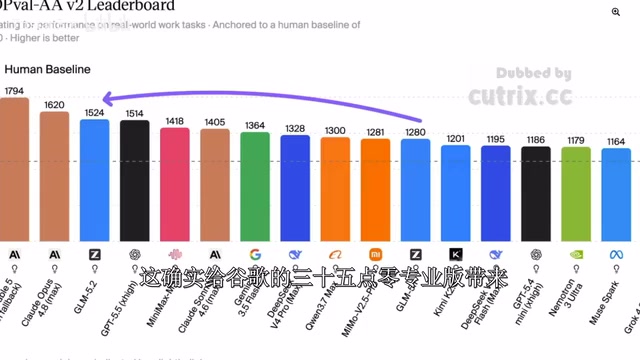
Most notably, a newly introduced deep search benchmark — replacing the previous premium scanning benchmark — shows GLM 5.2 matching Anthropic and OpenAI products and even surpassing them on certain dimensions.
The Key Leap from 5.1 to 5.2
If 5.1 was already a solid release, then 5.2's improvement in agentic coding is genuinely impressive. Comparative data shows that 5.2, after aggregating across multiple benchmarks, even surpasses strong competitors like DeepSeek. Zhipu has also introduced multi-token prediction (MTP) — a technique proposed by Meta in 2024 research that trains the model to predict multiple future tokens simultaneously, enabling inference-time acceleration via speculative decoding and similar parallel verification methods — resulting in noticeably faster inference compared to the previous version.
The data does reveal one limitation: in "bare" scenarios with no tool use, model scale becomes the ceiling, and models like Claude Opus perform better. But once tool calling is introduced, the gap closes rapidly — a very encouraging signal for an open-source model.
Token Consumption: The Double-Edged Sword of Long Chain-of-Thought
GLM 5.2's strong performance comes at the cost of very long chain-of-thought (CoT) reasoning. Chain-of-thought refers to the mechanism by which a model generates a series of intermediate reasoning steps before producing a final answer — systematized by Google researchers in 2022. Research shows that longer reasoning chains generally improve accuracy on complex tasks, but at the expense of significantly higher token consumption, which directly affects inference cost and latency. Data shows GLM 5.2's token output even exceeds DeepSeek version 2.6, with only a handful of models producing longer reasoning chains.
The ideal, of course, is "high intelligence with fewer tokens" — but GLM 5.2's largest version does the opposite, trading more tokens for output quality. The industry is actively exploring "efficient reasoning," including dynamically adjusting reasoning depth (such as OpenAI o-series' thinking budget) and pruning redundant reasoning steps. GLM 5.2 already demonstrates some on-demand reasoning — using shorter chains for simple tasks and expanding for complex ones — but how to achieve equivalent intelligence with fewer tokens remains a shared challenge across all major players, and GLM 5.2 still has room for improvement here.
Real-World Testing: Dual Surprises in Long-Form Writing and Frontend Design
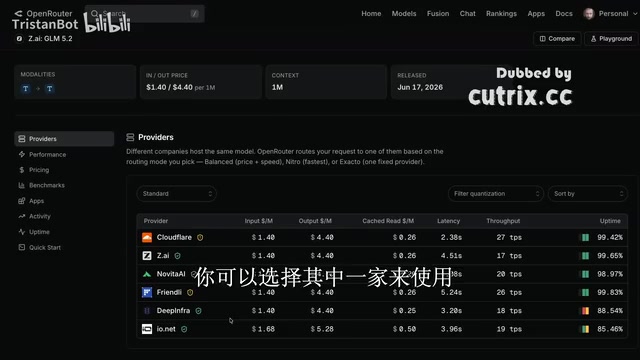
The author accessed Zhipu's official service via OpenRouter. OpenRouter is an aggregation layer platform for LLM APIs that allows developers to access models from multiple providers through a unified interface with unified billing — a platform category that emerged from the proliferation of third-party inference providers following the public release of open-source model weights. Average generation speed during testing was approximately 36–40 tokens per second, with some fluctuation but generally usable.
Long-Form Writing: Well Above the Competition
The most unexpected finding was long-form generation capability. When asked to write a 5,000-word article, most models tend to deliver a lazy 500-word response. GLM 5.2 actually produced over 5,000 words — remarkably rare for this type of task. The author flatly stated it was "much better than other models."
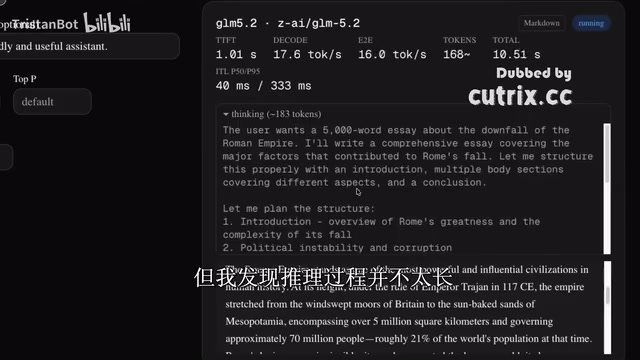
On logic puzzles and reasoning tasks, the model also performed well. Reasoning token counts spike significantly when genuinely needed — this kind of on-demand reasoning behavior is a good sign. That said, chain-of-thought length varies by task, so users are advised to run their own tests against their specific scenarios.
Frontend Design: Its Signature Strength at the Top of the Leaderboard
Design is one of GLM 5.2's core strengths — it ranks first in the design arena, even above Claude models. The author asked it to design a homepage for "Dario's Wellness Retreat in the Tuscan Hills," and the model not only completed the task smoothly but automatically incorporated images, entrance and exit animations, and other details.

Interestingly, the first run was truncated after exceeding an 8,000-token limit. After adjusting to a 32,000-token budget, the model completed the task just slightly past the 8,000 mark — multi-token prediction played an important role here, reducing serial wait times by predicting multiple subsequent tokens in parallel, making long-content generation feel fluid and natural.
Cost-Effectiveness: Real Choice Through Open Weights
GLM 5.2's most practical value lies in the deployment freedom that open weights provide. Because the weights are public, multiple inference providers — including Together AI, Fireworks AI, and Deepinfra — can offer inference services, giving users who prefer not to send data to a specific data center the ability to choose their own deployment.
Current pricing across providers is roughly consistent: approximately $1.40 per million input tokens and $4.40 per million output tokens. This represents a significant cost advantage over Claude Sonnet ($3/$15) and GPT-4o ($2.50/$10). Even accounting for GLM 5.2's higher token consumption, the total cost remains lower in many scenarios. The author has even started reconsidering their paid subscriptions, concluding that GLM 5.2 is fully capable of replacing proprietary models like Claude Sonnet and Gemini Flash for many use cases.
Conclusion: Worth Testing for Your Own Use Case
GLM 5.2's arrival once again confirms that open-source models are surging — putting real competitive pressure on closed-source products like Gemini 3.0 Pro. While the industry's attention tends to focus on Anthropic, OpenAI, and Google's frontier labs, open-source contributions from China have quietly filled the second tier.
Of course, when using third-party inference services, you should still pay attention to data retention and training policies — some providers retain prompts, so confirm this upfront. Overall, GLM 5.2 is a lower-cost, sufficiently capable alternative that stands out especially in long-form writing and frontend design. It's worth putting through its paces for your specific use case.
Key Takeaways
Related articles

The Truth Behind Codex 'Build a Website in 5 Minutes': AI Isn't Creating Sites—It's Helping You Copy Them
Exposing the truth behind viral Codex 5-minute website videos: creators aren't building original sites with AI—they're copying shared prompts or scraping others' work. Learn AI coding tools' real limits.

Getting Started with AI Agent Development: A Complete Guide from Concept to Practice
A comprehensive guide to AI Agent architecture and development, covering automated marketing, intelligent customer service, and investment analysis scenarios with single and multi-agent collaboration.

The Truth Behind Codex 'Build a Website in 5 Minutes': AI Isn't Creating Sites — It's Helping You Copy Them
Exposing the truth behind viral Codex 5-minute website videos: creators aren't building original sites with AI — they're copying shared prompts or scraping others' work.