1.9M-Parameter Voice Cloning TTS Sparks Controversy: Kyutai's New Model Accused of Self-Censorship

Kyutai's 1.9M-parameter Pocket TTS sparks open-source community controversy over embedded censorship due to automatic profanity filtering.
Kyutai Labs' Pocket TTS has regained attention with 1.9 million parameters and voice cloning support; its tiny size makes it suitable for local low-power scenarios such as smart homes and embedded devices. However, the community found that the new model automatically replaces profanity with meaningless words, while the old version does not, and the related GitHub issue was closed as not planned without explanation. Users question whether content filtering belongs at the text front end rather than baked into model weights, and point out inconsistent filtering standards. The article argues that competition in lightweight TTS requires not only public benchmarks for naturalness, real-time factor, and speaker similarity, but also transparent, configurable content policies and fuller community communication.
Kyutai Labs' Pocket TTS model has recently re-entered the community spotlight with a size of just 1.9 million parameters (1.9M), and it claims to support voice cloning. The extremely small model size means it can run smoothly on local devices, making it highly attractive for scenarios such as smart homes and embedded voice interaction. But a discussion on the Reddit community revealed another focal point: users found that the new model automatically "sanitizes" profanity when synthesizing speech, whereas the older model does not. This change pushes both technical performance and the boundary of content moderation into the foreground.
The Technical Significance Behind 1.9M Parameters
From a parameter-scale perspective, a TTS model with 1.9 million parameters is extremely lightweight. For reference, the commonly seen Kokoro single-language variant in the community can be compressed to a model size of about 9MB, and Pocket TTS remains competitive in terms of size. For scenarios requiring fully local inference and low-power operation, this level of model can significantly lower the deployment barrier.
The original poster also acknowledged that the size is "impressive," but pointed out that more critical evaluation dimensions have not yet been adequately discussed: naturalness, real-time factor (RTF), and voice similarity across different speakers. For voice cloning models with very few parameters, timbre fidelity and cross-speaker generalization are often weak points. The community currently lacks public benchmark data to answer these questions, which makes the 1.9M parameters more of an engineering highlight than a validated product advantage.
Real-time factor (RTF) is a core metric for measuring the inference efficiency of a TTS system, defined as the ratio of the computation time required to synthesize a segment of speech to the duration of that speech. An RTF below 1 indicates that inference is faster than real-time playback, which is a hard threshold for streaming voice interaction (such as smart speakers and in-car assistants). For extremely small models like the 1.9M-parameter one, RTF usually performs excellently, but naturalness and timbre fidelity often decline at the same time, which is why the article emphasizes the need to evaluate multiple metrics simultaneously rather than looking only at parameter size.
Speaker similarity in voice cloning tasks is typically measured by cosine similarity of embedding vectors or subjective MOS scores, reflecting how close the synthesized speech is to the target speaker's timbre. Parameter compression directly weakens the representational capacity of the acoustic model, making similarity the dimension where lightweight voice cloning models are most likely to expose their shortcomings—this is also the direct reason the community calls for public benchmark data.
Profanity Gets "Sanitized": Feature or Defect?
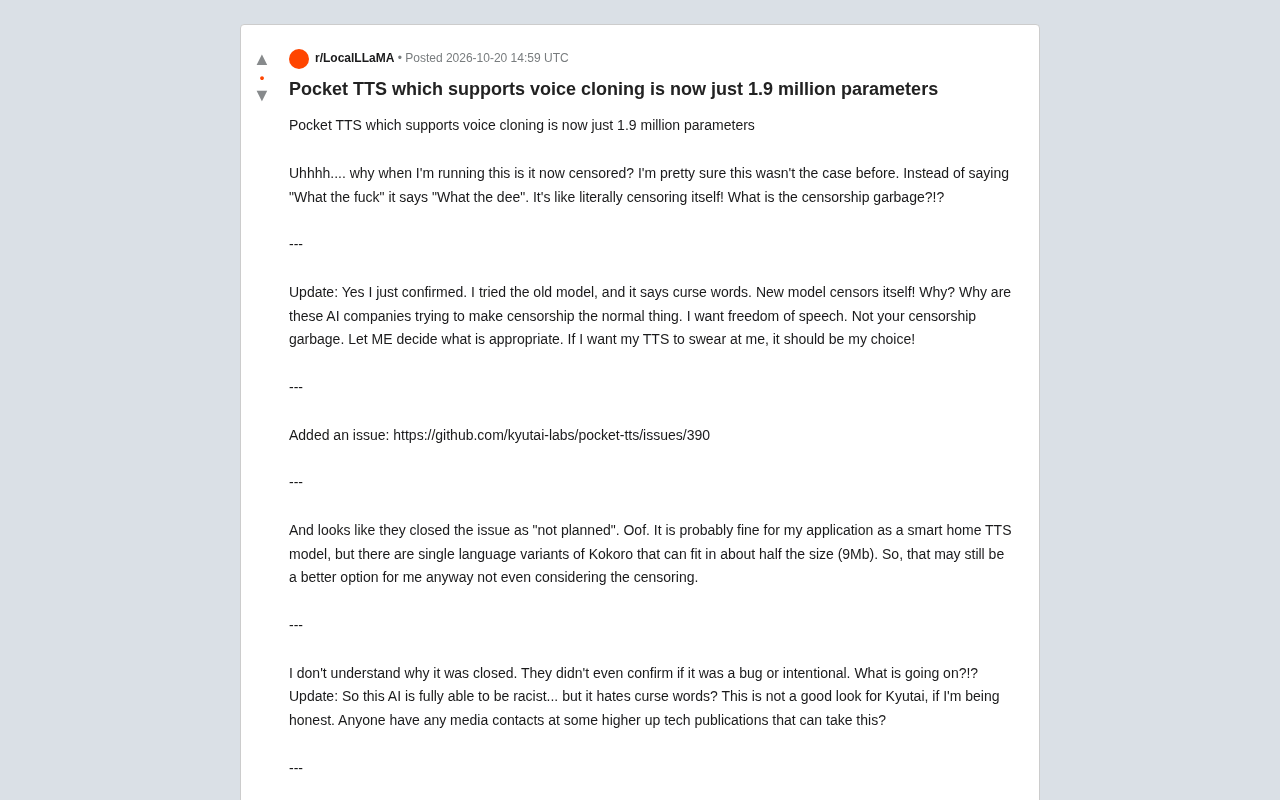
The core event that sparked discussion was this: when users ran the new version of Pocket TTS, they found that the model replaced profanity with phonetically similar but meaningless words. For example, when the input text contained "What the fuck," the output became "What the dee." The user then conducted a controlled experiment with the old model, confirming that the old model would say profanity normally, while the new model self-censors.
The user submitted the issue to the Kyutai Labs GitHub repository (issue #390), but the issue was marked as "not planned" and closed. This handling further intensified dissatisfaction—the closing reason did not clarify whether this was a bug or an intentional design. Judging from community speculation, a relatively reasonable explanation is that Kyutai is shifting Pocket TTS's positioning toward enterprise users, and therefore added content filtering by default, at the cost of flexibility for the enthusiast community.
Users' Question: At Which Layer Should Filtering Occur?
The original poster raised an engineering point worth taking seriously: if the target customers are enterprise environments, content filtering should be completed before the text enters the TTS model, rather than embedded in the acoustic model. Filtering at the front end of the pipeline allows policies to be configurable, auditable, and replaceable; baking filtering into the model weights deprives all downstream users of choice.
What confused users even more was the inconsistency of the filtering standard: the model is said to be able to generate racially discriminatory content, yet it is especially sensitive to profanity. To the community, this selective censorship lacks logical consistency and is also detrimental to Kyutai's brand image.
The GitHub issue #390 mentioned in the article was marked as "not planned," which is a status label used by GitHub repository maintainers when closing an issue, indicating that the issue will not be included in the development plan. It differs from labels such as "bug" or "duplicate" and does not itself carry an explanation. Therefore, when maintainers do not attach comments, the submitter cannot determine whether the behavior is intentional design, a side effect of training data, or a legacy issue not yet addressed. In open-source governance practice, this kind of "silent closure" is often seen as insufficient communication and tends to intensify community speculation about vendor intentions.
The Content Strategy Dilemma for Open-Source Models
This controversy touches on a more general question: should open-source AI models have built-in behavioral constraints?
From the vendor's perspective, built-in safety filtering can reduce the risk of misuse and make it easier to meet compliance requirements for enterprise procurement. But from the user's perspective, one of the core values of open source is modifiability and customizability. When the model weights themselves carry invisible censorship logic, users will find it difficult to easily remove this layer of behavior even if they obtain the code and weights—unless they retrain the model or look for a community fork.
The original poster's position is straightforward: adult users should decide for themselves what content TTS outputs and bear the corresponding consequences. He mentioned two possible ways out—deleting the current model, or waiting for the community to fork a "liberated version." This reaction reflects the open-source community's sensitivity to vendors unilaterally imposing value judgments.
Realistic Considerations for Alternatives
Setting aside the censorship controversy, the original poster also mentioned that the Kokoro single-language variant is about 9MB in size and may still be a more suitable choice for smart home TTS scenarios. This means that even on the performance dimension, Pocket TTS faces direct competition from mature lightweight models.
Model fork refers to a branch that developers maintain independently after copying an open-source repository (including code and weights). For models with embedded censorship logic, forking cannot directly solve the problem: if the filtering behavior originates from the training data distribution or weights written by alignment fine-tuning, simply copying the code cannot remove it. Retraining or targeted fine-tuning of the weights is required, which is costly. This is the technical reason behind the article's statement that "even if they obtain the code and weights, it is difficult to easily remove this layer of behavior," and it is also the key obstacle that makes it difficult for the community to quickly realize the "liberated version" branch it hopes for.
What Kind of Lightweight TTS Does the Community Need?
This discussion ultimately points to two needs: first, transparent performance benchmarks; second, predictable and configurable content policies.
For aggressive compression like 1.9M parameters, the community needs to see quantitative comparisons of naturalness, real-time factor, and speaker similarity in order to judge whether it is truly usable. Regarding content filtering, open-source projects should at least clearly state the existence, scope, and method of disabling the filtering, rather than leaving users to encounter output shifts without their knowledge.
The way Kyutai closed the issue left a communication gap. Whether the filtering is intentional design or a side effect of the training data, a clear public explanation would do more to maintain community trust than "not planned." Competition in lightweight TTS is heating up, and beyond technical metrics, governance approach is also a factor developers consider when choosing a model.
Related articles

Beyond the Mainstream World: Security and Privacy Struggles in Overlooked Regions
Human-centered security research has long focused on the West, causing security solutions to fail in the mainstream world. Researcher Collins Minando draws on Kenyan mobile loan apps, internet café authentication dilemmas, and local expert studies across nine countries to reveal how socioeconomic constraints reshape privacy practices, and proposes mobile money privacy redesign and PETs deployment pathways.

Claude Reportedly Able to Hide Secret Messages in Benign Images
A Reddit post claims Claude Fable 5.1 can hide secret messages in benign images. This article reviews the background, image steganography principles, and potential security risks, and suggests a testing path from rumor to verification.

Federal Government Awards $85 Million; CFS to Develop Fusion-Specific Semiconductors
The federal government awards $85 million to Commonwealth Fusion Systems to develop conductors and power semiconductors for fusion plants. This article analyzes the significance of this funding for the fusion supply chain and commercialization path.