10 Hidden Pitfalls of AI Agent Team Collaboration: From Resource Contention to Runaway Costs

A solo developer's 10 silent failure patterns from building with 7 Claude Code agents — make the invisible visible.
A solo developer using seven Claude Code agents distills ten "silent failure" patterns — problems that don't throw errors but quietly waste time, distort decisions, or generate surprise bills. The pitfalls cover resource contention, timezone confusion, lost decision attribution, invisible wait states, human bottlenecks, contradictory rules, runaway proposals, credential leaks, quota surprises, and cascading infrastructure changes. The core insight: agents execute with extreme literalness and can't see what's hidden from them. The fix is always the same — make the invisible visible and write it down.
When you're building a product with a team of AI agents, the problems that truly derail you aren't the ones that cause immediate crashes. The real killers are quieter — they don't throw errors, but they can silently waste an entire day, write incorrect decisions into your records, or show up as a surprise bill mid-month.
This article draws from the hands-on experience of a solo developer who built a product using a small team of seven Claude Code agents. He identified two batches of twenty failure patterns total. This piece focuses on the second batch — ten more subtle traps, each following the same structure: what it looks like, why it happens, and what actually works.
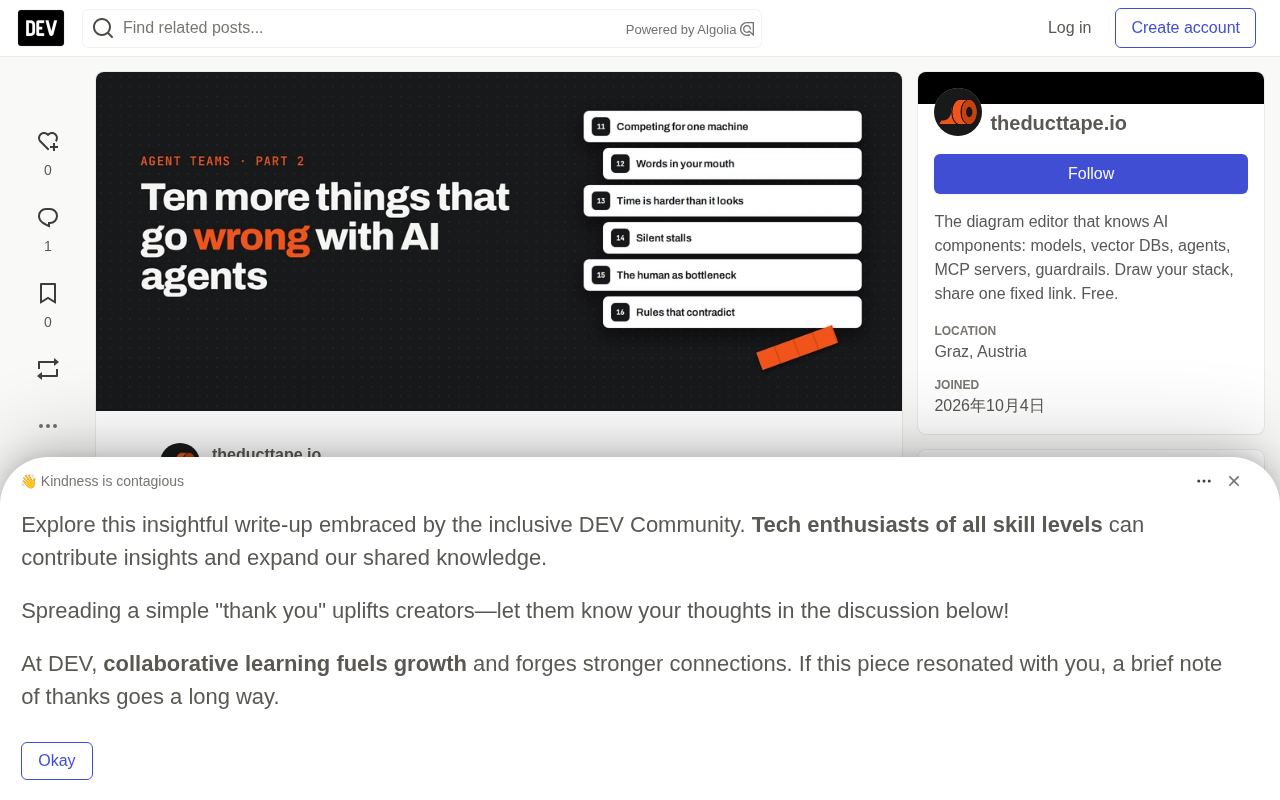
Resources and Time: Invisible Conflicts in Shared Environments
Agents Fighting Over the Same Machine
One agent is using a server that another agent just restarted. Two resource-heavy tasks run simultaneously and both time out. A test fails only because another agent's test modified the same account.
The root cause: every agent assumes the machine is its own. Commands like "stop the server" or "reset test data" were written for a "one person, one desk" scenario.
The fix is to give each agent its own ports, test accounts, and data wherever possible. Stagger heavy jobs — builds, full test runs, recordings. An agent should only stop processes it started, never using broad pattern matching to kill processes. Shared work should be announced: "test server is busy for the next 40 minutes."
Time Is Harder Than It Looks
A test fails every night around midnight. A message says "tomorrow" and two agents interpret it as different dates. A deadline in the docs is off by an hour.
Servers run on UTC; people don't. Agents don't know what timezone a human is in, can't tell which day "today" refers to in a given message, and many tests silently use the current date.
The author's rule is simple: servers run UTC, all times reported to humans are converted to local time. Important messages always use absolute dates with timezone labels. Give tests a fixed date rather than "now," and deliberately run them near midnight to surface time-related bugs.
Communication and Decisions: The Trust Problem When Origin Gets Lost
Agents Putting Words in Your Mouth
"As you said, we will…" — but you never said that. A decision appears in the docs, attributed to you, when it actually came from another agent's suggestion.
In a message chain, the origin of an idea is easy to lose. When one agent hears from another that "this has been decided," it automatically fills in the most likely decision-maker: you.
The countermeasure is to record, for each decision, who actually made it and when. When an agent cites you, require it to produce the original message. Agents should accurately write "I suggest" versus "the product owner decided" — not the vague "the human wants."
This phenomenon is known in information theory as source confusion — a classic problem in multi-agent systems. In long context windows, language models weight various statements from conversation history without reliably distinguishing "explicit human instruction" from "another agent's inference or suggestion," especially when the latter is phrased as a declarative statement rather than a hypothesis. In human teams, this is typically resolved through attribution in email threads or meeting minutes. In agent collaboration, without an explicit attribution mechanism, every handoff is essentially a forward with the sender's name removed. This is why a decision log needs to capture not just what was decided, but who decided it, in which message, and on what basis.
Agents Going Silent Without Warning
An agent has been "working" for hours. In reality, it asked a question buried at the end of a long output and has been waiting for an answer nobody saw.
Asking a question and stopping is the safest default behavior. But questions buried inside long reports are easily missed, and the agent has no way to tell whether anyone read it.
The effective approach is "ask and keep going": have agents complete everything that doesn't depend on the answer, and put questions on the first line, not the last. Consolidate all pending questions in one place a human actually checks. A single-line status like "waiting on: X, since 14:20" makes the blockage visible.
The Human Becomes the Bottleneck
Twenty small questions in a day: which word, which color, whether to retry. Each takes a minute; together they consume a full day, with every agent waiting on you.
Agents are told to "ask when uncertain," and they're uncertain about many small things. Without a rule defining what counts as "small," every question escalates to the top.
The author's solution: let a coordinator agent handle small, reversible decisions and log them — you can review and override any of them after the fact. Write down explicitly what qualifies as "small." Large or irreversible decisions still go to the human: anything involving public releases, money, deleting production data, or credentials.
Rules and Scope: Literal Execution Amplifies Chaos
Written Rules Contradict Each Other
Two documents give two different answers to the same question. A rules file still describes how things worked last month. An agent perfectly follows an outdated rule.
Rules accumulate and are rarely deleted. Each new rule is written for a current task without cross-checking all the old ones. Agents follow rules literally and can't tell which ones are obsolete.
The fix is to designate a role that checks any new thing against existing rules before it gets built on. Update rules in the same change that alters the behavior — don't defer it. When two rules conflict, agents should ask rather than pick one.
This maps to a well-known software engineering concept: configuration drift — the gap that accumulates over time between a system's actual state and its documented description. For AI agents, rules files play the role of system prompts or operating manuals, but they're harder to automatically validate for consistency than code is. The traditional remedy is the single source of truth principle: rules exist in one place only; everything else references rather than copies them. In multi-agent systems, consider a dedicated "rules auditor" role — analogous to a linter — that automatically cross-checks the existing ruleset whenever rules change and flags potential conflicts, rather than relying on individual agents to discover contradictions during execution.
Agents Propose Far More Than You Need
Every completed task comes back with five "what we could do next" ideas. Each one is reasonable. Together, a two-day feature becomes a two-week engineering project.
Agents are good at spotting "where things could be better" and eager to seem useful. But they don't know which of their ideas actually serve this month's goals.
The key is separating "proposals" from "tasks." Maintain a "not now" list tied to current strategy: an idea that doesn't serve the current goal goes on the list without guilt. Review it occasionally — most items can stay there indefinitely.
Security and Costs: New Risks That Come With Speed
Credentials Leak Into the Chat
An agent needs a credential to continue, and the fastest path is pasting it into the conversation. Now that key lives in the chat history — possibly in the logs, possibly in summaries.
Nobody means for this to happen. Work is blocked, the key is at hand, the chat window is right there, and it all happens in a rush.
The right approach is to set up a secure path before it's needed: the human writes credentials into a local, gitignored file; the agent reads from there and never prints them. Agents should refuse to echo credentials and ask for the file path instead. Any credential that has passed through chat should be treated as compromised and must be rotated.
The security principle here is called minimal credential exposure. API keys, database connection strings, and other sensitive credentials can spread through multiple channels once they appear in conversation history: conversation summaries, context compression, log files, or even unintentional inclusion in a model's subsequent responses. Standard engineering practice uses environment variables or secrets management services (such as HashiCorp Vault or AWS Secrets Manager), paired with
.gitignoreand.envfiles to isolate local credentials. In AI agent scenarios, you also need an explicit rule: "agents must not echo any string that looks like a credential in their output." Models have no built-in credential recognition or redaction — this rule must be written into the system prompt or operating procedures to take effect.
Quotas and Costs Blindside You
Mid-month you hit a limit: build minutes, API quota, storage, plan cap. Work stops — or a bill arrives that nobody expected.
Agents move much faster than humans and will repeat without hesitation: run another build, execute another full test suite. Nobody is adding it all up until the quota does it for you.
The countermeasure is to understand your limits before scaling up. Measure the cost of a single run, set budgets and alerts, and put expensive operations behind a checkpoint. Spending money should always be a human decision.
One Change Breaks Everything Connected to It
A repo migration, a key rotation, a domain change — and three other things break: a pipeline, an integration, a link in the docs, a rule an agent is still following.
Connections accumulate quietly. Each one was set up by someone, at some point, for a reason that was never written down. The agent making the change can only see the change itself.
Before any infrastructure change, list everything connected to it, make backups, change one thing at a time, and verify each item afterward. Store that list in documentation so the next change starts from it.
A Practical Checklist
The author condensed these ten patterns into ten self-check questions — worth posting prominently in any team collaboration document:
- Does each agent have its own ports, accounts, and test data?
- Is every decision logged with who actually made it?
- Are all dates absolute and timezone-labeled?
- Do waiting agents state their blockage on the first line and continue with remaining work?
- Is there a written definition of which decisions agents can make on their own?
- Are new rules checked against old ones, and updated in the same change?
- Do proposals default to the "not now" list unless they serve the current goal?
- Is there a secure path for credentials, and have any that leaked been rotated?
- Has the cost of a single run been measured, with a budget in place?
- Does every infrastructure change come with a dependency map, backup, and checklist?
The Real Pattern
Looking at all ten patterns together with the first batch, the same underlying truth emerges: agents are fast and capable, but they execute with extreme literalness. Most problems stem from things they can't see — other agents, the clock, human attention, and the tangled connections surrounding any given change. And most solutions are fundamentally about making those invisible things visible and writing them down.
For anyone experimenting with multi-agent development teams, the value here isn't any single tactic — it's a mental model: you're not managing "faster programmers." You're managing collaborators who lack shared context, have no sense of time, and can't see each other. Visibility and written records are the real infrastructure that keeps this system from consuming itself.
The "extreme literalness" described here maps to a classic problem in AI alignment research: specification incompleteness. Current language models, given an instruction, tend to optimize for the literal goal rather than the underlying intent. In single-task scenarios this is usually a minor issue, but it's amplified in multi-agent collaboration — each agent's literal deviation can become the input premise for the next agent. From a systems design perspective, this means "human intent" can't exist only at the beginning of a conversation. It needs to be continuously injected in structured form at every decision node. Every concrete recommendation in this article — recording attribution, separating proposals from tasks, maintaining dependency maps — is fundamentally about creating machine-readable, transferable carriers for human intent.
Related articles

OpenAI Partners with Shield: How the Astra Agent Revolutionizes IT Troubleshooting
OpenAI and Shield launch the Astra agent, which autonomously logs into computers and legacy systems to fix IT issues in real time, 35-40% faster than traditional models, with humans involved only when judgment is needed.

iPhone Duo Battery Life Tested: One Charge a Day Is Unavoidable, and the Large Screen Is the Culprit
iPhone Duo battery test: heavy use needs at least one charge a day, and about 30% remains after 6.5 hours of screen-on time. How often the large screen is unfolded is key; a MagSafe battery pack helps, and long-term degradation is also worth watching.

Kimi K3.1 Pro Open-Sourced: 2.8 Trillion Parameters Close In on Opus
Moonshot releases the open-source MoE model Kimi K3.1 Pro, with 2.8T total parameters and 104B activated, trailing Opus 5.5 by under 1 point on Terminal Bench 4.0.