10 Prompts to Build an Industrial-Grade LLM Wiki: A Complete DeepSeek Harness Walkthrough

Build an industrial-grade LLM Wiki with DeepSeek Harness using a Skills + preset + plugin assembly approach in just 10 prompts.
This article presents a hands-on Agent development approach using DeepSeek Harness (DSH): by assembling 8 Skills, 1 Agent preset, and 2 plugins, the author completed a full-featured LLM Wiki knowledge base — covering knowledge graphs, source-traceable Q&A, incremental compilation, and online evaluation — in just 10 professional prompts. The project is broken into 11 standardized development stages, with Agent presets identified as DSH's "most powerful hidden feature" for keeping complex workflows on track. The author notes that claims of surpassing Codex and Claude Code are subjective, but the modular assembly methodology itself offers broadly transferable value for Agent-driven development.
How Far Can an Agent Go in Building an Industrial-Grade Knowledge Base?
The market for AI coding agents is fiercely competitive, with Claude Code and Codex leading the pack. But this hands-on public course centered on DeepSeekAd Harness (DSH) offers an ambitious answer: using just 10 professional prompts, 8 Skills, one Agent preset, and two functional plugins, the author built a fully functional, industrial-grade LLM Wiki knowledge base.
According to the Bilibili creator behind this course, the development process was "remarkably stable and highly efficient" — an experience he claims even surpassed Codex and Claude Code. This assessment comes from a single source and should be taken with appropriate skepticism, but it does reflect a noteworthy trend: Agent development tools are evolving from "autocomplete assistants" toward "end-to-end delivery of complete projects."

What This LLM Wiki Actually Does
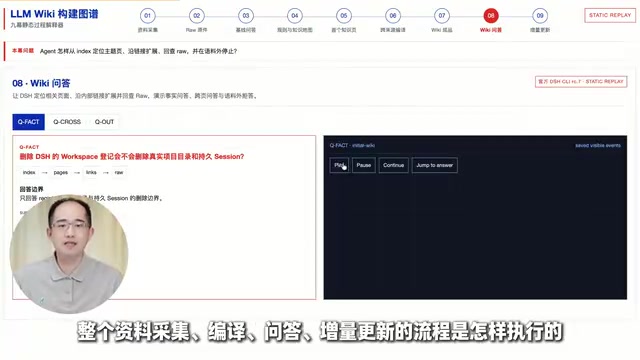
Based on the demo, this is no toy-level prototype — it's a complete system designed to production standards, covering the full pipeline from knowledge ingestion to Q&A:
- Visualization Dashboard: A unified management interface for document management, compilation, and uploading.
- Document Compilation & Incremental Updates: Supports browsing Wiki compilation results and incremental document compilation — meaning new content can be indexed without rebuilding the entire knowledge base from scratch.
- Dual-Form Knowledge Graph: A full knowledge graph view for mapping entities and relationships across documents.
- Source-Traceable Q&A: Every response is linked to the original knowledge snippet — a critical feature for enterprises to trust a knowledge base's answers.
- Online Evaluation & Optimization: Uses metrics like retrieval hit rate and evidence coverage to iteratively optimize compilation methods and retrieval pipelines.
- System Settings Page: Full configuration support for overall system operation.
Source traceability and online evaluation are precisely what separate a RAG prototype from an "industrial-grade" system. Traceability lets you verify answer reliability; evaluation enables continuous improvement of retrieval quality.
The Core Methodology: "Modular Assembly" of Agent Capabilities
The most valuable takeaway from this course isn't the project itself — it's the author's key insight: to get the most out of DSH, you need to "assemble" its capabilities around your development goals.
This assembly approach operates on three levels:
Skills: Injecting Domain Expertise
A set of Skills was configured for this project to supply intent context and support development. These Skills were hand-picked from a library of over 400 Agent Skills the team prepared for students. In essence, Skills act as "domain capability modules" that give a general-purpose Agent the specialized judgment it needs for specific tasks.
Within an Agent framework, Skills function like pluggable "specialist subroutines." General-purpose LLMs often lack sufficient domain judgment when faced with highly specialized development tasks — such as how to segment knowledge graph entities or design an incremental indexing strategy. Skills address this by injecting structured domain knowledge, constraints, or operational steps into the Agent, bringing its decisions closer to expert-level quality on specific tasks. This "assemble capabilities on demand" philosophy mirrors the concept of dependency injection in software engineering, and is also a core design principle in mainstream Agent frameworks like LangChain's Tool system and AutoGPT's plugin mechanism.
Plugins: Diagramming and Acceptance Testing
Two plugins were installed: DSH Diagram assists with drawing flowcharts and inspecting project structure at any time; DSH Build-in Browser handles functional acceptance testing of product pages. The former solves "understanding the architecture"; the latter solves "verifying the results" — together reinforcing two common weak points in the development feedback loop.
Agent Presets: The "Most Powerful Hidden Feature"
The author describes the Agent preset as "a dedicated Agent created specifically for this development task" — one that strictly follows the LLM Wiki development workflow and flexibly invokes plugins and Skills as needed. He calls it DSH's "most powerful hidden feature," and argues that mastering it can produce a dramatic leap in Agent performance.
From an engineering perspective, this is essentially a way of hardcoding "process standards" into Agent behavior — using presets to ensure the Agent always advances through defined development stages, avoiding the drift and rework that commonly plague large projects.

Agent presets are fundamentally a formalized approach to System Prompt Engineering. LLM behavior is highly context-dependent, and when development tasks span multiple stages, starting each conversation from scratch to re-describe roles and constraints makes it easy for the model to drift mid-project. By permanently embedding project goals, stage workflows, invocation rules, and output formats into the Agent's system layer, presets maintain a consistent behavioral baseline throughout the entire project lifecycle. This aligns with the guidance found in OpenAI Assistants API's Instructions field and Anthropic's best practices for Claude System Prompts — clearer system-level constraints consistently reduce "drift" risk in multi-step tasks.
11 Development Stages: A Standardized Agent Development Workflow
The entire LLM Wiki was broken down into 11 development stages, progressing strictly in the order of: environment setup → project foundation → core feature modules → functional acceptance testing. The author calls this "the most standardized complete Agent development workflow available today."
The value of this stage-based approach is clear: handing a complex project to an Agent all at once usually leads to loss of control. Splitting the goal into stages with well-defined inputs and outputs — where each stage includes prompts, execution walkthroughs, intermediate supplementary prompts, and milestone result screenshots — keeps the Agent delivering within a controllable scope. For beginners, even without understanding the underlying code, they can follow the prompt flow step by step and produce real results. For experienced developers, it provides a complete reference covering inputs, outputs, and explanations of the reasoning behind each step.
To lower the barrier to entry, the course also provides a one-click environment configuration script — double-click to set up the base development environment and jump straight into the DSH interface to start building.
Availability and Resources
According to the author, this LLM Wiki has been officially launched on the team's proprietary DeepSeek Harness Studio desktop application, available with a single click. A full set of accompanying resources has been made publicly available, including the installation package, course slides, project source code, Agent presets, Skills, architecture diagrams, per-round prompts, conversation run screenshots, and stage milestone screenshots.
A Few Objective Observations
The biggest highlight of this course is the relatively systematic way it presents the methodology for "delivering a complete project with an Agent" — the modular assembly approach (Skills + plugins + Agent presets) and the stage-based workflow are transferable lessons applicable to other Agent tools as well.
It's worth noting that claims like "10 prompts to build an industrial-grade project" and "outperforms Codex and Claude Code" are subjective assessments from a single author, without cross-tool comparative benchmarks. Readers should treat the published source code and prompts as the basis for verification, rather than accepting these conclusions at face value. The true test of an industrial-grade system lies in long-term maintenance and retrieval quality at scale — aspects that are difficult to demonstrate in a short video walkthrough.
That said, this "preset + Skills + plugins" assembly approach offers developers who want to deliver complete products with Agent tools a clear and reusable practical framework.
Background: What Is RAG?
RAG (Retrieval-Augmented Generation) is the dominant technical paradigm for enterprise knowledge base Q&A today. The system first retrieves the most relevant document chunks from a vector database, then passes those chunks as context to a large language model to generate an answer. The core challenge of this approach is the "hallucination" problem — models may generate responses that sound plausible but have no basis in the actual documents. Source-traceable design addresses this by attaching citations to original document chunks within each response, allowing users and auditors to verify the evidence behind every answer. This is a key engineering requirement for moving RAG systems from research prototype to enterprise trust.
Related articles

OpenAI Partners with Shield: How the Astra Agent Revolutionizes IT Troubleshooting
OpenAI and Shield launch the Astra agent, which autonomously logs into computers and legacy systems to fix IT issues in real time, 35-40% faster than traditional models, with humans involved only when judgment is needed.

iPhone Duo Battery Life Tested: One Charge a Day Is Unavoidable, and the Large Screen Is the Culprit
iPhone Duo battery test: heavy use needs at least one charge a day, and about 30% remains after 6.5 hours of screen-on time. How often the large screen is unfolded is key; a MagSafe battery pack helps, and long-term degradation is also worth watching.

Kimi K3.1 Pro Open-Sourced: 2.8 Trillion Parameters Close In on Opus
Moonshot releases the open-source MoE model Kimi K3.1 Pro, with 2.8T total parameters and 104B activated, trailing Opus 5.5 by under 1 point on Terminal Bench 4.0.