10X.ing: Enter Your URL, Get Cold Email, SEO, and AI Marketing Opportunities Automatically

10X.ing generates five types of acquisition opportunities from a URL, focused on discovery not execution.
10X.ing is a marketing tool by Alex West (14 votes on Product Hunt) that bundles cold email, social content, SEO, link building, and AI/LLM SEO into one URL input. It automates opportunity identification and drafting, but sending, follow-up, and outreach negotiation still require the team. Best for early-stage startups exploring channels; scaling teams may find suggestions too generic.
From URL to Marketing Opportunities: 10X.ing Wants to Run the First Step of Customer Acquisition for Startups
On Product Hunt, 10X.ing picked up 14 votes and ranked 20th. It turns the biggest headache for startups—finding customers—into a single input field: enter your website address, and the system automatically generates cold email, social content, SEO, link building, and AI/LLM-oriented search optimization opportunities. Its tagline is blunt—helping startups acquire new customers "on autopilot."
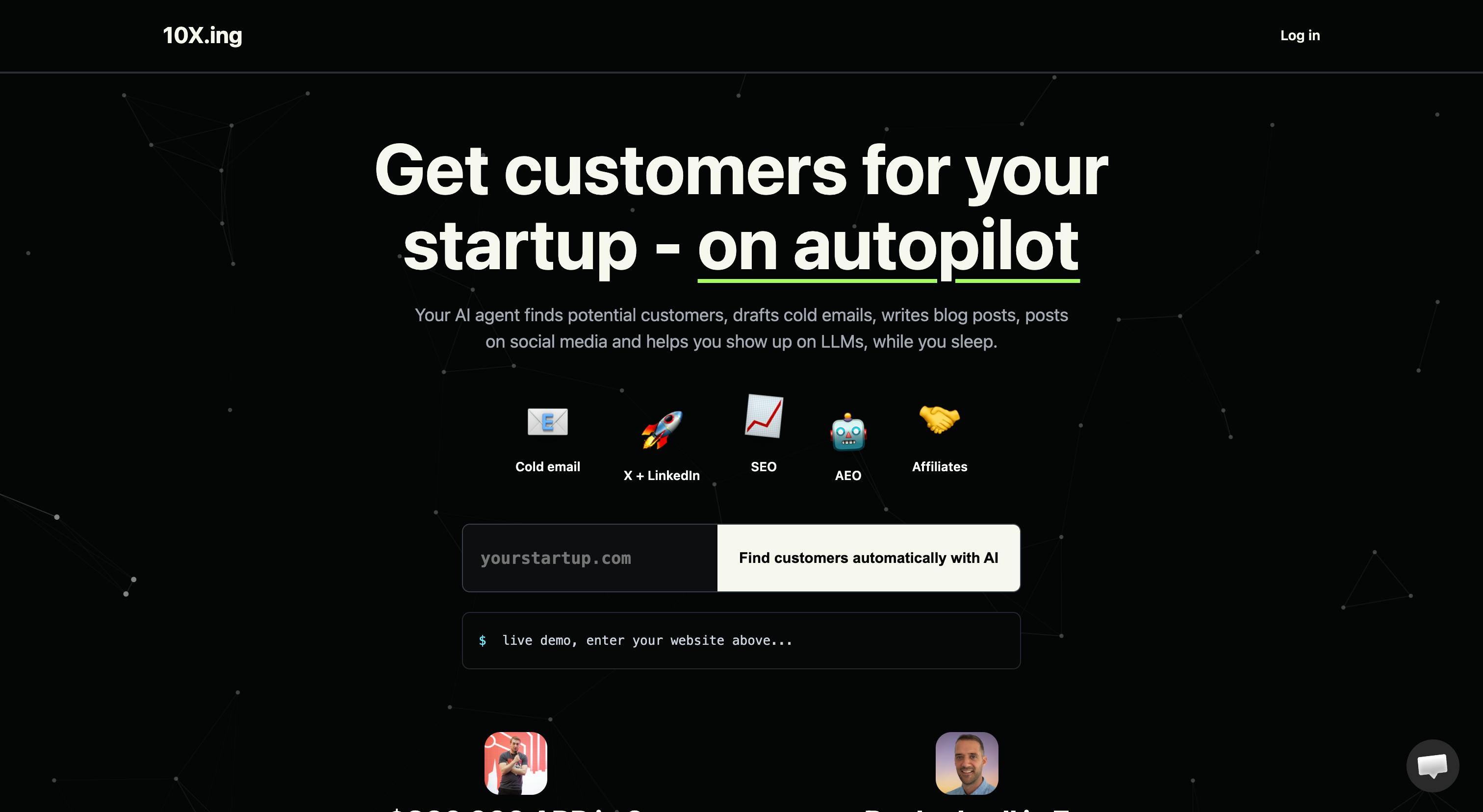
The product is built by Alex West and categorized under Marketing. Based on its positioning, it doesn't aim to be a full CRM or marketing automation suite. Instead, it focuses on the very front of the acquisition chain: telling you where to go, what content to use, and who to talk to.
Five Channels Bundled Together, Aimed at "Opportunity Discovery"
10X.ing claims to cover cold email, social content, SEO, link building, and AI/LLM SEO—a topic that's been discussed repeatedly over the past year. This bundling reveals a judgment: for early-stage teams, the problem often isn't that they can't write emails—it's that they don't know which channel to start with.
Putting five types of opportunities into one entry point lowers the cost of getting started—no need to subscribe to five separate tools and learn five different dashboards. The trade-off is depth: each channel may only produce "suggestion-level" output rather than execution-level tooling. For teams that need precision targeting, this is more of a starting checklist than a replacement.
Cold email refers to proactively sending emails to potential customers with whom no prior relationship exists, as opposed to regular marketing emails based on user subscriptions or past interactions. Its core metrics are open rate, reply rate, and meeting conversion rate, and success depends heavily on list accuracy, subject line writing, and follow-up cadence. On the compliance side, the U.S. CAN-SPAM Act, the EU GDPR, and the ePrivacy Directive impose clear restrictions on unsolicited commercial email, requiring an unsubscribe option and limiting who can be contacted. Link building is the practice of acquiring links from other websites to your own through guest posting, resource page inclusion, media coverage, directory submissions, and similar methods. It remains an important signal in traditional search rankings, but low-quality backlinks can carry penalty risk. Both channels require human negotiation and ongoing maintenance—tools can typically only provide target lists and content drafts.
AI/LLM SEO Listed Separately Shows Acquisition Entry Points Are Shifting
It's worth noting that 10X.ing places "AI/LLM SEO" alongside classic SEO. The reality behind this is that more and more potential customers no longer rely solely on Google search—they ask assistants like ChatGPT and Perplexity directly. Whether a brand gets mentioned in those answers is becoming a new visibility metric.
However, LLM SEO still lacks a unified, verifiable methodology. What 10X.ing can offer is most likely optimization suggestions based on public information, not direct control over model outputs. Treating this as directional guidance is reasonable; treating it as a deterministic growth lever is risky.
LLM SEO (also called Generative Engine Optimization, GEO) refers to optimization practices that make brand content more likely to be cited or mentioned by large language models when generating answers. Unlike traditional SEO, which relies on crawler indexing, keyword rankings, and backlink authority, LLM answers come from training data and retrieval-augmented generation (RAG) results. The optimization focus therefore shifts to content citability, structural clarity, factual density, and frequency of appearance in authoritative sources. Common industry practices currently include: establishing brand entries in wiki-style and industry directories, publishing pages with clear Q&A structures, maintaining consistent factual descriptions (to avoid model confusion), and increasing the likelihood of being retrieved through third-party reviews and rankings. Because each model's data sources and citation mechanisms are opaque, results are difficult to measure as reliably as search rankings—which is the core reason the field's methodology remains unsettled.
The Boundaries of Automation: Generating Opportunities Isn't Winning Customers
The word "Autopilot" easily leads to misunderstanding. Based on the product description, what 10X.ing automates is opportunity identification and content drafting, not a complete acquisition loop. Cold emails need someone to send them and someone to follow up; social content needs someone to maintain the accounts; link building needs someone to actually negotiate. Conversion at these stages still depends on team execution.
For indie developers and small teams, this is precisely where the value lies: saving the time of mapping out channels from scratch and focusing limited energy on execution. But if you expect "enter a URL and customers come automatically," you'll likely be disappointed. The history of marketing automation has repeatedly shown that tools can amplify execution but cannot replace judgment.
Marketing automation in mature products typically refers to orchestrated execution flows such as lead scoring, email sequences, behavioral triggers, and CRM sync—with HubSpot and Marketo as typical examples. The value of these systems lies in standardizing repetitive outreach and tracking conversion. 10X.ing sits at an earlier layer—it's an "opportunity generation" tool: it outputs suggestions rather than executable workflows, with no sending channel, contact management, or performance tracking. Comparing it to a marketing automation suite is therefore inappropriate. A more apt reference is keyword research tools or content planning assistants—they also provide direction, but execution and validation are still done by humans. Understanding this layer difference helps clarify where the tool actually fits in the acquisition chain.
Who It's For, Who It's Not For
Given its product form and the absence of pricing information, 10X.ing is better suited to startups that are just getting off the ground and don't yet have dedicated marketing staff—especially in the early stage when multiple acquisition channels need rapid validation. It offers breadth-first experimentation rather than single-channel depth.
Teams that have already validated a channel and need to scale their campaigns may find its suggestions too generic. The product currently has limited discussion on Product Hunt, and key questions—actual output quality, whether it supports multilingual markets, and data source transparency—still need more user feedback to verify.
For readers following AI marketing tools, 10X.ing represents a growing category of products: using large models to compress scattered marketing actions into a single input with multiple outputs. Whether it can establish itself depends on the accuracy of its suggestions and whether it can move "opportunities" forward into measurable results.
One-line Summary
10X.ing generates five types of customer acquisition opportunities from your website URL, focusing on opportunity discovery rather than execution.
Paragraph Summary
10X.ing is a marketing tool built by Alex West that received 14 votes on Product Hunt, centered on "enter your website URL and automatically generate marketing opportunities." It bundles cold email, social content, SEO, link building, and AI/LLM SEO into one entry point, aiming to help early-stage startups solve the problem of "not knowing which channel to start with." The article notes that the product automates opportunity identification and content drafting—sending emails, follow-ups, and link negotiation still require the team. So "Autopilot" is more of a directional aid. Listing AI/LLM SEO alongside classic SEO reflects the shift of acquisition entry points toward AI assistants, but the field's methodology is still immature. The product is better suited to early-stage teams lacking dedicated marketers for channel experimentation; scaling teams may find the suggestions generic, and actual output quality awaits more user validation.
Related articles

iPhone Duo Battery Life Tested: One Charge a Day Is Unavoidable, and the Large Screen Is the Culprit
iPhone Duo battery test: heavy use needs at least one charge a day, and about 30% remains after 6.5 hours of screen-on time. How often the large screen is unfolded is key; a MagSafe battery pack helps, and long-term degradation is also worth watching.

Kimi K3.1 Pro Open-Sourced: 2.8 Trillion Parameters Close In on Opus
Moonshot releases the open-source MoE model Kimi K3.1 Pro, with 2.8T total parameters and 104B activated, trailing Opus 5.5 by under 1 point on Terminal Bench 4.0.

Costco Tech Price Guessing: Are Monitors, Keyboards, Mice, and Bose Speakers Worth It?
A YouTube blogger guesses prices of Costco tech products: 2K 180Hz monitor, Logitech keyboard and mouse, Bose speaker, and CyberPower UPS, revealing warehouse-store selection and brand premium.