11M-Parameter Model Arc Tagger: Word-by-Word Real-Time Tagging Lets Voice Agents React Mid-Conversation
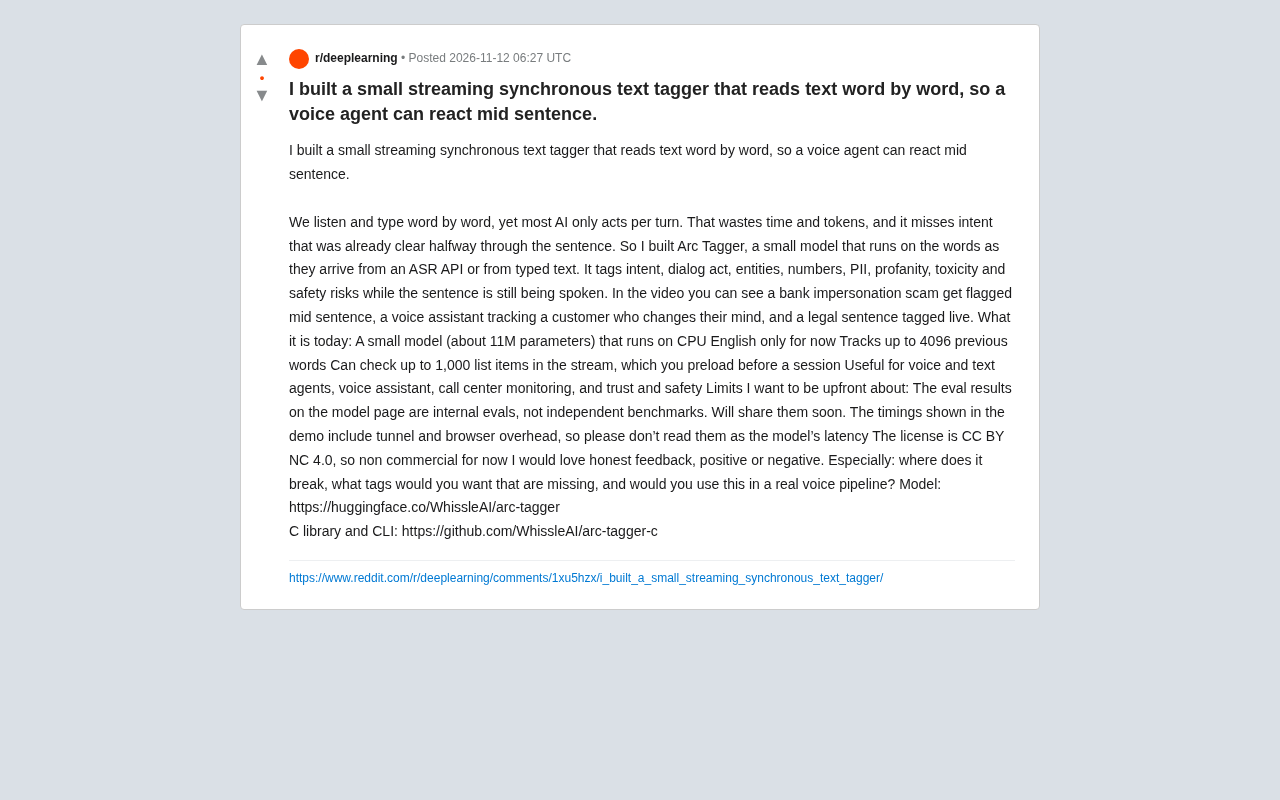
Reddit developer open-sources Arc Tagger, an 11M-parameter streaming tagger that lets voice agents understand while listening.
The article introduces Arc Tagger, built by a Reddit developer—an ~11M-parameter model that tags text word by word in ASR or keyboard input streams, identifying intents, entities, PII, toxic content, and safety risks in real time, moving a voice agent's understanding from utterance-end to mid-sentence. It supports up to 4096 historical words and 1000 preloaded list items for in-stream matching, suited to risk control, compliance, and call centers. The author notes it is English-only, CPU-based, internally evaluated, and non-commercial CC BY NC 4.0—closer to a proof-of-direction prototype. The article sees this as a valuable challenge to turn-based voice architectures and offers three takeaways: decoupling tagging from transcription, preloading lists, and edge deployment of small models.
Why Voice Agents Need to "Think While Listening"
Everyday conversation unfolds word by word, yet most AI voice assistants still follow a turn-based logic of "wait until you finish, then process." This approach not only slows response times and wastes tokens, but more critically—many intents are already clear halfway through a sentence. In a bank customer service scenario, for example, when a user says "My account was drained by someone...", the risk signal has already appeared, and there's no need to wait for the entire utterance to end.
A developer on Reddit built Arc Tagger for this purpose—a small model of about 11 million parameters that tags text word by word in the stream from an ASR (speech recognition) API or keyboard input, identifying intents, dialogue acts, entities, numbers, PII (personally identifiable information), profanity, toxic content, and safety risks in real time.
Turn-based interaction is the default architecture of most current voice assistants: the system uses voice activity detection (VAD) to determine whether the user has finished speaking, waits for silence to persist for a period, then sends the entire audio segment to ASR, and finally hands it to NLU for intent recognition. The end-to-end latency of this serial pipeline typically consists of three additive components—tail silence wait, ASR transcription time, and downstream understanding time—often totaling one to several seconds. Streaming processing is the opposite: audio or text arrives incrementally, and the model produces results immediately for each new word without waiting for a boundary. The fundamental difference between the two lies in "when understanding is triggered," not in the size of the model itself. Voice scenarios are especially latency-sensitive because the average turn gap in human conversation is only about 200 milliseconds; beyond that magnitude, users will noticeably feel lag.
Arc Tagger's Core Design: Streaming Synchronous Tagging
Traditional NLP pipelines usually "transcribe first, then understand," whereas Arc Tagger embeds the tagging process into the stream as words arrive. According to the author, the model can track up to 4096 historical words and supports preloading up to 1000 list items (such as blacklists and sensitive word lists) before a session starts for in-stream matching.
This means that while a sentence is still being spoken, the system can already output structured tags. The demo video shows three scenarios: bank impersonation fraud flagged mid-sentence, a voice assistant tracking a customer who changes their mind, and real-time annotation of legal clauses.
From an engineering perspective, the value of this direction lies in moving the timing of "understanding" earlier. For scenarios such as call center monitoring, Trust & Safety review, and voice assistants, receiving a signal a few hundred milliseconds earlier could change the entire interaction strategy—for example, interrupting a fraud script early, dynamically adjusting menu options, or triggering human intervention.
Sequence tagging is a classic task paradigm in NLP: given a word sequence, output a label for each position, such as entity category (BIO tagging), dialogue act, or risk level. The traditional approach tags on complete sentences, whereas streaming tagging requires the model to make a judgment for the current word with only partial context, and it cannot retroactively modify already-output results when subsequent words arrive (or can only make limited corrections). This imposes additional requirements on the model: it must both maintain memory of historical context and complete forward computation at extremely low latency. The 4096-word historical window roughly corresponds to about half an hour of conversation at normal speaking speed, enough to cover the context of a single customer service call; and the 1000 preloadable list items are equivalent to embedding a rule engine (such as blacklists and regex matching) inside the model, enabling a hybrid "neural + rules" judgment so that business teams can update policies without fine-tuning.
Capability Boundaries and Known Limitations
The author is very candid about the current version's limitations:
- English only, with a model size of about 11M parameters running on CPU.
- Evaluation results are internal, not independent benchmarks; the author says detailed data will be shared later.
- Demo latency includes tunnel and browser overhead and cannot be directly regarded as the model's own inference latency.
- The license is CC BY NC 4.0, currently limited to non-commercial use.
These limitations suggest that Arc Tagger is currently more of a proof-of-direction prototype than a production-grade tool. An 11M-parameter model inevitably has a ceiling on tag accuracy, and English monolingualism also limits its applicability. But the idea of "streaming synchronous tagging" itself poses a valuable challenge to the current mainstream turn-based voice agent architecture.
CC BY NC 4.0 is Creative Commons' "Attribution—NonCommercial" license, which allows others to copy, distribute, and adapt the work but requires attribution to the original author and prohibits commercial use. For teams hoping to integrate Arc Tagger into commercial voice products, this means they need to contact the author separately for a commercial license or use it only as a technical reference rather than a direct dependency. In addition, 11M parameters is roughly comparable to early BERT mini or DistilBERT scale; a single forward pass on CPU can typically complete in milliseconds, but this also determines its limited ability in fine-grained semantic distinctions (such as sarcasm or complex nested intents). The "internal evaluation" mentioned by the author lacks independent benchmarks, meaning metrics such as F1 and recall cannot be compared horizontally with public models, and reproducibility is questionable.
Implications for Voice Agent Developers
If you are building a voice agent or real-time text processing pipeline, Arc Tagger offers several transferable ideas:
First, decouple tagging from transcription. There is no need to wait for the complete transcription result; performing lightweight inference directly on the word stream can significantly reduce end-to-end response time.
Second, the preloaded list mechanism is very practical. The ability to check 1000 list items in-stream means business teams can dynamically inject risk control rules without retraining the model.
Third, small models have room in edge scenarios. Running 11M parameters on CPU means it could be deployed closer to the data, reducing dependence on large cloud models.
The author explicitly solicits feedback from the community in the post: where the model fails, what tags are missing, and whether people are willing to use it in real voice pipelines. This openness is commendable, but the lack of independent benchmarks also means that—before adopting it, developers need to run it on their own real data to verify effectiveness.
The model has been released on Hugging Face (WhissleAI/arc-tagger), and the C library and CLI are open-sourced on GitHub (WhissleAI/arc-tagger-c).
One-line Summary
A Reddit developer open-sources Arc Tagger, an 11M-parameter streaming tagging model that lets voice agents understand while listening.
Paragraph Summary
The article introduces Arc Tagger, built by a Reddit developer—a small model of about 11 million parameters that tags text word by word in the stream from ASR or keyboard input, identifying intents, entities, PII, toxic content, and safety risks in real time, thereby moving a voice agent's "understanding" from the end of an utterance to the middle of a sentence. The model supports tracking up to 4096 historical words and preloading up to 1000 list items for in-stream matching, suitable for risk control, compliance, and call center scenarios. The author candidly acknowledges that it supports only English, runs on CPU, uses internal evaluation, and is licensed under non-commercial CC BY NC 4.0, making it closer to a proof-of-direction prototype. The article argues that this idea poses a valuable challenge to mainstream turn-based voice architectures and offers three takeaways: decoupling tagging from transcription, preloading lists, and edge deployment of small models.
Related articles

Gemini 4 Neon Leak: A Potential Strong Contender Against Opus 5.5
A Hacker News thread suggests Gemini 4 Neon looks like an Opus 5.5 competitor. This article unpacks the product positioning behind this community signal, shifts in the top-model competitive landscape, and what it means for developers' model selection strategy.

Claude Fable 5.2's Self-Authored Short Film 'Fable' Sparks Discussion
A short film 'Fable,' credited to Claude Fable 5.2 for script, visuals, and directing, appears on Hacker News. This article analyzes the significance of full-pipeline AI creation, community reactions, and what it means for content creators.

Anthropic IPO Pricing: A Signal of AI Giants Going Public
Anthropic's IPO pricing draws attention. This article analyzes its potential impact on AI industry valuation, commercialization paths, and the competitive landscape, and highlights public-market expectations and challenges for AI companies.