14 Days of AI Programming: From Zero to Product with Vibe Coding

A 14-day live bootcamp teaching Vibe Coding with Cursor, Trae, and Codex — no prior coding experience required.
Bilibili creator Guo Ke's 14-Day AI Programming Live Bootcamp teaches complete beginners to build real products using Vibe Coding principles. Built around six hands-on projects, the course covers Cursor, Trae, and Codex across seven structured chapters — from environment setup and API integration to domestic deployment and product methodology.
A Learning Path for AI Programming from Scratch
AI-powered programming is dramatically lowering the barrier to software development. Bilibili creator Guo Ke has launched a "14-Day AI Programming Live Bootcamp" built around a simple premise: you don't need to understand code — with AI assistance, you can turn any idea into a working product. This aligns closely with the "Vibe Coding" trend that's been generating buzz in the industry — where developers describe what they want in natural language and let AI handle the vast majority of implementation work.
The Technical Background of "Vibe Coding": The concept was introduced by OpenAI co-founder Andrej Karpathy in early 2025. Its core idea is to drive code generation through natural-language conversation with AI, rather than writing code line by line. This paradigm shift has a solid technical foundation: breakthroughs in large language models (LLMs) — particularly the deep understanding of programming context in models like GPT-4 and Claude 3.5 — now enable AI to handle the full chain from requirements analysis to code implementation. Vibe Coding doesn't mean developers need zero technical background; rather, it shifts the human role from "code writer" to "requirements definer and reviewer" — something closer to a hybrid of product manager and engineer.
According to the creator, the accompanying course documentation took two weeks to refine and exceeds 40,000 characters in length. The curriculum is built around six hands-on case projects, with six live sessions scheduled from the 20th through the 2nd of the month, emphasizing a "learn by doing alongside beginners" approach. This case-driven, practice-first philosophy reflects the broader shift in programming education — away from theoretical instruction and toward engineering practice.

Three AI Coding Tools and Seven Course Chapters
The course is structured around three mainstream AI programming tools: Code (a coding assistant), Trae (Trae Work), and Codex-type tools. The creator stresses that each tool serves a different purpose, and learners need to understand those differences to choose the right tool for the right situation.
Breaking Down the Three Tool Categories: These three types of tools represent distinct layers of today's AI programming ecosystem. Cursor (referred to as "Code" in the course) is a deeply customized AI code editor built on VS Code, supporting multi-file context understanding and inline completion — well-suited for rapid iteration within local projects. Trae, developed by ByteDance, is an AI IDE that prioritizes Chinese-language friendliness and compatibility with domestic networks, with built-in project scaffolding and version management guidance to lower the engineering barrier. Codex-type tools (including OpenAI Codex and its derivatives) lean more toward a "prompt-to-code" one-shot generation mode, ideal for rapid prototype delivery once you understand the underlying logic. Understanding the differences between these three is essentially understanding the boundary between "AI-assisted writing" and "generative delivery" as two distinct collaboration models.
The full course is divided into seven chapters, forming a complete learning path from setup to deployment.
Chapter 1: Environment Setup
Environment configuration is treated as its own dedicated chapter, with particular attention to the higher "barrier to entry" that Codex-type tools present. The creator promises to walk through every step clearly. This is a pragmatic decision — many beginners get stuck at environment setup and give up before they've even started.
Chapter 2: Building a Minimal Working Loop with Code
This chapter focuses on the Code tool, chosen because it "best enables a minimal closed loop." The accompanying projects include a personal portfolio homepage and an AI travel planner. Helping beginners see a working result as quickly as possible is the most effective way to sustain their motivation.
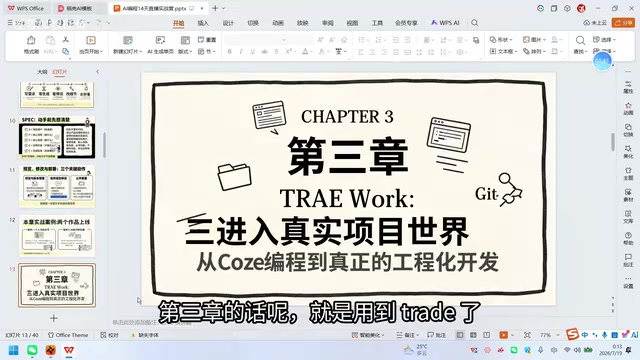
Chapter 3: Trae and Engineering Terminology in Practice
Using Trae Work, learners are introduced to version control concepts like Git and GitHub through an actual project — a task management kanban board.
The Engineering Value of Git and GitHub: Git is a distributed version control system created by Linux founder Linus Torvalds in 2005; GitHub is the world's largest Git-based code hosting platform (now owned by Microsoft). For AI programming learners, Git is more than a backup tool — it's an entry point into "engineering thinking." Commit history records the intent behind every change, and branching supports parallel development. In AI-assisted development, Git's importance is arguably amplified: since AI-generated code may frequently need to be rolled back or compared, good version management habits significantly reduce the engineering risks posed by AI hallucinations. Understanding abstract terminology through a real project is far more effective than memorizing definitions in isolation.
Advanced Practice: APIs, Databases, and Deployment
Chapter 4: APIs and Backend Fundamentals
Chapter 4 moves into more advanced territory, covering core concepts like API calls, environment variables, and databases. The creator specifically warns about what you should "never do" with environment variables — a direct reference to the risk of key exposure, one of the most common pitfalls in AI-assisted programming.
Environment Variables and Key Security: An environment variable is an OS-level key-value configuration mechanism used to inject sensitive information at runtime, keeping code decoupled from secrets. The standard approach is to store keys locally in a .env file (excluded via .gitignore) and have them injected by the cloud platform's Secrets management service during deployment. Because platforms like GitHub are continuously scanned by automated bots, hardcoding an API key and pushing it to a public repository can lead to unexpected charges at best, or account suspension and data breaches at worst. Beginners often overlook this step entirely, making the course's dedicated warning genuinely protective. The chapter's sample project is a monetization-enabled tool.
Chapter 5: Deployment and Going Live
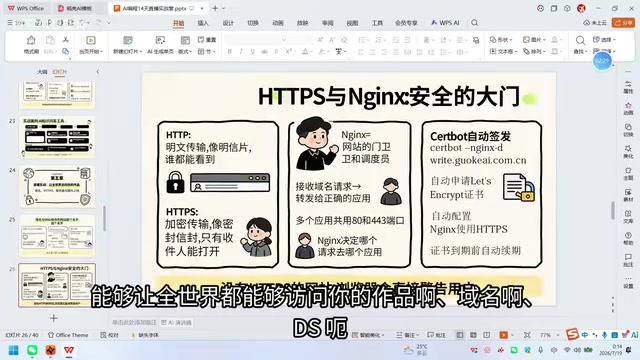
The deployment chapter aims to help learners "let the whole world access your work," covering topics like domains, DNS, and HTTPS. The creator dedicates specific attention to the unique aspects of deploying domestically in China — including the relatively complex ICP registration (备案) process, a topic most international tutorials skip entirely, but one that has real practical value for developers in China.
The Unique Challenges of Domestic Deployment: The domestic deployment process differs significantly from international norms, primarily due to the ICP registration system. Under regulations from China's Ministry of Industry and Information Technology, all publicly accessible websites hosted on servers in mainland China must complete ICP registration; unregistered domains will be blocked at the DNS level. The registration process typically takes 1–20 business days. DNS (Domain Name System), the infrastructure that translates human-readable domain names into IP addresses, requires additional consideration in the domestic environment — including differences between domestic and international resolution and the choice of CDN acceleration nodes. For HTTPS configuration, domestic cloud providers (such as Alibaba Cloud and Tencent Cloud) offer localized SSL certificate application channels that integrate more smoothly with registered domains. The chapter also covers "how to verify quality before deployment," reflecting a focus on delivery standards.
Chapter 6: One-Shot Delivery with Codex
After building up foundational knowledge in earlier chapters, Chapter 6 formally introduces Codex-type tools. The creator argues that once you understand the underlying principles, you'll find that Codex can "get things done in one shot" — you just need to articulate a few key points clearly. This chapter goes into greater depth and includes two sample projects: a resume optimization website and a content rewriting website.
Wrapping Up with Methodology: From Idea to Execution
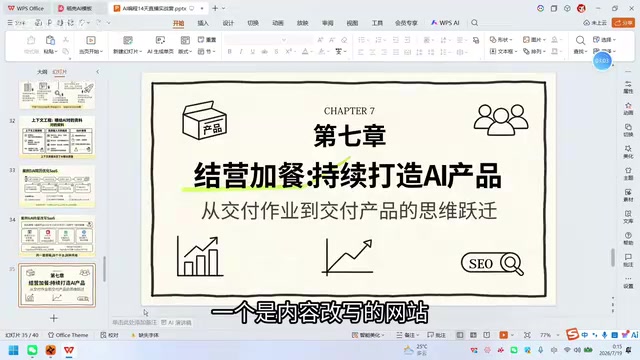
Chapter 7: Requirements, Design, and Full-Workflow Methodology
The final chapter returns to the conceptual level, covering how to understand requirements, how to approach page design, and how to navigate the full pipeline end to end. The creator believes that with this methodological foundation in place, the entire AI programming process becomes "much smoother."
The curriculum's structure — "do the hands-on cases first, then synthesize the methodology at the end" — aligns with how adults learn best: reasoning from practice back to theory. It effectively avoids the tedium of front-loading abstract concepts.
Notable Design Strengths Worth Highlighting
Looking at the course structure, it addresses several core trends in today's AI programming landscape:
- A toolkit rather than a single tool: Code, Trae, and Codex each play a distinct role, reflecting the reality of toolchain collaboration in real-world development.
- A complete product lifecycle: From a minimal demo to APIs and databases, through to deployment and public access — the course covers the full journey from idea to live application, rather than stopping at "getting a script to run."
- Localization for the Chinese context: Dedicated coverage of domestic ICP registration and deployment environments adds practical value that most generic tutorials simply don't provide.
That said, as an introductory course aimed at complete beginners, its depth and long-term value will need to be tested in practice. The promise of "no coding knowledge required" genuinely holds up for simple projects — but as application complexity increases and debugging and optimization become necessary, the absence of foundational knowledge may become a real bottleneck. AI coding lowers the barrier to entry, but it doesn't eliminate the need for engineering thinking. In fact, as AI tools become more capable, a developer's core competitive advantage is shifting away from "can you write code" toward "can you clearly define the problem, accurately review the deliverable, and effectively intervene when AI makes mistakes." For beginners, treating a course like this as a "fast-track starting point" and then gradually building up foundational knowledge is probably the more sustainable path forward.
Key Takeaways
Related articles

The Truth Behind Codex 'Build a Website in 5 Minutes': AI Isn't Creating Sites—It's Helping You Copy Them
Exposing the truth behind viral Codex 5-minute website videos: creators aren't building original sites with AI—they're copying shared prompts or scraping others' work. Learn AI coding tools' real limits.

Getting Started with AI Agent Development: A Complete Guide from Concept to Practice
A comprehensive guide to AI Agent architecture and development, covering automated marketing, intelligent customer service, and investment analysis scenarios with single and multi-agent collaboration.

The Truth Behind Codex 'Build a Website in 5 Minutes': AI Isn't Creating Sites — It's Helping You Copy Them
Exposing the truth behind viral Codex 5-minute website videos: creators aren't building original sites with AI — they're copying shared prompts or scraping others' work.